
Cross dowel nuts
1. Regional Industry Context — Middle East Mechanical Assembly Environment
Industrial fastening systems used across the Gulf Cooperation Council (GCC) region operate under environmental and operational conditions that significantly influence joint design philosophy. Cross dowel nuts are applied where controlled mechanical connections, serviceability, and structural alignment are required throughout the operational lifecycle of industrial assets.
1.1 GCC Industrial Installation Environment
Typical application environments include:
- Oil & gas processing equipment skids
- Offshore module structural assemblies
- Pipe rack support systems
- Valve actuator mounting arrangements
- Electrical and control panel enclosures
- Modular plant construction units
- Reverse osmosis desalination equipment frames
- Power generation auxiliary structures
- Heavy equipment maintenance platforms
These installations are rarely static structures. They experience:
- Continuous vibration
- Cyclic mechanical loading
- Thermal expansion differentials
- Periodic maintenance disassembly
- Corrosive atmospheric exposure
Mechanical fastening solutions must therefore enable repeatable assembly without degradation of structural integrity.
1.2 EPC Installation Philosophy in GCC Projects
Engineering, Procurement, and Construction (EPC) contractors operating in Saudi Arabia, UAE, and Qatar follow strict installation philosophies developed from decades of operational experience.
Key principles include:
Removable Mechanical Joints
Welded assemblies, while structurally rigid, introduce limitations:
- Heat-affected zones reduce fatigue life
- Field welding requires permits and inspection control
- Post-weld treatment increases installation time
- Maintenance removal becomes impractical
Bolted mechanical joints using cross dowel nuts allow:
- Controlled preload application
- Field alignment adjustment
- Repeatable dismantling
- Non-destructive maintenance access
Alignment During Field Installation
GCC facilities often involve:
- Large prefabricated modules
- Transportation-induced dimensional deviation
- Crane-based positioning during installation
Cross dowel systems enable transverse engagement allowing installers to compensate for minor alignment offsets without inducing bending stress into bolts.
Maintenance Accessibility Philosophy
Saudi Aramco, ADNOC, and regional operators prioritize maintainability over permanent fixation.
Typical maintenance requirements include:
- Actuator replacement
- Panel servicing
- Equipment re-alignment
- Structural modification during plant upgrades
Cross dowel nuts permit internal anchoring where rear-side access is restricted.
Vibration Exposure
Rotating equipment such as:
- Pumps
- Compressors
- Fans
- Generator auxiliaries
produce continuous vibration cycles.
Cross dowel fastening improves resistance against:
- joint loosening,
- bolt rotation,
- clamp force loss.
The perpendicular load-transfer mechanism distributes stresses more uniformly than conventional nut systems.
Thermal Expansion in Desert Climates
Temperature variations in GCC installations routinely exceed:
- Ambient exposure: 5°C to 60°C
- Equipment surface temperatures: >120°C
Thermal expansion induces differential movement between structural members. Cross dowel assemblies maintain clamp force while allowing controlled structural flexibility.
Coastal Corrosion Risks
Facilities near Arabian Gulf coastlines experience:
- Salt-laden humidity
- Chloride-induced corrosion
- Condensation during night cooling cycles
Material selection and coating integrity are therefore primary design considerations.
2. Technical Definition of Cross Dowel Nut
A Cross Dowel Nut is defined as:
A cylindrical internally threaded transverse fastening element designed to engage a mating bolt perpendicular to its longitudinal axis, providing concealed mechanical anchoring and controlled load transfer across intersecting components.
2.1 Functional Classification
Engineering classification:
- Cylindrical transverse connector
- Cross-axis threaded anchoring device
- Internal load-transfer fastener
- Embedded structural connection element
2.2 Geometry Characteristics
Key geometric features:
- Precision cylindrical body
- Cross-drilled threaded bore
- Central internal threading
- Optional drive slot or hex feature
- Controlled chamfered entry
The bolt axis intersects the dowel body at 90°.
Load transfer occurs perpendicular to bolt insertion direction.
2.3 Embedded Connection Principle
Unlike external nut systems:
- The cross dowel is housed within a structural member.
- The bolt engages internally.
- Clamp force is generated internally within the assembly.
Advantages:
- Protected fastening interface
- Reduced external projection
- Improved structural aesthetics
- Enhanced load alignment
2.4 Thread Standards
Cross dowel nuts supplied for GCC industrial usage typically comply with:
- ISO Metric Threads (ISO 965)
- Unified Threads (UNC / UNF) where specified
- Controlled tolerance classes ensuring proper preload generation
Typical tolerance classes:
- 6H internal threads (metric)
- Class 2B unified threads
2.5 Thread Engagement Principles
Engineering rules applied:
Minimum engagement length: 
Where:
 = thread engagement length
 = nominal bolt diameter
Proper engagement ensures:
- Prevention of thread stripping
- Uniform stress distribution
- Full tensile capacity utilization
2.6 Distinction from Similar Fasteners
Cross Dowel Nut
- Transverse threaded bore
- Hidden internal connection
- Used where access is limited
Barrel Nut
- Axial threading
- Primarily axial clamping
- Limited transverse load capability
Sleeve Nut
- Extended axial connector
- Designed for
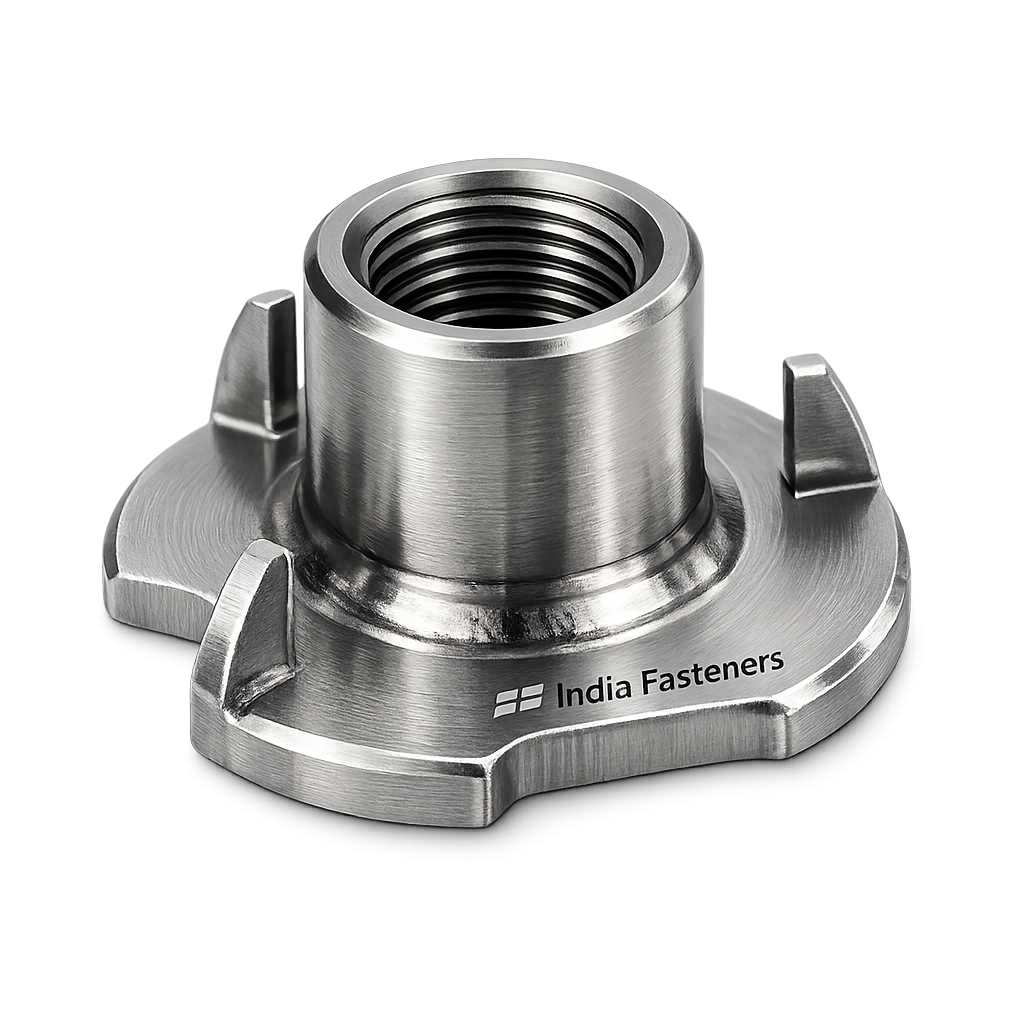
- t nut insert
- Embedded flange-based anchoring
- Primarily wood or soft substrate usage
Standard Hex Nut
- External fastening
- Requires dual-side access
- Exposed joint configuration
Cross dowels uniquely provide cross-axis anchoring with concealed installation.
3. Load Transfer Theory & Mechanical Behavior
3.1 Tensile Load Transmission
When torque is applied to the mating bolt: 
Where:
 = preload force
 = tightening torque
 = torque coefficient
 = bolt diameter
The cross dowel converts bolt torque into internal clamping force.
3.2 Clamp Force Generation
Clamp force:
- Compresses joint members
- Prevents relative movement
- Enables friction-based load sharing
Industrial philosophy in GCC EPC design prioritizes:
Frictional load transfer before bearing contact.
3.3 Shear Resistance Mechanism
Shear loads should not be carried directly by bolt shank where avoidable.
Joint slip resistance: 
Where:
 = friction coefficient
Adequate preload prevents joint slip.
3.4 Bearing Stress Distribution
Bearing pressure on dowel surface: 
Where:
 = applied force
- = dowel diameter
 = contact thickness
Proper dowel sizing reduces localized deformation.
3.5 Joint Stiffness Behavior
Cross dowel joints demonstrate:
- Improved load distribution
- Reduced eccentric loading
- Increased structural stiffness
This is critical in modular skid construction.
3.6 Anti-Pullout Characteristics
Pullout resistance depends on:
- thread engagement depth,
- material hardness,
- installation torque,
- substrate strength.
Correctly designed cross dowel assemblies typically fail in bolt tensile mode before dowel extraction — a preferred engineering outcome.
3.7 Fastening Reliability Philosophy in GCC EPC Design
GCC operators follow conservative reliability models:
- Design against fatigue failure
- Maintain preload under vibration
- Prevent corrosion-assisted loosening
- Ensure inspectability
- Guarantee repeatable assembly
Cross dowel nuts satisfy these requirements by combining:
serviceable mechanical connections.
internal anchoring,
controlled preload,
structural alignment capability,
4. Applicable Materials & Standards Mapped to GCC Industrial Use
Cross dowel nuts installed in Middle East EPC projects are classified as load-bearing mechanical fastening components. Material selection is therefore governed not by manufacturing convenience but by:
- structural load requirement,
- corrosion exposure,
- inspection authority acceptance,
- lifecycle reliability expectations.
Material engineering must satisfy ISO mechanical fastener standards while remaining compatible with GCC project specifications used by major operators and EPC contractors.
4.1 Material Selection Philosophy
Material choice for cross dowel nuts is determined through evaluation of:
- Mechanical strength requirement
- Environmental exposure condition
- Temperature operating range
- Corrosion resistance requirement
- Inspection and certification acceptance
- Compatibility with mating bolt property class
Improper material pairing results in:
- thread galling,
- preload relaxation,
- corrosion-driven seizure,
- premature joint failure.
4.2 Carbon Steel Grades
Carbon steel cross dowel nuts remain the most widely used option for controlled indoor or protected industrial assemblies.
Typical standards:
- ASTM A108 — Cold Finished Carbon Steel Bars
- ASTM A29 — General Alloy & Carbon Steel Bars
Characteristics:
- Good machinability
- Predictable heat treatment response
- Stable mechanical properties
- Economical large-volume production
Typical GCC applications:
- Equipment skid frames
- Control cabinet assemblies
- Structural mounting interfaces
- Indoor mechanical systems
Carbon steel components normally require protective coatings when used in Gulf climates.
4.3 Alloy Steel Grades
Where elevated loads or vibration environments exist, alloy steels are selected.
Common alloy systems:
- Chromium-Molybdenum steels
- Nickel-Chromium steels
- Quenched & tempered grades equivalent to ISO Property Class 10.9 or 12.9 performance
Advantages:
- Higher yield strength
- Improved fatigue resistance
- Better resistance to dynamic loading
- Suitable for rotating equipment structures
Typical use:
- Pump base assemblies
- Compressor auxiliary systems
- Heavy mechanical equipment mounting
4.4 Stainless Steel — AISI 304
AISI 304 stainless steel cross dowel nuts are selected where moderate corrosion resistance is required.
Properties:
- Excellent atmospheric corrosion resistance
- Good formability and machining characteristics
- Stable performance in humid environments
Limitations:
- Lower strength compared to alloy steel
- Not ideal for chloride-rich marine exposure
Typical GCC usage:
- Indoor desalination plant equipment
- Electrical panel systems
- HVAC support assemblies
4.5 Stainless Steel — AISI 316
AISI 316 is widely specified for coastal GCC installations.
Added molybdenum improves resistance against chloride attack.
Suitable environments:
- Offshore platforms
- Coastal refineries
- Marine desalination plants
- LNG loading terminals
Advantages:
- Superior corrosion resistance
- Reduced risk of crevice corrosion
- Long service life under salt exposure
4.6 Duplex Stainless Steel
Duplex stainless steels are selected when both high strength and corrosion resistance are simultaneously required.
Characteristics:
- Yield strength nearly double that of 316 stainless
- High resistance to stress corrosion cracking
- Excellent performance in sour service environments
Typical applications:
- Offshore structural modules
- Chemical processing units
- High-humidity marine installations
4.7 Applicable Mechanical Fastener Standards
Cross dowel nuts supplied for EPC projects align with internationally recognized standards:
ISO Standards
- ISO 898 — Mechanical properties of fasteners
- ISO 965 — Thread tolerances
- ISO 4759 — Dimensional tolerances
ASTM Standards
- ASTM A108
- ASTM A29
- ASTM A276 (stainless bar material)
DIN Dimensional Practices
- DIN cross dowel dimensional references
- Controlled concentricity requirements
Compliance ensures interchangeability with globally sourced bolts.
4.8 Material Mapping to GCC Environmental Conditions
Material selection must consider Gulf-specific exposure factors:
| Exposure Condition | Engineering Risk |
|---|---|
| Desert heat | Thermal expansion |
| Sand intrusion | Abrasive wear |
| Coastal humidity | Chloride corrosion |
| Offshore atmosphere | Pitting corrosion |
| Chemical plants | Chemical attack |
| Sour service | Sulfide stress cracking |
Material engineering therefore becomes a risk control measure, not simply a manufacturing decision.
5. Material Comparison Table (Mandatory Engineering Reference)
| Material Grade | Yield Strength (MPa) | Tensile Strength (MPa) | Hardness Range | Corrosion Resistance Level | Typical GCC Application |
|---|---|---|---|---|---|
| Carbon Steel (A108) | 350–550 | 500–700 | 20–28 HRC | Low | Indoor structural assemblies |
| Alloy Steel Q&T | 900–1100 | 1000–1300 | 28–38 HRC | Moderate (coated) | Rotating equipment mounts |
| Stainless Steel 304 | 215 | 505 | HRB 70–90 | Medium | Electrical & enclosure systems |
| Stainless Steel 316 | 290 | 580 | HRB 80–95 | High | Coastal installations |
| Duplex Stainless Steel | 450–550 | 650–800 | 25–32 HRC | Very High | Offshore & desalination plants |
Values represent typical engineering ranges and must be verified through mill certification.
6. Heat Treatment & Metallurgical Control
Heat treatment determines final mechanical performance of cross dowel nuts.
In EPC applications, metallurgical consistency is subject to third-party verification.
6.1 Manufacturing Routes
Two primary production routes exist:
Cold Formed Components
- Improved grain flow
- Higher fatigue resistance
- Reduced material waste
Machined Components
- High dimensional precision
- Suitable for specialty alloys
- Required for large diameters
Selection depends on geometry and material grade.
6.2 Quenching & Tempering
Applied to alloy steel cross dowels.
Process sequence:
- Austenitizing
- Rapid quenching
- Controlled tempering
Objectives:
- Increase yield strength
- Improve toughness
- Prevent brittle fracture
Improper tempering leads to hydrogen embrittlement susceptibility.
6.3 Stress Relieving
Machining operations introduce residual stresses.
Stress relief heat treatment:
- stabilizes geometry,
- prevents distortion,
- maintains thread alignment accuracy.
6.4 Surface Hardening Options
Where wear resistance is required:
- Induction hardening
- Case hardening
- Carbonitriding
Hardening depth must remain compatible with internal threading integrity.
6.5 Stainless Steel Passivation
Passivation removes free iron contamination.
Benefits:
- Enhanced corrosion resistance
- Improved inspection acceptance
- Reduced pitting initiation risk
Commonly performed using nitric or citric acid processes compliant with ASTM A967.
6.6 Hydrogen Embrittlement Prevention
High-strength fasteners are vulnerable after electroplating operations.
Preventive measures:
- Baking after plating
- Controlled coating processes
- Hardness limitation controls
Typical hardness limits maintained below embrittlement threshold levels.
6.7 Hardness Control
Hardness verification ensures:
- thread durability,
- proper load transfer,
- avoidance of brittle failure.
Testing methods:
- Rockwell hardness testing
- Microhardness verification (if required)
6.8 Metallurgical Consistency for EPC Approval
Consultant approval normally requires:
- Heat number traceability
- Mill test certificates
- Verified mechanical properties
- Documented heat treatment cycles
- Third-party inspection acceptance
Consistency across production batches is mandatory for vendor qualification.
7. Manufacturing Process Flow — Documentation Level Production Control
Cross dowel nut manufacturing intended for GCC project supply follows a controlled process chain ensuring traceability and dimensional repeatability.
7.1 Raw Material Certification
Incoming material must include:
- Mill Test Certificate (MTC)
- Heat number identification
- Chemical composition verification
- Mechanical property confirmation
Material verification forms the starting point of traceability.
7.2 Heat Number Traceability
Each production batch retains:
- material heat number,
- production lot number,
- inspection record linkage.
Traceability enables backward verification during audits.
7.3 Bar Cutting & Preparation
Certified bar stock is cut into blanks using controlled sawing operations ensuring:
- perpendicular faces,
- consistent blank length,
- minimal surface deformation.
7.4 Precision CNC Turning
Turning operations establish:
- external diameter tolerance,
- concentricity,
- chamfer geometry,
- seating surfaces.
Dimensional precision directly influences joint alignment performance.
7.5 Cross Drilling Operation
The most critical manufacturing stage.
Requirements:
- precise 90° drilling alignment
- positional tolerance control
- concentric intersection with dowel axis
Misalignment causes uneven load distribution.
7.6 Internal Thread Tapping
Threading operations must achieve:
- ISO tolerance class compliance
- correct pitch diameter
- smooth thread surface finish
Thread gauges used:
- GO gauge
- NO-GO gauge
7.7 Deburring & Chamfering
Sharp edges removed to:
- prevent assembly damage,
- eliminate stress risers,
- improve installation safety.
7.8 Heat Treatment Cycle
Where applicable:
- batch furnace processing
- temperature monitoring
- time-controlled soaking
- hardness verification post-treatment
Records retained for inspection review.
7.9 Surface Finishing / Coating
Depending on specification:
- Zinc plating
- Hot dip galvanizing
- Mechanical galvanizing
- Black oxide
- Passivation for stainless grades
Coating thickness monitored per specification.
7.10 Dimensional Inspection
Critical checks include:
- diameter tolerance
- length verification
- hole alignment
- thread depth
Measured using calibrated inspection instruments.
7.11 Thread Gauge Verification
Every batch undergoes:
- GO / NO-GO verification
- random sampling inspection
- documented acceptance criteria
7.12 Final Marking & Batch Traceability
Marking may include:
- manufacturer identification
- size reference
- batch code
Packaging retains full traceability to raw material origin.
7.13 Concentricity & Thread Alignment Control
Engineering requirement:
The threaded bore must remain concentric relative to dowel body axis within controlled tolerance limits.
Benefits:
- uniform preload distribution,
- minimized bolt bending stress,
- predictable joint behavior.
Concentricity errors are a primary rejection cause during consultant inspection.
8. Dimensional Reference Tables — Engineering Configuration Data
Cross dowel nuts used in EPC mechanical assemblies are manufactured according to controlled dimensional relationships ensuring compatibility with ISO and Unified bolt systems. Dimensional accuracy directly influences preload reliability, load transfer efficiency, and installation alignment.
The following tables represent standard industrial dimensional configurations typically supplied for equipment manufacturing and GCC project applications.
8.1 Standard Metric Cross Dowel Nut Dimensions
| Dowel Diameter (mm) | Overall Length (mm) | Thread Size | Cross Hole Diameter (mm) | Drive Feature | Tolerance Class |
|---|---|---|---|---|---|
| 8 | 10 | M4 | 4.2 | Slot | ISO 4759 Medium |
| 10 | 12 | M5 | 5.2 | Slot / Hex | ISO 4759 Medium |
| 12 | 14 | M6 | 6.2 | Slot / Hex | ISO 4759 Fine |
| 14 | 16 | M8 | 8.2 | Hex | ISO 4759 Fine |
| 16 | 18 | M10 | 10.2 | Hex | ISO 4759 Fine |
| 20 | 22 | M12 | 12.3 | Hex | ISO 4759 Fine |
| 24 | 28 | M16 | 16.3 | Internal Hex | ISO 4759 Precision |
| 30 | 32 | M20 | 20.3 | Internal Hex | ISO 4759 Precision |
Dimensional tolerances ensure controlled engagement without inducing misalignment stresses.
8.2 Unified Thread Cross Dowel Configurations
| Dowel Diameter (in) | Length (in) | Thread | Cross Hole (in) | Drive Type |
|---|---|---|---|---|
| 3/8 | 1/2 | 1/4-20 UNC | 0.257 | Slot |
| 1/2 | 5/8 | 5/16-18 UNC | 0.323 | Slot |
| 5/8 | 3/4 | 3/8-16 UNC | 0.390 | Hex |
| 3/4 | 1 | 1/2-13 UNC | 0.515 | Hex |
| 1 | 1-1/4 | 5/8-11 UNC | 0.640 | Internal Hex |
Unified systems remain common in imported OEM equipment supplied into Middle East facilities.
8.3 Dimensional Engineering Considerations
Critical dimensional relationships include:
- Cross hole axis perpendicularity ≤ 0.05 mm
- Thread concentricity tolerance ≤ 0.03 mm
- Surface finish typically Ra ≤ 3.2 µm
- Chamfer angle 30°–45° for installation guidance
These parameters directly affect bolt seating behavior and preload consistency.
9. Mechanical Load Capacity Table
Mechanical performance depends on both cross dowel material and mating bolt property class. The values below represent engineering reference data assuming proper installation and full thread engagement.
| Bolt Size | Recommended Torque (Nm) | Typical Clamp Load (kN) | Maximum Tensile Capacity (kN) | Allowable Shear Load (kN) |
|---|---|---|---|---|
| M6 | 10 | 5 | 7 | 4 |
| M8 | 25 | 12 | 18 | 9 |
| M10 | 50 | 20 | 30 | 15 |
| M12 | 85 | 32 | 48 | 24 |
| M16 | 210 | 70 | 105 | 52 |
| M20 | 410 | 110 | 165 | 80 |
Values assume:
- Property Class 8.8 bolts
- Steel-to-steel interface
- Friction coefficient ≈ 0.15
9.1 Safety Factors Applied in Industrial Assemblies
GCC EPC engineering practice typically applies:
- Static load safety factor: ≥ 2.0
- Dynamic vibration applications: ≥ 3.0
- Lifting or critical structural supports: ≥ 5.0
Cross dowel nuts must always be sized such that bolt failure occurs prior to dowel body deformation.
10. Torque Tightening Guide (Mandatory Engineering Reference)
Correct torque application determines joint reliability. Under-tightening causes joint slip, while excessive torque risks thread damage.
10.1 Property Class 8.8 Bolt Torque Values
| Bolt Size | Dry Torque (Nm) | Lubricated Torque (Nm) |
|---|---|---|
| M6 | 10 | 7 |
| M8 | 25 | 18 |
| M10 | 50 | 36 |
| M12 | 85 | 60 |
| M16 | 210 | 150 |
| M20 | 410 | 290 |
10.2 Property Class 10.9 Bolt Torque Values
| Bolt Size | Dry Torque (Nm) | Lubricated Torque (Nm) |
|---|---|---|
| M6 | 15 | 11 |
| M8 | 35 | 26 |
| M10 | 70 | 50 |
| M12 | 120 | 85 |
| M16 | 310 | 220 |
| M20 | 600 | 420 |
10.3 Property Class 12.9 Bolt Torque Values
| Bolt Size | Dry Torque (Nm) | Lubricated Torque (Nm) |
|---|---|---|
| M6 | 18 | 13 |
| M8 | 45 | 32 |
| M10 | 90 | 65 |
| M12 | 150 | 105 |
| M16 | 380 | 270 |
| M20 | 730 | 510 |
10.4 Preload Percentage Principle
Recommended preload: 70%−75% of bolt proof load70\% – 75\% \text{ of bolt proof load}70%−75% of bolt proof load
This level ensures:
- Maximum fatigue resistance
- Stable clamp force
- Minimal risk of yielding
Torque values must always consider lubrication condition and coating friction coefficient.
11. Joint Design Calculation Guide (Mandatory)
Cross dowel assemblies must be verified during EPC engineering design submissions.
11.1 Bolt Preload Calculation Example
For M12 bolt: 
If proof load = 85 kN:
This becomes the primary clamping force holding the joint.
11.2 Joint Separation Resistance
External tensile load must remain below preload level: 
If exceeded, joint separation occurs, transferring load directly into the bolt.
11.3 Shear Load Verification
Shear resistance through friction: 
Assuming 
If expected shear exceeds this value, designers introduce shear pins or dowel support.
11.4 Thread Engagement Length Rule
Engineering rule:
Adequate engagement prevents stripping inside the cross dowel.
11.5 Failure Mode Prevention
Proper design avoids:
- Bolt bending
- Thread stripping
- Dowel crushing
- Joint slip
- Fatigue cracking
Preferred failure hierarchy:
- Bolt yielding
- Joint slip
- Structural deformation
Cross dowel body failure must never govern design.
11.6 EPC Engineering Submission Methodology
Typical submission includes:
- Fastener calculation sheet
- Torque specification
- Material certificates
- Load verification summary
- Installation procedure statement
Consultant review focuses on mechanical reliability rather than appearance or geometry alone.
12. Mechanical Property Table
| Property | Carbon Steel | Alloy Steel Q&T | SS304 | SS316 | Duplex SS |
|---|---|---|---|---|---|
| Yield Strength (MPa) | 350–550 | 900–1100 | 215 | 290 | 450–550 |
| Ultimate Strength (MPa) | 500–700 | 1000–1300 | 505 | 580 | 650–800 |
| Hardness | 20–28 HRC | 28–38 HRC | HRB 70–90 | HRB 80–95 | 25–32 HRC |
| Elongation (%) | 15–20 | 10–14 | 40 | 40 | 25 |
| Proof Load Behavior | Moderate | High | Moderate | High | High |
Values verified through EN 10204 certification during supply.
13. Corrosion Resistance Comparison Table
| Material / Finish | Marine Exposure | Desert Humidity | Chemical Plant | Offshore Atmosphere | High Temperature Service |
|---|---|---|---|---|---|
| Carbon Steel | Poor | Moderate | Poor | Poor | Good |
| Zinc Plated | Moderate | Moderate | Limited | Poor | Limited |
| Hot Dip Galvanized | Good | Good | Moderate | Moderate | Limited |
| Stainless Steel 304 | Good | Excellent | Good | Moderate | Good |
| Stainless Steel 316 | Excellent | Excellent | Very Good | Excellent | Good |
| Duplex Stainless | Excellent | Excellent | Excellent | Excellent | Very Good |
Material and coating selection must be confirmed during project specification review.
14. Inspection & Quality Assurance
Cross dowel nuts intended for GCC EPC projects undergo multi-stage inspection aligned with third-party verification practices.
14.1 Dimensional Inspection
Measured characteristics:
- Diameter tolerance
- Length accuracy
- Cross hole location
- Concentricity
- Chamfer geometry
Inspection tools:
- Digital calipers
- Micrometers
- Coordinate measuring equipment where required
14.2 Thread Gauge Inspection
Verification performed using:
- GO gauges
- NO-GO gauges
Ensures thread compatibility with international bolt suppliers.
14.3 Hardness Testing
Conducted after heat treatment.
Typical methods:
- Rockwell testing
- Vickers microhardness (special applications)
Confirms compliance with specified mechanical properties.
14.4 Coating Thickness Verification
Measured through:
- Magnetic thickness gauges
- XRF testing when required
Coating uniformity is essential for corrosion protection in Gulf environments.
14.5 Salt Spray Testing
Accelerated corrosion testing performed in accordance with industry practices to validate coating durability.
Used particularly for:
- Zinc plated components
- Offshore project supply
14.6 Positive Material Identification (PMI)
Applied when specified by EPC contracts.
Verification confirms alloy composition using:
- XRF analyzers
- Spectrometry testing
14.7 Lot Traceability
Every production batch maintains linkage between:
- Raw material heat number
- Manufacturing batch
- Inspection records
- Shipment documentation
Traceability enables full audit capability.
14.8 EN 10204 Certification
Typical documentation supplied:
- EN 10204 Type 3.1 Material Certificate
- Mechanical property verification
- Chemical composition report
- Heat treatment confirmation
14.9 GCC Consultant Expectations During Vendor Approval
Inspection bodies operating across Middle East projects typically verify:
- dimensional repeatability,
- metallurgical consistency,
- coating performance,
- documentation completeness,
- traceability integrity.
Approval is granted only when ma
nufacturing discipline demonstrates controlled engineering processes rather than batch-dependent quality.
15. Industries Served — Middle East Industrial Application Analysis
Cross dowel nuts function as structural fastening elements across multiple GCC heavy industries where removable mechanical joints are mandatory for operational reliability, maintenance access, and modular construction philosophy.
Their application extends beyond general fastening into engineered load-transfer systems used within critical industrial infrastructure.
15.1 Oil & Gas Production Facilities
Upstream and midstream installations throughout the Middle East require mechanical joints capable of repeated servicing without degradation.
Typical applications include:
- Equipment skid structural frames
- Pump and compressor auxiliary assemblies
- Instrumentation mounting structures
- Pipe support frames
- Access ladder and platform assemblies
Operational considerations:
- Continuous vibration exposure
- Hydrocarbon environment contamination
- Maintenance-driven disassembly cycles
- Alignment sensitivity of rotating equipment
Cross dowel nuts enable concealed fastening where backside access is restricted by piping congestion or confined skid geometry.
Mechanical advantage:
- Uniform clamp force distribution
- Reduced bolt bending stress
- Controlled load transfer across intersecting members
15.2 Refineries and Petrochemical Complexes
Refinery environments introduce combined exposure risks:
- Elevated temperature zones
- Chemical vapor exposure
- Periodic shutdown maintenance
Common installation locations:
- Analyzer shelters
- Valve actuator mounting brackets
- Cable tray support systems
- Instrument racks
- Process enclosure structures
Bolted assemblies using cross dowel nuts allow equipment replacement without structural cutting or welding during plant turnaround operations.
15.3 LNG Terminals
Liquefied Natural Gas facilities emphasize:
- dimensional precision,
- vibration resistance,
- corrosion stability.
Typical uses:
- Cryogenic equipment frames
- Modular process skids
- Control cabinet anchoring
- Structural support assemblies
Material selection often favors stainless steel or duplex grades due to marine exposure near LNG jetties.
15.4 Desalination Plants
Desalination facilities represent one of the most aggressive corrosion environments within GCC infrastructure.
Exposure factors:
- continuous saline mist,
- high humidity,
- chloride concentration.
Applications include:
- Reverse osmosis skid structures
- Pump mounting bases
- Electrical control systems
- Maintenance platforms
Cross dowel fastening reduces exposed thread surfaces, minimizing corrosion initiation points.
15.5 Power Generation Facilities
Thermal and combined-cycle power plants rely heavily on serviceable mechanical joints.
Typical installations:
- Auxiliary equipment mounting
- Turbine support systems
- Cable containment structures
- Generator enclosure assemblies
- Cooling system platforms
Engineering requirement:
Fasteners must retain preload under vibration and temperature cycling.
15.6 Modular Skid Fabrication Industry
Modularization is a dominant construction strategy across Saudi Arabia, UAE, and Qatar.
Modules are:
- fabricated offsite,
- transported long distances,
- installed under tight alignment tolerances.
Cross dowel nuts assist in:
- multi-directional assembly,
- alignment correction,
- internal fastening where external nut access is impossible.
They support modular construction philosophy by enabling controlled assembly sequences.
15.7 Heavy Equipment OEM Manufacturing
Original Equipment Manufacturers supplying to GCC projects integrate cross dowel nuts into:
- packaged equipment frames,
- automation enclosures,
- machinery guarding systems,
- structural interface components.
OEM preference arises from:
- repeatable assembly geometry,
- hidden fastening,
- reduced installation complexity at site.
16. Export & GCC Supply Capability
Export supply to Middle East projects requires structured logistics discipline aligned with EPC documentation requirements.
India Fasteners supplies cross dowel nuts as an export-controlled industrial product, not commodity hardware.
16.1 Primary Export Regions
Supply capability covers:
- Saudi Arabia
- United Arab Emirates (Dubai / Abu Dhabi)
- Qatar
- Oman
- Kuwait
- Bahrain
Shipment planning aligns with project schedules rather than retail distribution models.
16.2 Export Packaging Systems
Packaging serves two engineering objectives:
- Preservation of dimensional integrity
- Protection against corrosion during transit
Typical packaging controls:
- sealed moisture-resistant poly systems,
- VCI corrosion protection materials,
- segregated batch packaging,
- reinforced export cartons,
- palletized loads for container transport.
Packaging must withstand:
- maritime humidity,
- extended shipping durations,
- temperature fluctuations.
16.3 Moisture Protection Methods
Preventive measures include:
- desiccant placement,
- vapor corrosion inhibitors,
- sealed pallet wrapping,
- humidity-controlled packing areas.
These measures are critical for shipments entering Gulf coastal ports.
16.4 Batch Traceability Documentation
Each shipment maintains documentation continuity:
- Manufacturing batch identification
- Heat number reference
- Inspection release record
- Packing list traceability
Traceability enables EPC contractors to link installed fasteners to certified production records.
16.5 Mill Test Reports
Documentation typically supplied:
- Material chemical composition
- Mechanical property verification
- Heat treatment confirmation
- Hardness verification
Reports support consultant review prior to installation approval.
16.6 Inspection Release Documentation
When specified, shipment release may involve:
- third-party inspection witness,
- dimensional sampling verification,
- coating inspection,
- certification validation.
Inspection agencies referenced generically include internationally recognized verification bodies operating within GCC project environments.
16.7 Container Loading Discipline
Container loading follows structured procedures:
- pallet stability verification,
- moisture isolation from container floor,
- weight distribution control,
- documentation separation from product packaging.
Improper container loading can compromise coating integrity before arrival at site.
17. Procurement & Installation Engineering View
Procurement engineers and field installation supervisors evaluate cross dowel nuts primarily on installation reliability and lifecycle maintainability.
17.1 Alignment During Assembly
Recommended practice:
- Insert cross dowel into pre-machined bore.
- Rotate dowel to align threaded axis with bolt entry.
- Use alignment slot or hex feature for positioning.
Proper alignment prevents thread damage during bolt engagement.
17.2 Bolt Insertion Direction
Engineering considerations:
- Install bolt from accessible inspection side.
- Maintain consistent installation orientation across assemblies.
- Avoid reverse installation where inspection visibility is restricted.
Consistent orientation simplifies maintenance procedures.
17.3 Torque Tightening Sequence
For multi-fastener assemblies:
- Hand-tighten all bolts.
- Apply 30% torque in cross pattern.
- Apply 60% torque.
- Final torque application.
Sequence prevents uneven clamp distribution and structural distortion.
17.4 Anti-Rotation Measures
Cross dowel rotation during tightening must be prevented.
Common methods:
- drive slot engagement,
- internal hex holding tools,
- interference-fit installation,
- design recess positioning.
Anti-rotation control ensures accurate preload development.
17.5 Lubrication Practices
Lubrication affects torque-to-preload relationship.
Accepted practices:
- apply approved assembly lubricant,
- maintain consistent lubrication condition across joint,
- adjust torque values accordingly.
Inconsistent lubrication leads to preload variation exceeding engineering tolerance.
17.6 Field Inspection Checklist
Typical EPC site inspection verifies:
- correct dowel orientation,
- full thread engagement,
- absence of coating damage,
- torque application confirmation,
- joint alignment verification.
Inspection records are retained within mechanical completion dossiers.
17.7 Storage Requirements for Gulf Climate
On-site storage controls:
- keep in covered storage areas,
- avoid direct sand exposure,
- maintain original packaging until installation,
- prevent condensation cycles.
Improper storage frequently causes premature corrosion prior to commissioning.
18. Custom Engineering Capabilities
Industrial projects frequently require deviations from standard catalog dimensions. Cross dowel nuts may therefore be engineered for project-specific requirements.
18.1 Non-Standard Diameters
Custom diameters produced to match:
- proprietary equipment designs,
- structural member thickness,
- OEM interface requirements.
Dimensional verification provided prior to production release.
18.2 Extended-Length Cross Dowels
Used where:
- thick structural sections exist,
- multi-layer assemblies are required,
- reinforced load transfer is necessary.
Extended geometry maintains full thread engagement without compromising structural stiffness.
18.3 High-Strength Special Alloys
Materials supplied based on project specification may include:
- quenched and tempered alloy steels,
- high-strength stainless alloys,
- duplex and super duplex materials.
Material selection validated against environmental exposure and load requirements.
18.4 NACE-Compliant Supply
Where sour service conditions apply, material processing may align with NACE environmental requirements addressing:
- sulfide stress cracking resistance,
- hardness limitations,
- metallurgical control.
18.5 Special Coatings for Offshore GCC Environments
Available surface treatments may include:
- hot dip galvanizing,
- mechanical galvanizing,
- specialized corrosion-resistant coatings,
- passivation treatments for stainless grades.
Coating selection determined by project corrosion classification.
18.6 Project-Specific Identification Marking
Industrial traceability may require:
- batch marking,
- size coding,
- project identification stamping,
- packaging-level labeling aligned with EPC documentation systems.
Marking assists inspection authorities during installation audits.
18.7 OEM Design Collaboration
Engineering collaboration may include:
- dimensional optimization,
- load verification support,
- fastening interface development,
- prototype validation for equipment manufacturers.
This process ensures integration compatibility within complex mechanical assemblies supplied to GCC infrastructure projects.
Final Engineering Position
Cross dowel nuts manufactured and supplied under controlled material selection, verified metallurgical discipline, precision machining, documented inspection procedures, and export traceability represent engineered fastening components suitable for evaluation within Middle East EPC project environments.
When reviewed under consultant scrutiny, the fastening system demonstrates:
- understanding of mechanical load transfer,
- alignment with international fastening standards,
- compatibility with GCC environmental exposure,
- manufacturing process control,
- inspection readiness and documentation discipline.
The product therefore functions not as general hardware but as a mechanically engineered structural fastening solution appropriate for industrial equipment, modular construction, and maintainable mechanical assemblies across GCC oil, gas, energy, desalination, and infrastructure projects.