
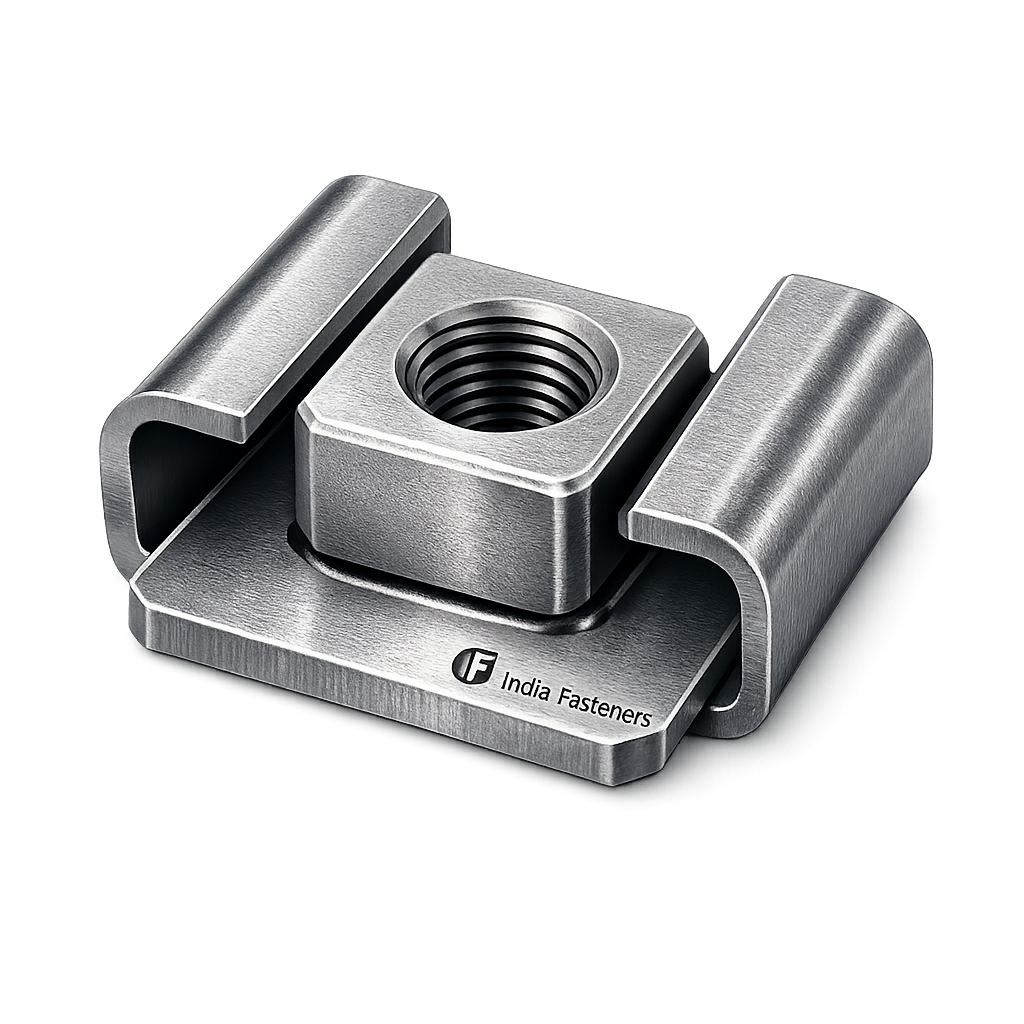
clip nut
1. Regional Industry Context — Middle East Industrial Environment
Industrial construction across the GCC region relies extensively on sheet-metal-based assemblies. Mechanical enclosures, equipment housings, electrical panels, HVAC systems, and modular infrastructure installations require repeatable threaded fastening without introducing permanent structural modifications to thin materials.
Within large projects executed for organizations such as Saudi Aramco, ADNOC, QatarEnergy, SABIC, and Dubai Electricity and Water Authority, the fastening strategy must satisfy several simultaneous constraints:
- Rapid installation during EPC construction schedules
- Controlled maintenance access during plant operation
- Protection against corrosion and environmental degradation
- Repeatability under inspection-controlled installation procedures
Clip nuts have become a standardized fastening solution in these environments due to their ability to introduce a threaded anchor into thin sheet metal without welding, tapping, or secondary fabrication.
1.1 GCC Industrial Application Landscape
Solar Mounting Systems
Solar installations across desert regions require corrosion-resistant fastening compatible with aluminium frames and thin steel brackets. Clip nuts reduce installation time while maintaining mechanical integrity under wind loading.
Railway & Metro Infrastructure
Modern rail systems employ modular sheet metal assemblies for:
- Signalling cabinets
- Platform equipment housings
- Electrical distribution boxes
Vibration resistance becomes a primary engineering requirement.
Automotive Assembly Plants
Manufacturing lines operating in the GCC utilize clip nuts for:
- Body panel fixtures
- Equipment guarding
- Assembly station structures
The requirement for rapid replacement without welding makes clip nuts operationally efficient.
Desalination Facilities
High humidity and saline exposure demand corrosion-resistant fastening solutions. Clip nuts permit replacement without damaging protective coatings applied to panels.
Power Generation Equipment Housings
Gas turbine auxiliary systems, MCC panels, and generator enclosures depend on removable threaded retention systems supporting periodic inspection.
1.2 Engineering Drivers Behind Clip Nut Adoption
GCC facilities operate under conditions that directly influence fastening selection:
High Ambient Temperature
- Desert temperatures exceeding 50°C influence material expansion and relaxation.
- Elastic retention of clip nuts compensates for thermal cycling.
Vibration & Mechanical Movement
- Rotating equipment induces cyclic loading.
- Spring steel clip action maintains consistent clamping force.
Corrosion Exposure
- Coastal environments introduce salt-laden atmosphere.
- Non-welded fastening avoids coating damage.
Maintenance Accessibility
1.3 Why Clip Nuts Are Preferred Over Alternative Fastening Methods
| Alternative Method | Engineering Limitation |
|---|---|
| Welded Nuts | Heat distortion, coating damage, inspection complexity |
| Tapped Holes | Insufficient thread engagement in thin sheet |
| Rivet Nuts | Installation tooling required, permanent deformation |
| Loose Nut Assemblies | Installation inefficiency and alignment difficulty |
Clip nuts eliminate secondary fabrication while maintaining threaded reliability.
2. Technical Definition of Clip Nut
A clip nut is a self-retaining spring steel fastener designed to provide a threaded attachment point on sheet metal edges or pre-punched holes without permanent modification of the host structure.
Primary characteristics:
- Self-positioning threaded anchor
- Elastic gripping mechanism
- Removable fastening solution
- Tool-free placement prior to screw installation
2.1 Functional Definition
A clip nut operates as:
- A floating or fixed threaded nut
- Retained by spring force
- Installed onto panel edges or holes
- Activated when a mating screw generates clamp load
2.2 Common Clip Nut Configurations
U-Type Clip Nut
- Slides over panel edge
- Widely used in enclosures and automotive assemblies
J-Type Clip Nut
- Extended leg for thicker grip range
- Used in structural panels
Screw-Retained Clip Nut
- Retention assisted by screw insertion
Floating Clip Nut
- Allows lateral movement
- Compensates for hole misalignment
Cage-Style Retention Variants
- Captive nut retained within spring cage
- Used where alignment tolerance is critical
2.3 Standards Compatibility
Clip nuts used in GCC projects typically comply with:
- ISO Metric Thread System
- DIN thread tolerances
- ASTM material equivalence requirements
- OEM fastening specifications adopted by EPC contractors
Thread compatibility ensures interchangeability with standard bolts supplied under international procurement frameworks.
2.4 Load Transfer Mechanism
The clip nut transfers load through four interacting mechanical actions:
- Clamp Load Generation — screw tightening produces compressive force.
- Thread Engagement Mechanics — internal threads resist axial load.
- Sheet Edge Gripping — spring legs apply elastic compression.
- Elastic Retention Principle — stored spring energy prevents displacement.
3. Fastening Mechanics & Load Behavior
Understanding load behavior is essential for consultant approval in EPC projects.
3.1 Clamp Force Generation
Clamp load is created when tightening torque converts rotational energy into axial tension.
Clamp Load Equation 
Where:
 = Clamp Load (N)
 = Applied Torque (Nm)
 = Torque Coefficient
 = Nominal Diameter (m)
3.2 Torque–Tension Relationship
Approximately:
- 90% torque → friction losses
- 10% torque → useful clamp load
Therefore surface finish and lubrication directly influence installation reliability.
3.3 Thread Shear Capacity

Where:
 = Shear Stress
- = Applied Load
 = Thread Shear Area
Adequate engagement length prevents thread stripping.
3.4 Pull-Out Resistance
Clip nut retention depends on:
- Spring hardness
- Panel thickness
- Edge grip geometry
Retention force must exceed installation vibration loads.
3.5 Panel Deformation Limits
Thin panels experience local bending if torque exceeds recommended limits.
Engineering practice requires:
- Controlled torque application
- Load distribution washers when necessary
3.6 Vibration Resistance Behavior
Clip nuts maintain preload through:
- Elastic spring pressure
- Frictional resistance
- Continuous contact force
This characteristic is critical in compressors, pumps, switchgear, and transport systems.
3.7 Recommended Engagement Length
Minimum engagement:
Where = nominal thread diameter.
Higher load applications may require 1.5D engagement.
3.8 EPC Installation Safety Factors
Typical safety factors applied:
| Condition | Safety Factor |
|---|---|
| Static Equipment Panels | 2.0 |
| Vibrating Equipment | 3.0 |
| Outdoor Infrastructure | 3.5 |
| Critical Access Panels | ≥4.0 |
4. Materials Used in Clip Nut Manufacturing
Material selection governs three critical performance outcomes:
- Spring retention capability
- Thread load capacity
- Environmental durability under GCC operating conditions
Clip nuts differ from conventional nuts because they must function simultaneously as:
- A structural threaded element
- A spring retention device
- A corrosion-resistant mounting interface
Accordingly, material engineering must balance strength, elasticity, and corrosion resistance.
4.1 Spring Steel (SAE 1074 / SAE 1075)
Primary industrial material for clip nut manufacturing
Spring steel grades SAE 1074 and SAE 1075 are widely applied where elastic recovery and retention force stability are mandatory.
Engineering Characteristics
- High carbon content enables spring memory
- Excellent fatigue resistance
- High yield strength after heat treatment
- Stable clamp retention under vibration
Typical GCC Applications
- Electrical panels
- Equipment covers
- HVAC mounting brackets
- Automotive assembly fixtures
- Telecom cabinets
Operational Advantages
- Maintains gripping force after repeated installations
- Resists relaxation under thermal cycling
- Suitable for progressive die stamping production
4.2 Carbon Steel
Used where structural strength is required but corrosion exposure is moderate.
Engineering Properties
- Good machinability
- Consistent thread forming performance
- Economical for large EPC volumes
Limitations
- Requires protective coating
- Not recommended for marine exposure without plating
Typical Uses
- Indoor equipment enclosures
- Power plant control rooms
- Industrial OEM assemblies
4.3 Stainless Steel 304
Austenitic stainless steel grade widely accepted across GCC infrastructure.
Engineering Characteristics
- Excellent corrosion resistance
- Non-magnetic behavior
- Good forming properties
Environmental Suitability
- High humidity zones
- Chemical processing plants
- Desalination auxiliary systems
Consideration
Lower spring modulus compared to hardened spring steel; design geometry compensates for reduced elasticity.
4.4 Stainless Steel 316
Preferred material for aggressive environments.
Advantages
- Superior chloride resistance
- Marine atmosphere durability
- Reduced pitting corrosion risk
Commonly selected for installations near coastal facilities operated by regional energy authorities.
Typical Applications
- Offshore platforms
- Desalination plants
- Coastal petrochemical terminals
4.5 Phosphor Bronze (Special Applications)
Used for electrically sensitive installations.
Engineering Benefits
- Excellent conductivity
- Non-sparking properties
- Corrosion resistance
Applications
- Electrical grounding panels
- Telecom equipment
- Specialized instrumentation enclosures
4.6 NACE Considerations
Although clip nuts are not pressure-containing components, projects aligned with sour service requirements influenced by NACE practices may impose material restrictions.
Engineering evaluation includes:
- Hydrogen embrittlement susceptibility
- Coating process control
- Hardness limitations where applicable
Clip nut hardness levels are controlled to prevent delayed cracking after plating operations.
5. Material Comparison Table
| Material Grade | Yield Strength (MPa) | Hardness Range | Corrosion Resistance Level | Temperature Capability | Typical GCC Application |
|---|---|---|---|---|---|
| Spring Steel SAE 1074/1075 | 900–1200 | 38–48 HRC | Moderate (Coated) | −40°C to 150°C | Switchgear panels, HVAC assemblies |
| Carbon Steel | 350–600 | 20–30 HRC | Low (Coating Required) | −20°C to 120°C | Indoor equipment housing |
| Stainless Steel 304 | 215–505 | 70–90 HRB | High | −200°C to 400°C | Desalination auxiliary equipment |
| Stainless Steel 316 | 205–515 | 70–95 HRB | Very High | −200°C to 450°C | Marine & offshore installations |
| Phosphor Bronze | 250–550 | 60–80 HRB | High | −40°C to 260°C | Electrical & telecom equipment |
6. Heat Treatment & Spring Property Control
Clip nut performance depends primarily on controlled spring characteristics rather than thread strength alone.
6.1 Hardening Process
After forming, spring steel clip nuts undergo controlled hardening:
- Austenitizing at defined temperature range
- Rapid quenching
- Microstructure transformation into martensite
Objective:
- Achieve required hardness
- Establish elastic energy storage capability
6.2 Tempering Control
Tempering stabilizes the hardened structure.
Engineering goals:
- Reduce brittleness
- Improve fatigue life
- Control residual stress
Incorrect tempering leads to:
- Loss of spring force
- Crack initiation during installation
- Premature retention failure
6.3 Spring Memory Characteristics
A clip nut must return to original geometry after installation deformation.
Key parameters:
- Elastic limit
- Deflection recovery
- Permanent set tolerance
Spring recovery is verified through compression testing cycles.
6.4 Residual Stress Management
Stamping and forming introduce internal stresses.
Controlled heat treatment ensures:
- Stress redistribution
- Dimensional stability
- Resistance to fatigue cracking
Residual stress control becomes critical for vibrating GCC installations.
6.5 Fatigue Resistance Improvement
Repeated removal and installation cycles create cyclic stress.
Heat treatment improves:
- Crack resistance
- Retention force durability
- Service life predictability
6.6 Elastic Recovery Requirement
Engineering requirement:
Clip leg deflection must remain within elastic range during installation.
Permanent deformation indicates material or process non-conformance.
6.7 Hardness Testing Limits
Typical control ranges:
| Material | Target Hardness |
|---|---|
| Spring Steel Clip Nut | 38–48 HRC |
| Carbon Steel | 20–30 HRC |
| Stainless Steel | Work-hardened condition |
Hardness testing methods:
- Rockwell testing
- Microhardness verification for thin sections
6.8 Clip Retention Force Validation
Retention force testing confirms:
- Minimum grip force
- Panel holding stability
- Resistance to displacement before screw installation
Testing involves simulated panel engagement and pull-off measurement.
7. Manufacturing Process Flow — Documentation Level
Manufacturing discipline for EPC-approved fastening systems requires traceability from raw material to shipment release.
7.1 Raw Coil Material Traceability
- Mill certificates verified upon receipt
- Heat number identification recorded
- Chemical composition validation
- Mechanical property confirmation
Traceability maintained throughout production batch.
7.2 Incoming Inspection
Inspection includes:
- Thickness verification
- Surface condition assessment
- Hardness confirmation
- Dimensional checks
Nonconforming coils are segregated.
7.3 Stamping & Progressive Die Forming
Clip nuts are produced using progressive stamping dies.
Process characteristics:
- High repeatability
- Controlled forming radii
- Burr minimization
- Consistent spring geometry
Tooling accuracy directly affects retention performance.
7.4 Thread Forming / Tapping
Thread creation methods:
- Extruded thread forming
- Roll tapping
- Cut tapping depending on design
Threads conform to ISO metric tolerance class requirements.
Critical controls:
- Pitch diameter accuracy
- Thread concentricity
- Surface finish integrity
7.5 Deburring Process
Edges must remain free from sharp burrs to prevent:
- Coating failure
- Installation injury
- Stress concentration points
Methods:
- Vibratory finishing
- Mechanical deburring
- Controlled tumbling
7.6 Heat Treatment
Performed under monitored furnace conditions:
- Controlled atmosphere
- Temperature recording
- Batch identification
- Cooling rate verification
Process records retained for inspection review.
7.7 Surface Finishing
Surface treatment selected according to project specification:
- Zinc plating
- Zinc-nickel coating
- Phosphate coating
- Passivation for stainless grades
Coating thickness measured per inspection standards.
7.8 Coating Application Controls
Key parameters:
- Adhesion verification
- Hydrogen embrittlement relief baking
- Uniform coverage on formed geometry
Special attention given to thread protection.
7.9 Dimensional Inspection
Inspection conducted using:
- Go/No-Go gauges
- Optical measurement systems
- Profile comparators
Dimensions verified:
- Clip opening
- Grip range
- Thread alignment
- Overall geometry
7.10 Spring Force Verification
Dedicated testing validates:
- Opening force
- Retention pressure
- Elastic recovery performance
Results recorded within production lot documentation.
7.11 Final Inspection
Final release inspection includes:
- Visual examination
- Thread verification
- Coating inspection
- Packaging conformity
Inspection aligned with third-party verification practices commonly required by international inspection agencies operating across GCC EPC projects.
7.12 Traceability Marking
Production batches are identifiable through:
- Lot numbering
- Heat number reference
- Inspection documentation linkage
Traceability ensures compliance with EPC procurement audit requirements.
7.13 Tolerance Control & Manufacturing Repeatability
Critical tolerances maintained for:
- Thread class accuracy
- Spring leg geometry
- Panel grip consistency
Process capability monitoring ensures repeatable performance across large project supply volumes.
8. Dimensional Reference Tables
Clip nuts are selected based on interaction between:
- Panel thickness
- Thread size
- Grip geometry
- Installation accessibility
- Load requirement
Dimensional compatibility directly influences retention reliability.
8.1 Standard Panel Thickness vs Clip Nut Selection
| Thread Size | Recommended Panel Thickness | Typical Grip Range | Hole Type |
|---|---|---|---|
| M4 | 0.6 – 1.6 mm | 0.5 – 2.0 mm | Edge / Slotted |
| M5 | 0.8 – 2.0 mm | 0.7 – 2.5 mm | Edge / Round |
| M6 | 1.0 – 2.5 mm | 0.9 – 3.0 mm | Round Hole |
| M8 | 1.2 – 3.0 mm | 1.0 – 3.5 mm | Reinforced Panel |
| M10 | 1.5 – 3.5 mm | 1.2 – 4.0 mm | Structural Sheet |
| M12 | 2.0 – 4.5 mm | 1.5 – 5.0 mm | Heavy Equipment Panel |
8.2 Typical Clip Nut Geometry Reference
| Thread | Clip Width | Clip Height | Nut Offset | Recommended Hole Size |
|---|---|---|---|---|
| M4 | 9–11 mm | 12–14 mm | 2.0 mm | 4.5 mm |
| M5 | 11–13 mm | 14–16 mm | 2.5 mm | 5.5 mm |
| M6 | 13–16 mm | 16–18 mm | 3.0 mm | 6.5 mm |
| M8 | 17–20 mm | 20–24 mm | 4.0 mm | 8.5 mm |
| M10 | 21–24 mm | 24–28 mm | 5.0 mm | 10.5 mm |
| M12 | 25–30 mm | 30–34 mm | 6.0 mm | 12.5 mm |
Dimensions may vary depending on floating or fixed nut configuration.
8.3 Imperial Thread Equivalents
| Metric Thread | UNC Equivalent |
|---|---|
| M4 | #8-32 |
| M5 | #10-24 |
| M6 | 1/4-20 |
| M8 | 5/16-18 |
| M10 | 3/8-16 |
| M12 | 1/2-13 |
Compatibility ensures interchangeability with equipment imported into GCC facilities.
9. Load Capacity & Torque Recommendation Table
Torque control is essential in preventing panel deformation and thread stripping.
9.1 Recommended Installation Torque
| Thread Size | Recommended Torque (Nm) | Installation Range (Nm) | Approx. Clamp Load (kN) | Proof Load (kN) |
|---|---|---|---|---|
| M4 | 2.5 | 2–3 | 3.5 | 5 |
| M5 | 5 | 4–6 | 6 | 8 |
| M6 | 9 | 8–11 | 10 | 14 |
| M8 | 22 | 20–26 | 18 | 26 |
| M10 | 45 | 40–50 | 30 | 45 |
| M12 | 75 | 70–85 | 45 | 65 |
Values depend on coating friction coefficient.
9.2 Torque Scatter Considerations
Torque scatter occurs due to:
- Surface coating variation
- Lubrication differences
- Operator technique
- Tool calibration accuracy
Engineering practice in EPC installations requires:
- Calibrated torque tools
- Controlled installation procedures
- Defined torque windows instead of single values
Typical torque scatter range: ±20–25%
9.3 Clamp Load Control Principle
Over-torque risks:
- Panel buckling
- Thread stripping
- Loss of spring retention
Under-torque risks:
- Vibration loosening
- Reduced preload
Balanced torque application is mandatory.
10. Thread Engagement & Retention Guide (MANDATORY)
Correct thread engagement ensures reliable load transfer.
10.1 Minimum Engagement Requirement
Engineering rule:
Where:
 = Engagement Length
- = Nominal Thread Diameter
Example:
For M6 screw → Minimum engagement = 6 mm
10.2 Floating Nut Alignment Benefits
Floating clip nuts provide lateral tolerance typically:
±0.5 mm to ±1.0 mm
Advantages:
- Compensates fabrication misalignment
- Reduces installation stress
- Prevents cross-threading
Widely adopted in switchgear and enclosure manufacturing.
10.3 Alignment Compensation Capability
Misalignment sources:
- Thermal expansion
- Panel distortion
- Field installation tolerance
Floating nuts prevent preload loss caused by forced alignment.
10.4 Reusability Considerations
Clip nuts support multiple installation cycles but are not unlimited-life components.
Typical guidance:
| Application | Recommended Reuse Cycles |
|---|---|
| Electrical Panels | 10–20 cycles |
| Maintenance Access Covers | 5–10 cycles |
| High Vibration Areas | Replace after inspection |
Inspection must verify retention force after repeated use.
10.5 Engineering Calculation Example
Given:
- Bolt: M6
- Torque Applied: 9 Nm
- Torque Coefficient (K): 0.2

Resulting clamp load ≈ 7.5 kN
This value must remain below proof load of clip nut threads.
11. Mechanical Property Table
| Property | Spring Steel Clip Nut | Stainless Steel Clip Nut |
|---|---|---|
| Yield Strength | 900–1200 MPa | 205–515 MPa |
| Hardness | 38–48 HRC | 70–95 HRB |
| Spring Deflection Range | 0.5–2.5 mm | 0.3–1.5 mm |
| Elastic Recovery | High | Moderate |
| Fatigue Life | High Cycle | Medium Cycle |
| Vibration Performance | Excellent | Good |
11.1 Spring Deflection Behavior
Clip legs act as elastic beams.
Performance requirements:
- No permanent set after installation
- Stable gripping force
- Controlled elastic modulus
11.2 Fatigue Life Expectation
Typical industrial expectation:
- 100,000 vibration cycles under moderate load
- Reduced life if over-compressed during installation
12. Corrosion Protection Systems
Corrosion protection is a primary requirement for GCC installations exposed to:
- Desert sand abrasion
- Coastal chloride atmosphere
- Industrial chemical vapors
- Condensation cycles
12.1 Coating System Comparison
| Coating Type | Corrosion Resistance | Temperature Capability | Typical GCC Use |
|---|---|---|---|
| Zinc Plating | Moderate | Up to 120°C | Indoor equipment |
| Zinc Nickel | High | Up to 180°C | Oil & Gas facilities |
| Phosphate Coating | Low–Moderate | 150°C | Dry environments |
| Black Oxide | Low | 120°C | Controlled indoor areas |
| Stainless Steel Finish | Very High | >400°C | Coastal & marine |
12.2 Marine Exposure Suitability
Coastal installations require:
- Stainless Steel 316 or Zinc-Nickel coating
- Uniform coating thickness
- No exposed base metal
12.3 Desert Environment Performance
Key risks:
- Sand abrasion removing coating
- Thermal cycling fatigue
- Dust infiltration into threads
Recommended solutions:
- Zinc-nickel coatings
- Passivated stainless grades
12.4 Chemical Plant Atmosphere
Chemical exposure considerations:
- Sulfur compounds
- Cleaning agents
- Process vapors
Material compatibility evaluation required during specification stage.
13. Inspection & Quality Assurance
Clip nuts supplied to GCC EPC projects must be inspection-ready.
Inspection requirements align with expectations of international verification bodies operating across Middle East energy and infrastructure projects.
13.1 Thread Gauge Inspection
Verification performed using:
- GO gauge
- NO-GO gauge
Ensures compliance with ISO metric tolerances.
13.2 Salt Spray Testing
Performed according to recognized corrosion testing practices.
Typical performance targets:
| Coating | Salt Spray Resistance |
|---|---|
| Zinc | 72–120 hrs |
| Zinc Nickel | 500–1000 hrs |
| Stainless Steel | No red rust |
13.3 Hardness Testing
Confirms heat treatment effectiveness.
Methods:
- Rockwell hardness testing
- Microhardness verification for thin formed sections
13.4 Dimensional Inspection
Critical dimensions checked:
- Thread alignment
- Clip opening width
- Grip range tolerance
- Leg geometry symmetry
Measurement tools include calibrated gauges and optical inspection equipment.
13.5 Spring Retention Force Testing
Test objective:
Validate clip remains secured before screw installation.
Typical verification:
- Installation simulation
- Pull-off force measurement
- Elastic recovery observation
13.6 Coating Thickness Verification
Measured using:
- Magnetic thickness gauges
- XRF analysis where required
Uniform coating prevents localized corrosion initiation.
13.7 Third-Party Inspection Readiness
Documentation prepared for inspection agencies commonly engaged in GCC projects:
- Dimensional inspection reports
- Material certificates
- Heat treatment records
- Coating test reports
- Batch traceability records
Inspection hold points can be supported during manufacturing or pre-shipment review.
13.8 EN 10204 3.1 Certification
Supply documentation may include:
- Chemical composition confirmation
- Mechanical property verification
- Batch traceability declaration
- Manufacturer inspection endorsement
This certification format supports EPC procurement approval workflows.
13.9 GCC Consultant Expectations
Consultants reviewing fastening systems typically verify:
- Engineering suitability for sheet metal applications
- Manufacturing repeatability
- Corrosion resistance adequacy
- Installation reliability
- Inspection transparency
Clip nuts meeting these criteria integrate into approved vendor evaluation processes.
14. Industries Served — Middle East Application Perspective
Clip nuts are primarily applied where threaded fastening must be introduced into thin-gauge sheet metal assemblies without welding or machining operations.
Industrial usage across the GCC reflects standardized mechanical design practices adopted by major energy operators including Saudi Aramco, ADNOC, QatarEnergy, SABIC, and Dubai Electricity and Water Authority.
14.1 Oil & Gas Facilities
Oil and gas installations utilize extensive modular equipment enclosures fabricated from sheet metal panels.
Typical clip nut functions include:
- Analyzer shelter access covers
- Instrument junction boxes
- Control panel mounting points
- Cable tray protection covers
- Equipment inspection panels
Engineering considerations:
- Resistance to vibration from rotating equipment
- Compatibility with coated carbon steel panels
- Replaceability during shutdown maintenance
Clip nuts allow removal without damaging enclosure integrity.
14.2 Power Generation Plants
Gas turbine and thermal power facilities incorporate thousands of removable panels requiring reliable threaded engagement.
Applications:
- Generator auxiliary housings
- MCC cabinets
- Control room panel systems
- Cooling system enclosures
Operational requirements include:
- Repeatable torque installation
- Stable preload under thermal expansion
- Long-term maintainability
14.3 Desalination Projects
Desalination infrastructure presents one of the most aggressive corrosion environments in the GCC region.
Clip nuts are applied in:
- Pump enclosure panels
- Electrical cabinets
- Chemical dosing equipment housings
- Instrumentation racks
Material preference:
- Stainless Steel 316
- Zinc-nickel coated spring steel
Selection prioritizes resistance to chloride-induced corrosion.
14.4 Electrical Switchgear & Enclosure OEMs
Switchgear manufacturers require fastening solutions allowing:
- Fast assembly line installation
- Alignment tolerance
- Non-destructive panel replacement
Clip nuts support modular manufacturing workflows while maintaining ISO-thread compatibility.
14.5 Rail & Infrastructure Systems
Metro and rail infrastructure employ sheet metal housings exposed to vibration and public operational environments.
Clip nut usage includes:
- Signal equipment cabinets
- Platform control panels
- Communication system enclosures
Engineering objective:
Maintain retention force under dynamic loading conditions.
14.6 Automotive Assembly Lines
Industrial automotive facilities operating in the GCC region use clip nuts extensively in:
- Equipment guarding
- Conveyor enclosures
- Fixture structures
- Body panel mounting
Advantages include rapid replacement and reduced production downtime.
14.7 Telecommunication Infrastructure
Outdoor telecom cabinets demand corrosion-resistant fastening compatible with frequent equipment upgrades.
Clip nuts provide:
- Tool-efficient installation
- Reusable threaded anchoring
- Alignment flexibility during field servicing
14.8 HVAC & Building Services
Large commercial and industrial buildings require extensive ducting and mechanical service panels.
Applications include:
- Air handling units
- Duct inspection covers
- Mechanical service enclosures
Clip nuts eliminate drilling or tapping during site installation.
15. Export & GCC Supply Capability
Export supply discipline is a primary evaluation criterion during EPC vendor qualification.
India Fasteners supplies clip nuts as industrial components supported by documentation, traceability, and shipment control practices aligned with GCC procurement expectations.
15.1 GCC Export Regions
Supply coverage includes:
- Saudi Arabia
- United Arab Emirates (Dubai / Abu Dhabi)
- Qatar
- Oman
- Kuwait
- Bahrain
Each region presents unique environmental and documentation requirements which influence packaging, coating selection, and inspection release procedures.
15.2 Export Packaging Standards
Packaging objectives:
- Prevent corrosion during marine transit
- Maintain dimensional integrity
- Preserve coating condition
Standard practices include:
- Moisture barrier packaging
- VCI corrosion protection materials
- Sealed cartons within export pallets
- Batch identification labeling
15.3 Corrosion-Protected Packing
Marine shipping conditions expose products to:
- High humidity
- Salt-laden air
- Temperature fluctuations
Packaging controls include:
- Desiccant inclusion
- Anti-condensation protection
- Controlled pallet wrapping
15.4 Project Documentation Pack
Typical shipment documentation may include:
- Material Test Certificates
- Inspection Reports
- Dimensional Verification Records
- Heat Treatment Documentation
- Coating Certification
- Packing List Traceability
Documentation structure supports EPC document control systems.
15.5 Inspection Release Documentation
Where required, inspection release procedures may include:
- Pre-shipment inspection readiness
- Lot traceability verification
- Visual and dimensional approval
- Certification endorsement
Inspection acceptance aligns with third-party verification bodies engaged by EPC contractors.
15.6 Container Loading Discipline
Loading procedures consider:
- Load stability
- Moisture protection
- Traceable pallet identification
- Segregation by batch and size
Container documentation supports customs clearance and project material tracking.
16. Procurement & Installation Engineering View
From a procurement engineering perspective, clip nuts are evaluated based on installation reliability, field usability, and maintenance compatibility.
16.1 Installation Procedure
Step 1 — Panel Edge Preparation
- Confirm panel thickness compatibility
- Ensure burr-free edges
Step 2 — Clip Positioning
- Slide clip nut onto panel edge or hole
- Verify full seating
Step 3 — Alignment Check
- Confirm thread alignment with mating hole
- Floating types allow minor adjustment
Step 4 — Screw Insertion
- Hand-start screw to prevent cross-threading
Step 5 — Torque Application
- Apply calibrated torque wrench
- Tighten within recommended range
16.2 Torque Control Discipline
EPC installation procedures require:
- Calibrated torque tools
- Defined torque values
- Controlled tightening sequence where multiple fasteners exist
Torque control prevents:
- Panel distortion
- Thread stripping
- Loss of retention force
16.3 Field Replacement Practices
Clip nuts enable replacement without structural modification.
Maintenance procedure:
- Remove screw
- Slide out worn clip nut
- Install new clip
- Reapply torque
No welding or drilling required.
16.4 Maintenance Removal Procedure
Removal considerations:
- Avoid prying deformation
- Use manual disengagement force
- Inspect panel edge condition before reinstalling
16.5 Site Inspection Checklist
Typical inspection points:
- Correct thread size installed
- Proper seating against panel
- Coating condition intact
- Torque verification completed
- No panel deformation visible
16.6 Storage Practices for Gulf Climate
Storage recommendations prior to installation:
- Indoor dry storage preferred
- Avoid direct ground contact
- Maintain sealed packaging until use
- Protect from condensation cycles
Improper storage can reduce coating life before installation.
17. Custom Engineering Capabilities
Industrial projects frequently require fastening solutions beyond catalog dimensions.
India Fasteners supports engineering adaptation of clip nut designs to meet project-specific requirements.
17.1 Non-Standard Clip Geometries
Custom development may include:
- Extended grip range designs
- Offset thread positioning
- Reinforced spring legs
- Large panel compatibility variants
17.2 Heavy-Duty Retention Designs
Applications involving vibration or heavier panels may require:
- Increased spring thickness
- Dual-leg retention geometry
- High preload thread structures
17.3 Floating Nut Tolerance Systems
Designed for:
- Misaligned fabrication holes
- Modular equipment assembly
- Rapid field installation
Floating designs reduce installation stress during large equipment assembly.
17.4 High-Vibration Solutions
Used in:
- Compressor stations
- Transport infrastructure
- Rotating equipment housings
Engineering solutions include optimized spring geometry and coating friction control.
17.5 Special Coatings for Offshore GCC Environments
Custom coatings may include:
- Enhanced zinc-nickel systems
- Passivated stainless materials
- Project-specified corrosion protection schemes
Selection aligned with environmental exposure classification.
17.6 Project-Specific Stamping & Identification
Where required, clip nuts can incorporate:
- Batch identification stamping
- Project reference marking
- Size identification coding
Supports EPC material traceability requirements.
Technical Conclusion — EPC Evaluation Perspective
From an engineering and procurement standpoint, clip nuts supplied for GCC industrial applications must demonstrate:
- Understanding of sheet-metal fastening mechanics
- Controlled spring retention behavior
- Verified manufacturing discipline
- Corrosion protection suitability for regional environments
- Installation reliability under field conditions
- Documentation transparency supporting inspection review
A fastening manufacturer capable of integrating material engineering, process control, dimensional consistency, and export documentation demonstrates readiness for technical vendor evaluation within Middle East EPC project frameworks.