
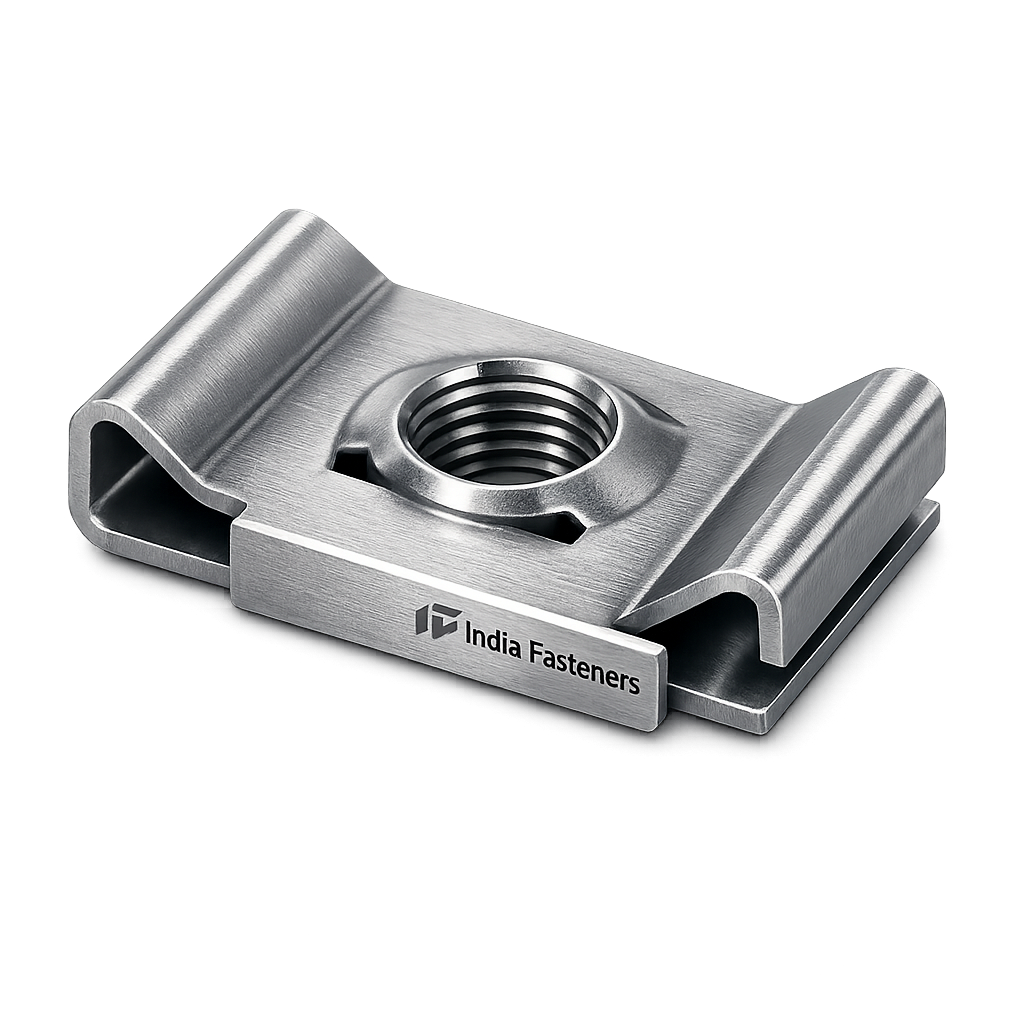
speed nut
1. Regional Industry Context — Middle East Industrial Environment
Industrial fastening selection within GCC infrastructure projects is driven by installation efficiency, inspection compliance, long-term maintainability, and environmental durability rather than component cost alone. Mechanical fastening devices used in Saudi Arabia, UAE, Qatar, and broader Gulf regions must operate reliably under extreme environmental and operational conditions unique to the Middle East.
Speed nuts are widely applied where threaded retention must be introduced into thin sheet metal assemblies without machining, welding, or tapping operations.
1.1 Oil & Gas Processing Facilities
Upstream and downstream oil & gas facilities include:
- Process skids
- Instrumentation mounting panels
- Pump enclosure panels
- Fire & gas detector housings
- Cable support structures
- Control system cabinets
Engineering challenges:
- Large quantities of removable panels
- Shutdown maintenance access requirements
- Corrosion exposure from saline coastal atmosphere
- Vibration generated by rotating equipment
Speed nuts eliminate welded nut distortion and avoid repaint damage during retrofit activities.
Typical GCC project drivers:
- Reduced hot work permissions
- Faster module assembly
- Simplified replacement during maintenance shutdowns
- Reduced fabrication cost for stainless or coated panels
1.2 Electrical Panel Installations & Control Cabinet Fabrication
Electrical and instrumentation contractors operating under EPC frameworks require fastening systems compatible with:
- IEC electrical enclosures
- MCC panels
- SCADA cabinets
- Junction boxes
- PLC control assemblies
Traditional tapped holes create problems:
- Thin panel thread stripping
- Alignment sensitivity
- Rework complexity
Speed nuts provide:
- Captive threaded engagement
- Assembly tolerance accommodation
- Reusable fastening points
- Tool-controlled installation
In high-volume panel fabrication environments across UAE and Saudi Arabia, speed nuts significantly reduce fabrication cycle time.
1.3 HVAC Ducting Systems
Large HVAC installations in desalination plants, airports, and power stations involve extensive sheet metal fabrication.
Challenges include:
- Thin galvanized steel duct walls
- Repetitive panel attachment
- Field assembly constraints
- Thermal expansion due to desert temperature variation
Speed nuts allow:
- Rapid assembly without drilling tapping operations
- Consistent clamp load distribution
- Controlled removal during servicing
1.4 Cable Tray & Electrical Infrastructure Systems
Cable management systems across petrochemical facilities require removable covers and accessories.
Engineering requirements:
- Quick installation during construction phase
- Frequent inspection access
- Corrosion resistance in outdoor installations
- Compatibility with coated tray systems
Speed nuts function as temporary or permanent threaded anchors without damaging protective coatings.
1.5 Automotive & Transport Equipment
Regional assembly operations supporting commercial vehicles, rail systems, and industrial transport equipment utilize speed nuts for:
- Interior panel retention
- Body panel mounting
- Equipment housings
- Electrical component fixation
Advantages include:
- Lightweight fastening solutions
- Reduced assembly tooling
- Resistance to vibration loosening
1.6 Rail Infrastructure Systems
Rail systems across GCC urban transport projects require vibration-resistant fastening for:
- Signal enclosures
- Equipment cabinets
- Access panels
- Lighting assemblies
Speed nuts enable maintenance removal without thread degradation.
1.7 Power Generation Plants
Combined cycle power plants and turbine installations incorporate extensive auxiliary enclosures requiring removable fastening.
Environmental exposure:
- Elevated temperature zones
- Continuous vibration
- Outdoor desert dust accumulation
- Periodic wash-down operations
Speed nuts support maintainability requirements mandated by plant reliability standards.
1.8 Desalination Facilities
Desalination environments present aggressive corrosion exposure due to:
- Salt-laden humidity
- Chloride contamination
- Continuous moisture presence
Material selection becomes critical, especially stainless steel speed nut configurations.
1.9 Offshore Platform Auxiliary Equipment
Offshore modules prioritize:
- No welding after coating
- Reduced fabrication heat input
- Replaceable fastening interfaces
- Corrosion resistant retention
Speed nuts allow mechanical attachment without compromising protective coatings applied during fabrication.
1.10 GCC Project Installation Drivers
Across Middle East mega projects, EPC contractors prioritize:
- Reduced installation manpower
- Modular construction speed
- Minimized rework
- Improved accessibility
- Inspection transparency
Speed nuts directly address these requirements.
2. Technical Definition of Speed Nut
A Speed Nut is a self-retaining spring steel fastening device designed to provide threaded engagement on sheet metal structures without requiring tapping, welding, or threaded inserts.
Functional Classification
- Clip-on threaded retention element
- Sheet metal captive fastening solution
- Non-welded reusable thread anchor
- Spring-loaded mechanical locking device
2.1 Thread Engagement Principle
Speed nuts operate using controlled elastic deformation.
Unlike conventional nuts:
- Threads are partially formed or extruded
- Spring tension forces threads against screw flanks
- Elastic preload generates locking resistance
Two mechanisms exist:
Thread Forming Engagement
- Screw creates mating thread during installation
- Used in softer speed nut designs
Pre-formed Thread Engagement
- Thread profile manufactured during stamping/extrusion
- Provides repeatable torque performance
2.2 Spring Retention Mechanism
Retention occurs through:
- Elastic bending arms
- Continuous spring pressure against panel edge
- Frictional retention prior to screw insertion
This allows the nut to remain captive during assembly operations.
2.3 Load Distribution Across Sheet Metal
Speed nuts distribute load by:
- Increasing bearing surface
- Preventing localized panel deformation
- Supporting thin sheet metal structures
Result:
Reduced risk of tearing compared to direct threading.
2.4 Self-Locking Characteristics
Locking behavior results from:
- Spring preload
- Thread interference
- Material elasticity
This improves resistance to vibration loosening common in rotating equipment zones.
2.5 Types of Speed Nuts
U-Type Speed Nut
- Slides over panel edge
- Most common industrial variant
- Suitable for removable covers
J-Type Speed Nut
- Extended retention arm
- Used where access from one side is limited
Flat Speed Nut
- Used on pre-punched holes
- Flush mounting requirement
Extruded Speed Nut
- Formed threaded extrusion
- Increased thread engagement length
Screw-Retaining Clip Nut Variants
- Captive screw retention
- Prevents fastener loss during maintenance
3. Mechanical Retention Theory & Load Behavior
Understanding load behavior is essential for EPC design approval.
3.1 Clamping Force Generation
Clamp load results from torque applied to screw threads.
Where:
- F = Clamp force (N)
- T = Applied torque (Nm)
- K = Nut factor (~0.18–0.25 typical)
- D = Nominal diameter (m)
Spring preload enhances clamp stability.
3.2 Spring Preload Mechanism
The speed nut stores elastic energy during installation.
Benefits:
- Compensates for vibration loosening
- Maintains contact pressure
- Absorbs minor dimensional variation
3.3 Panel Deformation Limits
Design consideration:
- Sheet metal thickness must exceed minimum support threshold
- Excessive torque causes panel yielding
Typical engineering practice:
Safety factor ≥ 2 against panel deformation.
3.4 Pull-Out Resistance
Pull-out strength depends on:
- Spring retention force
- Panel hardness
- Edge engagement length
Approximate estimation:
Where:
- P = Pull-out resistance
- τ = Shear strength of material
- A = Effective engagement area
3.5 Push-On Retention Force
Retention prior to screw installation prevents loss during assembly.
Influenced by:
- Spring stiffness
- Clip geometry
- Material hardness
3.6 Vibration Resistance Mechanics
Speed nuts resist loosening through:
- Constant spring tension
- Frictional damping
- Micro-movement absorption
Critical in:
- Compressors
- Fans
- Pump skids
- Rail equipment
3.7 Thread Stripping Prevention
Failure occurs when:
- Screw torque exceeds elastic limit
- Sheet metal collapses
- Thread flank shear exceeds material capacity
Engineering mitigation:
- Torque control tools
- Correct material selection
- Appropriate screw grade matching
3.8 Safety Factor Philosophy in GCC Installations
GCC industrial projects typically adopt conservative margins.
Common design philosophy:
- Minimum safety factor: 2.0 static load
- 3.0 for vibration zones
- 4.0 for critical removable access panels
Consultants require predictable mechanical behavior rather than maximum theoretical strength.
4. Applicable Material Standards (GCC Mapping)
Material selection for speed nuts used in GCC industrial projects is governed by environmental exposure, mechanical retention requirements, corrosion risk, electrical compatibility, and long-term spring performance stability.
Unlike conventional hex nuts, speed nuts function as elastic mechanical components. Therefore, material properties must satisfy both fastening and spring engineering criteria.
Primary governing characteristics:
- Yield strength
- Elastic recovery capability
- Fatigue endurance
- Corrosion resistance
- Coating compatibility
- Formability during stamping
4.1 Carbon Spring Steel — SAE 1074 / SAE 1075
Carbon spring steels remain the dominant material for industrial speed nut manufacturing.
Applicable References
- SAE J403
- ASTM A684
- EN 10132-4 equivalent grades
Engineering Characteristics
- High elastic limit
- Excellent spring memory
- Stable preload retention
- Economical for large-volume EPC applications
Typical GCC Applications
- Electrical panel assemblies
- Cable tray accessories
- HVAC sheet metal fastening
- Equipment enclosure mounting
- Automotive body panels
Operating Temperature Range
- −40°C to +120°C (continuous)
Corrosion Consideration
Requires protective coating for Gulf environments.
4.2 EN 10132 Cold Rolled Spring Steel
European EPC projects frequently reference EN material standards.
Advantages:
- Controlled strip flatness
- Consistent hardness distribution
- Reliable progressive stamping behavior
- Uniform spring response
Common in UAE and Qatar projects executed under European EPC contractors.
4.3 Stainless Steel 304 (AISI 304)
Used where corrosion resistance overrides maximum spring strength requirements.
Properties
- Austenitic structure
- Good corrosion resistance
- Non-magnetic condition after annealing
- Compatible with electrical enclosures
Typical Uses
- Indoor petrochemical areas
- Electrical cabinets
- Food-grade auxiliary facilities
- Instrument panels
Operating Temperature
- −200°C to +400°C
Limitation:
Lower spring modulus compared with carbon spring steel.
4.4 Stainless Steel 316 (AISI 316)
Preferred material for aggressive Gulf environments.
Enhanced resistance due to molybdenum addition.
Suitable for:
- Offshore platforms
- Desalination facilities
- Coastal refineries
- Marine atmosphere exposure
Provides improved resistance against chloride-induced corrosion.
4.5 Phosphor Bronze (Special Application)
Used selectively for:
- Electrical conductivity requirements
- Anti-sparking environments
- Sensitive instrumentation assemblies
Characteristics:
- Excellent corrosion resistance
- Good electrical performance
- Moderate spring strength
Applied mainly in specialized OEM equipment rather than heavy structural use.
4.6 Standards Alignment Relevant to GCC Projects
Speed nut material selection must align with international documentation expectations.
ISO Practices
- ISO 898 mechanical property principles
- ISO 4042 coating systems reference
- ISO 9227 corrosion testing
DIN References
- DIN sheet metal fastening geometry standards
- DIN spring material guidelines
ASTM References
- ASTM A684 — spring steel strip
- ASTM A240 — stainless steel sheet
- ASTM B103 — phosphor bronze strip
4.7 RoHS & REACH Compliance
Export to Middle East industrial projects increasingly requires environmental compliance documentation.
Relevance:
- European EPC contractors mandate RoHS statements.
- REACH compliance confirms restricted chemical control.
- Required for electrical equipment supply chains.
India Fasteners maintains documentation compatibility for international project submissions.
4.8 Material Selection vs GCC Environmental Conditions
| Environment | Preferred Material |
|---|---|
| Indoor electrical panels | Carbon Spring Steel (Plated) |
| HVAC systems | Carbon Spring Steel |
| Industrial outdoor installations | Zinc Nickel coated steel |
| Coastal refineries | Stainless Steel 316 |
| Offshore equipment | Stainless Steel 316 |
| Instrumentation assemblies | SS304 / Phosphor Bronze |
5. Material Comparison Table (Engineering Reference)
| Material Grade | Yield Strength (MPa) | Hardness Range | Corrosion Resistance | Operating Temperature | Typical GCC Application |
|---|---|---|---|---|---|
| SAE 1074 Spring Steel | 900–1200 | 44–52 HRC | Requires coating | −40 to 120°C | Panels, HVAC, trays |
| SAE 1075 Spring Steel | 1000–1300 | 46–54 HRC | Requires coating | −40 to 120°C | High retention clips |
| EN 10132 Spring Steel | 900–1250 | 44–52 HRC | Requires coating | −40 to 120°C | EPC equipment panels |
| Stainless Steel 304 | ~520 | 20–30 HRC | Good | −200 to 400°C | Electrical enclosures |
| Stainless Steel 316 | ~580 | 22–32 HRC | Excellent | −200 to 450°C | Marine & desalination |
| Phosphor Bronze | ~450 | 100–180 HV | Excellent | −100 to 260°C | Instrumentation systems |
6. Heat Treatment & Metallurgical Control
Speed nut performance depends primarily on controlled heat treatment rather than raw material strength alone.
Improper heat treatment leads to:
- Loss of spring retention
- Permanent deformation
- Premature fatigue failure
- Reduced vibration resistance
6.1 Spring Temper Hardening
Objective:
Create elastic memory enabling repeated installation cycles.
Process:
- Austenitizing
- Rapid quenching
- Controlled tempering
Results:
- High elastic limit
- Stable preload behavior
6.2 Austempering
Applied when:
- Distortion control is required
- Uniform hardness is critical
Advantages:
- Improved fatigue resistance
- Reduced residual stress
- Enhanced dimensional stability
6.3 Quenching & Tempering
Standard industrial method.
Key control parameters:
- Temperature uniformity
- Cooling rate
- Time at tempering temperature
Ensures predictable mechanical performance across production batches.
6.4 Stress Relief Processing
Stamping introduces internal stress.
Stress relief:
- Prevents crack initiation
- Improves long-term fatigue life
- Stabilizes spring geometry
Essential for vibration-zone installations.
6.5 Elastic Memory Requirement
Speed nuts must return to original shape after deflection.
Engineering requirement:
Elastic recovery ≥ 95%.
Loss of recovery results in reduced retention force.
6.6 Spring Recovery Characteristics
Controlled through:
- Grain structure refinement
- Tempering temperature
- Hardness consistency
This directly affects installation repeatability in EPC assembly operations.
6.7 Fatigue Resistance Behavior
Speed nuts experience cyclic loading due to:
- Equipment vibration
- Thermal expansion cycles
- Maintenance removal cycles
Heat treatment ensures endurance beyond expected service life.
6.8 Hydrogen Embrittlement Prevention
Critical for plated carbon steels.
Risk source:
Electroplating processes introduce hydrogen.
Mitigation:
- Post-plating baking
- Controlled coating chemistry
- Process monitoring
Mandatory for high-reliability GCC applications.
6.9 Surface Preparation for Coating Adhesion
Prior to coating:
- Degreasing
- Pickling
- Micro-etching
Ensures:
- Uniform coating thickness
- Long corrosion protection life
7. Manufacturing Process Flow — Documentation Level
Speed nut production is a controlled industrial process requiring repeatability suitable for EPC project qualification.
7.1 Raw Material Coil Inspection
Incoming inspection verifies:
- Chemical composition
- Mechanical properties
- Thickness tolerance
- Surface condition
Material certificates retained for traceability.
7.2 Chemical Composition Verification
Spectrometer analysis confirms:
- Carbon content
- Alloy elements
- Impurity limits
Ensures consistency with specified material grade.
7.3 Blanking & Progressive Stamping
High-speed progressive dies produce:
- External geometry
- Thread forming features
- Retention arms
Die precision controls dimensional repeatability.
7.4 Piercing Operation
Hole formation performed simultaneously with blanking.
Engineering focus:
- Burr control
- Hole concentricity
- Crack prevention
7.5 Thread Forming / Extrusion
Depending on design:
- Thread extruded from base material
- Or thread-forming screw interface created
Extrusion increases effective thread engagement length.
7.6 Bending & Spring Profile Forming
Critical operation defining retention performance.
Controlled parameters:
- Bend radius
- Spring angle
- Elastic deflection range
Even small deviations affect retention force.
7.7 Heat Treatment Cycle
Components processed through:
- Continuous furnace systems
- Controlled atmosphere heating
- Hardness verification post-treatment
Batch identification maintained throughout.
7.8 Surface Finishing Application
Common coatings:
- Zinc plated
- Zinc nickel plated
- Mechanical galvanization
- Passivation treatments
Selected based on GCC exposure category.
7.9 Dimensional Verification
Inspection tools include:
- Digital calipers
- Optical measurement systems
- Thread gauges
- Go/No-Go fixtures
Ensures interchangeability during field installation.
7.10 Retention Force Testing
Functional testing verifies:
- Clip gripping force
- Spring recovery
- Installation consistency
Simulates real panel conditions.
7.11 Final Inspection
Inspection scope:
- Surface defects
- Coating uniformity
- Dimensional accuracy
- Hardness verification
7.12 Batch Traceability Marking
Each production lot linked to:
- Material heat number
- Production date
- Heat treatment batch
- Inspection records
Required for EPC documentation submission.
7.13 Dimensional Tolerance Control & Repeatability Discipline
Industrial projects demand interchangeability across thousands of assemblies.
Manufacturing discipline ensures:
- Consistent torque behavior
- Predictable retention force
- Uniform installation performance
Statistical process control supports repeatable production output aligned with GCC consultant expectations.
8. Dimensional Reference Tables
Speed nut dimensional compatibility is governed primarily by:
- Panel thickness
- Screw diameter
- Spring deflection allowance
- Thread engagement length
Correct dimensional matching prevents:
- Panel deformation
- Clip disengagement
- Thread stripping
- Loss of clamp load
8.1 Standard Speed Nut Dimensional Reference
| Screw Size | Panel Thickness Range | Clip Width | Overall Height | Thread Engagement Length | Recommended Hole Size |
|---|---|---|---|---|---|
| M4 | 0.6–1.2 mm | 9–11 mm | 5–7 mm | 2.5–3.5 mm | 4.2–4.5 mm |
| M5 | 0.8–1.6 mm | 10–13 mm | 6–8 mm | 3.0–4.0 mm | 5.2–5.5 mm |
| M6 | 1.0–2.0 mm | 12–15 mm | 7–9 mm | 3.5–5.0 mm | 6.2–6.5 mm |
| M8 | 1.2–2.5 mm | 16–20 mm | 9–12 mm | 5.0–6.5 mm | 8.2–8.5 mm |
| M10 | 1.5–3.0 mm | 20–24 mm | 11–14 mm | 6.5–8.0 mm | 10.2–10.5 mm |
8.2 Design Engineering Notes
- Thread engagement ≥ 2× screw pitch preferred.
- Panel hardness influences retention performance.
- Excessive panel thickness reduces spring preload.
- Insufficient thickness reduces load capacity.
Typical EPC requirement:
Design verification drawing must include panel thickness confirmation.
9. Load Capacity Table
Speed nuts are primarily retention fasteners, not structural load-bearing connections.
Load limits must respect spring behavior.
9.1 Typical Mechanical Capacity (Carbon Spring Steel)
| Screw Size | Recommended Torque (Nm) | Maximum Clamp Load (N) | Allowable Shear Load (N) | Pull-Out Strength (N) |
|---|---|---|---|---|
| M4 | 2–3 | 900 | 450 | 350 |
| M5 | 4–5 | 1400 | 700 | 550 |
| M6 | 7–9 | 2200 | 1100 | 850 |
| M8 | 15–18 | 4200 | 2100 | 1600 |
| M10 | 30–35 | 6500 | 3200 | 2500 |
9.2 Engineering Interpretation
Speed nuts should not be selected where:
- Structural tension loads exist
- Safety-critical lifting is involved
- Dynamic shock loading occurs
Preferred applications:
- Covers
- Guards
- Enclosures
- Instrument mounts
- Cable management systems
9.3 Safety Margins
GCC industrial practice:
- Operating load ≤ 50% of tested capacity
- Vibration areas ≤ 40%
- Outdoor equipment ≤ 45%
Consultants typically verify safety margins during technical submission review.
10. Torque Recommendation Chart (MANDATORY)
Correct torque application is essential for maintaining elastic spring behavior.
10.1 Carbon Steel Speed Nut Torque Chart
| Screw Size | Recommended Torque (Nm) |
|---|---|
| M4 | 2.5 |
| M5 | 4.5 |
| M6 | 8 |
| M8 | 16 |
| M10 | 32 |
10.2 Stainless Steel Speed Nut Torque Chart
Stainless materials require reduced torque due to lower yield strength.
| Screw Size | Recommended Torque (Nm) |
|---|---|
| M4 | 2 |
| M5 | 3.5 |
| M6 | 6 |
| M8 | 13 |
| M10 | 26 |
10.3 Over-Torque Failure Modes
Improper torque leads to predictable failure mechanisms:
1. Spring Arm Yielding
- Permanent deformation
- Loss of retention force
2. Thread Collapse
- Reduced engagement depth
- Screw loosening risk
3. Panel Distortion
- Local buckling
- Paint coating damage
4. Fatigue Initiation
- Micro-crack formation
- Reduced service life
10.4 Installation Engineering Practice
EPC contractors typically specify:
- Torque-controlled screwdrivers
- Pre-set clutch tools
- Installation qualification testing
Manual tightening variability is discouraged for large installations.
11. Retention Force Calculation Guide (MANDATORY)
Retention force represents the clip’s ability to remain fixed before screw installation.
This parameter is frequently requested during EPC design approval.
11.1 Spring Force Equation

Where:
- F = Retention force
- E = Modulus of elasticity
- b = Clip width
- t = Material thickness
- L = Effective spring length
- δ = Deflection amount
11.2 Material Modulus Influence
| Material | Elastic Modulus (GPa) |
|---|---|
| Carbon Spring Steel | 200 |
| Stainless Steel 304 | 193 |
| Stainless Steel 316 | 193 |
| Phosphor Bronze | 110 |
Higher modulus → higher retention force.
11.3 Clip Deflection Example
Given:
- Material thickness = 0.8 mm
- Clip length = 12 mm
- Deflection = 1 mm
Result:
Retention force approximately 25–40 N depending on geometry.
This force prevents loss during overhead assembly operations.
11.4 Panel Thickness Example
If panel thickness increases beyond design range:
- Spring deflection decreases
- Retention force drops
- Clip may disengage during handling
Design submission must verify compatible panel range.
11.5 EPC Compliance Demonstration
During consultant review, manufacturers may submit:
- Retention force test report
- Deflection curve data
- Installation verification results
These demonstrate predictable installation behavior.
12. Mechanical Property Table
| Property | Carbon Spring Steel | SS304 | SS316 |
|---|---|---|---|
| Yield Strength | 900–1200 MPa | ~520 MPa | ~580 MPa |
| Hardness | 44–54 HRC | 20–30 HRC | 22–32 HRC |
| Elastic Limit | High | Moderate | Moderate |
| Fatigue Resistance | Excellent | Good | Good |
| Spring Recovery Ratio | >95% | ~85–90% | ~88–92% |
Engineering Interpretation
Carbon spring steel provides superior retention performance.
Stainless steel provides superior corrosion durability.
Material selection must consider environmental exposure first, mechanical performance second.
13. Corrosion Resistance Comparison Table
Speed nuts used in Gulf environments must address chloride exposure, humidity cycling, and industrial pollution.
| Finish / Material | Marine Exposure | Desert Humidity | Industrial Atmosphere | Chemical Plant Exposure | Outdoor Suitability |
|---|---|---|---|---|---|
| Plain Steel | Poor | Poor | Poor | Poor | Not Recommended |
| Zinc Plated | Moderate | Moderate | Moderate | Limited | Indoor/Protected |
| Zinc Nickel | Very Good | Very Good | Very Good | Good | Outdoor Industrial |
| Mechanical Galvanized | Good | Good | Moderate | Moderate | Structural Outdoor |
| Stainless Steel 304 | Good | Very Good | Good | Moderate | Coastal Indoor |
| Stainless Steel 316 | Excellent | Excellent | Excellent | Excellent | Offshore/Marine |
GCC Environmental Mapping
- Inland Saudi projects → Zinc Nickel preferred
- UAE coastal installations → SS316 recommended
- Desalination plants → SS316 mandatory
- HVAC interiors → Zinc plated acceptable
14. Inspection & Quality Assurance
Speed nuts supplied to EPC contractors must demonstrate traceable quality assurance systems.
14.1 Dimensional Inspection
Verification includes:
- Clip width
- Spring angle
- Thread diameter
- Hole alignment
- Overall height
Inspection performed using calibrated instruments.
14.2 Spring Force Verification
Functional testing confirms:
- Retention capability
- Elastic recovery
- Deflection limits
Performed on sample batches.
14.3 Coating Thickness Testing
Typical methods:
- X-ray fluorescence measurement
- Magnetic thickness gauges
Ensures corrosion protection compliance.
14.4 Salt Spray Testing
Performed according to ISO 9227.
Typical performance:
- Zinc plated: 72–120 hrs
- Zinc nickel: 500–1000 hrs
- SS316: No red rust under test conditions
Results included in documentation package when required.
14.5 Hardness Testing
Measured using:
- Rockwell hardness testing
- Micro-hardness verification
Confirms heat treatment effectiveness.
14.6 Thread Engagement Inspection
Checks:
- Screw insertion torque
- Thread formation integrity
- Reusability performance
Critical for maintenance access assemblies.
14.7 Batch Traceability
Each delivery batch linked to:
- Material heat number
- Production lot
- Heat treatment cycle
- Inspection records
Traceability supports failure investigation if required.
14.8 Third-Party Inspection Readiness
Industrial projects frequently involve inspection agencies such as:
- TÜV
- Bureau Veritas
- SGS
- Intertek
Typical inspection scope:
- Document verification
- Random dimensional inspection
- Mechanical testing witness
- Packaging verification
Manufacturing documentation must remain audit-ready.
14.9 EN 10204 3.1 Certification
Commonly requested certification includes:
- Material chemical composition
- Mechanical property confirmation
- Heat treatment declaration
- Inspection authority signature
Supports EPC material approval workflow.
14.10 GCC Consultant Expectations
Consultants reviewing fastening suppliers typically evaluate:
- Mechanical understanding of spring retention
- Material selection logic
- Environmental suitability
- Installation predictability
- Traceability discipline
Speed nut suppliers must demonstrate engineering control rather than catalog supply capability.
15. Industries Served — Middle East Industrial Application Focus
Speed nuts are applied across multiple industrial sectors where removable threaded retention is required on thin sheet metal assemblies. Within GCC projects, fastening components are evaluated not as individual items but as contributors to installation efficiency, maintainability, and lifecycle reliability.
15.1 Oil & Gas Facilities
Applicable Areas:
- Process equipment enclosures
- Analyzer cabinets
- Pump and compressor guards
- Fire & gas detector housings
- Instrumentation support panels
- Junction box mounting plates
Engineering Role:
Speed nuts provide threaded attachment without welding, preserving protective coatings applied during fabrication. This is particularly relevant in Saudi Arabian oil & gas projects where hot work restrictions apply after coating completion.
Operational Advantages:
- Reduced fabrication rework
- Faster modular assembly
- Replaceable fastening interfaces
- Maintenance access during shutdowns
15.2 Refineries & Petrochemical Plants
Refinery environments introduce:
- Hydrocarbon exposure
- Continuous vibration
- Elevated temperatures
- Corrosive industrial atmosphere
Speed nuts are used for:
- Control cabinet assemblies
- Access panels
- Cable routing equipment
- Lighting enclosures
- Inspection covers
Material Selection Consideration:
- Zinc nickel plated spring steel for industrial exposure
- Stainless steel 316 for coastal refineries
15.3 Power Generation Stations
Power plants require maintainable auxiliary equipment installation.
Typical Applications:
- Turbine auxiliary panels
- Electrical enclosures
- HVAC access covers
- Instrument mounting brackets
- Control room equipment
Engineering Requirement:
Fasteners must permit repeated removal without thread degradation. Speed nuts maintain performance after multiple installation cycles when torque limits are respected.
15.4 Desalination Infrastructure
Desalination plants represent one of the most aggressive corrosion environments within GCC infrastructure.
Exposure Conditions:
- Continuous salt spray
- High humidity
- Chloride concentration
- Wet maintenance operations
Preferred Configuration:
- Stainless Steel 316 speed nuts
- Passivated surface condition
- Controlled galvanic compatibility with panel material
15.5 HVAC Infrastructure Systems
Large HVAC systems installed in airports, metros, hospitals, and industrial complexes rely extensively on sheet metal fastening.
Applications:
- Duct access panels
- Filter housing assemblies
- Air handling unit covers
- Maintenance inspection doors
Speed nuts reduce installation time while allowing repeated servicing without thread wear.
15.6 Electrical Panel Manufacturing
OEM panel builders and EPC electrical contractors use speed nuts extensively.
Used for:
- Door assemblies
- Mounting rails
- Internal brackets
- Cable clamp supports
- Protective covers
Engineering Benefit:
Threaded capability introduced without increasing panel thickness.
15.7 Telecommunication Infrastructure
Communication systems require vibration-resistant fastening for:
- Outdoor cabinets
- Signal control units
- Antenna equipment housings
- Power distribution enclosures
Speed nuts maintain clamp force under cyclic environmental loading.
15.8 Rail & Transport Systems
Urban rail and transportation projects across GCC countries utilize speed nuts for:
- Interior equipment panels
- Electrical housings
- Lighting assemblies
- Maintenance access covers
Key Requirement:
Rapid replacement during scheduled service intervals.
15.9 Automotive & Industrial Assembly Lines
Regional manufacturing facilities employ speed nuts for:
- Body panels
- Equipment guards
- Interior assemblies
- Wiring protection panels
Benefits include reduced assembly tooling complexity and improved production throughput.
16. Export & GCC Supply Capability
India Fasteners operates as an industrial manufacturer supporting export-oriented project supply.
Supply capability is aligned with EPC contractor expectations rather than distributor-based shipments.
16.1 Target Export Regions
- Saudi Arabia
- United Arab Emirates (Dubai / Abu Dhabi)
- Qatar
- Oman
- Kuwait
- Bahrain
Export documentation structured to support project material approval processes.
16.2 Export Packaging Methods
Packaging is designed to prevent mechanical damage and corrosion during maritime transport.
Typical configuration:
- Moisture-resistant polybag packing
- VCI corrosion protection materials
- Industrial carton packaging
- Palletized export units
- Shrink wrapping for container stability
Packaging labels include:
- Part number
- Batch identification
- Quantity
- Production lot traceability
16.3 Anti-Corrosion Packing
For Gulf shipment conditions:
- Desiccant inclusion
- Humidity barrier film
- Anti-condensation packing
- Container moisture control
Necessary due to temperature fluctuation during sea transit.
16.4 Project Documentation Package
Typical EPC documentation includes:
- Material Test Reports (MTR)
- Chemical composition certificates
- Mechanical property reports
- Heat treatment declaration
- Coating specification confirmation
- Dimensional inspection reports
- Compliance declarations
Documentation format aligned with EPC submittal workflows.
16.5 Inspection Release Documentation
When required:
- Pre-shipment inspection coordination
- Inspection notification reports
- Manufacturing record books
- Final release note
Supports third-party verification prior to export.
16.6 Batch Traceability Records
Traceability maintained from raw material to shipment.
Records include:
- Coil heat number
- Production batch
- Furnace cycle identification
- Inspection approval records
This level of traceability aligns with GCC consultant expectations for critical industrial components.
16.7 Container Loading Discipline
Loading procedure considers:
- Load distribution
- Moisture ingress prevention
- Packaging compression avoidance
- Handling protection
Ensures delivery condition matches inspected condition.
17. Procurement & Installation Engineering View
Speed nuts are evaluated by procurement engineers based on installation predictability and lifecycle serviceability.
17.1 Panel Preparation Requirements
Engineering guidelines:
- Panels must be burr-free
- Edge thickness within specified range
- Protective coatings intact
- Proper hole alignment maintained
Improper panel preparation reduces retention performance.
17.2 Recommended Screw Selection
Compatible screw types:
- Metric machine screws
- Self-tapping screws (when specified)
- SEMS screw assemblies
- Stainless screws for corrosion environments
Engineering matching criteria:
- Screw hardness must not exceed speed nut capacity excessively.
- Thread pitch compatibility must be verified.
17.3 Installation Sequence
Recommended sequence:
- Install speed nut onto panel edge or hole.
- Verify retention engagement.
- Align mating component.
- Insert screw manually.
- Apply controlled torque.
- Verify seating condition.
Avoid powered installation before thread alignment.
17.4 Torque Application Discipline
Use:
- Torque-limited electric drivers
- Calibrated hand torque tools
- Controlled installation procedures
Avoid impact drivers unless validated.
17.5 Access Limitations in Confined Assemblies
Speed nuts support installation where backside access is unavailable.
Typical confined installations:
- Equipment cabinets
- HVAC interiors
- Electrical enclosures
- Offshore equipment modules
This reduces installation labor requirements.
17.6 Replacement Procedures
During maintenance:
- Remove screw carefully.
- Inspect clip deformation.
- Replace speed nut if spring preload reduced.
- Avoid reuse after plastic deformation.
Recommended inspection interval aligns with equipment maintenance schedules.
17.7 Maintenance Inspection Checks
Inspection engineers typically verify:
- Clip retention strength
- Corrosion condition
- Thread integrity
- Panel deformation
Visual inspection generally sufficient.
17.8 Storage Recommendations — Gulf Climate
Storage guidelines:
- Dry indoor environment
- Avoid direct sunlight exposure
- Maintain original packaging until installation
- Prevent condensation exposure
Long-term storage without protection may affect coating integrity.
18. Custom Engineering Capabilities
Industrial projects frequently require non-standard fastening solutions. India Fasteners supports engineering customization aligned with project-specific requirements.
18.1 Special Panel Thickness Designs
Custom spring geometry developed for:
- Heavy-gauge panels
- Lightweight aluminum assemblies
- Composite equipment housings
Ensures adequate retention force.
18.2 High-Retention Spring Profiles
Designed for:
- High vibration environments
- Rail systems
- Rotating equipment zones
- Mobile equipment assemblies
Enhanced preload stability achieved through geometry optimization.
18.3 Custom Screw Compatibility
Engineering adaptation available for:
- Non-standard screw diameters
- OEM proprietary fasteners
- Pre-assembled screw systems
- Captive fastener designs
Supports OEM manufacturing integration.
18.4 NACE-Compatible Material Options
For sour service or corrosive industrial environments:
- Stainless steel variants
- Controlled surface treatments
- Material compatibility verification
Supports oil & gas project specifications when required.
18.5 High Vibration Application Design
Engineering considerations include:
- Increased spring preload
- Optimized clip contact surface
- Enhanced fatigue resistance
Used in compressor skids, transport equipment, and industrial machinery.
18.6 Special Coatings for Offshore GCC Environments
Available surface treatments:
- Zinc nickel high-performance plating
- Passivated stainless surfaces
- Enhanced corrosion-resistant finishes
Selected according to exposure classification.
18.7 OEM-Specific Geometry Development
Development process:
- Application analysis
- Panel thickness study
- Retention force requirement calculation
- Prototype manufacturing
- Functional validation
- Production release
Ensures integration into customer equipment without redesign.
Final Engineering Position
Speed nuts, when engineered and manufactured under controlled material, metallurgical, and dimensional disciplines, provide a reliable fastening solution for sheet metal assemblies across GCC industrial infrastructure.
A supplier capable of demonstrating:
- Spring retention engineering knowledge
- Mechanical load behavior understanding
- Environmental exposure awareness
- Controlled manufacturing discipline
- Traceable quality assurance systems
- EPC documentation readiness
meets the expectations of consultant-led project evaluation environments.
India Fasteners positions its speed nut manufacturing and export capability within this engineering and compliance framework.
19. Engineering Summary — Functional Role of Speed Nuts in Modern EPC Projects
Within contemporary Middle East EPC projects, fastening components are evaluated based on installation efficiency, maintenance accessibility, environmental durability, and long-term mechanical predictability.
Speed nuts serve a defined engineering function:
Provide reusable threaded retention in thin sheet metal assemblies without welding, tapping, or backside access.
Across oil & gas, power, desalination, infrastructure, and industrial manufacturing sectors, project execution increasingly prioritizes:
- Modular fabrication
- Reduced site hot work
- Faster installation cycles
- Maintenance-friendly assemblies
- Controlled lifecycle cost
Speed nuts contribute directly to these objectives when correctly engineered and applied.
19.1 Replacement of Traditional Threaded Methods
Traditional fastening approaches include:
- Welded nuts
- Riveted threaded inserts
- Tapped sheet metal holes
Limitations encountered in GCC projects:
| Method | Limitation |
|---|---|
| Welded nut | Coating damage, hot work permits |
| Tapped hole | Limited thread depth |
| Rivet nut | Installation tooling required |
| Through bolt | Requires backside access |
Speed nuts eliminate these constraints by introducing threaded capability through spring retention mechanics.
19.2 Installation Efficiency in Mega Projects
GCC industrial projects involve large installation quantities:
- Electrical panels: thousands of connections
- HVAC assemblies: continuous sheet metal fastening
- Instrument cabinets: repetitive mounting points
Engineering benefit:
- Reduced installation man-hours
- Minimal tooling requirement
- Lower alignment sensitivity
- Faster commissioning timelines
Installation efficiency is a measurable evaluation factor during contractor performance assessment.
19.3 Maintainability & Lifecycle Considerations
Maintenance accessibility represents a critical requirement in Middle East facilities operating under continuous production conditions.
Speed nuts support:
- Repeated equipment opening
- Component replacement
- Inspection access
- Retrofit upgrades
Spring-based retention allows removal without permanent damage to panels.
19.4 Environmental Suitability — Gulf Conditions
GCC environmental stresses include:
- High ambient temperature cycles
- Coastal chloride exposure
- Desert humidity variation
- Industrial chemical atmosphere
- Equipment vibration zones
Correct material and coating selection ensures:
- Stable preload retention
- Corrosion resistance
- Reduced loosening risk
- Predictable service life
Engineering evaluation therefore focuses on material discipline rather than component appearance.
20. Manufacturer Technical Philosophy — India Fasteners
India Fasteners operates within a manufacturing philosophy aligned to industrial project expectations rather than catalog supply.
Core principles:
- Mechanical function verification before production release
- Material traceability throughout manufacturing cycle
- Controlled heat treatment ensuring elastic recovery
- Dimensional repeatability supporting interchangeability
- Documentation readiness for EPC submission workflows
Speed nuts are treated as engineered spring components rather than commodity hardware items.
20.1 Engineering Responsibility
Manufacturing responsibility extends beyond dimensional production.
Engineering control includes:
- Spring behavior validation
- Retention force consistency
- Torque response predictability
- Environmental compatibility verification
- Coating process control
This approach supports consultant confidence during vendor evaluation.
20.2 Compliance Orientation
Production and documentation systems support:
- ASME-aligned fastening practices
- ISO-based quality verification
- GCC third-party inspection readiness
- EPC contractor documentation requirements
Compliance evidence is demonstrated through records, testing, and traceability rather than marketing representation.
21. EPC Vendor Evaluation Perspective
When EPC contractors evaluate fastening manufacturers, assessment typically includes the following technical questions:
Mechanical Understanding
- Does the supplier understand spring retention mechanics?
- Are load behaviors clearly defined?
Material Discipline
- Are materials selected based on environmental exposure?
- Is corrosion resistance addressed technically?
Manufacturing Control
- Is heat treatment verified?
- Are dimensional tolerances repeatable?
Quality Assurance
- Is batch traceability maintained?
- Can inspection agencies audit production records?
Installation Predictability
- Are torque limits defined?
- Are failure modes understood?
A technically prepared supplier provides documented answers to these questions.
22. Typical Documentation Submitted During GCC Projects
Speed nuts supplied for project approval may be included within mechanical or electrical material submittals.
Common submission content:
- Technical datasheet
- Material specification declaration
- Mechanical property confirmation
- Coating specification
- Salt spray performance data
- Dimensional drawings
- Inspection test plan (ITP)
- EN 10204 3.1 certification (when requested)
Documentation clarity reduces approval cycle duration.
23. Integration Into Contractor Procurement Workflow
Speed nuts normally enter procurement through:
- Electrical bulk material packages
- HVAC accessories procurement
- OEM equipment supply chains
- Instrumentation installation materials
Procurement engineers prioritize suppliers capable of:
- Stable supply continuity
- Consistent dimensional quality
- Reliable export logistics
- Documentation completeness
Manufacturing predictability directly influences procurement approval.
24. Installation Reliability Philosophy
Reliable fastening performance depends on combined factors:
- Correct speed nut selection
- Compatible screw specification
- Proper panel preparation
- Controlled torque application
Failures typically originate from installation deviation rather than component design.
Engineering guidance therefore accompanies product supply.
25. Lifecycle Performance Expectations
Properly selected speed nuts demonstrate:
- Stable retention force throughout service life
- Resistance to vibration-induced loosening
- Maintainable threaded engagement
- Predictable inspection behavior
Expected lifecycle matches equipment service intervals when installation limits are respected.
26. Technical Limitations & Engineering Responsibility
Speed nuts are not intended for:
- Structural load-bearing joints
- Pressure boundary applications
- Safety lifting connections
- High-impact dynamic loading
Engineering selection must always respect application limits.
Clear definition of limitations represents responsible manufacturing practice.
27. Contribution to GCC Project Execution Efficiency
From an EPC execution perspective, speed nuts contribute to:
- Reduced fabrication complexity
- Faster module assembly
- Simplified field installation
- Improved maintenance accessibility
- Reduced lifecycle intervention cost
These factors align with ongoing regional emphasis on operational efficiency across Saudi Arabia, UAE, Qatar, and broader GCC infrastructure programs.
28. Continuous Engineering Development
Industrial fastening systems evolve alongside equipment design.
Ongoing development areas include:
- Improved corrosion-resistant coatings
- Enhanced vibration retention profiles
- Optimized spring geometry
- Lightweight panel compatibility
- OEM-specific fastening integration
Engineering development remains driven by application requirements rather than market trends.
29. Manufacturer Declaration — Technical Suitability
India Fasteners declares that its speed nut manufacturing capability is structured around:
- Controlled material sourcing
- Verified metallurgical processing
- Precision stamping discipline
- Functional spring performance validation
- Export documentation readiness
- Traceable production systems
The objective is alignment with consultant-led industrial project evaluation standards.
30. Consultant-Level Conclusion
A speed nut supplier suitable for GCC EPC projects must demonstrate understanding of:
- Spring retention engineering
- Sheet metal fastening mechanics
- Load behavior and torque interaction
- Gulf environmental exposure conditions
- Manufacturing repeatability
- Inspection and traceability discipline
- Installation and maintenance realities
When evaluated against these criteria, the manufacturer’s capability should communicate technical competence rather than promotional positioning.