
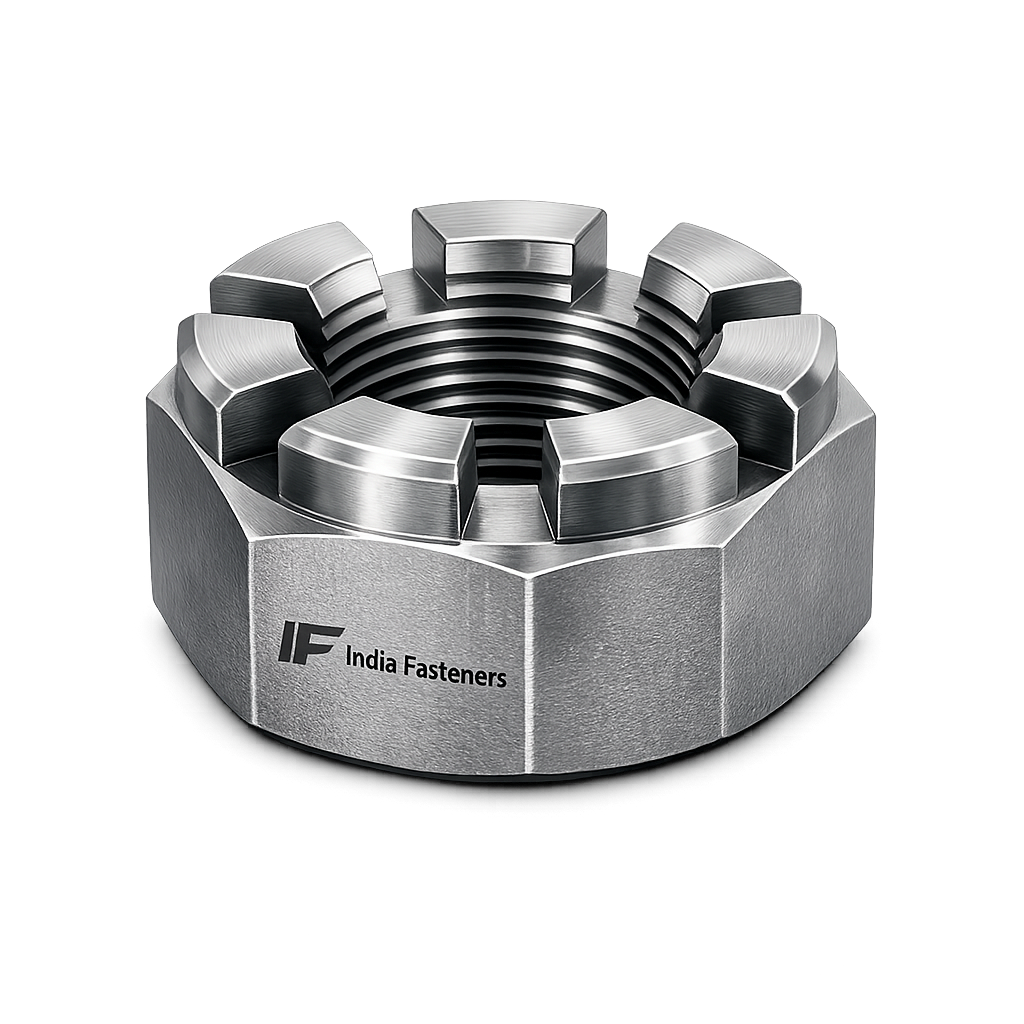
Castle nut
1. Regional Industry Context — Middle East Operating Conditions
Mechanical fastening systems used across the Gulf Cooperation Council (GCC) region operate under some of the most demanding service environments encountered in industrial engineering. Fasteners installed in Saudi Arabia, UAE, Qatar, Kuwait, Oman, and Bahrain must maintain structural integrity despite simultaneous exposure to vibration, thermal cycling, corrosion, sand intrusion, and continuous operational loading.
Within these conditions, positive mechanical locking becomes mandatory rather than optional.
1.2 Offshore Platforms — UAE & Qatar Offshore Installations
Offshore environments introduce additional challenges:
- Salt-laden atmosphere
- Continuous humidity exposure
- Splash zone corrosion
- Wind-induced structural vibration
Applications include:
- Deck equipment hinges
- Crane slewing systems
- Mooring winch assemblies
- Safety-critical structural joints
Mechanical locking ensures the fastening system remains secure even if corrosion reduces frictional resistance between mating threads.
1.3 Refinery Rotating Equipment
Refinery environments include:
- Compressors
- Pumps
- Turbines
- Gearboxes
- Valve actuation systems
Rotating machinery generates persistent vibration frequencies capable of initiating self-loosening, a phenomenon well documented in mechanical engineering research.
Castle nuts are frequently specified where:
- Inspection visibility is required
- Mechanical lock confirmation must be visual
- Maintenance teams must verify retention without torque measurement
1.4 Pipeline Valve Assemblies
Pipeline valves in GCC transmission networks operate under:
- Pressure fluctuations
- Thermal expansion from desert temperature swings
- Operational vibration during flow regulation
Critical applications:
- Valve stem retention
- Actuator linkages
- Mechanical stops
- Safety interlocks
Loss of nut position in these assemblies can directly impact plant operability and safety classification.
1.5 Heavy Construction Equipment
Large-scale infrastructure development across Saudi Arabia and UAE involves:
- Earthmoving machinery
- Mobile cranes
- Mining equipment
- Transport trailers
Axle retention systems commonly utilize castle nuts because:
- Shock loads exceed static preload assumptions.
- Repeated movement causes progressive loosening in conventional nuts.
- Maintenance inspection must remain rapid and reliable.
1.6 Power Generation Turbines
Power plants introduce combined conditions:
- High temperature gradients
- Rotational vibration
- Continuous duty cycles
Applications include:
- Turbine casing hardware
- Bearing retention assemblies
- Coupling alignment components
Positive locking prevents loss of preload during thermal expansion cycles.
1.7 Desalination Pump Systems
Desalination facilities operate in aggressive saline environments with continuous vibration.
Common fastening requirements:
- Corrosion resistance
- Mechanical retention
- Long inspection intervals
Castle nuts allow reliable locking even when lubricants degrade or coatings age.
1.8 Transport & Heavy Vehicle Axle Systems
One of the most recognized uses of castle nuts remains axle retention systems:
- Wheel hubs
- Suspension pivots
- Steering linkages
These assemblies undergo alternating loading and require absolute prevention of nut rotation after adjustment.
Why Positive Locking Fasteners Are Mandatory in GCC Installations
Operational Drivers
- High vibration frequency environments
- Extreme daily temperature variation (5°C–60°C surface exposure)
- Sand ingress affecting friction coefficient
- Lubricant degradation under heat
- Long maintenance intervals in remote facilities
Friction-based fastening alone cannot guarantee preload retention over long service cycles.
Castle nuts introduce redundant mechanical locking, eliminating dependence on torque retention alone.
Failure Risks of Standard Nuts
Self-loosening occurs when:
- Transverse vibration exceeds frictional resistance.
- Micro-slip develops between mating threads.
- Clamp load gradually decreases.
Consequences include:
- Loss of axial retention
- Misalignment
- Fatigue cracking
- Equipment shutdown
- Safety incidents
Desert Thermal Expansion Effects
Steel components in desert installations undergo thermal expansion
![\[\Delta L = \alpha L \Delta T\]](https://indiafastners.com/wp-content/ql-cache/quicklatex.com-d6ac9b17f4b138ca89b2a133da13ca3f_l3.png "Rendered by QuickLaTeX.com")
Where:
 = thermal expansion coefficient
 = original length
 = temperature variation
Expansion cycles cause preload relaxation. Mechanical locking prevents rotation even when preload temporarily reduces.
Sand Ingress & Operational Wear
Airborne sand:
- Enters exposed threads
- Alters friction behavior
- Accelerates wear
Castle nut locking does not depend on consistent friction conditions.
High Vibration Gulf Machinery Environment
Typical vibration sources:
- Gas compressors
- Centrifugal pumps
- Turbine shafts
- Vehicle suspension systems
The mechanical retention system must withstand cyclic displacement without loss of engagement.
Mechanical Retention Independent of Friction
Castle nut systems ensure retention through:
- Physical obstruction (cotter pin)
- Rotational stop mechanism
- Positive locking verification
2. Technical Definition of Castle Nut
A castle nut is a slotted hexagonal fastening component incorporating evenly spaced vertical slots (“castellations”) at the top of the nut.
It functions as a:
- Positive retention fastening device
- Mechanical locking nut
- Rotation-preventing assembly component
Functional Principle
The nut is installed on a drilled bolt or shaft.
After tightening:
- Nut slots align with the transverse hole.
- A cotter pin or split pin is inserted.
- Pin legs are bent to prevent withdrawal.
Rotation becomes mechanically impossible without removing the pin.
Slot Geometry — Castellations
Castellations include:
- Uniform slot spacing
- Controlled slot depth
- Machined alignment tolerance
- Structural integrity preservation
Slots must maintain sufficient material thickness to transmit axial load without deformation.
Interaction with Cotter Pin
The cotter pin provides:
- Shear restraint
- Rotation limitation
- Visual locking confirmation
The pin is not intended to carry preload; it prevents rotation only.
Difference Between Castle Nut and Slotted Nut
| Feature | Castle Nut | Slotted Nut |
|---|---|---|
| Height | Higher profile | Standard height |
| Slots | Extended castellations | Shallow slots |
| Application | Axle & retention systems | General locking |
| Load capacity | Higher | Moderate |
Castle nuts are typically used where axial positioning adjustment is required before locking.
Mechanical Locking vs Prevailing Torque Systems
Mechanical Locking
- Independent of friction
- Reusable
- Inspection visible
Prevailing Torque (Nyloc, distorted thread)
- Friction dependent
- Limited temperature resistance
- Performance decreases after reuse
GCC EPC specifications frequently prefer mechanical locking for safety-critical joints.
Reusability Characteristics
Castle nuts may be reused provided:
- Threads remain within tolerance
- No plastic deformation exists
- Surface corrosion is controlled
- Slot integrity is maintained
Cotter pins are not reusable.
Load Transfer Through Threaded Engagement
Axial load transmission occurs through:
- Thread flank contact
- Bearing face compression
- Bolt preload generation
The cotter pin does not carry service load.
Applicable International Standards
Castle nuts are produced according to globally recognized standards:
- DIN 935
- ISO 7035 / ISO 7036
- ASTM A194
- ASME B18.2.2
- ISO Metric Thread Systems
These standards define:
- Dimensions
- Material properties
- Thread tolerances
- Mechanical performance
3. Mechanical Locking Theory & Load Security
3.1 Axial Clamp Force Generation
When torque is applied:
![\[F = \frac{T}{K \times d}\]](https://indiafastners.com/wp-content/ql-cache/quicklatex.com-ee7cb6f9853c72044f067e268479e9af_l3.png "Rendered by QuickLaTeX.com")
Where:
 = preload force
 = applied torque
 = friction factor
 = nominal diameter
Proper preload ensures joint integrity.
3.2 Thread Friction Mechanics
Torque input distributes approximately as:
- 50% thread friction
- 40% bearing friction
- 10% useful preload generation
Variations in lubrication significantly affect preload reliability.
3.3 Self-Loosening Mechanisms Under Vibration
According to vibration testing principles:
- Lateral displacement reduces friction.
- Contact surfaces experience slip.
- Rotation begins incrementally.
This phenomenon is commonly explained by Junker vibration theory.
3.4 Junker Vibration Theory Overview
The Junker test demonstrates that:
- Transverse vibration causes rapid preload loss.
- Even high torque values cannot prevent loosening indefinitely.
Mechanical locking systems eliminate this failure mode.
3.5 Loss of Preload Mechanisms
Common causes include:
- Embedment relaxation
- Thermal expansion mismatch
- Surface wear
- Corrosion
- Dynamic loading
Castle nuts ensure positional stability despite preload variation.
3.6 Shear Restraint via Cotter Pin
The cotter pin acts as a rotational stop, not a load-bearing member.
Design considerations:
- Shear resistance adequate for incidental torque.
- Proper diameter selection required.
- Pin must fully pass through hole and slot.
3.7 Torque–Tension Relationship
![\[T = K \cdot F \cdot d\]](https://indiafastners.com/wp-content/ql-cache/quicklatex.com-7f8c5951dc276db99d717f55cac15dc8_l3.png "Rendered by QuickLaTeX.com")
Engineering design must account for friction uncertainty. Mechanical locking provides redundancy.
3.8 Clamp Force Calculation Example
For a lubricated M24 assembly:
- Torque = 650 Nm
- K factor ≈ 0.18
![\[F = \frac{650}{0.18 \times 0.024}\]](https://indiafastners.com/wp-content/ql-cache/quicklatex.com-2db9240e7ecc3f963aec9be0e19731db_l3.png "Rendered by QuickLaTeX.com")
![\[F \approx 150 \; \text{kN}\]](https://indiafastners.com/wp-content/ql-cache/quicklatex.com-26aa4f30cfa55357521bdd9cc78e1130_l3.png "Rendered by QuickLaTeX.com")
Preload verification remains essential before installing cotter pin.
3.9 Safety Factor Philosophy in GCC EPC Design
GCC project standards typically apply:
- Conservative preload assumptions
- Independent locking requirement
- Visual inspection capability
- Maintenance-friendly verification
Mechanical locking nuts satisfy consultant expectations for:
Long-term reliability
Mechanical integrity
Redundancy
4. Applicable Materials — Mapped to GCC Service Conditions
Material selection for castle nuts used in GCC oil & gas, petrochemical, power, offshore, and infrastructure projects is driven by mechanical integrity requirements rather than commercial considerations. The fastening component must maintain:
- Thread strength under sustained preload
- Resistance to corrosion and hydrogen damage
- Stability under elevated temperature exposure
- Compatibility with pressure equipment bolting systems
Castle nuts are therefore specified based on service environment, bolt material compatibility, and project material control philosophy.
4.1 ASTM A194 Grade 2H — High Temperature Carbon Steel
ASTM A194 Grade 2H is among the most widely approved nut materials in Middle East EPC projects.
Characteristics
- Heat-treated carbon steel
- High strength at elevated temperature
- Compatible with ASTM A193 B7 bolting
- Stable mechanical properties under sustained stress
Typical GCC Applications
- Refinery pressure equipment
- Pipeline flanges
- Valve actuator assemblies
- Rotating equipment structural connections
Service Capability
- Temperature range: −29°C to +425°C
- Good creep resistance for refinery conditions
- Suitable for dry hydrocarbon environments
Engineering Consideration
Proper hardness control is essential to prevent galling and hydrogen-assisted cracking.
4.2 ASTM A194 Grade 7 — Alloy Steel High Strength Application
Grade 7 material provides improved strength and temperature capability compared to standard carbon steel grades.
Usage Conditions
- High-load mechanical retention systems
- Heavy equipment pivot points
- Power generation assemblies
Advantages
- Enhanced tensile strength
- Improved fatigue resistance
- Better performance under cyclic loading
4.3 ASTM A563 Structural Carbon Steel Grades
ASTM A563 grades are commonly used where structural integrity rather than pressure containment governs the application.
Typical Uses
- Infrastructure equipment
- Mining machinery
- Transport axle systems
- Structural retention assemblies
Limitations
- Not preferred for high-temperature refinery service
- Requires protective coating in coastal GCC environments
4.4 Carbon Steel (C45 / EN8 Equivalent)
Medium carbon steels remain common for mechanical retention applications.
Properties
- Good machinability
- Suitable hardness after heat treatment
- Economical for large diameter castle nuts
Typical Use
- Vehicle suspension assemblies
- Mechanical adjustment systems
- Equipment mounting applications
4.5 Stainless Steel — AISI 304
AISI 304 provides corrosion resistance in moderate environments.
Characteristics
- Austenitic stainless steel
- Good atmospheric corrosion resistance
- Non-magnetic in annealed condition
Typical Applications
- Desalination auxiliary equipment
- Instrument supports
- Non-chloride chemical exposure
Limitations
Not recommended for chloride-rich offshore splash zones due to risk of pitting corrosion.
4.6 Stainless Steel — AISI 316 / 316L
AISI 316 stainless steel represents a primary material choice in coastal GCC regions.
Advantages
- Molybdenum addition improves pitting resistance
- Suitable for marine atmospheres
- Good performance in desalination plants
Applications
- Offshore platforms
- Pump assemblies
- Seawater handling systems
- Chemical processing equipment
4.7 Duplex Stainless Steel
Duplex stainless steels combine:
- High mechanical strength
- Excellent corrosion resistance
- Resistance to chloride stress corrosion cracking
GCC Relevance
Extensively used in:
- Offshore oil & gas facilities
- Subsea structures
- High chloride environments
Engineering Benefit
Higher yield strength allows reduced section size while maintaining load capacity.
4.8 Alloy Steel Grades
Special alloy steels are selected when operating conditions include:
- Elevated temperature
- High mechanical stress
- Fatigue loading
Examples include chromium-molybdenum alloy systems compatible with pressure equipment bolting.
4.9 NACE Considerations (Sour Service)
GCC oil fields frequently contain hydrogen sulfide (H₂S), requiring compliance with sour service material control principles.
Engineering concerns include:
- Sulfide stress cracking (SSC)
- Hydrogen embrittlement
- Hardness limitations
Typical requirements:
- Hardness ≤ 22 HRC for sour environments
- Controlled heat treatment
- Material traceability documentation
Castle nuts supplied for sour service must align with project material approval procedures.
5. Material Comparison Table (Mandatory Engineering Reference)
| Material Grade | Yield Strength (MPa) | Tensile Strength (MPa) | Temperature Range | Corrosion Resistance | Typical GCC Application |
|---|---|---|---|---|---|
| ASTM A194 2H | ~620 | 860–1000 | −29°C to 425°C | Moderate | Refinery bolting systems |
| ASTM A194 7 | ~720 | 950–1100 | Up to 450°C | Moderate | High-load mechanical joints |
| ASTM A563 | ~450 | 620–800 | −20°C to 300°C | Low | Structural equipment |
| C45 / EN8 | ~350 | 600–750 | −20°C to 300°C | Low | Axle retention |
| SS304 | ~215 | 515 | −196°C to 400°C | Good | General corrosion service |
| SS316 | ~220 | 530 | −196°C to 450°C | Very Good | Offshore & desalination |
| Duplex SS | ~450 | 620–800 | −50°C to 300°C | Excellent | Offshore splash zones |
Values represent typical engineering ranges. Project specifications govern final selection.
6. Heat Treatment & Metallurgical Control
Mechanical locking fasteners must maintain consistent hardness and grain structure to ensure long-term load stability.
Heat treatment is therefore a controlled and documented process.
6.1 Normalizing
Applied to carbon and alloy steels.
Purpose:
- Refines grain structure
- Improves toughness
- Reduces internal stresses from forging
Result:
Uniform mechanical properties throughout nut body.
6.2 Quench & Temper Treatment
Essential for ASTM A194 high-strength grades.
Process:
- Austenitizing at elevated temperature
- Rapid quenching
- Controlled tempering
Benefits:
- High tensile strength
- Controlled hardness
- Improved fatigue resistance
6.3 Stress Relieving
Performed after machining or slotting operations.
Objective:
- Remove residual stresses
- Prevent distortion
- Maintain thread geometry accuracy
6.4 Solution Annealing for Stainless Steel
Required for austenitic and duplex grades.
Purpose:
- Dissolve carbides
- Restore corrosion resistance
- Maintain ductility
Rapid cooling prevents sensitization.
6.5 Hydrogen Embrittlement Prevention
Electroplating processes introduce hydrogen risk.
Preventive measures include:
- Post-plate baking
- Controlled coating thickness
- Avoiding excessive hardness levels
Hydrogen embrittlement control is frequently audited during EPC vendor approval.
6.6 Hardness Control Limits
Typical hardness ranges:
- Carbon steel: 24–35 HRC
- Alloy steel: 28–38 HRC
- Sour service applications: ≤22 HRC
Hardness verification ensures compatibility with mating bolts.
6.7 Grain Flow Considerations After Forging
Hot forging aligns material grain flow with load direction.
Advantages:
- Improved fatigue resistance
- Reduced crack initiation
- Higher impact strength
Machined-from-bar nuts do not provide equivalent grain continuity.
7. Manufacturing Process Flow — Documentation Level
Castle nuts intended for EPC projects must follow a traceable manufacturing sequence compliant with international quality systems.
7.1 Raw Material Traceability
Each batch begins with:
- Approved steel mill sourcing
- Heat number assignment
- Mill test certification review
Traceability remains maintained through entire production cycle.
7.2 Heat Number Verification
Incoming material verification includes:
- Chemical composition confirmation
- Mechanical property validation
- Documentation matching purchase specification
7.3 Positive Material Identification (PMI)
PMI testing verifies alloy composition.
Methods include:
- XRF analysis
- Optical emission spectroscopy
Required particularly for stainless and duplex grades.
7.4 Hot Forging Process
Forging stages:
- Billet heating
- Closed-die forming
- Hex head formation
- Controlled cooling
Forging improves internal structure compared to machining methods.
7.5 Hex Machining Operations
Precision machining ensures:
- Across flats tolerance
- Bearing surface flatness
- Parallel seating faces
Dimensional control directly affects load distribution.
7.6 Thread Cutting or Thread Rolling
Threads may be produced via:
Cut Threads
- Suitable for large diameters
- Flexible production
Rolled Threads
- Increased fatigue strength
- Improved surface finish
Thread tolerance typically follows ISO 6H or UNC/UNF equivalent standards.
7.7 Castle Slot Machining Precision
Slot formation is a critical stage unique to castle nuts.
Requirements:
- Equal angular spacing
- Controlled slot depth
- Sharp edge removal
- Structural integrity preservation
Improper slot geometry can reduce nut strength or prevent cotter pin alignment.
7.8 Deburring & Surface Finishing
All edges are finished to eliminate:
- Burr formation
- Stress concentration points
- Installation injury risk
7.9 Heat Treatment Execution
Heat treatment follows validated furnace cycles.
Controls include:
- Temperature recording
- Soak time verification
- Cooling rate monitoring
Records remain traceable for inspection authorities.
7.10 Coating or Plating Operations
Common finishes include:
- Black oxide
- Zinc plating
- Hot-dip galvanizing
- Phosphate coating
- Passivation for stainless grades
Coating selection depends on project corrosion classification.
7.11 Final Inspection
Inspection stages include:
- Dimensional verification
- Thread gauge testing
- Slot alignment inspection
- Hardness measurement
- Visual inspection
7.12 Permanent Marking & Traceability
Marking typically includes:
- Manufacturer identification
- Material grade
- Heat number reference
Traceability ensures linkage between installed component and certification documentation.
Dimensional Control & Slot Alignment Accuracy
Castle nut functionality depends on predictable alignment between:
- Nut slots
- Bolt cross-hole
- Required preload position
Engineering controls ensure:
- Slot count uniformity
- Controlled angular pitch
- Acceptable alignment tolerance after tightening
This enables proper locking without excessive preload loss.
8. Dimensional Reference Tables — Castle Nut Engineering Data
Dimensional conformity is critical for castle nuts used in EPC-controlled installations. Unlike standard hex nuts, dimensional accuracy directly affects mechanical locking functionality, cotter pin alignment, and installation reliability.
Dimensions must comply with recognized standards such as:
- DIN 935
- ISO 7035 / ISO 7036
- ASME B18.2.2
All dimensions below represent engineering reference values. Project specifications and approved drawings govern final acceptance.
8.1 Metric Castle Nut Dimensions (DIN 935 — Typical Reference)
| Thread Size | Across Flats (mm) | Nut Height (mm) | Slot Width (mm) | Slot Depth (mm) | No. of Slots | Cotter Pin Size |
|---|---|---|---|---|---|---|
| M10 | 17 | 12 | 3 | 4 | 6 | 2.5 mm |
| M12 | 19 | 14 | 3 | 5 | 6 | 3.2 mm |
| M16 | 24 | 18 | 4 | 6 | 6 | 4 mm |
| M20 | 30 | 22 | 5 | 7 | 6 | 5 mm |
| M24 | 36 | 28 | 6 | 8 | 6 | 6 mm |
| M30 | 46 | 34 | 7 | 10 | 6 | 8 mm |
| M36 | 55 | 41 | 8 | 12 | 6 | 10 mm |
| M42 | 65 | 48 | 10 | 14 | 6 | 12 mm |
| M48 | 75 | 55 | 12 | 16 | 6 | 14 mm |
8.2 Imperial Castle Nut Dimensions (ASME Reference)
| Thread Size | Across Flats (in) | Nut Height (in) | Slot Width (in) | Slot Depth (in) | No. of Slots | Cotter Pin Size |
|---|---|---|---|---|---|---|
| 1/2″ | 3/4 | 1/2 | 1/8 | 3/16 | 6 | 1/8 |
| 5/8″ | 15/16 | 5/8 | 5/32 | 1/4 | 6 | 5/32 |
| 3/4″ | 1-1/8 | 3/4 | 3/16 | 5/16 | 6 | 3/16 |
| 1″ | 1-1/2 | 1 | 1/4 | 3/8 | 6 | 1/4 |
| 1-1/4″ | 1-7/8 | 1-1/4 | 5/16 | 1/2 | 6 | 5/16 |
| 1-1/2″ | 2-1/4 | 1-1/2 | 3/8 | 5/8 | 6 | 3/8 |
Dimensional Control Considerations
Engineering inspections verify:
- Slot symmetry
- Slot pitch uniformity
- Parallel bearing surfaces
- Thread engagement length
- Minimum remaining wall thickness after slotting
Incorrect slot depth can reduce load capacity and is typically rejected during third-party inspection.
9. Mechanical Property Tables
Mechanical properties must match both the nut specification and the mating bolt grade. Improper strength matching may cause thread stripping or joint failure.
9.1 Mechanical Properties by Material Grade
| Material Grade | Proof Load (MPa) | Yield Strength (MPa) | Tensile Strength (MPa) | Hardness Range | Elongation (%) |
|---|---|---|---|---|---|
| ASTM A194 2H | 650 | 620 | 860–1000 | 24–35 HRC | ≥16 |
| ASTM A194 7 | 720 | 720 | 950–1100 | 28–38 HRC | ≥14 |
| ASTM A563 DH | 450 | 450 | 620–800 | 20–30 HRC | ≥18 |
| SS304 | 205 | 215 | 515 | HRB 70–90 | ≥40 |
| SS316 | 220 | 220 | 530 | HRB 70–95 | ≥40 |
| Duplex SS | 450 | 450 | 620–800 | 28–32 HRC | ≥25 |
Strength Matching Principle
EPC bolting philosophy requires:
![\[\text{Nut Strength} \ge \text{Bolt Strength}\]](https://indiafastners.com/wp-content/ql-cache/quicklatex.com-ea8b8c20f8519163fdb5a223cda81fe9_l3.png "Rendered by QuickLaTeX.com")
Example:
- ASTM A193 B7 bolt → ASTM A194 2H nut minimum requirement.
Under-strength nuts may fail by thread shear before bolt preload is achieved.
10. Torque & Preload Chart (Mandatory Engineering Reference)
Correct torque application establishes required clamp force before mechanical locking is installed.
Castle nuts must never be locked before achieving preload.
10.1 Typical Torque Values — ASTM A193 B7 Bolting Compatibility
| Bolt Size | Dry Torque (Nm) | Lubricated Torque (Nm) | Approx. Preload (kN) |
|---|---|---|---|
| M12 | 90 | 65 | 45 |
| M16 | 220 | 160 | 85 |
| M20 | 430 | 310 | 135 |
| M24 | 740 | 540 | 210 |
| M30 | 1450 | 1050 | 340 |
| M36 | 2500 | 1800 | 520 |
| M42 | 3900 | 2800 | 720 |
| M48 | 5800 | 4200 | 950 |
Values depend on lubrication condition and friction factor.
10.2 Lubricated vs Dry Tightening
Lubrication reduces friction coefficient:
- Dry assembly:
![\[</li> <!-- /wp:list-item --> <!-- wp:list-item --> <li>K \approx 0.22</li> <!-- /wp:list-item --> <!-- wp:list-item --> <li>\]](https://indiafastners.com/wp-content/ql-cache/quicklatex.com-ca1c59696ed430f8e10c6c8843e40729_l3.png "Rendered by QuickLaTeX.com")
- Lubricated assembly:
![\[</li> <!-- /wp:list-item --> <!-- wp:list-item --> <li>K \approx 0.16\text{--}0.18</li> <!-- /wp:list-item --> <!-- wp:list-item --> <li>\]](https://indiafastners.com/wp-content/ql-cache/quicklatex.com-bd4901014f5c16e7f2741abf62b40d01_l3.png "Rendered by QuickLaTeX.com")
Lower friction increases preload for the same torque input.
10.3 Preload Percentage Philosophy
Typical EPC tightening targets:
- 65–75% of bolt yield strength
- Prevents plastic deformation
- Maintains fatigue resistance
Mechanical locking serves as secondary retention, not preload generation.
10.4 Tightening Discipline in GCC Installations
Common practices:
- Calibrated torque wrench usage
- Hydraulic tensioning for large diameters
- Sequential tightening pattern
- Final inspection prior to cotter pin installation
11. Mechanical Locking Verification Guide (Mandatory)
Castle nut locking effectiveness depends on correct installation methodology.
11.1 Slot Alignment Requirement
After achieving specified torque:
- One slot must align with drilled bolt hole.
- Alignment obtained by tightening only.
Back-off is limited to controlled conditions.
11.2 Maximum Allowable Back-Off Angle
Engineering practice typically limits reverse rotation to: ≤30∘≤ 30^\circ≤30∘
Excessive back-off reduces preload and may violate EPC inspection acceptance.
Preferred method: tighten to next available slot.
11.3 Cotter Pin Installation Procedure
- Insert cotter pin fully through bolt hole.
- Ensure pin passes through slot without deformation.
- Bend legs in opposite directions.
- Trim excess length where required.
The cotter pin prevents rotational movement only.
11.4 Preload Retention Logic
System behavior:
- Preload maintains joint compression.
- Cotter pin prevents rotation if preload relaxes.
- Mechanical locking provides redundancy.
11.5 Inspection Acceptance Criteria
Inspectors verify:
- Correct slot engagement
- Proper cotter pin diameter
- Complete insertion
- Leg bending secure
- No thread damage
- Proper seating surface contact
11.6 Sample Engineering Verification Method
Field engineer checklist:
- Confirm torque record.
- Verify slot alignment.
- Confirm cotter pin specification.
- Check for free rotation prevention.
- Record installation in mechanical completion dossier.
12. Corrosion Resistance Comparison Table
Environmental durability is a primary consideration in Gulf installations.
| Material / Finish | Marine Atmosphere | Desert Climate | High Humidity | Chemical Exposure | Offshore Splash Zone |
|---|---|---|---|---|---|
| Carbon Steel | Poor | Moderate | Poor | Low | Not Recommended |
| Zinc Plated | Moderate | Good | Moderate | Limited | Not Preferred |
| Hot-Dip Galvanized | Good | Excellent | Good | Moderate | Limited |
| SS304 | Good | Excellent | Good | Moderate | Limited |
| SS316 | Very Good | Excellent | Very Good | Good | Suitable |
| Duplex Stainless | Excellent | Excellent | Excellent | Excellent | Preferred |
Environmental Selection Guidance
- Onshore desert facilities: Galvanized or coated carbon steel
- Coastal refineries: SS316 minimum
- Offshore installations: Duplex stainless preferred
- Chemical processing: Alloy or stainless grades required
13. Inspection & Quality Assurance
Castle nuts supplied for EPC projects must withstand consultant-level scrutiny throughout procurement and installation stages.
13.1 Positive Material Identification (PMI)
Verification ensures material matches approved specification.
Typical inspection scope:
- Random sampling
- Alloy verification
- Documentation cross-check
13.2 Thread Gauge Inspection
Inspection tools:
- GO / NO-GO gauges
- Thread pitch verification
- Major and minor diameter measurement
Ensures proper engagement with mating bolts.
13.3 Hardness Testing
Performed after heat treatment.
Methods:
- Rockwell hardness testing
- Brinell testing for large components
Hardness must remain within specification limits to prevent brittle failure.
13.4 Dimensional Inspection
Critical parameters checked:
- Across flats
- Nut height
- Slot depth
- Slot spacing
- Bearing face flatness
Dimensional deviation may prevent mechanical locking functionality.
13.5 Surface Finish Inspection
Inspection verifies:
- Absence of cracks
- No forging laps
- No sharp burrs
- Smooth thread profile
Surface defects can initiate fatigue failure.
13.6 Coating Thickness Measurement
Applicable for plated or galvanized nuts.
Methods include:
- Magnetic thickness gauges
- Coating adhesion testing
Uniform coating prevents localized corrosion.
13.7 Third-Party Inspection Readiness
Typical project inspection stages:
- Raw material review
- In-process audit
- Final dimensional inspection
- Witness testing
- Documentation approval
Inspection bodies are referenced generically and operate according to project requirements.
13.8 Certification Documentation
Standard documentation packages include:
- EN 10204 3.1 Material Certificate
- Heat treatment records
- Hardness reports
- Dimensional inspection reports
- Coating certification
- Traceability records
3.2 certification may be required when third-party witnessing applies.
Consultant Documentation Expectations in GCC Projects
Consultants typically evaluate suppliers based on:
- Manufacturing control discipline
- Material traceability
- Dimensional consistency
- Inspection transparency
- Mechanical engineering understanding
Castle nut supply is therefore treated as an engineered product rather than a commodity fastener.
14. Industries Served — Middle East Mechanical Application Perspective
Castle nuts remain a preferred fastening solution across GCC industries where adjustable axial positioning combined with positive mechanical locking is required. Their application extends beyond general fastening into assemblies classified as mechanically critical or safety-influencing.
Engineering acceptance across Middle East projects is driven by reliability under vibration, ease of inspection, and predictable long-term retention performance.
14.1 Upstream Oil & Gas Facilities
Upstream installations include drilling rigs, wellhead platforms, gathering stations, and early production facilities.
Typical castle nut applications:
- Pump linkage assemblies
- Drill rig rotating structures
- Blowout preventer support mechanisms
- Mechanical actuator connections
- Safety equipment hinge points
Operating Conditions:
- Continuous vibration
- Cyclic torque transmission
- Remote operating locations
- Limited maintenance access
Mechanical locking prevents gradual loosening caused by cyclic motion and equipment resonance.
14.2 Refineries
Refinery mechanical systems operate continuously under combined thermal and vibrational loading.
Common applications include:
- Valve actuation mechanisms
- Damper control systems
- Mechanical limit stops
- Maintenance locking assemblies
- Rotating equipment auxiliary structures
Refinery EPC specifications frequently require visual confirmation of locking, which castle nuts provide without specialized measurement equipment.
14.3 Petrochemical Complexes
Petrochemical plants introduce additional concerns:
- Chemical exposure
- Corrosion risks
- High reliability expectations
Castle nuts are used where:
- Adjustable positioning is necessary
- Repeated inspection cycles occur
- Locking devices must remain reusable
Examples:
- Conveyor systems
- Reactor auxiliary hardware
- Mechanical handling systems
14.4 Offshore Structures
Offshore environments in the Arabian Gulf impose severe corrosion and vibration challenges.
Typical uses:
- Crane pivot assemblies
- Deck equipment retainers
- Mooring equipment mechanisms
- Access ladder hinges
- Safety restraint systems
Offshore engineers prefer mechanical locking systems that remain effective even if corrosion reduces thread friction performance.
14.5 Power Generation Plants
Thermal, combined-cycle, and renewable power facilities utilize castle nuts in:
- Turbine auxiliary components
- Generator mounting systems
- Cooling tower mechanisms
- Mechanical drive linkages
Operating characteristics:
- Continuous vibration
- Thermal expansion cycles
- Long service intervals
Mechanical locking ensures retention during startup and shutdown temperature transitions.
14.6 Desalination Facilities
Desalination plants combine:
- Marine exposure
- High humidity
- Continuous pump vibration
Applications include:
- Pump shaft adjustment assemblies
- Mechanical arm linkages
- Gate control mechanisms
Stainless and duplex material castle nuts are commonly specified due to chloride exposure.
14.7 Heavy Transport & Industrial Equipment
Large transport and mining equipment across GCC infrastructure projects rely extensively on castle nuts.
Typical examples:
- Wheel hub retention
- Steering joints
- Suspension pivots
- Hydraulic linkage systems
Castle nuts allow accurate bearing preload adjustment followed by mechanical locking.
14.8 Mining & Infrastructure Projects
Infrastructure development across Saudi Arabia and UAE includes rail, mining, and heavy construction equipment.
Engineering requirements:
- Shock loading resistance
- Dust and sand tolerance
- Maintenance accessibility
Mechanical locking independent of lubrication reliability becomes essential.
15. Export & GCC Supply Capability
Supply to Middle East EPC projects requires structured export discipline extending beyond manufacturing.
India Fasteners supplies castle nuts as traceable engineered components, aligned with project documentation workflows.
15.1 GCC Supply Regions
Export supply capability covers:
- Saudi Arabia
- United Arab Emirates (Dubai / Abu Dhabi)
- Qatar
- Oman
- Kuwait
- Bahrain
Shipment planning considers regional climate, logistics handling, and project documentation requirements.
15.2 Export Packaging Standards
Packaging objectives:
- Prevent corrosion during marine transport
- Maintain traceability
- Avoid dimensional damage
Typical packaging methods:
- VCI corrosion protection wrapping
- Sealed polyethylene liners
- Moisture-controlled packaging
- Heat-number segregation
- Palletized export crates
Heavy sizes are packed to prevent thread damage during container movement.
15.3 Humidity Protection for Gulf Logistics
Marine shipping exposes fasteners to:
- Condensation cycles
- Salt atmosphere
- Temperature variation
Protection methods include:
- Desiccant installation
- Vacuum sealing where required
- Oil preservation coatings
- Stainless passivation control
15.4 Project Documentation Packs
Typical EPC supply packages include:
- Mill Test Certificates
- Heat treatment reports
- Mechanical property records
- Dimensional inspection reports
- Coating certification
- PMI verification reports
- Packing lists linked to heat numbers
Documentation structure supports consultant review and material receiving inspection.
15.5 Inspection Release Documentation
Before shipment, inspection release notes confirm:
- Compliance with purchase specification
- Completion of inspection stages
- Approval for dispatch
Documentation aligns with EPC material control procedures.
15.6 Material Traceability Records
Traceability chain maintained from:
Raw Material → Forging Batch → Heat Treatment → Inspection → Packing → Shipment
Each supplied castle nut remains traceable to originating steel heat.
15.7 Container Loading Discipline
Export loading considers:
- Weight distribution
- Mechanical damage prevention
- Marking visibility
- Segregation by size and material grade
Loading records support receiving inspection at project site.
16. Procurement & Installation Engineering View
Procurement teams evaluate castle nuts not only by dimensional compliance but by installation reliability and lifecycle performance.
16.1 Installation Practices
Proper installation sequence:
- Inspect bolt threads.
- Apply approved lubricant if specified.
- Tighten to calculated torque.
- Verify preload condition.
- Align slot with bolt hole.
- Install cotter pin.
Mechanical locking must never substitute for correct tightening.
16.2 Torque Tightening Sequence
For critical assemblies:
- Incremental tightening
- Cross-pattern tightening where applicable
- Final torque verification
Hydraulic tensioning may be used for large-diameter bolting.
16.3 Slot Alignment Practice
Preferred engineering approach:
- Tighten to next slot alignment.
- Avoid significant back-off.
- Maintain preload integrity.
If alignment cannot be achieved:
- Washer adjustment or alternative nut height may be evaluated.
16.4 Cotter Pin Installation Procedure
Field installation requirements:
- Correct pin diameter
- Full insertion
- Legs bent securely
- No sharp projection hazards
Cotter pins must match corrosion class of nut material.
16.5 Inspection Checklist
Site inspectors verify:
- Proper torque application record
- Slot engagement confirmation
- Cotter pin presence
- No thread exposure beyond acceptable limits
- Seating surface contact
Inspection results become part of mechanical completion dossiers.
16.6 Maintenance & Replacement Guidance
During maintenance shutdown:
- Cotter pins must be replaced after removal.
- Threads inspected for wear or corrosion.
- Slot integrity checked.
- Reuse permitted only when dimensional tolerance remains compliant.
16.7 Field Verification Methods
Typical verification practices:
- Visual locking confirmation
- Physical rotation check
- Periodic inspection during preventive maintenance
Mechanical locking simplifies inspection compared to torque-retention systems.
16.8 Storage Practices — Gulf Climate
Recommended storage conditions:
- Covered storage areas
- Protection from sand contamination
- Controlled humidity exposure
- Original packaging retention until installation
Improper storage may affect coating performance and installation quality.
17. Custom Engineering Capabilities
EPC projects frequently require deviations from catalogue standards. Castle nuts are therefore manufactured with engineered customization capability.
India Fasteners supports project-driven requirements through controlled manufacturing processes.
17.1 Non-Standard Thread Sizes
Capabilities include:
- Special metric pitches
- UNC / UNF / BSW threads
- Large-diameter custom shafts
- Project-specific tolerances
Custom threading allows compatibility with legacy equipment.
17.2 Heavy Hex Configurations
Heavy hex castle nuts may be required for:
- High-load applications
- Structural retention systems
- Offshore mechanical equipment
Increased bearing surface improves load distribution.
17.3 Special Surface Coatings
Available engineered coatings include:
- Hot-dip galvanizing
- Zinc flake systems
- Phosphate coating
- PTFE-based anti-galling coatings
- Offshore corrosion protection systems
Coating selection aligns with project corrosion classification.
17.4 NACE-Compliant Material Supply
For sour service environments:
- Controlled hardness manufacturing
- Material certification verification
- Traceable heat treatment processes
Supplied materials meet project-defined sour service requirements.
17.5 Project-Specific Marking
Marking options include:
- Manufacturer identification
- Material grade
- Project coding
- Heat number reference
Marking supports long-term asset traceability.
17.6 High-Temperature Alloy Supply
Where required, castle nuts may be produced using:
- Chromium-molybdenum alloys
- Heat-resistant steels
- Elevated temperature bolting materials
Used in refinery heaters and power generation equipment.
17.7 Duplex & Offshore-Grade Fasteners
Manufacturing capability supports:
- Duplex stainless steel
- Super duplex grades
- Offshore-certified corrosion-resistant alloys
These materials support extended service life in Gulf offshore conditions.
17.8 Special Slot Geometry Customization
Projects may specify:
- Increased slot count
- Modified slot depth
- Custom cotter pin compatibility
- Enhanced inspection visibility
Slot geometry remains engineered to preserve mechanical strength while meeting locking requirements.
Technical Conclusion
Castle nuts serve as a mechanically positive retention solution where vibration, thermal expansion, or operational dynamics make friction-based fastening insufficient.
Within GCC oil & gas, petrochemical, offshore, desalination, power, and heavy infrastructure projects, their acceptance is based on:
- Predictable mechanical locking behavior
- Compatibility with international fastening standards
- Traceable manufacturing discipline
- Inspection transparency
- Long-term preload security
India Fasteners manufactures castle nuts as engineered fastening components aligned with EPC procurement expectations, consultant inspection requirements, and Middle East operating environments.