
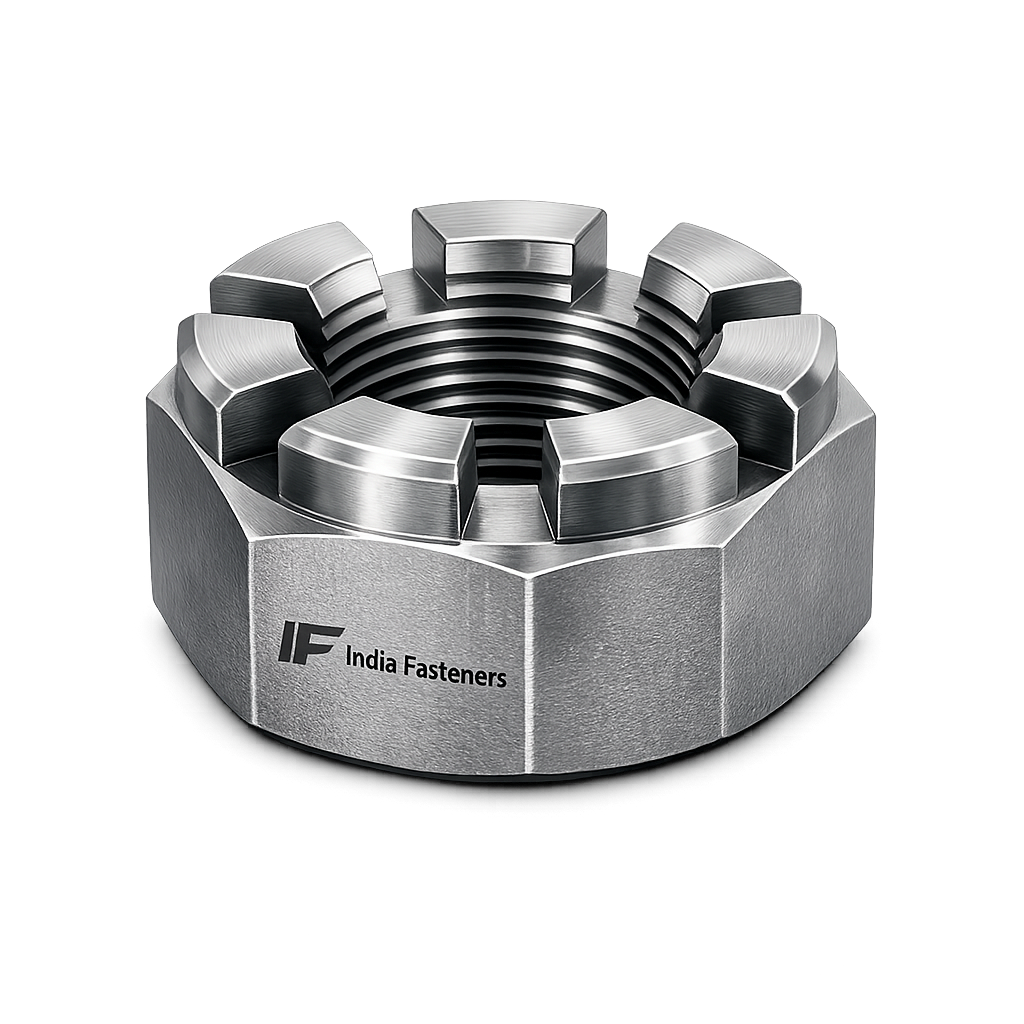
Slotted Nut
1. Regional Industry Context — Middle East Mechanical Reliability Requirements
Industrial fastening in Gulf Cooperation Council (GCC) facilities operates under operating environments fundamentally different from temperate industrial regions. Mechanical retention systems installed in Saudi Arabia, UAE, Qatar, Oman, Kuwait, and Bahrain must address simultaneous exposure to vibration, thermal fluctuation, marine atmosphere, abrasive contamination, and extended maintenance intervals.
Slotted nuts are therefore not considered general-purpose fasteners; they are specified primarily where mechanical locking redundancy is required independent of frictional preload.
1.1 Oil & Gas Rotating Equipment
Rotating assemblies in upstream and downstream facilities include:
- Centrifugal pumps
- Process compressors
- Turbine auxiliaries
- Gearboxes
- Agitators
- Pipeline pigging equipment
These assemblies generate:
- Transverse vibration
- Cyclic torque reversal
- Shaft oscillation
- Micro-slip at thread interfaces
Under such conditions, preload loss may occur even when initial torque values meet calculation requirements.
Slotted nuts combined with cotter pins provide positive rotation prevention, ensuring retention even after partial clamp force reduction.
1.2 Pipeline Valve Assemblies
Pipeline valves across GCC hydrocarbon networks operate under:
- Pressure cycling
- Thermal expansion
- Emergency actuation loads
- Flow-induced vibration
Critical components secured using slotted nuts include:
- Valve stem locking systems
- Lever arm connections
- Actuator linkage assemblies
- Trunnion mount supports
Mechanical locking ensures valve integrity during shutdown intervals exceeding several years.
1.3 Pump and Compressor Shaft Locking
Shaft-end retention represents one of the most critical applications of slotted nuts.
Typical risks include:
- Rotational inertia loosening
- Reverse rotation during shutdown
- Bearing preload loss
- Impeller displacement
A cotter pin engaged through a slotted nut creates a physical stop against rotational displacement, independent of lubrication conditions or vibration amplitude.
1.4 Offshore Platform Mechanical Joints
Offshore GCC platforms introduce additional constraints:
- Continuous vibration from drilling operations
- Salt spray exposure
- Galvanic corrosion risks
- Maintenance access limitations
Thread friction coefficients become unstable due to corrosion products and lubrication washout. Positive locking methods remain mandatory even when high preload bolts are used.
1.5 Refinery Mechanical Assemblies
Refineries impose combined thermal and chemical stress environments:
- Elevated temperatures
- Hydrocarbon vapor exposure
- Continuous operational cycling
Slotted nuts are frequently specified for:
- Burner assemblies
- Heat exchanger supports
- Mechanical linkages
- Control mechanisms
Design philosophy prioritizes fail-safe retention rather than reliance on torque integrity alone.
1.6 LNG Terminal Equipment
Cryogenic LNG facilities experience:
- Extreme temperature gradients
- Material contraction and expansion
- Cyclic stress fatigue
Differential expansion between bolt and flange materials can reduce clamp force. Mechanical locking prevents loosening despite dimensional changes.
1.7 Desalination Plant Machinery
Desalination facilities across the Gulf operate in:
- High salinity environments
- Continuous duty cycles
- High humidity conditions
Slotted nuts resist loosening in pumps, drives, and structural anchor assemblies exposed to aggressive corrosion environments.
1.8 Power Generation Turbine Auxiliaries
Gas and steam turbine support systems require retention devices capable of surviving:
- High-frequency vibration
- Thermal cycling
- Long maintenance intervals
Positive locking systems reduce risk of secondary equipment failure caused by fastener rotation.
1.9 Desert Environmental Challenges Affecting Fasteners
GCC facilities face environmental factors rarely combined elsewhere:
Thermal Expansion
Surface temperatures exceeding 60°C create cyclic expansion between mating components.
Sand Ingress
Fine silica dust enters exposed threads, modifying friction coefficients unpredictably.
Marine Corrosion
Coastal plants encounter chloride-driven corrosion accelerating preload degradation.
Maintenance Intervals
Shutdown cycles may exceed 36–60 months, requiring retention systems that remain effective without re-torque.
1.10 Why Mechanical Locking Remains Mandatory
Even when preload calculations satisfy design requirements, EPC standards often mandate mechanical locking due to:
- Risk of vibrational self-loosening
- Human installation variability
- Lubrication inconsistencies
- Thermal relaxation
- Material creep
- Corrosion-induced friction loss
Slotted nuts represent a secondary independent safety mechanism, ensuring retention after frictional locking effectiveness declines.
2. Technical Definition of Slotted Nut
A Slotted Nut is defined as:
An axially slotted hexagonal nut designed to accept a cotter pin through aligned slots and a drilled bolt or stud, providing positive mechanical locking against rotation.
It functions as:
- A secondary locking device
- A rotation-prevention component
- A fail-safe retention mechanism
The locking function does not depend on friction or torque alone.
2.1 Governing Standards
Common international specifications include:
- DIN 935 — Hexagon slotted nuts
- ISO 7035 / ISO 7036 — Metric slotted nuts
- ASTM A194 — Carbon and alloy steel nuts for pressure service
- ASME B18.2.2 — Dimensional requirements
- ISO Metric Thread Standards
These standards ensure compatibility across global EPC supply chains.
2.2 Slotted Nut vs Castellated Nut
Although often confused, technical differences exist.
| Feature | Slotted Nut | Castellated Nut |
|---|---|---|
| Slot Geometry | Straight axial slots | Raised castellations |
| Typical Use | Mechanical equipment | Automotive / bearing retention |
| Slot Depth | Controlled for pin engagement | Higher crown design |
| Industrial EPC Use | Common | Limited |
Both permit cotter pin locking; however, slotted nuts are frequently preferred in industrial assemblies requiring controlled height and predictable engagement.
2.3 Cotter Pin Engagement Principle
Locking occurs through:
- Nut tightened to required torque.
- Slots aligned with drilled bolt hole.
- Cotter pin inserted through hole.
- Pin legs bent to prevent withdrawal.
The cotter pin physically blocks nut rotation.
2.4 Mechanical Redundancy Concept
GCC design philosophy applies layered safety:
Primary Retention → Bolt preload
Secondary Retention → Slotted nut
Tertiary Protection → Cotter pin mechanical stop
Failure of one mechanism does not result in joint separation.
2.5 Alignment Requirement
Correct installation requires:
- Pre-drilled bolt or stud
- Proper slot positioning
- Controlled tightening to nearest slot alignment without over-torque
Engineering practice prohibits excessive torque applied solely to achieve slot alignment.
2.6 Suitability for Critical Applications
Slotted nuts are selected where:
- Rotation must be prevented absolutely
- Inspection visibility is required
- Maintenance confirmation must be visual
- Safety classification is high
Common sectors include:
- Rotating machinery
- Pressure equipment
- Safety-critical assemblies
- Offshore installations
3. Locking Mechanics & Load Retention Theory
3.1 Bolt Preload vs Rotational Loosening
Fastened joints depend on preload tension.
Bolt preload equation
![\[F = \frac{T}{K \times D}\]](https://indiafastners.com/wp-content/ql-cache/quicklatex.com-1d526bf32831a128706e0d44343eae7e_l3.png "Rendered by QuickLaTeX.com")
Where:
- F = Bolt preload force
- T = Applied torque
- K = Nut factor (friction coefficient)
- D = Nominal bolt diameter
Preload generates clamping force preventing separation.
However, preload alone does not guarantee resistance to rotational loosening.
3.2 Self-Loosening Under Transverse Vibration
Dynamic shear forces cause:
- Micro-slip between joint faces
- Reduction in friction resistance
- Progressive rotation of nut
This mechanism is widely demonstrated through the Junker vibration principle, which shows rapid preload loss under transverse vibration even at high initial torque.
3.3 Clamp Force Loss Mechanisms
Typical causes observed in GCC facilities:
- Thermal relaxation
- Embedment settling
- Surface corrosion
- Lubricant degradation
- Material creep at temperature
Loss of clamp load permits rotation initiation.
3.4 Frictional Locking vs Positive Locking
Frictional Locking
- Depends on torque accuracy
- Sensitive to lubrication
- Affected by environment
Positive Locking
- Independent of friction
- Physical rotation barrier
- Maintains retention after preload reduction
Slotted nuts operate under the positive locking principle.
3.5 Cotter Pin as Rotation Limiter
The cotter pin acts as:
- A shear-resistant obstruction
- A rotation stop
- A visible inspection indicator
Even complete preload loss will not allow nut disengagement without pin failure.
3.6 Torque–Tension Relationship
Torque application creates tension according to:
![\[T = K F D\]](https://indiafastners.com/wp-content/ql-cache/quicklatex.com-8f5db7c0c61fdf06aacf36a07ebeb590_l3.png "Rendered by QuickLaTeX.com")
Variations in friction coefficient significantly alter preload.
Typical torque scatter may exceed ±25%.
Mechanical locking compensates for installation variability.
3.7 Thread Friction Influence
Friction arises from:
- Thread surface finish
- Coating type
- Lubrication condition
- Environmental contamination
Desert dust contamination frequently alters friction unpredictably, reinforcing the need for mechanical locking.
3.8 Safety Factor Philosophy in GCC Petrochemical Design
GCC EPC specifications emphasize:
- Redundancy
- Visual inspection capability
- Long-term reliability
- Failure containment
Slot
ted nuts align with these principles by providing independent retention assurance beyond theoretical preload calculations.
4. Applicable Materials for Slotted Nuts in GCC Service Conditions
Material selection for slotted nuts used in GCC oil & gas, petrochemical, offshore, and power generation facilities is governed primarily by service environment, mechanical loading, temperature exposure, and corrosion risk rather than cost considerations.
Mechanical locking components must maintain:
- Thread integrity
- Slot geometry stability
- Hardness compatibility with mating bolts
- Resistance to corrosion-assisted cracking
- Long-term dimensional reliability
Slotted nuts supplied for EPC projects are therefore manufactured under controlled material specifications aligned with international pressure equipment standards.
4.1 Carbon Steel — ASTM A194 Grade 2H
ASTM A194 Grade 2H remains one of the most widely specified materials for slotted nuts in hydrocarbon service.
Characteristics
- Quenched and tempered carbon steel
- High proof load capacity
- Stable mechanical performance under moderate temperature
- Compatible with ASTM A193 B7 bolting systems
Typical GCC Applications
- Pipeline flange assemblies
- Structural anchoring systems
- Pump and valve assemblies
- Onshore refinery mechanical equipment
Operating Temperature Range
- −29°C to approximately 425°C
Engineering Considerations
- Requires corrosion protection coating
- Not suitable for marine exposure without plating or galvanizing
- Hardness must be controlled for sour service compliance
4.2 Alloy Steel — ASTM A194 Grades 7 and 7M
Alloy steel slotted nuts are selected where higher temperature resistance or improved toughness is required.
Grade 7
- High-temperature pressure equipment
- Steam service
- Turbine auxiliary equipment
Grade 7M
- Reduced hardness variant
- Designed for sour gas environments
- Improved resistance to sulfide stress cracking
Typical GCC Applications
- Gas processing facilities
- High-pressure compressor assemblies
- Steam generation units
- Process heaters
Operating Temperature Range
- Up to 540°C depending on bolt pairing
4.3 Stainless Steel — AISI 304
Austenitic stainless steel slotted nuts provide corrosion resistance in atmospheric and chemical environments.
Properties
- Excellent oxidation resistance
- Non-magnetic condition
- Good fabrication characteristics
Typical Use
- Instrumentation assemblies
- Desalination equipment
- Non-critical offshore structures
Limitations
- Lower strength compared with alloy steel
- Susceptible to chloride stress corrosion cracking in marine GCC environments
4.4 Stainless Steel — AISI 316 / 316L
316 stainless steel is widely used in coastal and offshore Gulf installations due to molybdenum-enhanced corrosion resistance.
Advantages
- Improved chloride resistance
- Suitable for marine atmospheres
- Stable performance in humid desert climates
Typical GCC Applications
- Offshore platforms
- Desalination plants
- LNG terminal mechanical assemblies
- Chemical handling systems
4.5 Duplex Stainless Steel
Duplex stainless steels combine ferritic and austenitic microstructures.
Engineering Benefits
- Higher yield strength than austenitic grades
- Superior resistance to pitting corrosion
- Excellent resistance to stress corrosion cracking
Common Applications
- Offshore process equipment
- Seawater systems
- High-pressure piping supports
- Subsea mechanical assemblies
4.6 Super Duplex Stainless Steel
Super duplex grades are selected for severe marine or aggressive chemical exposure.
Characteristics
- Very high mechanical strength
- Exceptional corrosion resistance
- Long-term durability under chloride exposure
Typical Use
- Offshore production platforms
- Seawater injection systems
- LNG loading infrastructure
4.7 High-Temperature Alloy Grades
Certain refinery and power generation applications require elevated temperature capability.
Examples include:
- Chromium-molybdenum alloys
- Nickel-based alloys for extreme service
Used in:
- Turbine auxiliary equipment
- Furnace assemblies
- High-temperature pressure vessels
4.8 Material Selection Considerations for GCC Projects
Material specification depends on:
- Operating temperature
- Corrosion environment
- Pressure class
- Inspection authority requirements
- NACE sour service classification
- Bolt compatibility
Incorrect material pairing may cause:
- Galling
- Differential corrosion
- Hardness mismatch
- Premature thread failure
4.9 Applicable Standards Mapping
Slotted nuts supplied for EPC projects typically comply with:
- ASTM A194 — Pressure service nuts
- ISO 898 — Mechanical properties of fasteners
- DIN 267 — Technical delivery conditions
- ASME B1.1 — Unified thread system
- ASME B1.13M — Metric thread system
These standards ensure global interchangeability across EPC contractors.
5. Material Comparison Table — GCC Application Mapping (MANDATORY)
| Material Grade | Yield Strength (MPa) | Tensile Strength (MPa) | Temperature Range | Corrosion Resistance | Typical GCC Application |
|---|---|---|---|---|---|
| ASTM A194 2H | ~660 | 850–1000 | −29°C to 425°C | Moderate | Refinery piping, valves |
| ASTM A194 7 | ~720 | 950–1100 | Up to 540°C | Moderate | Steam systems |
| ASTM A194 7M | ~620 | 860–1000 | High temp sour service | Moderate–High | Gas processing |
| Stainless Steel 304 | ~215 | ~505 | −196°C to 870°C | Good | Desalination equipment |
| Stainless Steel 316 | ~205 | ~515 | −196°C to 870°C | Very Good | Offshore structures |
| Duplex SS | ~450 | ~700 | −50°C to 300°C | Excellent | Seawater systems |
| Super Duplex | ~550 | ~800 | −50°C to 300°C | Exceptional | Offshore platforms |
Values represent typical ranges; project specifications govern final acceptance.
6. Heat Treatment & Metallurgical Control
Mechanical locking integrity depends not only on geometry but also on metallurgical stability.
Improper heat treatment may cause:
- Brittle fracture
- Slot cracking
- Thread deformation
- Hydrogen embrittlement
6.1 Quenching and Tempering
Applied primarily to alloy and carbon steel grades.
Purpose
- Increase strength
- Improve toughness
- Achieve required hardness range
Controlled cooling prevents internal stresses affecting slot durability.
6.2 Normalizing
Normalizing refines grain structure after forging or machining.
Benefits include:
- Uniform mechanical properties
- Improved machinability
- Reduced distortion during slot milling
6.3 Solution Annealing (Stainless Steels)
Required for stainless and duplex materials.
6.7 Hardness Limits for Sour Service
GCC oil & gas projects frequently impose NACE-related hardness limits to prevent sulfide stress cracking.
Typical requirements:
- Maximum hardness restrictions
- Verified heat treatment certification
- Batch traceability
Failure to control hardness may lead to catastrophic brittle failure.
7. Manufacturing Process Flow — EPC Documentation Level
Manufacturing slotted nuts for GCC projects requires disciplined process control ensuring dimensional accuracy and traceability.
7.1 Raw Material Verification
Incoming materials undergo:
- Mill certificate review
- Heat number identification
- Chemical composition verification
- Mechanical property confirmation
Traceability begins at material receipt.
7.2 Heat Number Traceability
Each production batch maintains linkage between:
- Raw material heat
- Manufacturing lot
- Inspection records
- Final shipment documentation
Traceability is essential for EPC audit acceptance.
7.3 Forging or Bar Machining
Two primary manufacturing routes:
Hot Forging
- Improved grain flow
- Higher fatigue resistance
- Preferred for heavy-duty applications
Precision Machining
- Used for specialty alloys
- Tight dimensional control
7.4 Hex Profile Machining
Across-flat dimensions must comply with:
- ASME dimensional tolerances
- Wrench engagement standards
- Load distribution requirements
Poor hex geometry may cause installation damage.
7.5 Thread Cutting or Rolling
Threads must achieve:
- Concentric alignment
- Correct pitch diameter
- Surface finish compatibility
Thread tolerance directly influences preload consistency.
7.6 Slot Milling Operation
Slot creation represents the defining manufacturing stage.
Critical controls include:
- Slot width tolerance
- Slot depth uniformity
- Alignment with thread axis
- Root radius control to avoid stress concentration
Improper slot geometry reduces mechanical locking reliability.
7.7 Deburring and Surface Finishing
After slot machining:
- Burr removal prevents cotter pin damage
- Edges rounded to avoid crack initiation
- Surface cleaned prior to coating
7.8 Heat Treatment Processing
Applied according to material grade requirements.
Controlled furnaces maintain:
- Uniform temperature distribution
- Time-at-temperature control
- Documented treatment cycles
7.9 Surface Coating or Plating
Common finishes include:
- Black oxide
- Zinc plating
- Hot dip galvanizing
- Mechanical galvanizing
- Passivation (stainless steel)
Coating selection must consider torque coefficient effects.
7.10 Final Dimensional Inspection
Inspection verifies:
- Thread dimensions
- Nut height
- Across flats
- Slot alignment
- Slot depth
- Concentricity
Only inspected components proceed to marking.
7.11 Marking and Traceability
Marking may include:
- Manufacturer identification
- Material grade
- Heat number reference
- Standard designation
Marking ensures inspection traceability throughout project lifecycle.
7.12 Engineering Importance of Slot Geometry Control
The slot functions as the mechanical locking interface.
Critical engineering requirements:
- Proper cotter pin seating
- Adequate shear engagement
- Prevention of slot deformation under load
- Uniform alignment capability
Tolerance deviations may prevent correct installation despite acceptable thread dimensions.
7.13 Fit Between Nut, Bolt, and Cotter Pin
Successful locking depends on compatibility between three components:
- Slotted nut
- Drilled bolt or stud
- Cotter pin
Manufacturing precision ensures:
- Alignment without excessive tightening
- Reliable mechanical locking
- Repeatable field installation
8. Dimensional Reference Tables — Slotted Nut Engineering Data
Dimensional accuracy of slotted nuts directly influences:
- Proper cotter pin engagement
- Torque transmission capability
- Load distribution across threads
- Assembly reliability under EPC inspection
Dimensions follow internationally harmonized standards derived from DIN, ISO, and ASME fastening systems to maintain interchangeability across global EPC procurement.
8.1 Critical Dimensional Parameters
A slotted nut is defined by the following engineering dimensions:
- Thread Size (d) — Nominal internal thread
- Across Flats (s) — Wrench engagement dimension
- Nut Height (m) — Load-bearing height
- Slot Width (w) — Cotter pin clearance
- Slot Depth (t) — Engagement depth into nut crown
- Number of Slots (n) — Alignment flexibility
- Cotter Pin Diameter Compatibility
Dimensional tolerance control is essential to prevent excessive tightening required for slot alignment.
8.2 Metric Slotted Nut Dimensions (Reference — DIN 935 / ISO 7035)
| Thread Size | Across Flats (mm) | Nut Height (mm) | Slot Width (mm) | Slot Depth (mm) | Slots | Cotter Pin Size |
|—|—|—|—|—|—|
| M6 | 10 | 5 | 1.6 | 2 | 6 | 1.6 mm |
| M8 | 13 | 6.5 | 2 | 2.5 | 6 | 2 mm |
| M10 | 17 | 8 | 2.5 | 3 | 6 | 2.5 mm |
| M12 | 19 | 10 | 3 | 4 | 6 | 3.2 mm |
| M16 | 24 | 13 | 4 | 5 | 6 | 4 mm |
| M20 | 30 | 16 | 5 | 6 | 6 | 5 mm |
| M24 | 36 | 19 | 6 | 7 | 6 | 6 mm |
| M30 | 46 | 24 | 8 | 9 | 6 | 8 mm |
| M36 | 55 | 29 | 10 | 11 | 6 | 10 mm |
Values shown represent engineering reference data; project specifications govern acceptance.
8.3 Imperial Slotted Nut Dimensions (ASME Reference)
| Bolt Size | Across Flats (in) | Nut Height (in) | Slot Width (in) | Slot Depth (in) | Slots | Cotter Pin |
|---|---|---|---|---|---|---|
| 1/4″ | 7/16 | 1/4 | 1/16 | 3/32 | 6 | 1/16″ |
| 3/8″ | 9/16 | 5/16 | 3/32 | 1/8 | 6 | 3/32″ |
| 1/2″ | 3/4 | 7/16 | 1/8 | 5/32 | 6 | 1/8″ |
| 5/8″ | 15/16 | 17/32 | 5/32 | 3/16 | 6 | 5/32″ |
| 3/4″ | 1-1/8 | 21/32 | 3/16 | 7/32 | 6 | 3/16″ |
| 1″ | 1-1/2 | 7/8 | 1/4 | 9/32 | 6 | 1/4″ |
| 1-1/4″ | 1-7/8 | 1 | 5/16 | 3/8 | 6 | 5/16″ |
8.4 Engineering Importance of Slot Quantity
Six-slot configurations are standard because they:
- Reduce required rotation for alignment
- Prevent over-torqueing
- Improve installation flexibility
- Maintain preload accuracy
9. Torque & Preload Chart (MANDATORY)
Correct torque application ensures required clamp load prior to installation of the cotter pin locking device.
9.1 Torque–Preload Relationship
Torque does not directly measure preload.
Only approximately:
- 10–15% of torque creates tension
- Remaining torque overcomes friction
Environmental variations in GCC facilities significantly influence preload outcomes.
9.2 Recommended Torque Values — Metric Bolting
(Typical values for carbon/alloy steel bolting)
| Bolt Size | Dry Torque (Nm) | Lubricated Torque (Nm) | Approx. Preload (%) |
|---|---|---|---|
| M8 | 25 | 18 | 75% |
| M10 | 49 | 35 | 75% |
| M12 | 85 | 60 | 75% |
| M16 | 210 | 150 | 75% |
| M20 | 410 | 290 | 75% |
| M24 | 710 | 500 | 75% |
| M30 | 1420 | 1000 | 75% |
| M36 | 2450 | 1730 | 75% |
9.3 Torque Scatter Considerations
Preload variation arises from:
- Lubrication inconsistency
- Surface roughness
- Coating thickness
- Operator technique
- Tool calibration
Variation commonly reaches ±25%.
Mechanical locking using slotted nuts compensates for torque uncertainty.
9.4 Alignment Rule for Slotted Nuts
Engineering practice requires:
- Tighten to specified torque first
- Continue tightening only to nearest slot alignment
- Never loosen nut to achieve alignment
Loosening reduces preload integrity.
10. Cotter Pin Selection & Locking Method Guide
The cotter pin is an integral part of the locking system rather than an accessory component.
10.1 Cotter Pin Diameter Selection
Pin diameter must:
- Match bolt hole diameter
- Fully occupy hole clearance
- Provide shear resistance without deformation
Undersized pins permit rotation; oversized pins prevent installation.
10.2 Material Compatibility
Common cotter pin materials:
- Carbon steel (zinc plated)
- Stainless steel 304
- Stainless steel 316
Material compatibility must prevent galvanic corrosion between nut, bolt, and pin.
10.3 Installation Procedure
- Tighten slotted nut to required torque.
- Align slot with drilled hole.
- Insert cotter pin completely.
- Bend longer leg over bolt end.
- Bend shorter leg along nut face.
Proper bending prevents vibration-induced withdrawal.
10.4 Accepted Bending Practices
Engineering best practice:
- One leg bent over bolt end
- One leg secured against nut flat
- Avoid repeated bending cycles
Excessive re-bending weakens the pin.
10.5 Inspection Acceptance Criteria
Inspection agencies typically verify:
- Full pin insertion
- Proper leg separation
- No cracks at bending points
- Correct pin diameter
- Visible locking confirmation
Visual verification is a primary advantage of slotted nut systems.
10.6 Failure Modes from Incorrect Installation
Incorrect installation may result in:
- Pin shear failure
- Partial engagement
- Nut rotation under vibration
- Premature joint loosening
Most failures originate from installation errors rather than component defects.
11. Mechanical Property Table
Mechanical properties ensure compatibility between nut and mating bolt.
| Property | ASTM A194 2H | ASTM A194 7 | SS316 | Duplex |
|---|---|---|---|---|
| Yield Strength (MPa) | ≥660 | ≥720 | ~205 | ~450 |
| Proof Load | High | Very High | Moderate | High |
| Hardness (HB) | 248–352 | Controlled | ≤200 | Controlled |
| Elongation (%) | ≥16 | ≥14 | ≥40 | ≥25 |
| Impact Resistance | Good | Excellent | Excellent | Excellent |
Proper mechanical balance prevents thread stripping or brittle fracture.
12. Corrosion Resistance Comparison Table
Environmental resistance is critical in GCC service due to combined marine and desert exposure.
| Material / Finish | Marine Atmosphere | High Humidity | Chemical Exposure | Hydrocarbon Service | Desert Thermal Cycling |
|---|---|---|---|---|---|
| Carbon Steel | Low | Low | Moderate | Good | Good |
| Zinc Plated | Moderate | Moderate | Limited | Good | Moderate |
| Hot Dip Galvanized | Good | Good | Moderate | Good | Excellent |
| SS304 | Good | Good | Good | Excellent | Excellent |
| SS316 | Very Good | Excellent | Very Good | Excellent | Excellent |
| Duplex Stainless | Excellent | Excellent | Excellent | Excellent | Excellent |
Material selection must follow project corrosion allowance philosophy.
13. Inspection & Quality Assurance — GCC Project Expectations
Slotted nuts supplied to EPC projects undergo comprehensive inspection programs aligned with international third-party verification practices.
13.1 Thread Gauge Inspection
Performed using:
- GO gauges
- NO-GO gauges
Confirms:
- Pitch diameter accuracy
- Thread tolerance compliance
- Assembly compatibility
13.2 Hardness Testing
Ensures:
- Compliance with ASTM mechanical properties
- Prevention of hydrogen embrittlement risk
- Sour service acceptability
Testing methods include Rockwell or Brinell verification.
13.3 Positive Material Identification (PMI)
PMI testing verifies alloy composition using spectrometry.
Required particularly for:
- Duplex stainless
- Alloy steel grades
- Offshore applications
13.4 Coating Thickness Inspection
Measured using calibrated gauges to verify:
- Corrosion protection performance
- Coating uniformity
- Torque coefficient consistency
13.5 Dimensional Inspection
Inspection includes:
- Across flats dimension
- Nut height
- Slot width
- Slot depth
- Slot symmetry
- Thread concentricity
Slot geometry inspection is essential for locking reliability.
13.6 Visual Slot Verification
Inspectors confirm:
- Absence of burrs
- Smooth edges
- Proper machining finish
- No cracks at slot roots
Slot defects may initiate fatigue failure.
13.7 Third-Party Inspection Readiness
Typical inspection authorities may witness:
- Material verification
- Heat treatment records
- Dimensional checks
- Final release inspection
Manufacturing documentation must remain audit-ready at all times.
13.8 Certification Documentation
Common certification requirements include:
- EN 10204 3.1 Material Test Certificate
- EN 10204 3.2 Independent inspection certificate
- Heat treatment reports
- Coating certification
- Dimensional inspection reports
- Traceability records
Documentation completeness strongly influences EPC vendor approval.
13.9 GCC Consultant Documentation Expectations
Consultants evaluating mechanical locking fasteners typically assess:
- Standard compliance
- Material traceability
- Manufacturing control
- Inspection evidence
- Installation reliability
Slotted nuts must demonstrate engineering discipline rather than commercial positioning.
14. Industries Served — Middle East Mechanical Application Perspective
Slotted nuts are deployed across GCC industrial sectors where mechanical retention reliability is mandatory and inspection visibility is required throughout operational life cycles. Their selection reflects engineering risk management rather than convenience fastening.
The following industry applications represent typical EPC specification environments.
14.1 Upstream Oil & Gas Facilities
Upstream production installations operate under continuous vibration, pressure fluctuation, and harsh environmental exposure.
Typical slotted nut applications include:
- Wellhead mechanical assemblies
- Christmas tree actuator linkages
- Pump jack mechanical connections
- Compressor skid equipment
- Drilling rig auxiliary machinery
- Rotating drive systems
Operational risks addressed:
- Shock loading during drilling operations
- Reverse torque conditions
- High vibration frequencies
- Limited maintenance accessibility
Positive locking ensures retention integrity during long operational campaigns.
14.2 Refinery Installations
Refineries contain thousands of mechanically retained assemblies operating under thermal cycling and hydrocarbon exposure.
Common usage areas:
- Burner mounting assemblies
- Valve stem retention systems
- Heat exchanger support structures
- Mechanical linkages in control equipment
- Pump bearing lock assemblies
- Mechanical actuator joints
Refinery maintenance philosophy prioritizes visual verification of locking condition during shutdown inspection.
Slotted nuts provide immediate confirmation of locked status through cotter pin presence.
14.3 Petrochemical Complexes
Petrochemical processing units involve continuous duty equipment with high reliability requirements.
Applications include:
- Agitator shaft retention
- Conveyor drive components
- Reactor auxiliary mechanisms
- Polymer processing equipment
- Mechanical positioning systems
Chemical exposure combined with vibration requires locking systems independent of lubrication condition.
14.4 Offshore Platforms
Offshore structures introduce combined challenges:
- Constant vibration
- Marine chloride exposure
- Restricted maintenance access
- Corrosion-driven preload loss
Typical offshore applications:
- Crane mechanical joints
- Winch systems
- Mooring equipment components
- Seawater pump assemblies
- Deck machinery linkages
Mechanical locking minimizes risk associated with delayed offshore maintenance schedules.
14.5 LNG Terminals
Liquefied Natural Gas facilities impose extreme temperature differentials and dimensional movement between components.
Slotted nuts are used in:
- Loading arm mechanisms
- Cryogenic pump systems
- Compressor auxiliary assemblies
- Valve actuation linkages
Positive locking remains effective despite contraction-induced preload variation.
14.6 Desalination Plants
Desalination installations combine continuous mechanical operation with aggressive saline exposure.
Typical uses:
- High-pressure pump drives
- Motor coupling assemblies
- Structural retention points
- Intake system mechanisms
Material selection frequently favors stainless or duplex grades due to chloride exposure.
14.7 Power Generation Facilities
Gas turbine and steam turbine support systems rely on secure retention of auxiliary equipment.
Applications include:
- Turbine auxiliary drives
- Cooling system mechanisms
- Fuel handling equipment
- Generator auxiliary assemblies
Mechanical locking reduces risk of fastener loosening caused by vibration harmonics generated during turbine operation.
14.8 Heavy Mechanical Equipment OEMs
Original equipment manufacturers supplying GCC projects specify slotted nuts where equipment must arrive installation-ready.
Typical equipment:
- Industrial pumps
- Compressors
- Gearboxes
- Material handling systems
- Heavy mechanical skids
OEM specification frequently requires standardized locking methods acceptable to EPC contractors and inspection authorities.
15. Export & GCC Supply Capability
Supplying slotted nuts to Middle East EPC projects requires structured export discipline extending beyond manufacturing.
The supply chain must preserve mechanical integrity, traceability, and documentation compliance throughout transportation and project handling.
15.1 Regional Export Coverage
Industrial slotted nuts are supplied for projects across:
- Saudi Arabia
- United Arab Emirates
- Qatar
- Oman
- Kuwait
- Bahrain
Each region maintains project-specific documentation expectations aligned with international EPC practices.
15.2 Export Packaging Discipline
Packaging for GCC shipment considers:
- Sea freight duration
- Humidity variation
- Salt-laden atmosphere exposure
- Mechanical handling during port transfer
Typical practices include:
- Moisture-resistant packaging
- Anti-corrosion protection wrapping
- Segregation by heat number
- Protective coating preservation
- Batch identification labeling
Improper packaging may compromise coating integrity before site delivery.
15.3 Corrosion Protection During Transit
Protection measures typically include:
- VCI (Volatile Corrosion Inhibitor) packaging
- Oil preservation for carbon steel grades
- Sealed cartons within wooden crates
- Desiccant inclusion for container transport
Transit protection is considered part of product compliance, not logistics convenience.
15.4 Project Documentation Dossier
EPC deliveries typically include a structured documentation package containing:
- Material Test Certificates
- Heat treatment records
- Dimensional inspection reports
- Coating certification
- Traceability register
- Packing list linked to batch numbers
Documentation accompanies shipment to support inspection clearance at destination.
15.5 Mill Test Reports (MTR)
Mill Test Reports verify:
- Chemical composition
- Mechanical properties
- Heat number traceability
- Standard compliance
MTR traceability is mandatory for pressure equipment applications.
15.6 Inspection Release Notes
Prior to shipment, inspection release documentation confirms:
- Completion of quality verification
- Compliance with purchase specification
- Acceptance by inspection authority (when applicable)
Release notes allow logistics clearance and project acceptance.
15.7 Material Traceability Records
Traceability connects:
Raw Material → Manufacturing Batch → Inspection → Shipment → Installation
This continuity supports lifecycle verification during plant audits or incident investigation.
15.8 Container Loading Practices
Export loading procedures consider mechanical preservation:
- Separation of stainless and carbon steel items
- Protection from mechanical deformation
- Prevention of coating abrasion
- Secure palletization
Improper loading may damage slot geometry or threads.Z
16.2 Alignment Before Tightening
Correct assembly sequence:
- Install bolt or stud.
- Ensure drilled hole orientation allows slot alignment.
- Hand tighten nut prior to torque application.
Improper alignment may force over-torqueing during installation.
16.3 Torque Application Sequence
Engineering practice requires:
- Use of calibrated torque wrench
- Gradual torque application
- Cross-pattern tightening for multi-bolt assemblies
- Final torque verification prior to locking
Torque must achieve design preload before cotter pin insertion.
16.4 Cotter Pin Installation Procedure
After torque verification:
- Rotate nut slightly tighter to align slot.
- Insert cotter pin fully.
- Bend legs securely.
- Confirm no interference with moving parts.
Cotter pin installation finalizes mechanical locking.
16.5 Field Inspection Checklist
Typical inspection items:
- Correct nut grade installed
- Slot alignment verified
- Cotter pin installed correctly
- Pin legs properly bent
- No visible thread damage
- Coating integrity maintained
Inspection verification supports mechanical completion certification.
16.6 Maintenance Replacement Practice
During shutdown maintenance:
- Cotter pins are typically replaced, not reused
- Nuts inspected for thread wear and slot deformation
- Corrosion assessment performed
- Torque re-verification completed
Replacement practices follow plant maintenance standards rather than visual condition alone.
16.7 Storage Requirements for Gulf Climate
Storage conditions significantly affect fastener integrity prior to installation.
Recommended practices:
- Indoor covered storage
- Protection from sand contamination
- Separation of stainless and carbon steel materials
- Retention of original packaging until installation
High humidity combined with desert dust may degrade exposed threads.
17. Custom Engineering Capability
GCC projects frequently require modifications beyond catalog standards. Engineering capability therefore includes controlled customization aligned with project specifications.
17.1 Non-Standard Slot Configurations
Customization may include:
- Increased slot count for alignment flexibility
- Modified slot width for special cotter pins
- Deep-slot designs for heavy-duty retention
Design modifications remain compliant with mechanical strength requirements.
17.2 Heavy Hex Slotted Nuts
Heavy hex configurations provide:
- Increased bearing surface
- Higher torque capacity
- Improved load distribution
Used in:
- Structural anchoring
- High-load mechanical assemblies
- Pressure vessel connections
17.3 High-Temperature Material Grades
Custom supply may include:
- Alloy steel grades for elevated temperature service
- Heat-resistant materials for furnace environments
- Special metallurgy for turbine auxiliary equipment
Material selection follows project engineering approval.
17.4 NACE-Compliant Supply
For sour service environments:
- Hardness controlled manufacturing
- Material verification testing
- Documented compliance with sulfide stress cracking requirements
Such controls are mandatory for many GCC gas processing facilities.
17.5 Special Coatings for Offshore GCC Service
Project-specific coatings may include:
- Hot dip galvanizing
- PTFE-based coatings
- Marine-grade anti-corrosion systems
- Specialized plating compatible with torque requirements
Coating selection considers both corrosion resistance and torque coefficient stability.
17.6 Project-Specific Marking & Traceability
Customization may include:
- Client identification marking
- Purchase order traceability
- Heat number stamping
- Inspection code references
Marking supports lifecycle documentation demanded by EPC operators.
ENGINEERING CONCLUSION
Slotted nuts serve as positive mechanical retention devices engineered to maintain joint security where vibration, thermal cycling, corrosion exposure, and long maintenance intervals challenge traditional friction-based fastening methods.
Through controlled material selection, disciplined manufacturing, dimensional precision, and inspection readiness, slotted nuts support:
- Rotating equipment reliability
- Pressure equipment safety
- Offshore mechanical security
- Long-term operational integrity
A manufacturer supplying such components to GCC projects must demonstrate understanding of:
- Mechanical locking principles
- Vibration-induced loosening mechanisms
- Metallurgical control requirements
- Dimensional tolerance discipline
- Inspection and traceability expectations
- EPC procurement and installation realities
When evaluated from a consultant or EPC engineering perspective, the supplied slotted nut system functions not merely as a fastener, but as an engineered retention solution aligned with international oil & gas project execution standards.