
J Bolts
1. Infrastructure Context in GCC Construction
Industrial infrastructure projects across the Gulf Cooperation Council (GCC) region involve extremely large structural loads transferred between equipment bases, steel structures, and reinforced concrete foundations. Anchor bolt systems form the critical mechanical interface responsible for transferring these loads safely into structural concrete.
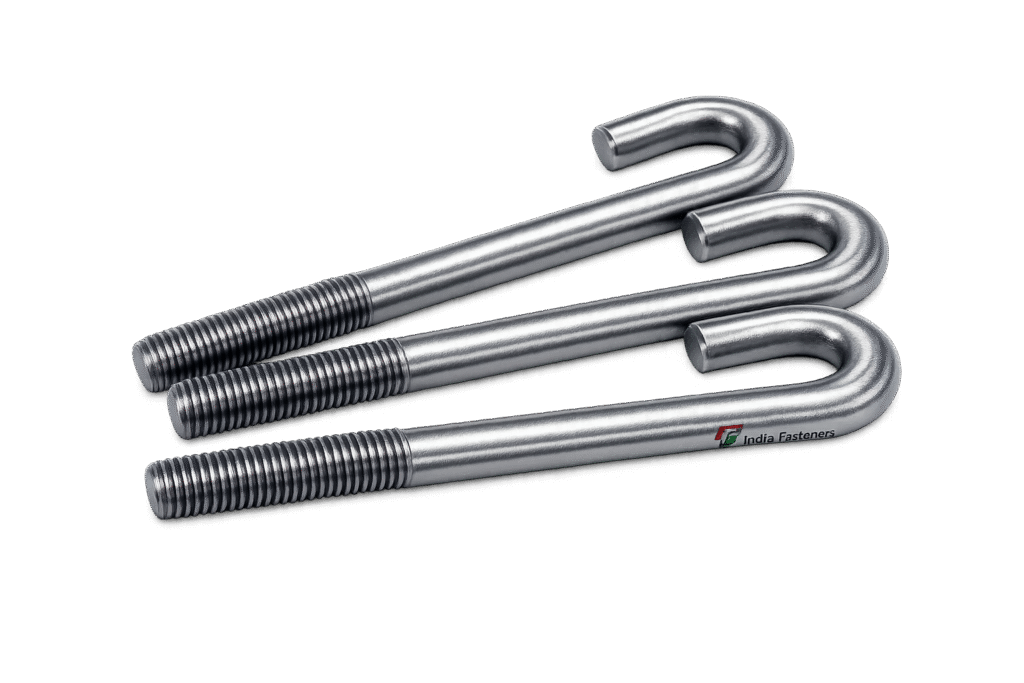
Within this context, J bolts represent one of the most widely used embedded anchor bolt configurations for equipment bases, pipe rack structures, support frames, and industrial foundation plates.
Large-scale industrial facilities in the Middle East operate under demanding structural and environmental conditions. These include:
• High mechanical loads from rotating machinery
• Thermal expansion caused by extreme ambient temperatures
• Corrosive marine exposure in coastal regions
• Chemical exposure in petrochemical plants
• Dynamic vibration from compressors, turbines, and pumps
As a result, anchor bolt systems must be engineered to maintain long-term load transfer integrity throughout the service life of the facility.
1.1 Anchor Bolt Role in Industrial Foundations
Anchor bolts perform the fundamental structural role of connecting steel structures or industrial equipment to reinforced concrete foundations. These bolts are installed prior to concrete pouring and remain permanently embedded within the foundation block.
Once the concrete cures, the anchor bolt provides a rigid connection between:
• Equipment base plates
• Structural steel columns
• Pipe rack support frames
• Skid-mounted equipment platforms
• Heavy machinery foundations
The anchor bolt allows loads generated by the superstructure to be transferred safely into the concrete mass through a combination of:
• Mechanical interlock
• Bond strength between steel and concrete
• Frictional resistance
• Concrete compression forces
The geometry of the anchor bolt plays a major role in determining how these forces are transferred.
1.2 Industrial Facilities Utilizing Anchor Bolt Systems
Across the GCC region, major industrial construction projects incorporate extensive anchor bolt networks within reinforced concrete foundations. These installations are commonly found in the following infrastructure sectors.
Oil & Gas Processing Plants
Upstream and downstream oil facilities contain large process units mounted on reinforced foundations. Equipment anchored using heavy anchor bolts includes:
• Gas compressors
• Pump skids
• Heat exchangers
• Storage tanks
• Pipe rack structures
Facilities within large industrial zones such as Jubail Industrial City and Ruwais Industrial Complex rely on engineered anchor bolt systems to stabilize equipment exposed to vibration and operational loads.
Petrochemical Complexes
Petrochemical plants involve continuous processing units containing high-pressure equipment and structural steel frames. Anchor bolt systems are required to secure:
• Reactor structures
• Distillation column support frames
• Process skid assemblies
• Pipe support structures
• Steel access platforms
In these facilities, anchor bolts must resist both static loads and vibration forces generated by processing equipment.
LNG Terminals
Liquefied natural gas (LNG) export terminals utilize extremely heavy cryogenic equipment mounted on reinforced foundations. Anchor bolt systems in LNG infrastructure secure:
• Cryogenic pumps
• Compressor units
• Pipe rack structures
• Loading arm platforms
• Equipment modules
Design considerations include thermal expansion and contraction resulting from cryogenic service temperatures.
Desalination Facilities
Desalination plants across Saudi Arabia, UAE, and Qatar incorporate heavy rotating machinery for seawater intake and high-pressure reverse osmosis systems.
Anchor bolts are used to secure:
• High-pressure pumps
• Turbine systems
• Motor foundations
• Structural support frames
• Intake and filtration structures
In coastal desalination environments, corrosion resistance becomes a critical engineering factor due to continuous exposure to salt-laden air and moisture.
Power Generation Plants
Thermal and combined cycle power plants rely on large anchor bolt systems to secure:
• Gas turbines
• Steam turbines
• Generator bases
• Condenser structures
• Structural steel frameworks
These installations require extremely precise anchor bolt alignment due to the tight tolerances associated with turbine and generator assemblies.
Steel Structures and Pipe Rack Foundations
Industrial pipe racks represent one of the most common applications for foundation anchor bolts in large EPC construction projects. These structures support:
• Process piping systems
• Cable trays
• Instrumentation lines
• Structural access walkways
Pipe rack columns are typically secured using anchor bolts embedded into reinforced concrete pedestals.
1.3 Load Transfer Interface Between Concrete and Steel Structures
The anchor bolt serves as the mechanical connector that transfers loads between steel base plates and concrete foundations. The connection typically consists of:
• Embedded anchor bolt
• Base plate
• Washer plate
• Anchor bolt nuts
• Grouting layer
When loads are applied to the structure, they are transmitted through the base plate and into the anchor bolt system. The anchor bolt then transfers these loads into the surrounding concrete through mechanical interaction and friction.
The design of the anchor bolt embedment geometry directly influences the ability of the system to resist structural forces.
1.4 Seismic and Vibration Considerations
Industrial equipment often generates continuous vibration during operation. This is particularly relevant for:
• Gas compressors
• Pump systems
• Turbines
• Fans and blowers
Anchor bolt systems must therefore be designed to resist cyclic loading without fatigue failure.
Foundation design engineers evaluate:
• Bolt tensile capacity
• Shear resistance
• Fatigue resistance
• Embedment depth
• Bolt spacing
In regions where seismic activity may occur, anchor bolt design may also consider seismic load combinations defined in structural design codes.
1.5 Thermal Expansion Effects in Gulf Climates
Ambient temperatures in GCC countries frequently exceed 45°C during summer months, creating significant thermal expansion in steel structures.
Steel structures anchored to concrete foundations may expand and contract due to temperature variation. Anchor bolt systems must therefore accommodate thermal movement while maintaining structural integrity.
Engineering design may incorporate:
• Slotted base plates
• Controlled bolt pretension
• Expansion joints in steel structures
These measures prevent excessive stress from developing within the anchor bolt system.
1.6 Corrosion Exposure in Coastal Industrial Zones
Many industrial zones in the GCC are located near coastal environments where anchor bolt systems are exposed to:
• Salt-laden air
• High humidity
• Chloride-induced corrosion
• Chemical plant emissions
Industrial regions such as:
• Jubail (Saudi Arabia)
• Ruwais (UAE)
• Mesaieed (Qatar)
present particularly aggressive corrosion environments for embedded steel components.
For this reason, anchor bolts are frequently supplied with corrosion protection systems such as:
• Hot-dip galvanizing
• Epoxy coatings
• Stainless steel materials for severe environments
2. Technical Definition of J Bolts
2.1 Engineering Definition
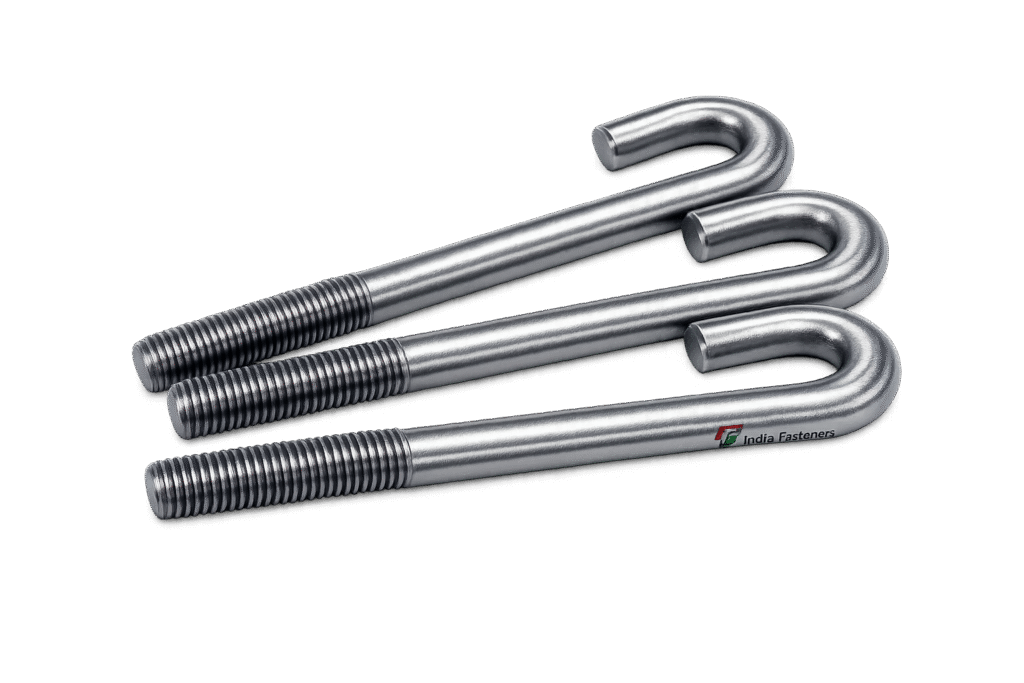
A J bolt is a type of anchor bolt characterized by a curved hook at one end, forming a shape similar to the letter “J”. The hooked geometry provides mechanical anchoring within reinforced concrete foundations.
The bolt consists of three primary sections:
• Threaded straight shank
• Curved hook section
• Embedded anchor end
The curved end creates a mechanical interlock within the concrete mass, preventing the bolt from being pulled out when tensile loads are applied.
2.2 Functional Role of the Hooked End
The hook at the embedded end increases the resistance of the anchor bolt against pull-out forces.
When tensile forces attempt to extract the bolt from the concrete, the hooked section bears against the surrounding concrete mass. This mechanical resistance improves the load transfer capacity of the anchor system.
The curved geometry also distributes stresses across a larger volume of concrete, reducing the likelihood of localized concrete cracking.
2.3 Typical Applications of J Bolts
J bolts are commonly used for anchoring:
• Structural steel columns
• Equipment base plates
• Pipe rack supports
• Industrial machinery foundations
• Tank support frames
• Light to medium load structural systems
For extremely heavy load conditions, other anchor bolt types may be used depending on structural design requirements.
2.4 Differences Between Common Anchor Bolt Types
Industrial foundation systems utilize several types of anchor bolts depending on the structural requirements of the installation.
J Bolts
Hooked anchor bolts with curved embedded ends.
Advantages:
• Simple geometry
• Effective mechanical anchoring
• Widely used in general foundation applications
L Bolts
L-shaped anchor bolts with a 90-degree bend.
Characteristics:
• Straight embedded leg
• Right-angle bend
Often used for structural steel column anchoring.
Straight Anchor Bolts
Straight rods embedded into concrete with bonding or mechanical anchors.
These may rely on:
• Chemical anchoring systems
• Expansion anchors
• Grouted sleeves
Headed Anchor Bolts
Anchor bolts containing forged or welded heads at the embedded end.
Used where higher load transfer capacity is required.
2.5 Applicable Manufacturing and Material Standards
Industrial anchor bolts used in structural foundations typically comply with internationally recognized material standards.
Common standards include:
ASTM F1554
Standard specification for anchor bolts used in structural foundations.
ASTM A36
Structural carbon steel used for general fabrication.
ASTM A307
Carbon steel bolts used for general applications.
ASTM A193 Grade B7
High-strength alloy steel bolts used for high-temperature or high-strength applications.
ISO standards related to thread tolerances and bolt manufacturing may also apply.
3. Load Transfer Mechanisms in J Bolts
Anchor bolts embedded within reinforced concrete foundations are subjected to multiple structural forces during service conditions. The design of the anchor system must consider the interaction between these forces and the surrounding concrete structure.
3.1 Tensile Loading
Tensile forces act to pull the anchor bolt out of the concrete foundation.
Sources of tensile loading include:
• Wind loads acting on structures
• Uplift forces on steel columns
• Dynamic equipment forces
• Thermal expansion stresses
The capacity of the bolt to resist tensile loading depends on:
• Bolt diameter
• Material strength
• Embedment depth
• Concrete compressive strength
3.2 Shear Loading
Shear forces act perpendicular to the axis of the anchor bolt. These forces may arise from:
• Lateral structural loads
• Equipment movement
• Seismic forces
• Wind-induced structural forces
Shear resistance depends on:
• Bolt diameter
• Bolt material strength
• Edge distance from concrete boundary
• Friction between base plate and concrete surface
3.3 Combined Tension and Shear
In most real industrial applications, anchor bolts experience combined loading conditions where both tension and shear forces act simultaneously.
Structural design must therefore evaluate interaction equations that determine allowable loads under combined stress conditions.
3.4 Pull-Out Resistance
Pull-out resistance refers to the ability of the anchor bolt to resist extraction from the concrete foundation.
Factors affecting pull-out resistance include:
• Hook geometry
• Embedment depth
• Concrete strength
• Concrete cracking conditions
In J bolts, the curved hook provides additional mechanical resistance against pull-out forces.
3.5 Concrete Breakout Resistance
Concrete breakout occurs when a cone-shaped section of concrete fails around the anchor bolt due to excessive tensile loading.
Structural engineers evaluate the concrete cone breakout capacity when designing anchor bolt embedment depth.
Typical failure geometry forms a cone-shaped fracture extending outward from the anchor bolt location.
Design methods for evaluating this failure mode are defined in structural concrete codes such as ACI anchor design provisions.
3.6 Embedment Depth Considerations
The embedment depth of the anchor bolt is a major factor affecting its load capacity.
Greater embedment depth generally provides:
• Higher pull-out resistance
• Greater concrete cone breakout capacity
• Improved load distribution
However, embedment depth must also account for practical construction limitations and reinforcement layout within the concrete foundation.
3.7 Structural Safety Factors
Engineering design of anchor bolts typically incorporates safety factors to ensure adequate structural performance.
These factors account for:
• Material variability
• Construction tolerances
• Load uncertainties
• Long-term service conditions
The safety factors applied depend on the design code and project specification used by the structural engineer.Materials, Standards & Manufacturing Discipline
Industrial anchor bolts used in foundation systems must comply with internationally recognized material standards, controlled manufacturing procedures, and strict dimensional tolerances. In EPC construction environments across the Middle East, anchor bolt supply documentation is typically reviewed by structural consultants, third-party inspection agencies, and client engineering teams prior to project approval.
This section presents the engineering material standards, manufacturing practices, and corrosion protection considerations associated with industrial J bolts supplied for heavy foundation installations.
Manufacturer Reference
India Fasteners
Manufacturer & Global Exporter of Industrial J Bolts
https://indiafastners.com
4. Material Standards Used in J Bolt Manufacturing
Material selection represents one of the most critical factors influencing the structural performance of foundation anchor bolts. J bolts used in industrial infrastructure projects are typically produced from carbon steel or alloy steel grades defined by ASTM material specifications.
The appropriate material grade is selected based on:
• Required tensile strength
• Structural load requirements
• Environmental exposure conditions
• Temperature operating range
• Project engineering specifications
The following sections describe commonly specified material grades for industrial anchor bolts.
4.1 ASTM F1554 Grade 36
ASTM F1554 Grade 36 is one of the most widely used material specifications for anchor bolts embedded in structural concrete foundations.
Key characteristics include:
• Minimum yield strength: 36 ksi (250 MPa)
• Moderate tensile strength
• Good ductility
• Suitable weldability
This material grade is frequently used for:
• Structural column anchoring
• Pipe rack foundations
• Light to medium equipment anchoring
• General infrastructure anchor bolts
Due to its ductile characteristics, Grade 36 provides reliable performance in applications where moderate tensile loads are present.
4.2 ASTM F1554 Grade 55
ASTM F1554 Grade 55 provides higher strength compared to Grade 36 and is frequently specified for industrial projects requiring improved tensile capacity.
Material properties include:
• Minimum yield strength: 55 ksi (380 MPa)
• Higher tensile capacity
• Increased resistance to mechanical loading
Typical applications include:
• Heavy structural frames
• Pipe rack anchor systems
• Equipment support structures
• Industrial infrastructure projects
Many EPC contractors prefer Grade 55 anchor bolts for structural foundations where higher load resistance is required without moving to alloy steel materials.
4.3 ASTM F1554 Grade 105
ASTM F1554 Grade 105 represents a high-strength anchor bolt material designed for applications involving significant tensile loading.
Key properties include:
• Minimum yield strength: 105 ksi (724 MPa)
• High tensile strength
• Increased hardness
This grade is typically used for:
• Heavy industrial equipment anchoring
• Turbine foundations
• Large rotating machinery installations
• High-load structural connections
Due to its high strength, welding restrictions may apply depending on the project specification.
4.4 ASTM A36 Carbon Steel
ASTM A36 structural steel is commonly used for fabrication of anchor bolts in general construction applications.
Material characteristics include:
• Minimum yield strength: 36 ksi
• Good machinability
• Moderate strength characteristics
ASTM A36 anchor bolts are commonly used for:
• Structural column anchoring
• Steel frame foundations
• Light industrial applications
In some projects, ASTM A36 bolts are used when ASTM F1554 certification is not specifically required.
4.5 ASTM A193 Grade B7
ASTM A193 Grade B7 is an alloy steel material commonly used for high-strength bolting in industrial environments.
Key mechanical characteristics include:
• Minimum tensile strength: approximately 125 ksi
• Excellent high-temperature performance
• Good resistance to mechanical fatigue
Applications include:
• High-temperature industrial equipment
• Pressure vessel supports
• Heavy rotating machinery foundations
In foundation systems, B7 anchor bolts may be specified for high-load equipment bases.
4.6 ASTM A320 Grade L7
ASTM A320 L7 is designed for low-temperature service environments. Although less common in GCC climates, this material may be used in certain cryogenic installations such as LNG terminals.
Key characteristics:
• Excellent impact resistance at low temperatures
• Suitable for cryogenic service conditions
Applications include:
• LNG processing equipment foundations
• Cryogenic storage infrastructure
4.7 NACE Considerations for Sour Environments
In oil and gas installations where hydrogen sulfide (H₂S) exposure may occur, material selection must comply with corrosion resistance requirements defined in NACE standards.
Sour service environments may cause:
• Sulfide stress cracking
• Hydrogen embrittlement
• Accelerated corrosion
In such environments, anchor bolt materials and coatings must be selected carefully to ensure long-term durability.
5. Material Comparison Table
The following table summarizes key mechanical characteristics and typical industrial applications of commonly used anchor bolt materials.
| Material Grade | Minimum Yield Strength | Tensile Strength | Service Temperature Range | Corrosion Resistance | Typical GCC Application |
|---|---|---|---|---|---|
| ASTM F1554 Grade 36 | 36 ksi (250 MPa) | ~58–80 ksi | -20°C to 200°C | Moderate | Structural columns, pipe racks |
| ASTM F1554 Grade 55 | 55 ksi (380 MPa) | ~75–95 ksi | -20°C to 200°C | Moderate | Equipment bases, heavy structures |
| ASTM F1554 Grade 105 | 105 ksi (724 MPa) | ~125 ksi | -20°C to 200°C | Moderate | Turbine foundations |
| ASTM A36 | 36 ksi | ~58–80 ksi | -20°C to 200°C | Moderate | Structural anchor systems |
| ASTM A193 B7 | ~105 ksi | ~125 ksi | Up to 450°C | Moderate | High-load equipment anchoring |
| ASTM A320 L7 | ~75 ksi | ~95 ksi | Down to -100°C | Moderate | LNG facilities |
6. Manufacturing Process of J Bolts
Industrial anchor bolts require precise dimensional control to ensure correct fit within foundation templates and equipment base plates. Manufacturing processes therefore follow a structured production workflow.
6.1 Raw Steel Procurement
Production begins with procurement of certified steel bars or threaded rod stock from approved steel mills.
Material documentation typically includes:
• Mill Test Certificates
• Chemical composition verification
• Mechanical property certification
Only material grades compliant with project specifications are accepted for production.
6.2 Material Grade Verification
Upon receipt, incoming steel materials undergo verification procedures including:
• Heat number identification
• Chemical composition confirmation
• Material grade validation
These procedures ensure traceability between finished bolts and the original steel heat.
6.3 Cutting of Steel Rod Stock
Steel rods are cut to the required length based on project specifications.
Cutting processes may include:
• Mechanical cutting
• Abrasive cutting
• CNC controlled cutting equipment
Dimensional tolerances are controlled to ensure correct overall bolt length.
6.4 Hook Bending Operation
The characteristic hook of a J bolt is formed through controlled bending operations.
Two methods are commonly used:
Hot bending
Steel is heated to allow forming without cracking.
Cold bending
Mechanical bending is performed at ambient temperature using hydraulic equipment.
The bending radius must comply with engineering design requirements to prevent stress concentration.
6.5 Thread Formation
The threaded section of the J bolt is produced using either thread rolling or thread cutting methods.
Thread Rolling
Thread rolling forms threads through plastic deformation of the steel surface.
Advantages include:
• Increased fatigue resistance
• Improved thread strength
• Smooth surface finish
Thread Cutting
Thread cutting removes material to produce threads.
Although less common for high-performance bolts, it may be used for certain custom bolt configurations.
6.6 Heat Treatment (Where Applicable)
For high-strength alloy steel bolts such as ASTM A193 B7, heat treatment processes may be required to achieve the specified mechanical properties.
Heat treatment operations may include:
• Quenching
• Tempering
• Stress relieving
These processes improve strength and hardness characteristics.
6.7 Surface Finishing
After forming and threading operations, J bolts may receive surface finishing treatments depending on project requirements.
Common finishes include:
• Black finish (uncoated steel)
• Hot-dip galvanizing
• Zinc electroplating
• Epoxy coating
• Specialized corrosion protection coatings
6.8 Dimensional Inspection
Each production batch undergoes dimensional verification to confirm compliance with drawing specifications.
Inspection checks include:
• Bolt diameter
• Thread length
• Hook radius
• Hook length
• Overall bolt length
Precision measurement instruments are used to ensure compliance with tolerances.
6.9 Mechanical Testing
Quality assurance procedures may include mechanical property testing.
Typical tests include:
• Tensile strength testing
• Yield strength verification
• Bend testing
These tests confirm that the material meets specified mechanical requirements.
6.10 Marking and Traceability
Finished anchor bolts are marked to maintain traceability between the product and the raw material heat number.
Traceability markings may include:
• Material grade identification
• Heat number
• Manufacturer identification
Traceability ensures compliance with EPC project documentation requirements.
7. Surface Protection & Corrosion Control
Anchor bolts embedded in industrial foundations may be exposed to aggressive environmental conditions throughout their service life.
Corrosion protection therefore plays an essential role in ensuring long-term structural reliability.
7.1 Hot-Dip Galvanizing
Hot-dip galvanizing involves coating the steel bolt with a layer of zinc through immersion in molten zinc.
Benefits include:
• Long-term corrosion protection
• Resistance to atmospheric corrosion
• Suitable for outdoor infrastructure
This coating method is commonly used for anchor bolts installed in coastal environments.
7.2 Zinc Electroplating
Zinc plating provides a thinner protective coating compared to galvanizing.
Advantages include:
• Smooth surface finish
• Suitable for indoor equipment installations
However, zinc plating provides less corrosion resistance compared to hot-dip galvanizing.
7.3 Epoxy Coating
Epoxy coatings provide strong chemical resistance and are often used in industrial environments where chemical exposure may occur.
Applications include:
• Petrochemical facilities
• Chemical processing plants
7.4 PTFE Coatings
PTFE coatings may be applied where additional corrosion resistance and low friction characteristics are required.
These coatings are sometimes used in:
• High-temperature installations
• Chemically aggressive environments
7.5 Bitumen Coating for Buried Installations
Bitumen-based coatings are sometimes applied to anchor bolts embedded in underground concrete structures.
This coating helps prevent corrosion caused by:
• Ground moisture
• Soil chemicals
• Underground exposure conditions
7.6 Corrosion Risks in GCC Industrial Environments
Industrial anchor bolts installed across the GCC region are exposed to several corrosion risk factors, including:
• High humidity levels
• Salt-laden coastal air
• Industrial chemical emissions
• Elevated ambient temperatures
Engineering material selection and coating systems must therefore be selected carefully to ensure long-term durability of foundation anchor Engineering Data, Design Tables & Quality Assurance
Industrial anchor bolt systems must be supported by clearly defined engineering data to allow structural consultants, EPC contractors, and inspection agencies to evaluate suitability for specific foundation applications. J bolts used in industrial infrastructure projects are therefore accompanied by dimensional references, mechanical property data, installation torque guidelines, and load capacity information.
The following sections provide engineering reference data typically reviewed during structural design evaluation and procurement documentation.
Manufacturer Reference
India Fasteners
Manufacturer & Global Exporter of Industrial J Bolts
https://indiafastners.com
8. Dimensional Reference Tables
Dimensional consistency is essential for proper installation of anchor bolts in reinforced concrete foundations. Foundation templates and base plates are manufactured based on specific bolt spacing and bolt projection requirements. Any deviation in bolt geometry can affect alignment of structural components.
The dimensional parameters typically defined for J bolts include:
• Nominal bolt diameter
• Thread length
• Hook radius
• Hook length
• Overall bolt length
• Recommended embedment depth
The following reference table illustrates typical dimensional ranges used for industrial anchor bolts.
| Bolt Diameter | Thread Length | Hook Radius | Hook Length | Overall Bolt Length | Recommended Embedment Depth |
|---|---|---|---|---|---|
| M16 (5/8″) | 75–100 mm | 30–40 mm | 60–70 mm | 400–600 mm | 250–300 mm |
| M20 (3/4″) | 80–120 mm | 35–45 mm | 70–90 mm | 450–700 mm | 300–350 mm |
| M24 (1″) | 100–150 mm | 45–55 mm | 90–110 mm | 500–800 mm | 350–450 mm |
| M30 (1-1/4″) | 120–180 mm | 55–70 mm | 110–140 mm | 600–1000 mm | 400–500 mm |
| M36 (1-1/2″) | 150–200 mm | 70–85 mm | 140–180 mm | 700–1200 mm | 500–600 mm |
| M42 (1-3/4″) | 180–220 mm | 85–100 mm | 180–220 mm | 800–1400 mm | 600–700 mm |
| M48 (2″) | 200–250 mm | 100–120 mm | 200–250 mm | 900–1600 mm | 700–800 mm |
Actual dimensions are typically determined by project-specific engineering drawings issued by structural consultants.
9. Mechanical Properties Table
Mechanical properties of anchor bolt materials determine their ability to resist tensile and shear loads in foundation systems. The following table provides typical mechanical characteristics for common materials used in industrial J bolt manufacturing.
| Material Grade | Yield Strength | Tensile Strength | Elongation | Hardness | Impact Properties |
|---|---|---|---|---|---|
| ASTM F1554 Grade 36 | 250 MPa | 400–550 MPa | 23% min | ~120–170 HB | Moderate |
| ASTM F1554 Grade 55 | 380 MPa | 520–690 MPa | 21% min | ~150–200 HB | Moderate |
| ASTM F1554 Grade 105 | 724 MPa | ~860 MPa | 18% min | ~250–300 HB | Moderate |
| ASTM A193 B7 | ~720 MPa | ~860–965 MPa | 16% min | ~248–302 HB | Good |
| ASTM A320 L7 | ~520 MPa | ~725–860 MPa | 18% min | ~235–300 HB | High at low temperature |
These mechanical values allow structural engineers to evaluate bolt strength relative to applied loads.
10. Anchor Bolt Load Capacity Guide
Anchor bolt capacity is determined through evaluation of multiple potential failure modes. Structural design methods generally assess the capacity of the anchor bolt under tensile forces, shear forces, and combined loading conditions.
Factors influencing anchor bolt capacity include:
• Bolt diameter
• Material grade
• Embedment depth
• Concrete compressive strength
• Edge distance
• Bolt spacing
• Base plate configuration
10.1 Tensile Capacity
The theoretical tensile capacity of a bolt is calculated using the tensile stress area of the threaded section.
The basic tensile resistance relationship is represented by:

Where:
•  = tensile load capacity
•  = tensile stress area of the bolt
•  = ultimate tensile strength of the bolt material
Actual allowable loads used in engineering design are reduced using appropriate safety factors.
10.2 Shear Capacity
Shear capacity represents the ability of the bolt to resist lateral loads acting perpendicular to its axis.
The approximate relationship used in structural design can be represented as: 
Where:
•  = shear load capacity
• = tensile stress area
• = ultimate tensile strength
Additional design checks may include evaluation of base plate friction and concrete edge distance.
10.3 Combined Tension and Shear
Most industrial anchor bolts experience both tensile and shear forces simultaneously. Structural engineers therefore evaluate interaction equations to verify that the combined stress conditions remain within allowable design limits.
Combined loading design ensures that anchor bolts maintain structural reliability even when multiple forces act simultaneously.
10.4 Concrete Cone Breakout
When tensile forces exceed the concrete’s capacity, failure may occur in the form of a cone-shaped breakout around the anchor bolt.
Factors influencing breakout capacity include:
• Embedment depth
• Concrete compressive strength
• Bolt spacing
• Edge distance
Increasing embedment depth generally increases the resistance to concrete breakout failure.
11. Installation Torque Guide
Anchor bolts must be tightened to appropriate torque levels to develop the required clamping force between the base plate and foundation.
The torque applied during tightening creates bolt preload, which improves joint stability and prevents loosening under vibration.
The relationship between torque and preload can be approximated using: 
Where:
• = tightening torque
•  = friction coefficient
•  = preload force
•  = bolt diameter
Typical Installation Torque Values
ASTM F1554 Anchor Bolts
| Bolt Diameter | Recommended Torque |
|---|---|
| M16 (5/8″) | 100–120 Nm |
| M20 (3/4″) | 200–250 Nm |
| M24 (1″) | 350–420 Nm |
| M30 (1-1/4″) | 650–750 Nm |
| M36 (1-1/2″) | 1100–1250 Nm |
| M42 (1-3/4″) | 1700–1900 Nm |
| M48 (2″) | 2500–2800 Nm |
ASTM A193 B7 High-Strength Bolts
| Bolt Diameter | Recommended Torque |
|---|---|
| M16 (5/8″) | 140–160 Nm |
| M20 (3/4″) | 260–300 Nm |
| M24 (1″) | 480–550 Nm |
| M30 (1-1/4″) | 900–1000 Nm |
| M36 (1-1/2″) | 1500–1650 Nm |
| M42 (1-3/4″) | 2300–2600 Nm |
| M48 (2″) | 3200–3600 Nm |
Actual torque requirements may vary depending on lubrication condition, washer configuration, and project installation procedures.
12. Corrosion Resistance Comparison Table
Anchor bolt material selection must consider environmental exposure conditions typical of industrial infrastructure installations.
The following table compares common materials used in anchor bolt manufacturing relative to corrosion resistance.
| Material Type | Marine Environments | Industrial Chemicals | High Humidity | Underground Exposure |
|---|---|---|---|---|
| Carbon Steel | Low | Low | Moderate | Low |
| Hot-Dip Galvanized Steel | Good | Moderate | Good | Good |
| Stainless Steel 304 | Good | Moderate | Excellent | Good |
| Stainless Steel 316 | Excellent | Good | Excellent | Good |
| Duplex Stainless Steel | Excellent | Excellent | Excellent | Excellent |
For installations located near coastal industrial zones, stainless steel or galvanized coatings may be required to achieve adequate corrosion resistance.
13. Inspection & Quality Control
Industrial anchor bolts supplied to EPC construction projects must undergo documented inspection and quality control procedures before shipment. These procedures ensure that the product meets engineering specifications and project documentation requirements.
13.1 Dimensional Inspection
Dimensional inspection verifies that all critical bolt dimensions comply with engineering drawings.
Inspection parameters include:
• Bolt diameter
• Thread pitch
• Thread length
• Hook geometry
• Overall bolt length
• Bend radius
Precision measurement instruments such as calipers, micrometers, and thread gauges are typically used during this process.
13.2 Thread Gauge Verification
Thread quality is verified using standardized gauges.
Inspection tools include:
• Go/No-Go thread gauges
• Pitch gauges
These tools confirm compliance with specified thread tolerances.
13.3 Tensile Testing
Mechanical testing may include tensile strength verification performed on representative samples from each production batch.
Testing confirms that the bolt material meets the required strength properties defined in ASTM specifications.
13.4 Bend Testing
Bend testing may be conducted to verify the integrity of the hook portion of the J bolt.
This test evaluates:
• Ductility of the material
• Resistance to cracking during bending
13.5 Coating Thickness Measurement
For galvanized or coated anchor bolts, coating thickness is verified using measurement instruments such as magnetic thickness gauges.
This ensures that the protective coating meets specified corrosion protection requirements.
13.6 Visual Inspection
Visual inspection is performed to identify:
• Surface defects
• Thread damage
• Coating irregularities
• Manufacturing defects
Any bolts not meeting quality standards are removed from the production batch.
13.7 Documentation & Traceability
Industrial anchor bolt supply for EPC projects typically includes complete documentation packages.
Common documentation includes:
• Mill Test Certificates (EN 10204 3.1)
• Heat number traceability records
• Mechanical testing reports
• Coating inspection reports
• Dimensional inspection records
These documents allow structural consultants and third-party inspection agencies to verify compliance with project specifications.systems.GCC Industry Applications & Export Capability
Industrial anchor bolts used in large-scale infrastructure projects must satisfy both structural engineering requirements and international procurement standards. In engineering, procurement, and construction (EPC) environments across the Middle East, anchor bolt suppliers are typically evaluated based on their ability to meet technical specifications, manufacturing consistency, documentation traceability, and export logistics capability.
This section describes the industrial applications of J bolts, their role within major infrastructure sectors, export supply considerations for Gulf Cooperation Council (GCC) markets, installation practices used in foundation construction, and manufacturing flexibility for project-specific anchor bolt systems.
Manufacturer Reference
India Fasteners
Manufacturer & Global Exporter of Industrial J Bolts
https://indiafastners.com
14. Industrial Applications of J Bolts
J bolts are widely used in industrial construction for securing structural steel and mechanical equipment to reinforced concrete foundations. Their geometry allows for reliable mechanical anchoring within concrete, making them suitable for numerous infrastructure applications.
The following sections describe the major industrial sectors where J bolts are commonly utilized.
14.1 Oil and Gas Facilities
Oil and gas processing facilities contain extensive networks of equipment mounted on reinforced concrete foundations. Anchor bolt systems provide the structural connection required to secure these installations.
Common applications include:
• Pump base anchoring
• Compressor skid foundations
• Equipment support frames
• Structural steel column anchoring
• Pipe rack support structures
In these installations, anchor bolts must accommodate dynamic loads produced by rotating equipment while maintaining alignment of mechanical systems.
The design of anchor bolt embedment depth and bolt diameter is typically determined during structural foundation design conducted by engineering consultants.
14.2 Petrochemical Plants
Petrochemical complexes involve numerous process units supported by structural steel frameworks. J bolts are frequently used for anchoring these structures to concrete foundations.
Typical applications include:
• Reactor support structures
• Distillation column frames
• Process equipment platforms
• Structural pipe rack columns
• Maintenance access structures
Because petrochemical plants may expose anchor bolts to chemical atmospheres, corrosion protection coatings are often specified to extend service life.
14.3 Power Generation Facilities
Power plants contain large mechanical systems requiring stable and precisely aligned foundation anchoring.
J bolts may be used for securing:
• Auxiliary equipment foundations
• Structural steel frames
• Pump and motor bases
• Support structures for piping and electrical systems
Where extremely high loads are present, structural engineers may specify large-diameter anchor bolts or alternative anchoring configurations.
14.4 Water Treatment and Desalination Plants
Desalination facilities represent a major infrastructure sector within the GCC region. These plants rely on large pumping systems and structural equipment installations.
Anchor bolts are used to secure:
• High-pressure pumps
• Motor bases
• Filtration systems
• Structural equipment platforms
• Pipe support structures
Due to the presence of saltwater and high humidity levels, corrosion protection systems are frequently applied to anchor bolts used in these environments.
14.5 Industrial Machinery Foundations
Heavy machinery installed in industrial facilities requires rigid anchoring to prevent movement during operation.
J bolts are commonly used for securing:
• Compressors
• Industrial pumps
• Turbine auxiliary equipment
• Generator support systems
• Fabrication machinery
Foundation bolts for such equipment are typically installed using precision templates to ensure accurate alignment with base plate holes.
14.6 Structural Steel Anchoring
Structural steel columns in industrial buildings and pipe rack systems are typically secured using anchor bolts embedded within reinforced concrete pedestals.
Applications include:
• Pipe rack columns
• Steel building columns
• Equipment support structures
• Cable tray support frames
• Platform structures
In these installations, the anchor bolt must provide both tensile resistance and shear resistance to maintain structural stability.
15. Export Capability to GCC Markets
Industrial infrastructure projects across the Middle East often require anchor bolts to be sourced from international manufacturers capable of meeting project documentation and export requirements.
Anchor bolt supply for GCC projects typically involves coordination between manufacturers, EPC contractors, and inspection agencies.
Export capability involves several key stages.
15.1 Export Packaging Methods
Anchor bolts must be packaged in a manner that prevents mechanical damage and corrosion during international transportation.
Common packaging methods include:
• Bundled packaging with steel straps
• Wooden crate packaging for large bolts
• Protective wrapping for coated bolts
• Palletized shipment for container loading
Packaging methods are selected based on bolt size, weight, and shipping distance.
15.2 Documentation Packages
Industrial infrastructure projects typically require detailed documentation packages accompanying anchor bolt shipments.
These documents may include:
• Material Test Certificates (EN 10204 3.1)
• Chemical composition reports
• Mechanical testing reports
• Coating inspection records
• Dimensional inspection reports
• Packing lists
Documentation allows EPC contractors and consultants to verify compliance with project specifications.
15.3 Third-Party Inspection
Large industrial projects frequently require independent inspection prior to shipment.
Inspection procedures may include:
• Visual inspection
• Dimensional verification
• Material documentation review
• Coating verification
Independent inspection organizations may perform these verification procedures in accordance with project requirements.
15.4 Shipping Preparation
Prior to shipment, anchor bolts are prepared for international transport through:
• Batch identification labeling
• Documentation attachment
• Container loading planning
Each shipment must maintain traceability between the packaged bolts and the corresponding material certificates.
15.5 Container Loading Practices
Industrial fasteners such as anchor bolts are typically transported in standard shipping containers.
Loading practices include:
• Distribution of weight to prevent container imbalance
• Securing cargo to prevent movement during transport
• Protection against moisture exposure
These procedures help ensure that anchor bolts arrive at the project site without damage.
15.6 GCC Regional Supply Destinations
Industrial anchor bolts are frequently exported to the following Middle Eastern markets:
Saudi Arabia
UAE
Qatar
Oman
Kuwait
Bahrain
These markets contain numerous large infrastructure projects involving oil and gas processing facilities, petrochemical complexes, desalination plants, and power generation stations.
16. Installation Engineering Guidance
The performance of anchor bolts within concrete foundations depends heavily on correct installation procedures during foundation construction.
The following practices are typically followed by civil contractors during installation of embedded anchor bolts.
16.1 Anchor Bolt Placement Before Concrete Pouring
J bolts are installed prior to pouring concrete so that the curved hook section becomes embedded within the foundation.
The bolt is positioned at the required location and secured in place to prevent movement during concrete placement.
16.2 Template Plate Usage
Template plates are commonly used to maintain accurate spacing and alignment of anchor bolts.
The template plate contains holes corresponding to the base plate bolt pattern.
Benefits of template plates include:
• Accurate bolt spacing
• Correct bolt vertical alignment
• Prevention of movement during concrete pouring
16.3 Alignment Checks
Before concrete placement, contractors perform alignment checks to verify:
• Bolt verticality
• Correct bolt spacing
• Proper projection height above foundation surface
These checks help ensure compatibility with equipment base plates.
16.4 Concrete Placement and Curing
Once the anchor bolts are positioned and secured, concrete is poured around the bolts to form the foundation.
During this stage:
• Concrete must fully surround the hook section
• Air pockets must be avoided
• Adequate curing time must be provided
Proper curing allows the concrete to achieve its design compressive strength.
16.5 Base Plate Installation
After the concrete foundation has cured, the equipment or structural base plate is installed over the anchor bolts.
Typical installation steps include:
• Placement of leveling nuts or shims
• Positioning of the base plate
• Installation of washers and nuts
Grouting may be applied beneath the base plate to provide uniform load transfer.
16.6 Nut Tightening Sequence
Anchor bolt nuts are tightened according to specified torque values to develop the required preload.
Tightening procedures may involve:
• Cross-pattern tightening sequence
• Gradual torque application
• Verification using calibrated torque tools
These procedures help ensure uniform load distribution across the anchor bolt group.
17. Custom Engineering Capabilities
Industrial infrastructure projects often require anchor bolts manufactured according to project-specific engineering drawings.
Manufacturing capability must therefore accommodate a wide range of customized bolt configurations.
17.1 Large Diameter Anchor Bolts
Heavy industrial equipment foundations may require anchor bolts with large diameters.
Common large bolt sizes include:
• M36
• M42
• M48
• Larger custom diameters depending on project requirements
These bolts are used in heavy equipment foundations where significant loads must be transferred into concrete.
17.2 Extended Embedment Anchor Bolts
Certain applications require extended embedment depth to increase load resistance.
Extended embedment bolts may be specified for:
• Turbine foundations
• Heavy machinery bases
• High-load structural columns
Manufacturing processes must accommodate long bolt lengths while maintaining dimensional accuracy.
17.3 Heavy Equipment Foundation Bolts
Industrial machinery such as compressors and large pumps often require specially designed anchor bolts.
These bolts may incorporate:
• Large diameters
• Long threaded sections
• Custom hook geometry
Design parameters are determined by structural engineers responsible for the foundation design.
17.4 Special Corrosion Protection Systems
In aggressive environments such as marine or chemical processing facilities, specialized coatings may be specified.
Examples include:
• Multi-layer epoxy coatings
• Marine-grade protective coatings
• Stainless steel anchor bolts
These coatings are selected to improve durability in corrosive environments.
17.5 Custom Thread Lengths
Project specifications may require anchor bolts with thread lengths adjusted to match base plate thickness and installation requirements.
Thread length is typically determined based on:
• Plate thickness
• Washer thickness
• Nut engagement requirements
17.6 Project-Specific Fabrication
Industrial anchor bolts may be produced according to custom engineering drawings provided by EPC contractors or structural consultants.
Custom fabrication may involve:
• Non-standard hook geometries
• Special bolt lengths
• Customized thread configurations
• Project-specific identification marking
Such fabrication ensures compatibility with project foundation designs.