
Elevator Bolts
Elevator Bolts in GCC Bulk Material Handling Infrastructure
1. Regional Industry Context (Middle East Focus)
Bulk material handling systems form a critical mechanical backbone across large-scale industrial infrastructure in the Gulf Cooperation Council (GCC) region. Within these systems, bucket elevators are deployed extensively for vertical transport of granular, powdered, and abrasive materials. Elevator bolts function as a primary fastening interface between conveyor belts and buckets, directly influencing operational reliability, maintenance cycles, and safety compliance.
1.1 Cement Industry (Saudi Arabia, UAE)
Cement production facilities across Saudi Arabia and the UAE operate continuous-process plants with high throughput requirements. Bucket elevators are used for:
- Raw meal transport
- Clinker handling
- Cement powder elevation
Operating conditions include:
- High temperatures (up to 200–300°C in clinker zones)
- Severe abrasion due to limestone and clinker particles
- Dust-laden environments affecting thread integrity and tightening reliability
Elevator bolts in these systems must:
- Maintain clamping force under thermal expansion
- Resist abrasive wear at the head interface
- Prevent pull-through under dynamic loading
1.2 Mining & Aggregate Processing Plants
Mining and aggregate facilities across Oman, Saudi Arabia, and Qatar utilize bucket elevators for:
- Crushed stone transport
- Sand and mineral handling
- Screening and grading systems
These systems introduce:
- High impact loading during material discharge
- Irregular particle sizes causing localized stress
- Continuous vibration and cyclic loading
Elevator bolts must therefore exhibit:
- High shear resistance
- Fatigue durability
- Secure anti-rotation characteristics
1.3 Fertilizer & Chemical Plants
Material handling in fertilizer plants involves:
- Urea granules
- Phosphate compounds
- Chemical powders
Operating risks include:
- Corrosive atmospheres
- Hygroscopic materials causing moisture retention
- Chemical exposure affecting coating systems
Fasteners must provide:
- Corrosion resistance (coated or stainless variants)
- Stable preload under chemical exposure
- Resistance to stress corrosion cracking
1.4 Grain Storage & Processing Facilities
Grain elevators across GCC ports and inland storage facilities rely on bucket systems for:
- Wheat, corn, and rice handling
- Feed processing plants
Challenges include:
- Dust explosion risk (requiring low-profile fastening)
- Continuous operation cycles
- Hygiene considerations
Elevator bolts are selected for:
- Smooth head profile to minimize product accumulation
- Secure fastening to prevent loosening
- Compatibility with belt materials (rubber, PVC)
1.5 Power Plants (Coal & Ash Handling Systems)
In thermal power plants, bucket elevators handle:
- Coal feed systems
- Fly ash removal
- Bottom ash transport
These environments involve:
- High-temperature exposure
- Abrasive ash particles
- Corrosive flue gas residues
Fasteners must maintain:
- Structural integrity under heat
- Resistance to abrasive wear
- Stable preload under vibration
1.6 Ports & Bulk Cargo Terminals
Bulk terminals across UAE and Saudi Arabia manage:
- Cement
- Fertilizers
- Grain
- Minerals
Elevator systems operate under:
- Marine atmospheric conditions
- Continuous high-load cycles
- Exposure to humidity and salt
Elevator bolts must address:
- Corrosion resistance (galvanized or stainless steel)
- Long-term durability under cyclic loading
- Ease of maintenance and replacement
1.7 Operational Characteristics of Bucket Elevators
Bucket elevators in GCC applications operate under:
- Continuous duty cycles (24/7 operation)
- High-speed belt movement
- Repetitive loading and unloading cycles
Mechanical demands include:
- Repeated impact loading at discharge points
- Belt tension forces acting on bolt assemblies
- Dynamic imbalance and vibration
Environmental conditions include:
- Ambient temperatures exceeding 50°C
- Dust ingress affecting threads and seating surfaces
- Limited shutdown windows for maintenance
1.8 Reliability Requirements in GCC Mega Projects
Large EPC projects in the Middle East impose strict mechanical reliability requirements:
- Zero unplanned downtime tolerance in process-critical systems
- Defined maintenance intervals aligned with plant shutdown schedules
- Compliance with third-party inspection protocols
Elevator bolts must therefore ensure:
- Consistent dimensional accuracy
- Verified mechanical properties
- Traceable manufacturing batches
- Predictable performance under load
Failure of a single bolt can lead to:
- Bucket detachment
- Belt damage
- System shutdown
This elevates the fastening system from a commodity component to a critical engineered element.
2. Technical Definition of Elevator Bolt
2.1 Functional Definition
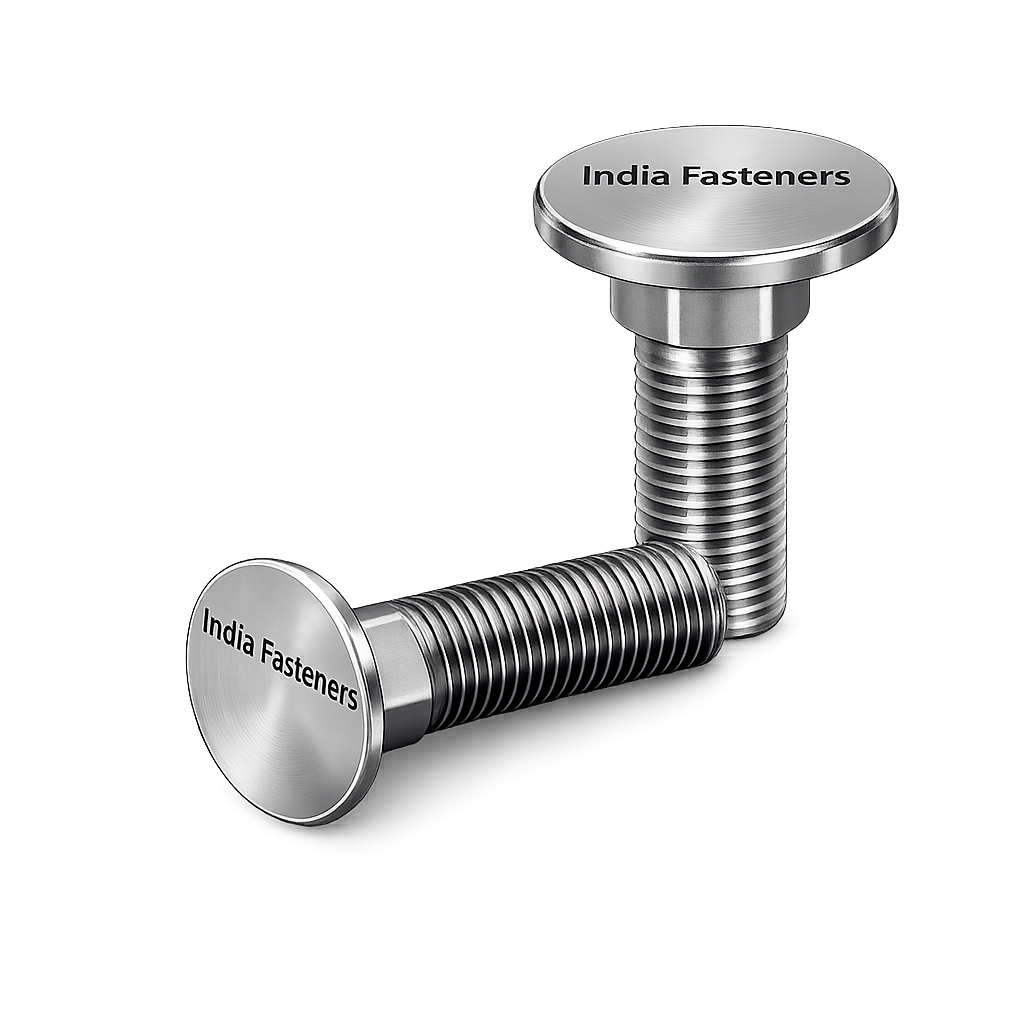
An elevator bolt is a specialized fastening component designed to secure buckets to conveyor belts in vertical material handling systems. It differs from conventional fasteners through its geometry, load distribution capability, and anti-rotation design.
Primary characteristics include:
- Large-diameter flat head
- Low-profile design
- Square neck or ribbed shank
- Threaded end for nut engagement
The design objective is to:
- Distribute load across a wider belt surface
- Prevent localized stress concentration
- Maintain secure fastening under dynamic conditions
2.2 Structural Features
a. Head Design
The head is:
- Wide and flat (or slightly domed depending on design)
- Designed to sit flush against the belt surface
Functions:
- Prevents pull-through of the belt
- Distributes clamping force over a larger area
- Minimizes belt damage
Variants include:
- Flat head
- Countersunk head
- Domed (mushroom) head
b. Neck Design
The neck section typically includes:
- Square neck
- Ribbed or serrated neck
Functions:
- Prevents bolt rotation during tightening
- Ensures proper torque transfer
- Maintains alignment within the belt hole
c. Threaded Portion
- Metric threads (ISO standard)
- Rolled threads for improved fatigue resistance
Used with:
2.3 Relevant Standards
Elevator bolts are commonly manufactured in accordance with:
- DIN 15237 (bucket elevator bolts standard)
- ISO metric thread standards
- EN ISO mechanical property standards
DIN 15237 defines:
- Head dimensions
- Neck configuration
- Thread specifications
- Dimensional tolerances
These standards ensure:
- Interchangeability across conveyor systems
- Compatibility with OEM equipment
- Compliance with EPC project requirements
2.4 Difference from Standard Hex Bolts
| Parameter | Elevator Bolt | Standard Hex Bolt |
|---|---|---|
| Head Type | Flat / wide | Hexagonal |
| Load Distribution | High | Localized |
| Anti-Rotation | Built-in (square neck) | External holding required |
| Application | Conveyor buckets | General fastening |
| Profile | Low-profile | Protruding head |
Elevator bolts are specifically engineered for:
- Surface contact with belts
- Dynamic load environments
- Repetitive mechanical stress
Standard bolts are not suitable due to:
- Insufficient load distribution
- Risk of belt damage
- Increased loosening under vibration
2.5 Nut and Washer Combinations
Typical assembly includes:
- Hex nut (standard or lock type)
- Flat washer or specialized bucket washer
Functions:
- Distributes load on bucket side
- Prevents deformation of bucket wall
- Enhances clamping stability
Locking options:
- Nylon insert lock nuts
- Double nutting
- Thread-locking compounds (project-dependent)
3. Load Distribution & Fastening Mechanics
Elevator bolts operate under combined loading conditions. Understanding load behavior is essential for correct selection and installation.
3.1 Load Types Acting on Elevator Bolts
a. Shear Load
Occurs due to:
- Weight of material in buckets
- Gravitational force during vertical lifting
Acts perpendicular to bolt axis.
b. Tensile Load
Generated from:
- Belt tension
- Clamping force between bucket and belt
Acts along the bolt axis.
c. Impact Load
Occurs during:
- Material loading into buckets
- Discharge at elevator head
Creates transient high-stress conditions.
d. Cyclic Load
Due to:
- Continuous rotation
- Repeated loading and unloading
Leads to fatigue over time.
3.2 Shear Stress Calculation
Shear stress in a bolt is calculated as:
τ = F / A
Where:
- τ = shear stress
- F = applied force
- A = cross-sectional area
In bucket elevators:
- Shear force is distributed across multiple bolts per bucket
- Uneven load distribution may occur due to misalignment
3.3 Tensile Stress Calculation
Tensile stress is calculated as:

Where:
- σ = tensile stress
- F = axial load
- A = tensile stress area of thread
Tensile loading is influenced by:
- Belt tension
- Bolt preload
3.4 Clamping Force and Preload
Clamping force ensures:
- Secure attachment of bucket to belt
- Resistance to slip and movement
Preload is generated during tightening and is critical for:
- Maintaining joint integrity
- Preventing loosening under vibration
Preload estimation:

Where:
- Fₚ = preload force
- T = applied torque
- K = torque coefficient
- d = nominal diameter
3.5 Load Distribution Across Multiple Bolts
Each bucket is typically secured with multiple bolts. Load sharing depends on:
- Bolt spacing
- Installation accuracy
- Uniform torque application
Non-uniform tightening can result in:
- Overloading of individual bolts
- Premature failure
3.6 Failure Modes in Elevator Bolt Systems
a. Pull-Through Failure
Occurs when:
- Head diameter is insufficient
- Belt material weakens over time
Result:
- Bolt head passes through belt
- Bucket detachment
b. Shear Failure
Occurs due to:
- Excessive load
- Material inadequacy
Result:
- Bolt fracture
c. Loosening
Caused by:
- Vibration
- Improper preload
Result:
- Loss of clamping force
- Progressive joint failure
d. Fatigue Failure
Occurs under:
- Repeated cyclic loading
Result:
- Crack initiation and propagation
3.7 Safety Factors in GCC Industrial Systems
Typical safety considerations include:
- Conservative load assumptions
- Multiple bolt redundancy per bucket
- Material selection based on worst-case conditions
Design factors consider:
- High ambient temperatures
- Abrasive material handling
- Continuous operation cycles
Safety factors are applied to:
- Shear strength
- Tensile strength
- Fatigue life
3.8 Engineering Considerations for Reliable Performance
To ensure long-term performance:
- Correct bolt grade selection is required
- Proper torque application must be maintained
- Regular inspection intervals should be defined
- Replacement schedules must align with plant shutdowns
Installation accuracy directly affects:
System reliability
Load distribution
Bolt life
Material Engineering, Standards & Manufacturing Discipline
4. Applicable Materials (Mapped to GCC Use)
Material selection for elevator bolts is directly linked to operational loading, environmental exposure, and lifecycle expectations within GCC bulk material handling systems. Selection is not based solely on strength but on a combination of mechanical performance, corrosion resistance, abrasion resistance, and temperature stability.
4.1 Carbon Steel (Low & Medium Carbon)
a. Low Carbon Steel (Typical: ≤0.25% C)
Characteristics:
- Moderate strength
- High ductility
- Good formability for cold forging
- Lower hardness
Mechanical behavior:
- Suitable for light to moderate load applications
- Good resistance to brittle fracture
- Limited wear resistance
Typical applications in GCC:
- Grain handling systems
- Light-duty conveyor elevators
- Non-abrasive material transport
Limitations:
- Susceptible to corrosion in humid or marine environments
- Not suitable for high-impact or abrasive conditions
b. Medium Carbon Steel (0.25%–0.55% C)
Characteristics:
- Higher strength than low carbon steel
- Improved hardness after heat treatment
- Balanced ductility and toughness
Mechanical behavior:
- Suitable for moderate to high load conditions
- Improved resistance to wear and deformation
Typical applications:
- Cement plants (moderate zones)
- Aggregate handling systems
- General industrial elevators
Limitations:
- Requires surface protection in corrosive environments
- Heat treatment must be controlled to avoid brittleness
4.2 Alloy Steel (High Strength Applications)
Typical grades include:
- Chromium-based steels
- Chromium-molybdenum alloys
Characteristics:
- High tensile strength
- Improved fatigue resistance
- Enhanced wear resistance
Mechanical performance:
- Suitable for high-load and high-impact applications
- Maintains integrity under cyclic loading
Typical GCC applications:
- Clinker transport systems in cement plants
- Mining and heavy aggregate processing
- High-capacity bucket elevators
Advantages:
- Superior strength-to-weight ratio
- Better fatigue life
Considerations:
- Requires controlled heat treatment
- Higher cost relative to carbon steel
- Requires coating for corrosion protection
4.3 Stainless Steel (SS304 / SS316)
Characteristics:
- Austenitic structure
- Good corrosion resistance
- Moderate strength
a. SS304
Applications:
- Food-grade grain systems
- Non-chloride environments
- Fertilizer handling (limited exposure)
b. SS316
Characteristics:
- Molybdenum addition improves corrosion resistance
- Superior resistance to chlorides
Applications in GCC:
- Coastal and marine environments (ports, UAE terminals)
- Chemical plants
- High-humidity installations
Advantages:
- No additional coating required
- Long-term corrosion resistance
Limitations:
- Lower strength compared to alloy steels
- Risk of galling during tightening
- Higher material cost
4.4 Surface-Hardened Steels
Surface hardening processes are applied to:
- Improve wear resistance at the bolt head
- Reduce deformation under abrasive contact
Characteristics:
- Hard outer layer
- Tough and ductile core
Applications:
- Cement clinker systems
- Ash handling
- Abrasive bulk material transport
4.5 Coated Fasteners
Coatings are critical in GCC environments due to:
- Marine exposure
- High humidity in coastal regions
- Chemical exposure
Common coating systems:
a. Zinc Plating
- Electroplated coating
- Provides basic corrosion resistance
- Suitable for indoor or dry conditions
b. Hot Dip Galvanizing (HDG)
- Thick zinc coating
- Superior corrosion protection
- Suitable for outdoor and marine environments
c. Specialized Coatings
- PTFE-based coatings
- Anti-corrosion chemical coatings
Applications:
- Fertilizer plants
- Chemical processing units
- Coastal installations
4.6 Standards Mapping
Elevator bolt materials and mechanical properties are aligned with international standards used in GCC project specifications.
Primary Standard
DIN 15237
Defines:
- Geometry
- Head dimensions
- Neck configuration
- Application-specific design
Mechanical Property Standards
ISO 898-1
Defines:
- Mechanical properties of carbon and alloy steel fasteners
- Strength classes (e.g., 4.6, 5.8, 8.8, 10.9)
Reference Standards (Contextual)
ASTM A307
- Low carbon steel bolts
- General-purpose applications
ASTM A325 (Reference Context)
- High-strength structural bolts
- Used as benchmark for high-strength performance
EN ISO Standards
Applicable for:
- Thread dimensions
- Mechanical testing
- Quality assurance
4.7 Material Selection Mapping (GCC Conditions)
| Material Type | Load Capacity | Corrosion Resistance | Temperature Suitability | Abrasion Resistance | Typical GCC Application |
|---|---|---|---|---|---|
| Low Carbon Steel | Low–Moderate | Low | Moderate | Low | Grain systems |
| Medium Carbon Steel | Moderate | Moderate (coated) | Moderate | Moderate | Cement plants |
| Alloy Steel | High | Moderate (coated) | High | High | Mining, clinker handling |
| SS304 | Moderate | Good | Moderate | Low | Food-grade systems |
| SS316 | Moderate | High | Moderate | Low | Marine, chemical plants |
| Surface-Hardened Steel | High | Moderate | High | Very High | Ash, clinker systems |
5. Material Comparison Table (Mandatory)
| Grade / Material | Yield Strength (MPa) | Tensile Strength (MPa) | Hardness (HB/HRC) | Corrosion Resistance | Typical GCC Application |
|---|---|---|---|---|---|
| ISO 4.6 (Low Carbon) | ~240 | ~400 | 120–180 HB | Low | Grain elevators |
| ISO 5.8 (Medium Carbon) | ~400 | ~500 | 150–200 HB | Moderate (coated) | Cement plants |
| ISO 8.8 (Alloy Steel) | ~640 | ~800 | 22–32 HRC | Moderate (coated) | Mining systems |
| ISO 10.9 (Alloy Steel) | ~900 | ~1040 | 32–39 HRC | Moderate (coated) | Heavy-duty elevators |
| SS304 | ~210 | ~520 | ~150–200 HB | Good | Food & light chemical |
| SS316 | ~220 | ~530 | ~150–200 HB | High | Marine & chemical |
6. Heat Treatment & Metallurgical Control
Heat treatment defines the mechanical performance of elevator bolts, particularly for medium carbon and alloy steel variants.
6.1 Case Hardening
Process:
- Surface enriched with carbon
- Followed by quenching
Result:
- Hard outer surface
- Tough core
Benefits:
- Improved wear resistance at head
- Reduced deformation under load
Applications:
- Abrasive material handling systems
6.2 Quenching & Tempering
Process:
- Heating to austenitizing temperature
- Rapid cooling (quenching)
- Reheating (tempering)
Result:
- Increased strength
- Controlled toughness
Used for:
- High-strength bolts (ISO 8.8, 10.9)
6.3 Surface Hardening vs Core Ductility
Engineering requirement:
- Hard surface for wear resistance
- Ductile core to absorb shock loads
Improper balance may lead to:
- Brittle fracture (over-hardening)
- Excessive deformation (under-hardening)
6.4 Galvanizing Effects on Mechanical Properties
Hot dip galvanizing introduces:
- Elevated temperature exposure (~450°C)
- Potential reduction in mechanical strength for high-grade bolts
Engineering considerations:
- Avoid HDG for very high-strength bolts (10.9+) unless controlled
- Re-evaluate mechanical properties post-coating
6.5 Hydrogen Embrittlement Considerations
Occurs when:
- Hydrogen enters steel during plating or pickling
Risks:
- Delayed brittle failure
- Sudden fracture under load
Preventive measures:
- Baking after electroplating
- Controlled plating processes
- Use of lower-strength grades when appropriate
7. Manufacturing Process Flow (Documentation Level)
Elevator bolt manufacturing must follow a controlled, traceable process aligned with EPC documentation expectations.
7.1 Raw Material Inspection
Includes:
- Chemical composition verification
- Mechanical property certification
- Surface defect inspection
Documentation:
- Mill test certificates
- Heat number traceability
7.2 Wire Rod Selection
Criteria:
- Correct diameter
- Uniform microstructure
- Compliance with specified grade
7.3 Forging Process
a. Cold Forging
- Used for smaller diameters
- Produces high dimensional accuracy
- Improves grain flow
b. Hot Forging
- Used for larger sizes
- Allows complex head formation
7.4 Head Formation
Critical step:
- Formation of wide, flat head
Control parameters:
- Head diameter tolerance
- Flatness
- Surface finish
Importance:
- Directly affects load distribution on belt
7.5 Neck Formation (Anti-Rotation Feature)
Methods:
- Square neck forming
- Ribbed/serrated shaping
Requirements:
- Accurate geometry
- Proper engagement with belt hole
7.6 Thread Rolling
Preferred over cutting due to:
- Improved fatigue strength
- Better surface finish
- Work hardening effect
Control parameters:
- Thread pitch accuracy
- Major/minor diameter tolerance
7.7 Heat Treatment
Applied based on grade:
- Controlled furnace cycles
- Temperature monitoring
- Cooling rate control
Verification:
- Hardness testing
- Microstructure evaluation
7.8 Surface Coating
Processes include:
- Zinc plating
- Hot dip galvanizing
- Specialized coatings
Control:
- Coating thickness measurement
- Adhesion testing
7.9 Final Inspection
Includes:
- Dimensional checks
- Mechanical testing
- Visual inspection
Tools:
- Vernier calipers
- Thread gauges
- Hardness testers
7.10 Marking & Traceability
Requirements:
- Batch identification
- Heat number traceability
- Manufacturer identification (if required by project)
Supports:
- Third-party inspection
- Project documentation compliance
7.11 Dimensional Tolerances & Quality Control
Critical parameters:
- Head diameter and thickness
- Shank diameter
- Thread accuracy
- Straightness
Head flatness is particularly critical to:
- Prevent belt damage
- Ensure uniform load distribution
Thread accuracy ensures:
- Proper nut engagement
- Reliable preload generation
7.12 Documentation for EPC Compliance
Manufacturing must support:
- EN 10204 3.1 certification
- Inspection reports
- Material traceability records
- Coating test reports
These documents are required for:
- Saudi Aramco-approved vendor evaluation
- ADNOC and QatarEnergy project submissions
- Third-party inspection validation
8. Dimensional Reference Tables (DIN 15237 Based)
Elevator bolts are manufactured in standardized dimensions to ensure compatibility with conveyor belts, buckets, and OEM equipment. The following reference aligns with DIN 15237 geometry requirements, with typical industrial ranges used in GCC projects.
8.1 Standard Metric Dimensions
| Bolt Diameter (d) | Bolt Length (L) (mm) | Head Diameter (dk) (mm) | Head Thickness (k) (mm) | Neck Type | Thread Length (b) (mm) |
|---|---|---|---|---|---|
| M6 | 20 – 80 | 16 – 20 | 3.5 – 4.5 | Square / Ribbed | 12 – 24 |
| M8 | 25 – 100 | 20 – 26 | 4.0 – 5.5 | Square / Ribbed | 16 – 32 |
| M10 | 30 – 120 | 26 – 32 | 5.0 – 6.5 | Square / Ribbed | 20 – 40 |
| M12 | 40 – 150 | 32 – 40 | 6.0 – 8.0 | Square / Ribbed | 25 – 50 |
| M16 | 50 – 200 | 40 – 55 | 8.0 – 10.0 | Square / Ribbed | 30 – 65 |
| M20 | 60 – 250 | 55 – 70 | 10.0 – 12.0 | Square / Ribbed | 35 – 80 |
8.2 Engineering Notes on Dimensions
- Head Diameter (dk):
Determines load distribution across belt surface. Larger diameters reduce risk of pull-through. - Head Thickness (k):
Must be sufficient to resist deformation under clamping force. - Neck Geometry:
Ensures anti-rotation during tightening; must match belt hole configuration. - Thread Length (b):
Must accommodate bucket thickness + washer + nut engagement.
9. Mechanical Strength Table
Mechanical performance is defined based on ISO strength classes and material grade.
9.1 Strength Properties
| Bolt Size | Strength Class | Proof Load (kN) | Tensile Strength (MPa) | Shear Strength (Approx. MPa) | Hardness Range |
|---|---|---|---|---|---|
| M6 | 4.6 | 5.2 | 400 | 240 | 120–180 HB |
| M8 | 5.8 | 12.0 | 500 | 300 | 150–200 HB |
| M10 | 8.8 | 23.0 | 800 | 480 | 22–32 HRC |
| M12 | 8.8 | 33.0 | 800 | 480 | 22–32 HRC |
| M16 | 10.9 | 75.0 | 1040 | 620 | 32–39 HRC |
| M20 | 10.9 | 117.0 | 1040 | 620 | 32–39 HRC |
9.2 Engineering Interpretation
- Shear strength is typically approximated as 0.6 × tensile strength
- Proof load defines maximum load without permanent deformation
- Hardness range correlates with wear resistance and fatigue life
10. Bolt Torque & Tightening Guidelines
Proper torque application is critical to achieve required preload without damaging the conveyor belt.
10.1 Recommended Torque Values (Indicative)
| Bolt Size | Strength Class | Torque (Nm) – Dry | Torque (Nm) – Lubricated | Estimated Preload (% of Proof Load) |
|---|---|---|---|---|
| M6 | 4.6 | 8 | 6 | 60–70% |
| M8 | 5.8 | 20 | 15 | 65–75% |
| M10 | 8.8 | 50 | 38 | 70–80% |
| M12 | 8.8 | 85 | 65 | 70–80% |
| M16 | 10.9 | 210 | 160 | 75–85% |
| M20 | 10.9 | 410 | 310 | 75–85% |
10.2 Engineering Considerations
a. Lubrication Effect
- Reduces friction coefficient
- Increases preload for same torque
- Requires torque adjustment to prevent over-tightening
b. Conveyor Belt Protection
Excessive torque may result in:
- Belt compression damage
- Material cracking (rubber/PVC belts)
- Reduced service life
c. Tightening Sequence
Recommended method:
- Insert all bolts loosely
- Apply initial tightening (50% torque)
- Final tightening in cross pattern
- Re-check after initial operation cycle
d. Preload Control
Uniform preload ensures:
- Even load distribution
- Reduced fatigue risk
- Prevention of bolt loosening
11. Load Calculation Guide (Mandatory)
Accurate load calculation is required for selecting bolt size, grade, and quantity.
11.1 Bucket Load Calculation
Total load per bucket:

Where:
 = material weight
 = total load
 = bucket weight
11.2 Material Weight Estimation

Where:
 = material density (kg/m³)
- V = bucket volume (m³)
11.3 Load per Bolt
If a bucket is secured with n bolts:

Where:
 = load per bolt
11.4 Dynamic Load Factor
Due to impact and vibration:

Where:
 = dynamic factor (typically 1.5 – 3.0 in GCC systems)
11.5 Sample Engineering Calculation
Given:
- Bucket volume = 0.01 m³
- Material density (cement) = 1500 kg/m³
- Bucket weight = 2 kg
- Number of bolts = 4
- Dynamic factor = 2
Step 1: Material Weight
= 1500 × 0.01 = 15 kg
Step 2: Total Load
= 15 + 2 = 17 kg
Step 3: Load per Bolt
= 17 / 4 = 4.25 kg
Step 4: Dynamic Load
 = 4.25 × 2 = 8.5 kg per bolt
11.6 Engineering Interpretation
- Actual design must consider safety factor ≥ 3
- Selection should be based on worst-case loading conditions
- Uneven load distribution must be accounted for
12. Wear & Abrasion Resistance Table
Elevator bolts are subjected to continuous abrasion, especially at the head interface.
| Material Type | Wear Resistance | Surface Hardness | Performance in Abrasive Systems | Typical Application |
|---|---|---|---|---|
| Standard Carbon Steel | Low | Low | Rapid wear | Grain systems |
| Medium Carbon Steel | Moderate | Moderate | Acceptable | Cement plants |
| Hardened Steel | High | High | Excellent | Clinker handling |
| Coated Steel | Moderate | Moderate | Improved corrosion, limited wear benefit | Chemical plants |
| Stainless Steel | Low | Low | Not suitable for high abrasion | Food & marine |
12.1 Engineering Notes
- Surface hardening significantly improves head life
- Abrasion resistance directly affects maintenance intervals
- Material selection must match conveyed material properties
13. Corrosion Resistance Comparison
Corrosion performance varies significantly based on material and coating.
| Material / Coating | Humidity Resistance | Marine Exposure | Chemical Exposure | Dust Environment Performance |
|---|---|---|---|---|
| Carbon Steel (Plain) | Poor | Very Poor | Poor | Acceptable (dry only) |
| Zinc Plated | Moderate | Low | Low | Moderate |
| Hot Dip Galvanized | Good | Good | Moderate | Good |
| SS304 | Good | Moderate | Moderate | Good |
| SS316 | Excellent | Excellent | High | Excellent |
13.1 GCC Environmental Mapping
- Coastal UAE / Saudi Ports: SS316 or HDG
- Cement Plants (Dry): Medium carbon steel with coating
- Chemical Plants: SS316 or specialized coatings
- Mining: Alloy steel with protective coating
14. Inspection & Quality Assurance
Elevator bolts used in EPC projects must undergo systematic inspection and verification to ensure compliance with project specifications.
14.1 Dimensional Inspection
Parameters checked:
- Head diameter
- Head thickness
- Bolt length
- Thread dimensions
Tools used:
- Vernier calipers
- Micrometers
- Thread gauges
14.2 Mechanical Testing
Includes:
- Tensile testing
- Proof load testing
- Hardness testing
Purpose:
- Verify compliance with ISO 898-1
- Ensure material performance under load
14.3 Coating Thickness Testing
Methods:
- Magnetic thickness gauge
- Micrometer measurement
Ensures:
- Uniform corrosion protection
- Compliance with coating specifications
14.4 Thread Inspection
Performed using:
- Go / No-Go gauges
Ensures:
- Proper fit with nuts
- Reliable preload generation
14.5 Surface & Visual Inspection
Checks for:
- Cracks
- Surface defects
- Coating irregularities
14.6 Batch Traceability
Each production batch must be traceable through:
- Heat number
- Manufacturing lot number
- Inspection records
Supports:
- Quality audits
- Third-party inspection
- Project documentation
14.7 Third-Party Inspection Readiness
Elevator bolts for GCC projects must be suitable for inspection by:
- Independent inspection agencies (generic reference)
Requirements include:
- Inspection test plans (ITP)
- Material test certificates
- Dimensional reports
- Coating reports
14.8 EN 10204 3.1 Certification
Mandatory documentation includes:
- Chemical composition
- Mechanical properties
- Heat treatment records
Certified by:
- Manufacturer’s authorized inspection representative
14.9 Quality Control Integration
Quality assurance is integrated across:
- Raw material stage
- Manufacturing process
- Final inspection
Objective:
- Ensure consistency across large-volume supply
- Maintain compliance with EPC project requirements
15. Industries Served (Middle East Focus)
Elevator bolts are deployed across multiple heavy industries in the GCC where vertical bulk material transport is required. Their performance directly affects equipment uptime, maintenance cycles, and operational safety.
15.1 Cement Plants
Bucket elevators are extensively used in:
- Raw mill feed systems
- Clinker transport
- Cement grinding units
Fastening role:
- Secures buckets under high-temperature and abrasive conditions
- Maintains clamping force despite thermal expansion
- Prevents bucket detachment during continuous high-load operation
Engineering considerations:
- Use of medium carbon or alloy steel bolts
- Surface hardening for abrasion resistance
- Coated or galvanized finish depending on plant exposure
15.2 Mining & Aggregate Processing
Applications include:
- Crushed rock handling
- Sand and gravel transport
- Mineral processing systems
Fastening role:
- Withstands high impact loads from irregular material
- Resists shear forces due to heavy bucket loading
- Maintains integrity under vibration
Engineering considerations:
- High-strength alloy steel bolts (ISO 8.8 / 10.9)
- Reinforced head design for load distribution
- Regular inspection due to high wear rates
15.3 Fertilizer & Chemical Plants
Applications:
- Urea and phosphate transport
- Chemical powder handling
Fastening role:
- Maintains structural integrity under corrosive exposure
- Prevents loosening due to chemical interaction
Engineering considerations:
- Stainless steel (SS316) or coated bolts
- Anti-corrosion coatings for carbon steel variants
- Controlled preload to avoid stress corrosion cracking
15.4 Grain Handling Systems
Applications:
- Storage silos
- Processing facilities
- Feed mills
Fastening role:
- Provides smooth, low-profile fastening to prevent product accumulation
- Reduces risk of contamination
Engineering considerations:
- Low-profile head geometry
- Corrosion-resistant materials (SS304 or coated steel)
- Controlled tightening to prevent belt damage
15.5 Ports & Bulk Terminals
Applications:
- Cement export terminals
- Grain import/export systems
- Bulk cargo handling
Fastening role:
- Operates under continuous duty cycles
- Maintains integrity in marine environments
Engineering considerations:
- Hot dip galvanized or SS316 bolts
- Corrosion-resistant washers and nuts
- Maintenance planning for salt exposure
15.6 Power Plants (Coal & Ash Handling)
Applications:
- Coal feeding systems
- Fly ash and bottom ash handling
Fastening role:
- Handles abrasive ash materials
- Maintains performance under high temperature
Engineering considerations:
- Surface-hardened alloy steel bolts
- High-temperature-resistant coatings
- Periodic inspection due to abrasive wear
16. Export & GCC Supply Capability
India Fasteners operates as a manufacturer and exporter supporting EPC contractors and industrial clients across the GCC region.
16.1 Export Regions
Supply capability covers:
- Saudi Arabia
- United Arab Emirates
- Qatar
- Oman
- Kuwait
- Bahrain
Each region requires compliance with:
- Project-specific specifications
- International standards (DIN, ISO, EN)
- Third-party inspection protocols
16.2 Export Packaging
Packaging is designed to preserve product integrity during long-distance transport and storage.
Typical methods:
- Bulk packing in heavy-duty cartons
- Wooden palletization
- Moisture-resistant packaging for marine transport
Engineering considerations:
- Prevention of coating damage
- Avoidance of contamination
- Protection against corrosion during transit
16.3 Fastener Kitting
For EPC projects:
- Bolts, nuts, and washers supplied as matched sets
- Quantity aligned with installation drawings
- Segregated packaging for easy site identification
Advantages:
- Reduces installation errors
- Improves site efficiency
- Ensures compatibility of components
16.4 Batch Traceability
Each shipment includes:
- Heat number identification
- Batch numbers linked to production records
- Inspection documentation
Traceability supports:
- Quality audits
- Third-party inspections
- Project documentation compliance
16.5 Inspection Documentation
Typical export documentation includes:
- EN 10204 3.1 material certificates
- Dimensional inspection reports
- Mechanical test reports
- Coating thickness reports
Prepared in accordance with:
- EPC contractor requirements
- Consultant review standards
16.6 Container Loading Discipline
Loading procedures are structured to ensure:
- Weight distribution compliance
- Prevention of product damage
- Ease of unloading at project sites
Methods include:
- Palletized loading
- Container segregation by batch
- Labeling aligned with packing list
17. Procurement & Installation Engineering View
From a procurement and site engineering perspective, elevator bolts are evaluated based on installation reliability, maintainability, and compliance.
17.1 Bolt Installation Procedure
Standard installation sequence:
- Align bucket holes with belt holes
- Insert elevator bolts from belt side
- Ensure head sits flush against belt surface
- Install washer and nut on bucket side
- Apply initial tightening
- Perform final torque tightening
Critical requirement:
- Head must fully contact belt surface without tilt
17.2 Alignment with Belt Holes
Improper alignment may result in:
- Uneven load distribution
- Bolt bending stresses
- Premature failure
Engineering controls:
- Accurate hole punching in belts
- Proper jig alignment during installation
17.3 Nut Tightening Practices
Recommended methods:
- Use calibrated torque tools
- Apply uniform torque across all bolts
- Avoid impact tightening without control
Improper tightening leads to:
- Under-tightening → loosening
- Over-tightening → belt damage or bolt yielding
17.4 Locking Systems
To prevent loosening under vibration:
- Nylon insert lock nuts
- Double nutting
- Mechanical locking washers
Selection depends on:
- Operating vibration level
- Maintenance accessibility
- Project specifications
17.5 Maintenance Inspection Intervals
Inspection frequency depends on:
- Material handled
- Operating hours
- Environmental conditions
Typical checks include:
- Bolt tightness
- Head wear condition
- Corrosion status
- Bucket alignment
17.6 Replacement Guidelines
Replacement is required when:
- Head thickness reduces due to wear
- Corrosion affects structural integrity
- Threads are damaged
- Bolt loosening is recurrent
Best practice:
- Replace bolts in sets per bucket
- Use identical grade and specification
18. Custom Engineering Capabilities
Project-specific requirements often demand non-standard elevator bolt configurations.
18.1 Non-Standard Dimensions
Capabilities include:
- Custom head diameters
- Special bolt lengths
- Modified thread lengths
Used when:
- OEM designs differ from DIN standards
- Belt thickness varies
- Bucket design requires adjustment
18.2 High-Strength Variants
Manufacturing of:
- ISO 8.8 / 10.9 grade bolts
- Alloy steel configurations
Applications:
- High-capacity elevators
- Mining and clinker systems
18.3 Custom Coating Systems
Available options:
- Heavy-duty galvanizing
- Chemical-resistant coatings
- PTFE-based anti-corrosion systems
Selected based on:
- Environmental exposure
- Chemical interaction
- Maintenance intervals
18.4 Anti-Corrosion Engineering
Includes:
- Material selection (SS316 for marine)
- Coating optimization
- Surface preparation processes
Objective:
- Extend service life in aggressive environments
18.5 OEM-Specific Designs
Adaptation to:
- Conveyor manufacturer specifications
- Project-specific drawings
- Non-standard fastening systems
Includes:
- Custom neck configurations
- Special head profiles
- Integrated washer designs
18.6 Bulk Project Supply Capability
Production and supply aligned with:
- Large EPC project quantities
- Scheduled delivery timelines
- Batch consistency requirements
Includes:
- Controlled production planning
- Quality consistency across batches
- Documentation alignment with project milestones
Final Engineering Position
Elevator bolts in GCC bulk material handling systems are not treated as standard hardware components but as engineered fastening elements with direct impact on system reliability.
A compliant manufacturer must demonstrate:
- Understanding of load distribution in bucket elevators
- Capability to match material properties with operating conditions
- Control over manufacturing processes and dimensional accuracy
- Ability to meet international standards (DIN, ISO, EN)
- Readiness for third-party inspection and EPC documentation requirements
- Experience in supplying to high-demand environments such as cement plants, mining operations, and bulk terminals
From a consultant and EPC evaluation perspective, the suitability of a supplier is determined by:
- Technical documentation completeness
- Traceability and inspection readiness
- Consistency in mechanical and dimensional properties
- Alignment with GCC environmental and operational demands