
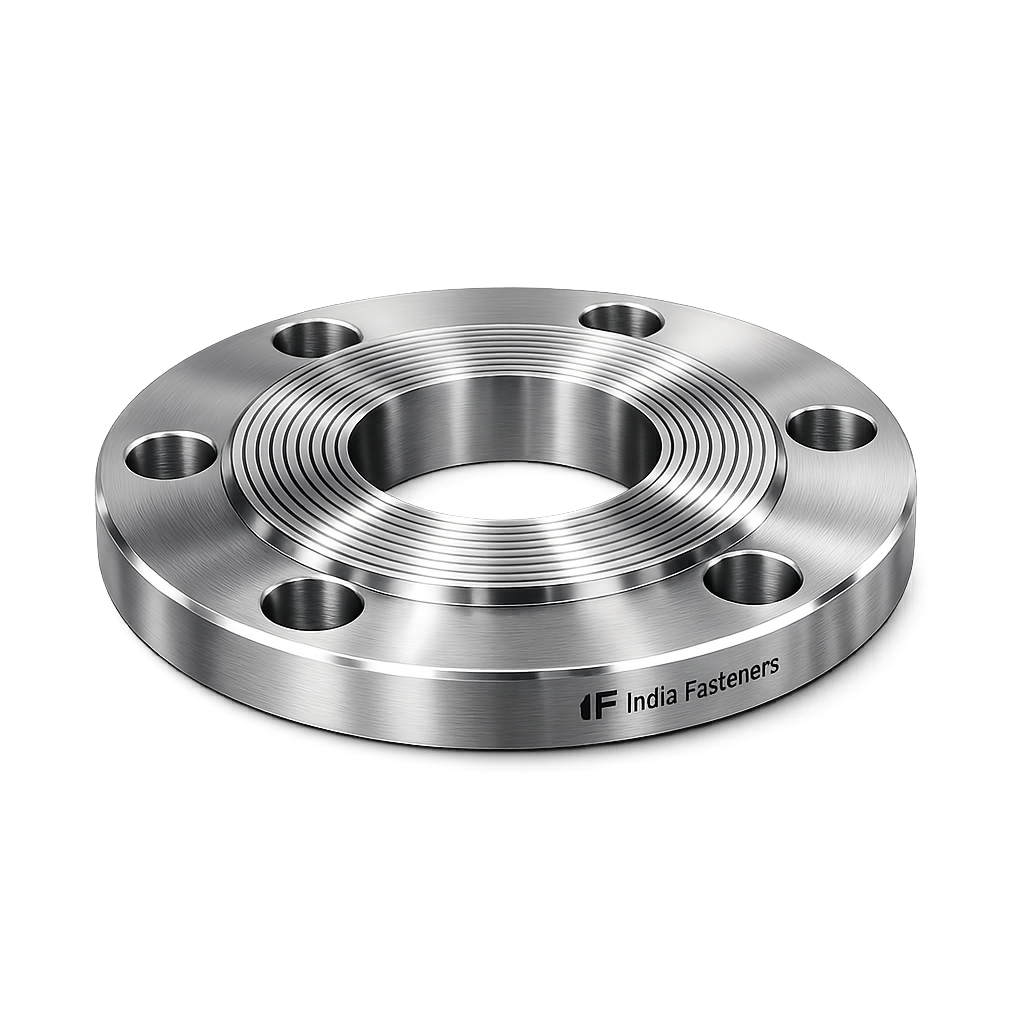
Serrated flange
1. Regional Industry Context — Middle East Process Infrastructure
Hydrocarbon processing facilities across the Gulf Cooperation Council operate under some of the most demanding mechanical joint integrity environments globally. Flanged piping systems represent the primary method of assembling pressure-containing equipment where maintenance access, inspection capability, and operational flexibility are required.
Within these systems, the sealing performance of the flange facing becomes the governing factor controlling leakage risk, emission compliance, and operational reliability.
Primary GCC Applications
1. Saudi Onshore Oil Transmission Pipelines
Long-distance crude and multiphase pipelines operate under:
- High internal pressures
- Cyclic flow variations
- Thermal gradients between day and night desert temperatures
- Vibrational loading from pumping stations
Bolted flange joints must maintain sealing integrity despite mechanical relaxation and pressure fluctuation. Serrated flange facings generate controlled gasket seating stress necessary for maintaining leak-tight performance.
2. Offshore UAE Platforms
Offshore installations introduce additional loading conditions:
- Continuous vibration from rotating equipment
- Marine salt exposure
- Elevated humidity
- Cathodic protection interactions
Serrated flange surfaces prevent gasket slip and improve sealing stability under dynamic loading conditions.
3. LNG Export Terminals — Qatar
Cryogenic and LNG processing environments impose:
- Extreme temperature variation
- Thermal contraction cycles
- Strict fugitive emission control requirements
Controlled serration profiles maintain sealing stress even when gasket materials experience differential contraction.
4. Petrochemical Complexes — Jubail & Ruwais
High-temperature chemical processing units expose flange joints to:
- Hydrogen service
- Aromatic hydrocarbons
- Polymerizing fluids
- Pressure cycling during process transitions
Leak prevention requirements exceed standard industrial expectations. Serrated flange finishes ensure predictable gasket compression behavior.
5. Desalination Facilities
Thermal desalination plants contain:
- High chloride exposure
- Steam service
- Brine corrosion environments
Flange joints must resist corrosion-induced relaxation and maintain consistent gasket sealing stress.
6. Power Generation Steam Systems
Steam headers and turbine auxiliary piping experience:
- Rapid startup cycles
- High temperature expansion
- Continuous vibration
Serrated flange facings stabilize gasket compression during repeated thermal expansion events.
7. Hydrogen & Gas Processing Facilities
Hydrogen molecules present exceptional leakage risk due to molecular size. Micro-leak paths must be eliminated through controlled surface geometry.
Serrated flange finishes interrupt potential leak channels by embedding gasket material into defined groove geometry.
8. District Cooling Networks
Large-diameter chilled water pipelines require repeatable sealing during frequent maintenance shutdowns. Serrated facings ensure predictable resealing performance following disassembly.
2. Technical Definition of Serrated Flange
A Serrated Flange is a metallic flange incorporating precision-machined concentric phonographic grooves on the sealing surface designed to control gasket compression and sealing stress distribution.
The serrated facing forms an engineered energy-transfer interface between:
- Bolt preload
- Flange stiffness
- Gasket material deformation
Core Functional Definition
The serrated face:
- Concentrates compressive stress
- Produces localized gasket deformation
- Creates multiple sealing barriers
- Prevents gasket extrusion
Common Facing Configurations
Raised Face (RF) Serrated Flange
Most widely applied configuration in GCC process piping.
Characteristics:
- Raised sealing area
- Concentrated load region
- Improved gasket seating stress
- Reduced bolt load requirement
Flat Face Serrated Flange
Used where mating equipment requires full-face contact:
- Cast iron equipment
- FRP connections
- Low-pressure utilities
Ring Type Joint Compatibility
Although RTJ flanges use metal-to-metal sealing, serrated secondary faces may be applied for hybrid gasket arrangements or maintenance conversions.
Interaction With Gasket Types
Spiral Wound Gaskets
Serrations embed into filler material:
- Prevent radial movement
- Maintain compression stability
- Enhance recovery characteristics
Soft Gaskets
Fiber or PTFE gaskets rely heavily on serration geometry to prevent blowout and creep.
Metallic Gaskets
Serrations assist load distribution and prevent surface galling.
Applicable Engineering Standards
- ASME B16.5 — Pipe Flanges and Flanged Fittings
- ASME B16.47 — Large Diameter Flanges
- MSS SP-6 — Standard Finishes for Contact Faces
- ASME PCC-1 — Bolted Flange Joint Assembly
- ASME B31.3 — Process Piping Design Requirements
3. Serration Engineering & Sealing Mechanics
The sealing effectiveness of a flange joint depends primarily on controlled surface geometry rather than material strength alone.
Serration Geometry Parameters
Key variables include:
- Groove pitch
- Groove depth
- Surface roughness
- Peak radius
- Concentricity
Typical stock finish range:
125–250 AARH (3.2–6.3 µm Ra)
Gasket Bite Mechanics
Under bolt preload:
- Flange peaks penetrate gasket surface.
- Localized plastic deformation occurs.
- Multiple micro-sealing zones develop.
- Fluid leak paths are interrupted.
Each serration acts as an independent sealing barrier.
Micro-Sealing Mechanism
The sealing principle relies on:
- High localized contact stress
- Controlled gasket deformation
- Elastic recovery after pressure fluctuations
Without serrations, gasket compression spreads over larger area, reducing effective sealing pressure.
Contact Stress Theory
Sealing requires: σc>σmin seating\sigma_c > \sigma_{min\,seating}σc>σminseating
Where:
- σc\sigma_cσc = Contact stress
- σmin seating\sigma_{min\,seating}σminseating = Minimum gasket seating stress
Serrations increase local contact stress without increasing bolt load.
Bolt Load Transfer Mechanism
Energy path:
Bolt Tension → Flange Flexure → Serrated Face → Gasket Compression → Seal Formation
Improper surface finish disrupts this load transfer chain.
Why Smooth Faces Are Unacceptable
Smooth machined faces create:
- Continuous leak channels
- Reduced friction resistance
- Gasket slip during pressure cycling
- Loss of preload stability
GCC hydrocarbon standards therefore specify controlled serrated finishes.
4. Flange Joint Load Distribution Theory
A bolted flange joint behaves as an elastic mechanical system.
Bolt Preload Generation
Torque or tension creates preload:
Where:
 = Bolt preload
 = Applied torque
 = Nut factor
 = Bolt diameter
Elastic Interaction
The joint consists of three spring elements:
- Bolt elasticity
- Flange rigidity
- Gasket compressibility
Correct sealing occurs when bolt stiffness exceeds gasket relaxation rate.
Flange Rotation
Internal pressure causes flange rotation around bolt circle.
Effects:
- Outer edge unloading
- Inner edge compression increase
Serrated surfaces compensate by maintaining sealing friction.
Hydrostatic End Force
Internal pressure attempts to separate the joint: 
Where:
 = Internal pressure
 = Effective gasket area
Bolt preload must exceed hydrostatic separation force.
Gasket Seating Stress
Required seating load: 
Where:
 = Gasket seating stress
 = Gasket contact area
Serrations reduce required bolt load while maintaining sealing performance.
Thermal Expansion Effects
GCC desert operation introduces:
- Day–night temperature swings exceeding 40°C
- Differential expansion between piping materials
Serrated flanges maintain frictional grip during thermal movement.
EPC Safety Margins in Gulf Projects
Typical consultant design philosophy:
- Bolt stress utilization: 50–70% yield
- Minimum seating stress maintained after relaxation
- Leak-tight performance under upset conditions
Serrated flange surfaces form a fundamental requirement within these safety margins.
5. Applicable Materials for Serrated Flanges
Material selection for serrated flanges is not driven solely by pressure rating. In GCC process facilities, the governing considerations include:
- Operating temperature range
- Corrosion environment
- Hydrogen or sour gas exposure
- Mechanical loading behavior
- Weld compatibility with piping materials
- Long-term gasket sealing stability
The flange material must preserve dimensional stability and surface integrity so that serration geometry remains effective throughout service life.
ASTM A105 — Forged Carbon Steel
Engineering Role
Primary material for hydrocarbon and utility piping systems operating within moderate temperature limits.
Characteristics
- Excellent machinability for serration precision
- High structural rigidity
- Stable gasket seating behavior
- Suitable for large production volumes
Typical GCC Applications
- Crude oil pipelines
- Gas transmission headers
- Refinery process lines
- Desalination utilities
- Power plant steam auxiliaries
Operating Temperature Range
−29°C to +425°C
Limitations
- Requires corrosion protection in marine or coastal environments
- Not inherently suitable for sour service without hardness control
ASTM A350 LF2 — Low Temperature Carbon Steel
Designed for low-temperature service where brittle fracture risk must be controlled.
Engineering Importance
LNG facilities and gas processing plants require impact-tested materials maintaining toughness under cryogenic or near-cryogenic conditions.
Key Properties
- Improved notch toughness
- Mandatory Charpy impact testing
- Controlled heat treatment
Typical GCC Applications
- LNG terminals
- Gas fractionation units
- Refrigeration piping
- Export gas lines
ASTM A182 F304 / F316 — Austenitic Stainless Steel
Used where corrosion resistance dominates material selection.
F304 Characteristics
- General corrosion resistance
- Good fabrication performance
- Suitable for non-chloride services
F316 Characteristics
- Molybdenum addition improves pitting resistance
- Preferred for marine and desalination exposure
Typical GCC Applications
- Seawater systems
- Chemical processing units
- Offshore topsides piping
- Instrument impulse lines
Duplex Stainless Steel — ASTM A182 F51 / F60
Duplex materials combine ferritic and austenitic microstructures.
Engineering Advantages
- High yield strength
- Superior chloride stress corrosion resistance
- Reduced flange thickness requirement
- Excellent fatigue resistance
GCC Usage
- Offshore production platforms
- Seawater injection systems
- Firewater networks
- Subsea tie-ins
Alloy Steel — ASTM A182 F11 / F22
Applied in elevated temperature service.
Engineering Function
Maintains mechanical strength during long-term exposure to high temperature creep conditions.
Applications
- Steam lines
- Reformers
- Heat recovery systems
- Power generation plants
ASTM A694 High Yield Grades
High-strength forged materials used for pipeline transmission systems.
Engineering Benefits
- Reduced flange weight
- Improved pressure containment
- Suitable for large diameter pipelines
Typical Applications
- Cross-country pipelines
- Gas transmission networks
- High-pressure pumping stations
Material Selection Philosophy in GCC Projects
Engineering consultants evaluate flange materials using:
- Process fluid compatibility
- Temperature envelope
- NACE MR0175 hardness limits
- Weldability considerations
- Availability of certified forging stock
The serrated sealing surface must maintain geometry throughout the service life; therefore metallurgical stability is directly linked to leak prevention performance.
6. Material Comparison Table
| Grade | Yield Strength (MPa) | Tensile Strength (MPa) | Operating Temperature Range | Corrosion Resistance | Typical GCC Application |
|---|---|---|---|---|---|
| ASTM A105 | ≥250 | 485–620 | −29°C to 425°C | Moderate | Oil & gas process piping |
| ASTM A350 LF2 | ≥250 | 485–655 | −46°C to 345°C | Moderate | LNG & gas processing |
| ASTM A182 F304 | ≥205 | ≥515 | −196°C to 870°C | High | Chemical & offshore service |
| ASTM A182 F316 | ≥205 | ≥515 | −196°C to 870°C | Very High | Seawater & desalination |
| ASTM A182 F51 Duplex | ≥450 | ≥620 | −50°C to 300°C | Excellent | Offshore & subsea |
| ASTM A182 F22 | ≥415 | ≥585 | Up to 600°C | Moderate | High-temperature steam |
| ASTM A694 F52/F60 | ≥360–415 | ≥455–520 | −29°C to 425°C | Moderate | Transmission pipelines |
7. Metallurgical Control & Heat Treatment
Serrated flange performance depends heavily on metallurgical stability. Distortion, hardness variation, or residual stresses can degrade sealing capability.
Normalizing
Purpose:
- Refines grain structure
- Improves toughness
- Enhances dimensional stability during machining
Applied mainly to carbon steel forgings.
Quenching & Tempering
Used for alloy steels and high-strength grades.
Effects:
- Increased strength
- Improved fatigue resistance
- Controlled hardness
Improper tempering may cause flange rotation or surface distortion under load.
Solution Annealing
Required for stainless and duplex materials.
Objectives:
- Dissolve carbides
- Restore corrosion resistance
- Prevent intergranular attack
Cooling rate must prevent sigma phase formation in duplex steels.
Stress Relieving
Reduces machining-induced residual stresses that may:
- Distort serration geometry
- Affect gasket contact stress
- Cause sealing irregularities
Post Weld Heat Treatment (PWHT)
Applied when flanges are welded to piping systems.
Benefits:
- Reduces residual stress
- Prevents hydrogen cracking
- Maintains sealing face flatness
Low Temperature Impact Testing
Mandatory for LNG and gas service materials.
Typical requirements:
- Charpy V-notch testing
- Specified absorbed energy levels
- Traceable heat number documentation
NACE MR0175 Hardness Control
For sour service:
- Hardness typically limited to ≤22 HRC for carbon steels
- Prevents sulfide stress cracking
Hardness exceeding limits risks flange failure despite adequate strength.
Metallurgical Risks Affecting Sealing Integrity
| Risk | Effect on Serrated Flange |
|---|---|
| Overhard material | Gasket damage |
| Residual stress | Face distortion |
| Improper heat treatment | Loss of preload |
| Grain coarsening | Reduced toughness |
| Phase precipitation | Corrosion initiation |
8. Serration Machining Engineering
The sealing performance of a serrated flange depends primarily on machining precision rather than forging quality alone.
CNC Facing Operations
Modern manufacturing uses CNC vertical turning centers to ensure:
- Face perpendicularity to bore
- Controlled tool feed
- Consistent groove geometry
Manual machining cannot reliably achieve required concentric tolerances.
Phonographic Serration Tooling
Serrations are produced using:
- Form-ground cutting tools
- Controlled feed rates
- Continuous spiral machining motion
This produces concentric grooves resembling phonograph records.
Critical Serration Parameters
| Parameter | Engineering Requirement |
|---|---|
| Groove spacing | Uniform distribution |
| Groove depth | Controlled gasket penetration |
| Peak radius | Prevents gasket cutting |
| Surface finish | 125–250 AARH |
| Concentricity | Maintains load symmetry |
Surface Roughness Measurement
Verification performed using:
- Surface profilometers
- Stylus measurement equipment
- Ra and AARH conversion evaluation
Inspection records form part of project documentation packages.
AARH Verification
Typical acceptance:
- 125–250 AARH for RF faces
- Verified at multiple radial locations
- Recorded for third-party inspection
Consequences of Improper Serration
Improper machining leads to:
- Gasket extrusion
- Blowout risk
- Uneven stress distribution
- Fugitive emission leakage
- Failure during pressure testing
In GCC projects, surface finish nonconformance commonly results in rejection by inspection agencies.
9. Manufacturing Process Flow — Documentation Level
Serrated flange production follows a controlled sequence ensuring traceability and dimensional reliability.
1. Raw Material Traceability
- Approved forging stock procurement
- Heat number allocation
- Material test certificate verification
Each flange maintains traceability throughout manufacturing.
2. Heat Number Verification
Incoming material cross-checked against:
- Chemical composition
- Mechanical properties
- Certification documentation
3. Positive Material Identification (PMI)
Performed using spectrometer or XRF equipment to confirm alloy composition.
Essential for mixed-material fabrication environments.
4. Forging Process
Forging objectives:
- Eliminate internal porosity
- Align grain flow
- Improve mechanical properties
Controlled deformation ratios ensure structural integrity.
5. Ring Rolling (Where Applicable)
Large-diameter flanges produced through ring rolling to achieve:
- Uniform grain structure
- Reduced machining allowance
- Improved fatigue resistance
6. CNC Machining
Operations include:
- Bore machining
- Hub profiling
- Facing preparation
- Dimensional tolerance control
7. Serration Facing Machining
Critical stage involving:
- Final sealing surface machining
- Controlled feed speed
- Surface finish verification
This stage directly governs sealing performance.
8. Bolt Hole Drilling
Performed using indexed CNC positioning:
- Equal spacing tolerance
- Bolt circle accuracy
- Alignment with mating flange
9. Heat Treatment
Applied according to material specification:
- Normalizing
- Q&T
- Solution annealing
Heat treatment records retained for documentation packages.
10. Dimensional Inspection
Verification against ASME B16.5/B16.47 includes:
- Outside diameter
- Thickness
- Bore tolerance
- Raised face height
- Bolt circle location
11. Surface Finish Inspection
Profilometer verification ensures serration compliance with MSS SP-6.
12. Marking & Traceability
Each flange marked with:
- Material grade
- Heat number
- Pressure class
- Size
- Manufacturer identification
Traceability maintained through packing and shipment.
Concentricity and Flatness Control
Engineering requirement:
- Face flatness maintained within specified tolerance
- Concentric serrations centered relative to bore axis
Loss of concentricity results in uneven gasket compression and potential leakage.
10. Dimensional Reference Tables — ASME Serrated Flanges
Dimensional accuracy directly governs flange joint integrity. EPC consultants evaluate flange dimensional conformity against ASME B16.5 and ASME B16.47 requirements before approving installation.
The following reference values represent standard Raised Face serrated flange geometry typically applied in GCC hydrocarbon facilities.
ASME B16.5 Raised Face Serrated Flange — Typical Dimensions
| NPS (in) | Pressure Class | Flange OD (mm) | Bolt Circle (mm) | Bolt Holes | Bolt Size (mm) | RF Height (mm) | Serration Finish |
|---|---|---|---|---|---|---|---|
| 1 | 150 | 108 | 79 | 4 | M16 | 1.6 | 125–250 AARH |
| 2 | 150 | 152 | 121 | 4 | M16 | 1.6 | 125–250 AARH |
| 4 | 150 | 229 | 190 | 8 | M16 | 1.6 | 125–250 AARH |
| 6 | 300 | 318 | 270 | 12 | M20 | 1.6 | 125–250 AARH |
| 8 | 300 | 381 | 330 | 12 | M20 | 1.6 | 125–250 AARH |
| 10 | 600 | 483 | 387 | 16 | M24 | 1.6 | 125–250 AARH |
| 12 | 600 | 559 | 451 | 20 | M24 | 1.6 | 125–250 AARH |
| 16 | 900 | 686 | 559 | 20 | M30 | 1.6 | 125–250 AARH |
| 20 | 1500 | 914 | 762 | 24 | M36 | 1.6 | 125–250 AARH |
| 24 | 2500 | 1067 | 914 | 24 | M42 | 1.6 | 125–250 AARH |
Engineering Note
Raised face height maintains controlled gasket compression zone independent of flange outside geometry.
11. Pressure Rating Table — ASME Classes
Flange pressure class does not represent allowable operating pressure alone. Ratings depend on temperature and material strength.
ASME Pressure Classes Converted to MPa
| Class | Approx. Pressure Rating (MPa) | Typical Service |
|---|---|---|
| 150 | 1.9 MPa | Utilities & low-pressure hydrocarbon |
| 300 | 5.0 MPa | Refinery process lines |
| 600 | 10.2 MPa | High-pressure process systems |
| 900 | 15.3 MPa | Gas compression facilities |
| 1500 | 25.5 MPa | Critical hydrocarbon service |
| 2500 | 42.5 MPa | High-pressure reactors & injection |
Temperature Derating Principle — ASME B16.5
Allowable pressure decreases with temperature increase due to material strength reduction. 
Where:
 = allowable pressure at temperature
 = reference pressure rating
 = temperature reduction factor
Engineering practice in GCC projects requires confirmation of pressure-temperature ratings during design review.
12. Serration Finish Specification Table (MANDATORY)
Surface finish directly controls gasket seating performance.
| Facing Type | Groove Density | Finish Range (AARH) | Compatible Gaskets | Typical Application |
|---|---|---|---|---|
| Raised Face RF | 30–55 grooves/in | 125–250 | Spiral wound | Hydrocarbon service |
| Flat Face | 30–55 grooves/in | 125–250 | Non-metallic | Utility systems |
| Tongue & Groove | Precision machined | 63–125 | Metallic | High pressure |
| RTJ Secondary Face | Controlled smooth | 63 max | Metal ring | Extreme pressure |
| Custom Fine Serration | High density | 90–125 | PTFE | Chemical service |
Engineering Requirement
Surface finishes smoother than specification reduce frictional grip. Rougher finishes risk gasket damage.
13. Bolt Torque Chart (MANDATORY)
Bolt preload governs sealing success. Torque values are calculated to achieve required bolt stress while accounting for friction losses.
Typical Torque Values — ASTM A193 B7 Bolting
(Approximate values assuming K = 0.18 lubricated)
| Bolt Size | Torque Lubricated (Nm) | Torque Dry (Nm) | Approx Bolt Stress (% Yield) |
|---|---|---|---|
| M16 | 110 | 150 | 60% |
| M20 | 215 | 295 | 60% |
| M24 | 370 | 500 | 60% |
| M30 | 750 | 1020 | 65% |
| M36 | 1300 | 1750 | 65% |
| M42 | 2100 | 2850 | 70% |
ASTM A320 L7 — Low Temperature Service
Torque values typically similar but applied using controlled tightening to prevent brittle fracture risks.
ASME PCC-1 Tightening Philosophy
- Multiple tightening passes required
- Cross-pattern bolt sequence mandatory
- Final verification pass recommended
- Torque scatter must be minimized
Preferred tightening methods:
- Torque control
- Hydraulic tensioning
- Bolt elongation measurement
14. Flange Leakage Prevention Engineering Guide
Leakage prevention depends on maintaining adequate gasket seating stress throughout operating life.
Minimum Seating Stress Requirement

Where:
 = bolt load
- = gasket area
Serrated faces increase effective stress by concentrating load at groove peaks.
Gasket Creep Relaxation
Over time:
- Gasket thickness reduces
- Bolt load decreases
- Seal integrity reduces
Serrations reduce creep impact by anchoring gasket material.
Thermal Relaxation
Temperature cycling causes:
- Bolt elongation variation
- Differential expansion
- Loss of preload
Engineering mitigation:
- Proper lubrication
- Controlled tightening
- Correct serration finish
Bolt Scatter
Variations in friction cause unequal bolt load distribution.
Typical scatter without lubrication: ±35%
With controlled lubrication: ±15%
Elastic Recovery Principle
After pressure fluctuation:
- Gasket attempts recovery
- Serrations maintain mechanical engagement
- Seal continuity preserved
Sample Sealing Integrity Calculation
Assume:
- Pressure = 8 MPa
- Effective gasket diameter = 300 mm
Hydrostatic force: 
Bolt preload must exceed hydrostatic force plus seating requirement.
Serrated flange surfaces allow lower bolt load while maintaining required sealing stress.
15. Mechanical Property Table
| Material | Yield Strength (MPa) | Tensile Strength (MPa) | Hardness | Elongation (%) | Impact Energy |
|---|---|---|---|---|---|
| A105 | ≥250 | 485–620 | ≤187 HB | 22 | Moderate |
| LF2 | ≥250 | 485–655 | ≤187 HB | 22 | High |
| F304 | ≥205 | ≥515 | ≤201 HB | 30 | High |
| F316 | ≥205 | ≥515 | ≤217 HB | 30 | High |
| Duplex F51 | ≥450 | ≥620 | ≤290 HB | 25 | High |
| F22 | ≥415 | ≥585 | ≤220 HB | 20 | Moderate |
Mechanical properties influence flange rigidity, which directly affects gasket seating stability.
16. Corrosion Resistance Comparison Table
| Material | Marine Exposure | Humidity | Sour Gas | Hydrocarbon Service | Desert Temperature Stability |
|---|---|---|---|---|---|
| Carbon Steel | Low | Moderate | Limited | Good | Excellent |
| SS304 | Moderate | High | Moderate | Good | Excellent |
| SS316 | High | Excellent | Good | Excellent | Excellent |
| Duplex | Excellent | Excellent | Excellent | Excellent | Excellent |
| Alloy Steel | Moderate | Moderate | Limited | Excellent | Excellent |
Material degradation can alter flange flatness and serration integrity; therefore corrosion allowance selection is critical.
17. Inspection & Quality Assurance
GCC EPC projects apply extensive inspection protocols prior to acceptance of serrated flanges.
Positive Material Identification (PMI)
Confirms chemical composition:
- Prevents alloy mix-up
- Mandatory for stainless and duplex materials
- Required during third-party inspection
Ultrasonic Testing (UT)
Detects internal forging defects:
- Shrinkage cavities
- Laminations
- Inclusion clusters
Magnetic Particle Inspection (MPI)
Applied to carbon and alloy steels to identify:
- Surface cracks
- Forging discontinuities
Dye Penetrant Inspection (DPI)
Used for stainless materials where MPI is unsuitable.
Dimensional Inspection
Verification includes:
- Bore alignment
- Bolt hole spacing
- Raised face dimensions
- Flatness tolerance
- Perpendicularity
Surface Finish Inspection
Critical inspection activity for serrated flanges:
- Profilometer measurement
- Groove verification
- Surface roughness documentation
Nonconforming surface finish is treated as functional rejection.
Hardness Testing
Ensures compliance with:
- Material specifications
- NACE sour service limits
Third-Party Inspection Readiness
Documentation typically reviewed by independent inspection bodies:
- TÜV
- Bureau Veritas
- SGS
- Lloyd’s Register
Inspection scope includes witnessing manufacturing and reviewing traceability.
Certification Requirements
Typical documentation supplied:
- EN 10204 3.1 Material Test Certificate
- Heat treatment records
- NDT reports
- Dimensional inspection reports
- Surface finish verification
- PMI reports
For critical projects, EN 10204 3.2 certification may be requested with third-party endorsement.
18. Industries Served — Middle East Engineering Applications
Serrated flanges are deployed where bolted joint sealing reliability directly influences plant safety, environmental compliance, and operational continuity. Within GCC industrial infrastructure, flange joints are treated as engineered pressure boundaries rather than simple mechanical connectors.
Upstream Oil & Gas Facilities
Upstream installations include:
- Wellhead flowlines
- Gathering systems
- Separation units
- Gas compression stations
Operating Conditions:
- Pressure fluctuations from production variability
- Sand and particulate erosion
- Sour gas exposure
- Remote operating environments
Engineering Role of Serrated Flanges
Serrated sealing surfaces ensure gasket anchoring under vibration and pulsation loading. The serration profile prevents gasket migration commonly observed in smooth-faced connections during pressure cycling.
Leak prevention at wellhead and gathering systems is critical due to flammable hydrocarbon presence and remote inspection intervals.
Refinery Processing Units
Refinery piping systems operate across multiple pressure and temperature envelopes:
- Crude distillation
- Hydrocracking
- Reforming units
- Delayed coking systems
- Hydrogen processing
Refineries impose strict fugitive emission requirements.
Serrated Flange Contribution
- Maintains seating stress during thermal expansion
- Supports spiral wound gasket performance
- Limits hydrocarbon vapor leakage
- Reduces maintenance re-tightening frequency
Process licensors and EPC consultants typically specify stock finish serrated facings in refinery service.
Petrochemical Plants
Petrochemical facilities process aggressive chemical streams including aromatics, olefins, and polymers.
Engineering challenges include:
- Chemical attack
- Temperature transients
- High joint density
- Continuous operation requirements
Serrated flange faces stabilize gasket compression, preventing relaxation that may lead to emissions or contamination.
LNG Facilities
Liquefied natural gas systems introduce extreme temperature variations between ambient and cryogenic service.
Primary concerns:
- Thermal contraction
- Gasket hardening
- Reduced bolt preload
Serrated flange geometry enhances mechanical engagement between gasket and flange, supporting sealing reliability through temperature transitions.
Desalination Plants
Thermal and reverse-osmosis desalination systems operate in chloride-rich environments.
Engineering risks include:
- Pitting corrosion
- Bolt relaxation due to temperature cycling
- Salt deposition
Serrated facings maintain gasket stability even when minor corrosion occurs outside sealing zones.
Power Generation Facilities
Steam and combined-cycle power plants operate under:
- High-temperature creep conditions
- Startup/shutdown cycling
- Vibration from turbines and pumps
Serrated flange sealing surfaces ensure uniform compression distribution across spiral wound gaskets used in steam service.
District Cooling Networks
Large-diameter chilled water pipelines require frequent maintenance access.
Repeated disassembly can damage sealing surfaces; serrated finishes maintain predictable resealing behavior after maintenance activities.
Pipeline Infrastructure
Transmission pipelines across Saudi Arabia, UAE, Oman, and Kuwait depend on reliable flange joints at:
- Pump stations
- Valve stations
- Metering skids
- Pig launchers and receivers
Serrated flanges support consistent sealing performance during pressure surge events.
19. Export & GCC Supply Capability
Supplying serrated flanges to Middle East EPC projects requires manufacturing discipline extending beyond machining operations into logistics, documentation, and preservation practices.
Export Regions Served
Flange Face Protection
Mandatory protective measures include:
- Rigid face protectors
- Raised face covers
- RTJ groove protection where applicable
Protection prevents:
- Serration deformation
- Surface contamination
- Handling damage
Documentation Package Structure
Typical EPC shipment documentation includes:
- Material Test Certificates (EN 10204 3.1 / 3.2)
- Dimensional inspection reports
- Heat treatment charts
- Surface finish verification
- PMI reports
- NDT records
- Packing lists
- Traceability matrix
Documentation forms part of project turnover records reviewed by consultants and inspection agencies.
Inspection Release Documentation
Prior to shipment:
- Final inspection release note issued
- Third-party inspection clearance obtained when required
- Traceability verified against purchase order and project specification
Traceability Systems
Each serrated flange remains traceable through:
- Heat number marking
- Manufacturing batch record
- Inspection documentation linkage
- Packing identification
Traceability is maintained from raw forging to site delivery.
Container Loading Practices
Export loading procedures consider Gulf climate conditions:
- Desiccant use inside containers
- Segregation of stainless and carbon steels
- Mechanical blocking to prevent movement
- Protection from condensation during sea transit
20. Installation & Bolted Joint Assembly — Engineering View
Correct installation determines whether serrated flange engineering benefits are realized in service.
Installation practices follow principles described in ASME PCC-1.
Flange Alignment Requirements
Before assembly:
- Flange faces must be parallel
- Misalignment must remain within allowable tolerance
- Piping stress must not be corrected using bolt force
Improper alignment leads to uneven gasket compression regardless of serration quality.
Gasket Placement Rules
- Gasket centered within raised face
- No reuse of compressed gaskets
- Gasket surface clean and undamaged
- Compatibility confirmed with process service
Serrated faces rely on controlled initial gasket deformation.
Bolt Tightening Cross Pattern
Recommended tightening sequence:
- Hand tightening
- 30% torque pass
- 60% torque pass
- 100% torque pass
- Circumferential verification pass
Cross-pattern tightening minimizes flange rotation.
Torque vs Tension Method
Torque Method
- Most common
- Sensitive to friction variation
Hydraulic Tensioning
- Preferred for large diameter flanges
- Provides uniform preload
- Reduces bolt scatter
Lubrication Requirements
Approved lubricants reduce friction variation and improve preload accuracy.
Benefits:
- Reduced galling
- Improved bolt stress consistency
- Lower torque requirement
Field Inspection Checklist
Prior to pressurization:
- Surface cleanliness verified
- Bolt grade confirmed
- Washer installation checked
- Torque records completed
- Alignment verified
- Gasket certification confirmed
Storage Practices — Gulf Climate
Field storage requirements include:
- Protection from sand contamination
- Elevated storage above ground
- Face covers retained until installation
- Avoidance of direct sun exposure where possible
Loss of serration cleanliness may compromise sealing performance.
21. Custom Engineering Capability
Complex EPC projects frequently require deviations from standard flange configurations. Serrated flange manufacturing must therefore support engineered customization while maintaining compliance.
Non-Standard Sizes
Capability includes production outside standard ASME dimensional ranges:
- Large diameter special flanges
- Project-specific drilling patterns
- Custom hub dimensions
Engineering review ensures compatibility with piping stress calculations.
Special Serration Finishes
Project specifications may require:
- Fine serration for PTFE gaskets
- Modified groove density
- Controlled sealing stress profiles
Surface finish is verified using calibrated profilometry equipment.
NACE-Compliant Supply
For sour service environments:
- Hardness control maintained
- Heat treatment documented
- Material certification aligned with NACE MR0175 requirements
RTJ + Serrated Hybrid Designs
Certain applications require:
- RTJ primary sealing
- Serrated secondary sealing face
Used where operational flexibility or maintenance conversion is anticipated.
Heavy Wall Flanges
High-pressure reactors and hydrogen service systems may require:
- Increased hub thickness
- Reinforced stress distribution
- Enhanced rigidity against rotation
Project Stamping & Identification
Flanges may be marked according to project requirements:
- Client tag numbers
- Line numbers
- Heat traceability identifiers
- Inspection authority stamping
Marine Coating Systems
For offshore and coastal installations:
- Anti-corrosion coating systems
- Temporary preservation coatings
- Long-duration shipment protection
Coatings applied without affecting serrated sealing surfaces.
Engineering Conclusion — GCC Consultant Perspective
Serrated flanges function as precision sealing interfaces rather than general mechanical components. Their effectiveness depends on the combined interaction of:
- Controlled metallurgical properties
- Accurate serration machining
- Verified surface finish
- Correct bolt preload application
- Proper installation discipline
Within GCC hydrocarbon, LNG, power, and desalination projects, consultant approval is typically granted only when the manufacturer demonstrates comprehensive understanding of bolted joint mechanics and sealing behavior.
A serrated flange supplied under documented manufacturing control, traceability discipline, and inspection readiness satisfies the expectations of EPC contractors, inspection authorities, and end users operating critical pressure systems.