
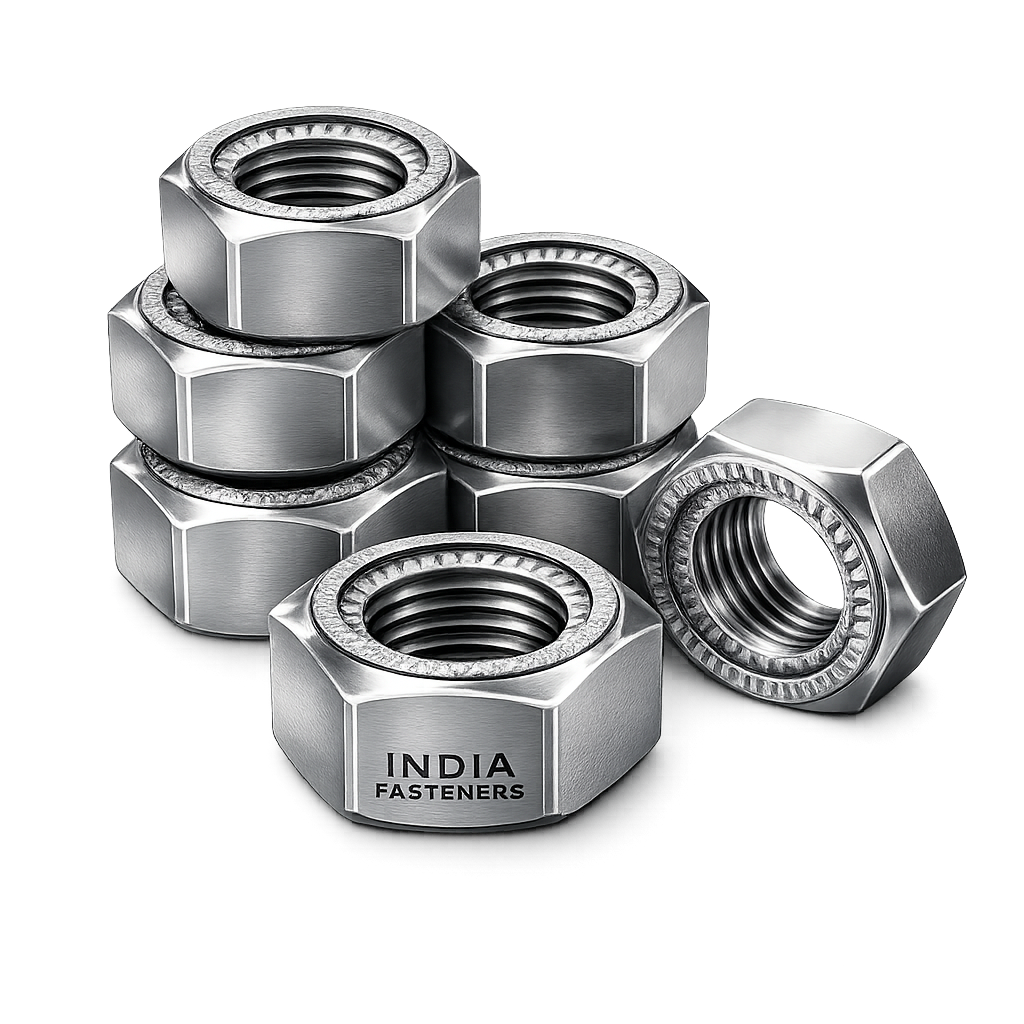
All Metal Lock Nuts
1. Regional Industry Context — Middle East Critical Service Environment
Bolted joint reliability is a primary mechanical integrity concern across Middle East energy and infrastructure facilities. The operating conditions typical to Gulf Cooperation Council (GCC) projects create combined mechanical, thermal, and environmental stresses that directly influence fastener performance.
All Metal Lock Nuts are deployed in these environments to address loss of preload caused by vibration, cyclic loading, and elevated temperatures where conventional locking solutions are insufficient.
Primary GCC Industrial Applications
Oil & Gas Upstream Facilities
- Wellhead assemblies
- Christmas tree connections
- Separator skids
- Drill floor equipment
- Pipeline manifolds
Upstream installations experience:
- pressure pulsation,
- dynamic vibration,
- temperature variation,
- corrosive hydrocarbon exposure.
Bolted joints must maintain clamp force without dependence on polymer-based locking elements.
Offshore Platforms — Arabian Gulf Conditions
Offshore facilities introduce simultaneous mechanical and environmental loading:
- Continuous wave-induced vibration
- Salt-laden marine atmosphere
- High humidity corrosion acceleration
- Thermal cycling between day and night operation
Self-loosening caused by transverse vibration is a recognized failure mode in offshore bolting systems. Metal locking mechanisms remain stable where elastomer inserts degrade.
Petrochemical Complexes (Jubail / Ruwais Type Installations)
Petrochemical plants operate under:
- sustained high temperature process conditions,
- rotating equipment vibration,
- aggressive chemical exposure,
- long operational cycles between shutdowns.
Applications include:
- heat exchanger bolting,
- reactor access flanges,
- compressor base frames,
- pipe support assemblies.
Prevailing torque lock nuts provide mechanical resistance independent of friction loss.
LNG Plants — Cryogenic to High Temperature Transition
LNG facilities introduce wide temperature variation:
- cryogenic piping systems,
- regasification units,
- compressor trains,
- loading arm structures.
Thermal expansion mismatch between bolt and joint members leads to preload relaxation. All Metal Lock Nuts maintain resistance to rotation even after partial preload reduction.
Gas Compression Stations
Gas compressors generate continuous cyclic vibration.
Common failure observations in standard bolting:
- nut rotation under transverse excitation,
- reduction in clamp load,
- fatigue crack initiation.
Prevailing torque nuts introduce controlled rotational resistance preventing spontaneous loosening.
Power Generation Turbine Installations
Applications include:
- gas turbine casings,
- generator foundations,
- exhaust systems,
- structural equipment anchoring.
High-frequency vibration combined with thermal expansion eliminates effectiveness of traditional lock washers.
Desalination Plants
Operating factors:
- saline atmosphere,
- elevated humidity,
- constant vibration from pumps and rotating machinery.
All-metal locking solutions avoid degradation associated with polymer locking systems.
Pipeline Pumping Stations
Large diameter pipelines generate:
- pressure surges,
- start-stop vibration,
- structural oscillation.
Mechanical locking systems maintain joint security during transient loading events.
Heavy Rotating Equipment Foundations
Examples:
- compressors,
- centrifugal pumps,
- blowers,
- large electric motors.
Joint reliability directly influences equipment alignment and bearing life.
Why Vibration Loosening Is a Primary Failure Mode in GCC Facilities
The dominant mechanism is transverse cyclic displacement rather than direct torque loss.
Contributing factors:
- Rotational machinery excitation.
- Sand-induced micro-abrasion reducing friction.
- Thermal expansion differences.
- Pressure pulsation in piping systems.
- Structural resonance amplification.
Even correctly torqued bolts may loosen without mechanical locking resistance.
Environmental Effects Unique to GCC Installations
High Ambient Temperature
Typical surface temperatures:
- 50–70°C external exposure.
- Higher near process equipment.
Polymer inserts soften or creep under heat.
Sand & Dust Intrusion
Fine particles reduce thread friction stability and accelerate embedment relaxation.
Thermal Cycling
Daily expansion/contraction causes:
- preload decay,
- micro-slip at contact surfaces.
Limitations of Nylon Insert Lock Nuts
Nylon insert nuts are unsuitable for many hydrocarbon facilities because:
- polymer softening occurs above ~120°C,
- fire exposure causes rapid failure,
- chemical attack degrades insert material,
- loss of locking capability after limited reuse.
GCC EPC specifications frequently prohibit polymer lock nuts in critical bolted joints.
Requirement for Metal Locking Systems
Metal locking nuts provide:
- temperature independence,
- fire resistance,
- vibration resistance,
- predictable prevailing torque performance,
- repeated installation capability under controlled limits.
2. Technical Definition of All Metal Lock Nut
An All Metal Lock Nut is a prevailing torque type self-locking nut designed to resist loosening through controlled metal-to-metal interference within the threaded engagement.
Primary Characteristics
- No polymer insert.
- Locking achieved through controlled thread deformation.
- Generates resistance torque independent of clamp load.
- Maintains locking function even under partial preload loss.
Prevailing Torque Concept
Prevailing torque is defined as:
The torque required to rotate a nut on a bolt without clamp load applied.
This torque results from elastic deformation within the locking portion of the nut.
Two torque components exist: 
Where:


Metal-to-Metal Locking Mechanisms
1. Top Thread Deformation
Upper threads intentionally distorted during manufacturing to create interference fit.
2. Elliptical Offset Thread
Thread diameter slightly ovalized, producing radial pressure against bolt threads.
3. Slotted Crown Locking
Segmented deformation provides elastic recovery maintaining constant locking force.
4. Cone Locking Principle
Tapered geometry induces radial compression during installation.
5. Distorted Thread Locking
Local plastic deformation generates controlled frictional resistance.
Applicable Standards
| Standard | Scope |
|---|---|
| ASTM A194 | Alloy and carbon steel nuts |
| ASTM A563 | Carbon steel structural nuts |
| ISO 7042 | All-metal prevailing torque nuts |
| ISO 2320 | Prevailing torque testing |
| ASME B18.2.2 | Dimensional requirements |
Lock Nut vs Double Nut Method
Double nut systems depend on friction interaction between nuts.
Limitations:
- installation complexity,
- variable preload,
- space constraints,
- unreliable under vibration.
All Metal Lock Nuts provide engineered locking without secondary components.
Limitations of Lock Washers
Lock washers fail under vibration because:
- joint slip eliminates spring force,
- washer flattens under preload,
- no resistance to transverse motion.
Prevailing torque nuts directly resist rotation rather than relying on surface friction.
Self-Loosening Prevention Theory
A bolted joint loosens when transverse displacement exceeds frictional resistance between threads.
All Metal Lock Nuts introduce additional rotational resistance: Mresistance>MvibrationM_{resistance} > M_{vibration}Mresistance>Mvibration
ensuring stability under dynamic loading.
3. Bolted Joint Mechanics & Self-Loosening Theory
Understanding locking nut performance requires analysis of bolted joint mechanics.
Junker Vibration Effect
The Junker test demonstrates that transverse movement causes rapid preload loss even when torque is correct.
Observed sequence:
- micro-slip begins,
- preload decreases,
- rotation initiates,
- joint separation occurs.
Prevailing torque nuts delay or prevent step 3.
Loss of Preload Mechanisms
Embedment Relaxation
Surface asperities flatten after installation.
Typical preload loss:
- 2–10% immediately after tightening.
Thermal Expansion Mismatch
Different expansion rates between bolt and clamped members alter tension.
Dynamic Loading
Repeated shear forces reduce friction coefficient stability.
Metal-to-Metal Locking Mechanisms
1. Top Thread Deformation
Upper threads intentionally distorted during manufacturing to create interference fit.
2. Elliptical Offset Thread
Thread diameter slightly ovalized, producing radial pressure against bolt threads.
3. Slotted Crown Locking
Segmented deformation provides elastic recovery maintaining constant locking force.
4. Cone Locking Principle
Tapered geometry induces radial compression during installation.
5. Distorted Thread Locking
Local plastic deformation generates controlled frictional resistance.
Applicable Standards
| Standard | Scope |
|---|---|
| ASTM A194 | Alloy and carbon steel nuts |
| ASTM A563 | Carbon steel structural nuts |
| ISO 7042 | All-metal prevailing torque nuts |
| ISO 2320 | Prevailing torque testing |
| ASME B18.2.2 | Dimensional requirements |
Lock Nut vs Double Nut Method
Double nut systems depend on friction interaction between nuts.
Limitations:
- installation complexity,
- variable preload,
- space constraints,
- unreliable under vibration.
All Metal Lock Nuts provide engineered locking without secondary components.
Limitations of Lock Washers
Lock washers fail under vibration because:
- joint slip eliminates spring force,
- washer flattens under preload,
- no resistance to transverse motion.
Prevailing torque nuts directly resist rotation rather than relying on surface friction.
Self-Loosening Prevention Theory
A bolted joint loosens when transverse displacement exceeds frictional resistance between threads.
All Metal Lock Nuts introduce additional rotational resistance: Mresistance>MvibrationM_{resistance} > M_{vibration}Mresistance>Mvibration
ensuring stability under dynamic loading.
3. Bolted Joint Mechanics & Self-Loosening Theory
Understanding locking nut performance requires analysis of bolted joint mechanics.
Junker Vibration Effect
The Junker test demonstrates that transverse movement causes rapid preload loss even when torque is correct.
Observed sequence:
- micro-slip begins,
- preload decreases,
- rotation initiates,
- joint separation occurs.
Prevailing torque nuts delay or prevent step 3.
Loss of Preload Mechanisms
Embedment Relaxation
Surface asperities flatten after installation.
Typical preload loss:
- 2–10% immediately after tightening.
Thermal Expansion Mismatch
Different expansion rates between bolt and clamped members alter tension.
Dynamic Loading
Repeated shear forces reduce friction coefficient stability.
Bolt Preload Equation

Where:
 = preload force
 = applied torque
 = torque coefficient
 = nominal diameter
Torque–Tension Relationship
Approximate relation:
![\[T = K \times F \times D\]](https://indiafastners.com/wp-content/ql-cache/quicklatex.com-ce1763d0c365717f9544d872e010b394_l3.png "Rendered by QuickLaTeX.com")
Typical torque coefficient values:
- Lubricated: 0.15–0.18
- Dry: 0.20–0.25
Clamp Force Equation

Where:
 = tensile stress area
 = proof strength
 = safety factor
Influence of Friction Coefficient
Over 85% of applied torque is consumed overcoming friction.
All Metal Lock Nuts intentionally increase friction within controlled limits without compromising preload accuracy.
Prevailing Torque Calculation

Where:
 = radial interference force
 = effective thread radius
 = friction coefficient
GCC EPC Mechanical Design Philosophy
Middle East EPC specifications prioritize:
- predictable preload retention,
- resistance to vibration loosening,
- fire-safe mechanical locking,
- inspectable installation methods,
- repeatable performance across maintenance cycles.
All Metal Lock Nuts align with this philosophy by providing independent mechanical locking rather than relying solely on torque accuracy.
4. Applicable Material Standards — Mapped to GCC Operating Conditions
Material selection for All Metal Lock Nuts used in Middle East EPC projects is governed by mechanical strength requirements, temperature exposure, corrosion environment, hydrogen service risks, and inspection authority expectations.
Fastener material is not selected solely on strength. In GCC hydrocarbon facilities, material compatibility with process service and long-term metallurgical stability determines qualification acceptance.
ASTM A194 — High Integrity Pressure Equipment Nuts
ASTM A194 specifies carbon, alloy, and stainless steel nuts intended for high-pressure and high-temperature service.
ASTM A194 Grade 2H
Material Type: Quenched and tempered carbon steel
Typical Use: Standard pressure equipment bolting
Characteristics
- High strength capability
- Stable at elevated temperature
- Suitable for flange bolting with ASTM A193 B7 bolts
- Widely approved across GCC EPC specifications
Typical Applications
- Refinery piping
- Pressure vessels
- Heat exchangers
- Pump casings
Temperature Range
- −29°C to 425°C (typical service envelope)
ASTM A194 Grade 7
Material Type: Alloy steel heat-treated nut
Used where higher temperature resistance is required.
Applications
- Steam service
- High-pressure piping
- Turbine systems
Provides improved creep resistance compared to Grade 2H.
ASTM A194 Grade 8
Material Type: Stainless Steel (304 series)
Characteristics
- Excellent atmospheric corrosion resistance
- Non-magnetic condition after solution annealing
- Suitable for marine and desalination environments
Limitations
- Galling risk without lubrication
- Not recommended for high chloride stress cracking environments at elevated temperatures.
ASTM A194 Grade 8M
Material Type: Stainless Steel 316
Preferred for offshore and coastal installations.
Advantages
- Improved pitting resistance
- Chloride environment suitability
- Desalination plant compatibility
Common GCC applications:
- seawater systems,
- offshore platforms,
- marine structural assemblies.
ASTM A194 Grade 4
Material Type: Alloy steel quenched and tempered
Designed for higher temperature strength retention.
Used in:
- thermal power plants,
- refinery heaters,
- high-temperature piping.
ASTM A194 Grade 16
High strength alloy steel grade developed for severe service.
Applications include:
- high-pressure reactors,
- critical rotating equipment,
- severe cyclic loading environments.
ASTM A563 — Structural Lock Nut Materials
ASTM A563 covers carbon steel nuts for structural bolting applications.
Grade DH
- Heat-treated carbon steel
- High strength structural applications
- Frequently paired with ASTM A325/A490 structural bolts
Used in:
- pipe racks,
- steel structures,
- equipment foundations.
Grade C
Medium strength carbon steel nut.
Typical uses:
- secondary structures,
- supports,
- non-pressure assemblies.
Grade A
General purpose carbon steel material used where strength demands are moderate.
Special Material Options for GCC Projects
Stainless Steel 304 (A2)
Applications:
- atmospheric exposure,
- HVAC structures,
- instrumentation supports.
Operating temperature:
- up to ~400°C intermittent.
Stainless Steel 316 (A4)
Preferred where chloride exposure exists.
Common in:
- offshore installations,
- desalination facilities,
- coastal power plants.
Duplex Stainless Steel
Used where combined strength and corrosion resistance are required.
Advantages:
- higher yield strength than austenitic stainless steel,
- strong resistance to chloride stress corrosion cracking,
- suitable for seawater systems.
Typical use:
- subsea structures,
- offshore skids,
- sour gas environments.
Alloy Steel (Cr-Mo Grades)
Chromium-molybdenum steels used in elevated temperature systems:
Applications:
- steam piping,
- refinery heaters,
- turbine bolting.
Material Selection vs GCC Service Conditions
| Service Condition | Recommended Material |
|---|---|
| Standard refinery service | ASTM A194 2H |
| High temperature steam | ASTM A194 7 |
| Offshore marine exposure | ASTM A194 8M |
| Sour gas service | Controlled hardness alloy steel / duplex |
| LNG facilities | Stainless or alloy steel |
| Structural foundations | ASTM A563 DH |
Hydrogen & Sour Service Considerations
GCC hydrocarbon plants frequently operate under sour service conditions.
Material requirements include:
- hardness limitation control,
- resistance to sulfide stress cracking,
- hydrogen embrittlement prevention.
Compliance considerations typically reference NACE MR0175 philosophy:
- hardness limits generally ≤22 HRC for carbon/alloy steels,
- controlled heat treatment mandatory,
- traceable metallurgy verification required.
5. Material Comparison Table
| Grade | Yield Strength (MPa) | Tensile Strength (MPa) | Temperature Range | Corrosion Resistance | Typical GCC Application |
|---|---|---|---|---|---|
| A194 2H | ~660 | ~860 | −29°C to 425°C | Moderate | Pressure vessel flanges |
| A194 7 | ~720 | ~940 | Up to 500°C | Moderate | Steam systems |
| A194 8 | ~205 | ~515 | −196°C to 400°C | Good | LNG & atmospheric |
| A194 8M | ~205 | ~515 | −196°C to 400°C | Very High | Offshore / desalination |
| A563 DH | ~620 | ~830 | Ambient | Moderate | Structural steel |
| Duplex SS | ~450 | ~620 | −50°C to 300°C | Excellent | Offshore equipment |
| Cr-Mo Alloy | 600–750 | 800–1000 | Up to 550°C | Moderate | High temp refinery units |
Values are representative engineering ranges.
6. Heat Treatment & Metallurgical Control
Mechanical locking performance depends heavily on metallurgical stability. Improper heat treatment produces unstable prevailing torque values and potential cracking.
Quenching & Tempering
Applied to carbon and alloy steel lock nuts.
Process sequence:
- Austenitizing
- Rapid quench
- Controlled tempering
Purpose:
- achieve required strength,
- maintain ductility,
- prevent brittle fracture.
Stress Relieving
Performed after deformation locking operation when required.
Benefits:
- reduces residual stresses,
- stabilizes thread geometry,
- improves fatigue performance.
Solution Annealing — Stainless Steel
Required for austenitic stainless grades.
Objectives:
- dissolve carbides,
- restore corrosion resistance,
- eliminate sensitization risk.
Grain Flow Control
Forged nuts maintain directional grain flow improving:
- fatigue resistance,
- crack propagation resistance,
- load distribution.
Machined-from-bar nuts may not provide equivalent structural integrity for critical service.
Hardness Control for Sour Service
Excessive hardness increases susceptibility to sulfide stress cracking.
Typical GCC requirements:
- ≤22 HRC carbon/alloy steel
- controlled tempering verification
- hardness mapping across batch.
Decarburization Control
Surface carbon loss reduces thread strength.
Manufacturing control includes:
- protective furnace atmosphere,
- controlled heating cycles,
- post-process inspection.
Hydrogen Embrittlement Prevention
Key controls:
- avoidance of acid pickling without baking,
- post-plating hydrogen relief bake,
- controlled electroplating procedures.
Microstructure Verification Logic
Inspection laboratories evaluate:
- martensitic structure consistency,
- absence of untempered martensite,
- uniform grain distribution,
- inclusion control.
Metallographic examination may be required for project approval.
7. Manufacturing Process Flow — EPC Documentation Level
Manufacturing of All Metal Lock Nuts intended for GCC projects follows traceable, inspection-oriented production discipline.
Step 1 — Raw Material Verification
- Mill Test Certificate review
- Chemical composition confirmation
- Heat number allocation
- Incoming material inspection
Traceability begins at steel melt level.
Step 2 — Heat Number Traceability
Each production batch maintains linkage between:
- raw material heat,
- forging lot,
- heat treatment batch,
- final inspection records.
Step 3 — Hot or Cold Forging
Forging provides:
- improved grain flow,
- mechanical strength consistency,
- dimensional integrity.
Heavy hex lock nuts typically hot forged.
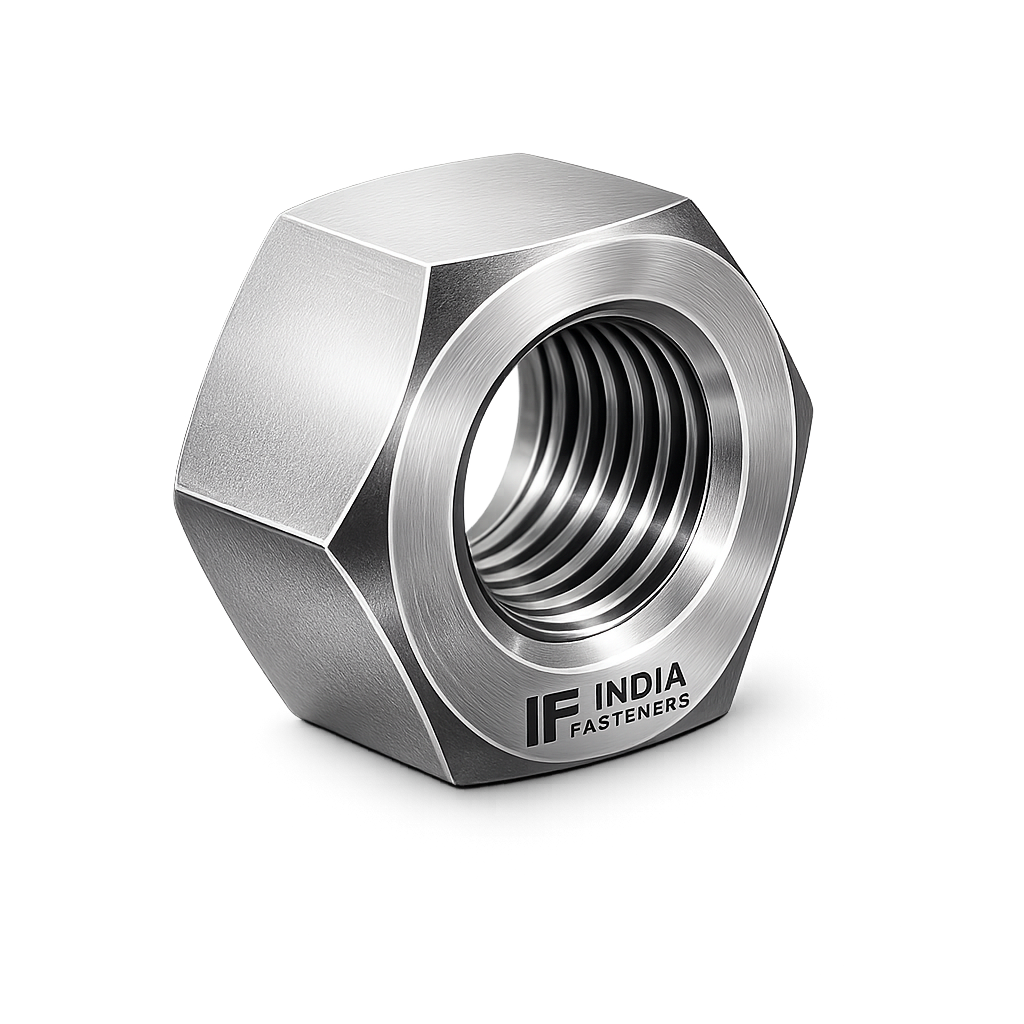
Step 4 — Nut Forming
Operations include:
- heading,
- punching,
- trimming,
- face finishing.
Controlled geometry ensures uniform load distribution.
Step 5 — Thread Tapping / Thread Rolling
Precision internal threading performed per ASME dimensional tolerance.
Critical controls:
- pitch accuracy,
- flank angle consistency,
- surface finish.
Thread class tolerance directly affects prevailing torque stability.
Step 6 — Locking Deformation Operation
Specialized tooling applies controlled distortion to create prevailing torque zone.
Engineering considerations:
- elastic deformation only,
- no cracking permitted,
- repeatable interference value.
This step defines locking performance.
Step 7 — Heat Treatment
Applied according to material grade.
Controlled parameters:
- furnace temperature uniformity,
- soaking time,
- cooling rate monitoring.
Batch records retained for inspection review.
Step 8 — Surface Finishing
Options include:
- black oxide,
- phosphating,
- hot dip galvanizing,
- zinc plating,
- mechanical galvanizing,
- fluoropolymer coatings.
Selection based on corrosion exposure and project specification.
Step 9 — Coating Application
Coating thickness control prevents thread interference loss.
Engineering balance required between:
- corrosion protection,
- prevailing torque performance.
Step 10 — Dimensional Inspection
Inspection equipment verifies:
- across flats dimension,
- height tolerance,
- thread pitch diameter,
- perpendicularity.
Measured against ASME B18.2.2 requirements.
Step 11 — Prevailing Torque Testing
Performed in accordance with ISO 2320.
Testing verifies:
- minimum locking torque,
- installation torque limits,
- reusability characteristics.
Statistical sampling applied.
Step 12 — Marking & Traceability
Each nut marked with:
- manufacturer identification,
- material grade,
- heat traceability code.
Supports third-party inspection acceptance.
Tolerance Discipline & Thread Accuracy Control
Prevailing torque nuts require tighter process control than standard hex nuts because:
- excessive deformation increases installation torque,
- insufficient deformation reduces locking capability.
Manufacturing stability ensures repeatable mechanical performance across production batches.
8. Dimensional Reference Tables — ASME B18.2.2 Basis
All Metal Lock Nuts supplied for GCC pressure equipment and structural applications are manufactured in accordance with ASME B18.2.2 dimensional requirements unless project specifications require ISO dimensional conformity.
Dimensional accuracy directly influences:
- load distribution,
- thread engagement efficiency,
- prevailing torque stability,
- inspection acceptance.
Heavy Hex geometry is typically preferred in refinery and offshore projects due to improved bearing surface area.
Heavy Hex All Metal Lock Nut Dimensional Reference
(Representative engineering reference — final dimensions governed by applicable standard revision and project specification.)
| Nominal Size | Thread Pitch | Across Flats (mm) | Nut Height (mm) | Minimum Thread Engagement | Approx Weight (kg/1000) |
|---|---|---|---|---|---|
| M12 | 1.75 | 19 | 12 | ≥10 mm | 22 |
| M16 | 2.0 | 24 | 16 | ≥13 mm | 48 |
| M20 | 2.5 | 30 | 20 | ≥16 mm | 88 |
| M24 | 3.0 | 36 | 24 | ≥19 mm | 150 |
| M30 | 3.5 | 46 | 30 | ≥24 mm | 310 |
| M36 | 4.0 | 55 | 36 | ≥29 mm | 520 |
| M42 | 4.5 | 65 | 42 | ≥34 mm | 820 |
| M48 | 5.0 | 75 | 48 | ≥38 mm | 1250 |
Engineering Importance of Dimensional Control
Key dimensional relationships:
- Nut height ≥ bolt diameter improves thread load sharing.
- Heavy hex geometry reduces localized bearing stress.
- Correct thread engagement prevents stripping before bolt yield.
GCC consultant inspections frequently verify:
- across flats tolerance,
- chamfer angle,
- bearing face perpendicularity.
9. Prevailing Torque Requirement Table — ISO 2320 Logic
Prevailing torque defines the mechanical locking performance of All Metal Lock Nuts.
Testing follows ISO 2320 procedures:
- Nut run onto test bolt without clamp load.
- Torque measured during rotation.
- Verification conducted for first installation and reuse cycles.
Typical Prevailing Torque Requirements
| Nominal Size | Minimum Prevailing Torque (Nm) | Maximum Installation Torque (Nm) | First Installation Torque Range | Reuse Torque Limit |
|---|---|---|---|---|
| M12 | 2–5 | 90 | 60–80 | ≥1 Nm |
| M16 | 5–10 | 220 | 160–200 | ≥2 Nm |
| M20 | 10–20 | 430 | 300–380 | ≥4 Nm |
| M24 | 20–40 | 740 | 520–650 | ≥6 Nm |
| M30 | 40–80 | 1450 | 1000–1200 | ≥10 Nm |
| M36 | 70–120 | 2500 | 1800–2100 | ≥15 Nm |
Values depend on material grade, coating condition, and lubrication.
Engineering Interpretation
Prevailing torque must satisfy two conditions:
- Provide resistance against self-rotation.
- Not excessively increase installation torque causing bolt overstressing.
Correct balance ensures: 
EPC specifications often require recorded prevailing torque test results within quality dossiers.
10. Bolt Torque & Clamp Load Engineering Chart
All Metal Lock Nuts function as part of a complete bolted joint system. Torque values must always correspond to the bolt material grade.
ASTM A193 B7 Bolting — Typical Torque Guidance
| Bolt Size | Lubricated Torque (Nm) | Dry Torque (Nm) | Approx Clamp Load (kN) |
|---|---|---|---|
| M16 | 150 | 200 | 85 |
| M20 | 300 | 400 | 135 |
| M24 | 520 | 700 | 195 |
| M30 | 1050 | 1400 | 320 |
| M36 | 1800 | 2400 | 460 |
ASTM A320 L7 (Low Temperature Service)
Torque values remain similar but lubrication control becomes critical to prevent galling at low temperatures.
Stainless Steel Bolting Considerations
Stainless assemblies require:
- anti-seize lubricant,
- controlled tightening speed,
- avoidance of high friction coefficient.
Galling risk increases with metal-to-metal contact pressure.
Torque Coefficient Explanation

Where:
- K varies with lubrication,
- coating systems significantly influence torque values.
Typical values:
| Condition | Torque Coefficient |
|---|---|
| Dry carbon steel | 0.22–0.25 |
| Lubricated | 0.15–0.18 |
| Fluoropolymer coated | 0.10–0.14 |
Preload Percentage Discussion
Industry practice aims for:
- 60–75% of bolt proof load.
Higher preload improves joint fatigue resistance but must remain below yield strength.
11. Locking Performance Engineering Guide
All Metal Lock Nuts do not replace proper preload; they preserve it.
Prevailing Torque vs Clamp Load Balance
If prevailing torque is excessive:
- installation torque uncertainty increases,
- preload accuracy decreases.
If too low:
- vibration resistance becomes insufficient.
Manufacturing deformation must therefore remain controlled and repeatable.
Loss-of-Preload Prevention Logic
Self-loosening occurs when transverse displacement reduces frictional resistance below rotational excitation forces.
All Metal Lock Nuts introduce an additional resisting torque independent of clamp force.
This ensures: Mlocking+Mfriction>MvibrationM_{locking} + M_{friction} > M_{vibration}Mlocking+Mfriction>Mvibration
Sample Installation Calculation
Example
- Bolt: M24 ASTM A193 B7
- Target preload: 190 kN
- Torque coefficient: 0.16
- Diameter: 24 mm

Installer must apply total torque including prevailing resistance.
High Vibration Performance Explanation
Under vibration:
- Joint slip initiates.
- Friction reduces.
- Standard nuts rotate.
Prevailing torque maintains resistance even after partial preload loss, delaying rotation initiation and preventing catastrophic loosening.
12. Mechanical Property Table
Representative mechanical properties for common lock nut materials.
| Material Grade | Yield Strength (MPa) | Proof Load (MPa) | Hardness (HRC) | Elongation (%) | Impact Resistance |
|---|---|---|---|---|---|
| ASTM A194 2H | 660 | 620 | 24–35 | 16 | Moderate |
| ASTM A194 7 | 720 | 650 | 28–36 | 14 | High temp capable |
| ASTM A194 8 | 205 | 205 | ≤22 | 30 | Excellent toughness |
| ASTM A194 8M | 205 | 205 | ≤22 | 30 | Marine suitable |
| A563 DH | 620 | 580 | 24–34 | 16 | Structural duty |
| Duplex SS | 450 | 450 | ≤28 | 25 | High fatigue resistance |
Mechanical properties must be verified by certified testing prior to shipment.
13. Corrosion Resistance Comparison Table
Environmental compatibility strongly influences material selection in Gulf installations.
| Material | Marine Exposure | Desert Humidity | Sour Gas Service | High Temperature | Offshore Atmosphere |
|---|---|---|---|---|---|
| Carbon Steel | Low | Moderate | Limited | Good | Low |
| Hot Dip Galvanized | Moderate | Good | Limited | Limited | Moderate |
| Stainless Steel 304 | Good | Good | Limited | Moderate | Good |
| Stainless Steel 316 | Very Good | Excellent | Moderate | Moderate | Excellent |
| Duplex Stainless Steel | Excellent | Excellent | Excellent | Good | Excellent |
| Alloy Steel Cr-Mo | Moderate | Moderate | Controlled | Excellent | Moderate |
Engineering Observations
- Offshore projects increasingly specify duplex or 316 materials.
- Hot dip galvanizing unsuitable for high temperature service.
- Carbon steel acceptable only with controlled coatings and maintenance planning.
14. Inspection & Quality Assurance — GCC Project Expectations
All Metal Lock Nuts supplied to Middle East EPC projects must demonstrate inspection readiness rather than post-production verification.
Positive Material Identification (PMI)
Performed using XRF or OES methods.
Confirms:
- alloy composition,
- stainless grade verification,
- prevention of material substitution.
Thread Gauge Inspection
Inspection using calibrated gauges:
- GO gauge verifies minimum material condition.
- NO-GO gauge prevents oversized thread acceptance.
Thread accuracy directly affects prevailing torque performance.
Proof Load Testing
Nuts subjected to axial loading to confirm:
- thread stripping resistance,
- load bearing capacity,
- compliance with ASTM mechanical requirements.
Prevailing Torque Verification
ISO 2320 testing confirms:
- minimum locking torque,
- functional repeatability,
- reuse performance capability.
Inspection records commonly included in project dossiers.
Hardness Testing
Methods:
- Rockwell hardness,
- Brinell verification.
Ensures:
- compliance with NACE hardness limits,
- prevention of brittle fracture.
Coating Thickness Inspection
Measured using calibrated coating gauges.
Typical controls:
- uniform deposition,
- avoidance of thread interference,
- corrosion protection verification.
Dimensional Inspection
Verification includes:
- across flats dimension,
- nut height,
- thread concentricity,
- bearing face quality.
Performed prior to packaging release.
Third-Party Inspection Readiness
Project inspectors commonly include independent agencies performing:
- document review,
- witnessing of testing,
- random sampling inspection,
- marking verification,
- packaging audit.
Documentation discipline determines approval efficiency.
EN 10204 Certification
Typical documentation levels:
| Certificate | Description |
|---|---|
| 2.1 | Compliance statement |
| 2.2 | Test report |
| 3.1 | Mill test certification (standard EPC requirement) |
| 3.2 | Third-party witnessed certification |
GCC projects frequently mandate 3.1 certification minimum.
Consultant Expectations in Middle East Projects
Approval authorities evaluate:
- metallurgy control,
- traceability continuity,
- locking performance verification,
- inspection transparency,
- documentation completeness.
Acceptance is based on demonstrated process discipline rather than product description.
15. Industries Served — Middle East Operational Application
All Metal Lock Nuts are deployed where joint security must be maintained despite vibration, temperature variation, and long operational intervals between shutdowns. GCC projects typically define such bolting as critical service fastening.
The following sections describe engineering usage from an EPC installation perspective rather than product categorization.
Upstream Oil & Gas Facilities
Upstream production environments involve dynamic mechanical loading combined with corrosive exposure.
Typical installations:
- Wellhead assemblies
- Choke manifolds
- Separator skids
- Pipeline launchers and receivers
- Compressor modules
Engineering concern:
- continuous vibration generated by flow turbulence and rotating equipment,
- pressure cycling,
- limited maintenance access.
All Metal Lock Nuts provide rotational resistance independent of preload degradation caused by operational cycling.
Locking systems are commonly specified for:
- skid-mounted equipment,
- structural bolting exposed to vibration,
- instrumentation platforms subject to movement.
Refineries
Refinery environments combine elevated temperature service with mechanical vibration.
Typical locations include:
- Heat exchanger channel covers
- Fired heater access assemblies
- Pump and compressor base frames
- Pipe rack structures
- Flange bolting exposed to cyclic thermal loading
Refinery bolted joints frequently undergo temperature fluctuations between shutdown and operation. Expansion and contraction cause embedment relaxation.
Metal prevailing torque locking systems maintain thread resistance after preload reduction events.
Petrochemical Plants
Petrochemical complexes operate continuously for extended campaigns.
Critical bolting applications:
- reactor manways,
- agitator drive assemblies,
- column platforms,
- rotating machinery supports,
- polymer processing units.
Operational philosophy emphasizes minimizing unplanned shutdowns. Mechanical locking nuts reduce inspection frequency associated with re-tightening programs.
LNG Terminals
Liquefied natural gas installations introduce extreme thermal variation:
- cryogenic piping,
- regasification units,
- loading arms,
- compressor structures.
Thermal contraction can reduce clamp load. Conventional friction-based locking methods become unreliable.
All Metal Lock Nuts maintain locking performance despite dimensional movement between joint components.
Power Generation Plants
Gas and steam turbine facilities generate persistent vibration and temperature gradients.
Applications include:
- turbine casing supports,
- exhaust duct systems,
- generator frames,
- boiler structures,
- auxiliary equipment skids.
Bolted joints must maintain alignment stability. Loss of preload may lead to equipment misalignment and accelerated bearing wear.
Prevailing torque locking minimizes rotation under vibration excitation.
Desalination Facilities
Desalination plants present a combination of marine corrosion and mechanical vibration.
Common applications:
- high-pressure pump foundations,
- brine discharge piping,
- structural platforms,
- seawater intake systems.
Material selection typically favors stainless steel or duplex grades to resist chloride exposure.
Offshore Platforms
Offshore structures impose continuous cyclic loading from wave motion and wind excitation.
Typical uses:
- topside equipment mounting,
- cable tray supports,
- riser clamps,
- structural steel joints.
Maintenance access constraints increase the value of reusable mechanical locking nuts.
Pipeline Compressor Stations
Gas transportation infrastructure operates continuously under pulsating loads.
Critical fastening locations:
- compressor foundations,
- pipe supports,
- valve station equipment,
- vibration-prone assemblies.
Prevailing torque lock nuts prevent gradual rotational loosening during long operational cycles.
Rotating Equipment Installations
Rotating equipment represents the most demanding application category.
Examples:
- centrifugal compressors,
- pumps,
- blowers,
- fans,
- electric motors.
Joint integrity directly affects equipment reliability.
All Metal Lock Nuts are frequently applied where:
- vibration amplitudes exceed static friction capability,
- periodic retorque is impractical,
- safety factors require redundant locking resistance.
16. Export & GCC Supply Capability
India Fasteners supplies industrial fastening systems aligned with international export documentation and Middle East project logistics requirements.
Primary Export Regions
- Saudi Arabia
- United Arab Emirates (Dubai / Abu Dhabi)
- Qatar
- Oman
- Kuwait
- Bahrain
Supply programs typically support EPC contractors, maintenance shutdown contractors, and project procurement packages.
Export Packaging Systems
Packaging design considers Gulf climatic exposure during transit and storage.
Typical measures include:
- moisture barrier packaging,
- sealed polyethylene liners,
- vapor corrosion inhibitor (VCI) protection,
- desiccant inclusion,
- palletized crate systems.
Objective: maintain coating integrity and traceability marking until installation.
Humidity Protection Methods
During marine shipment and desert storage:
- corrosion initiation risk increases due to condensation cycles,
- coating damage may occur from salt exposure.
Protection strategy includes:
- sealed container loading,
- anti-corrosion wrapping,
- controlled stacking to prevent thread damage.
Project Documentation Packages
GCC procurement typically requires comprehensive documentation submission prior to shipment release.
Documentation may include:
- Mill Test Certificates (EN 10204 3.1 / 3.2)
- Chemical composition reports
- Mechanical test results
- Heat treatment records
- Prevailing torque test reports
- Dimensional inspection records
- Coating inspection results
- Traceability matrix
- Packing list with heat number reference
Documentation structure aligns with EPC material approval workflows.
Inspection Release Documentation
Shipment release commonly requires:
- inspection notification,
- witness testing opportunity,
- inspection release note,
- packing verification.
Documentation transparency reduces project site rejection risk.
Traceability Systems
Traceability is maintained from raw material to final packaging.
Identification methods include:
- heat number marking,
- batch coding,
- inspection lot references,
- packaging label traceability.
Traceability allows investigation of field performance if required.
Container Loading Discipline
Export loading procedures consider:
- load distribution,
- moisture ingress prevention,
- segregation by heat number,
- damage prevention during handling.
Proper container discipline reduces reinspection delays at GCC ports.
17. Procurement & Installation Engineering View
Correct application of All Metal Lock Nuts depends on installation discipline rather than product selection alone.
Correct Bolt and Nut Pairing
Typical pairing examples:
| Bolt Grade | Recommended Lock Nut |
|---|---|
| ASTM A193 B7 | ASTM A194 2H |
| ASTM A320 L7 | ASTM A194 7 |
| Stainless Steel Bolts | ASTM A194 8 / 8M |
| Structural Bolts | ASTM A563 DH |
Strength compatibility prevents thread stripping before bolt yield.
Installation Sequence
Recommended procedure:
- Verify material markings.
- Confirm lubrication condition.
- Run nut to seating position.
- Apply torque using calibrated tool.
- Include prevailing torque within total torque value.
- Apply tightening pattern appropriate to joint geometry.
Flanged joints typically require cross-pattern tightening.
Torque Application Method
Preferred methods:
- calibrated torque wrench,
- hydraulic torque wrench,
- hydraulic tensioner for critical flanges.
Impact wrench installation without torque verification is generally unacceptable for critical joints.
Reuse Limitations
All Metal Lock Nuts are reusable only when:
- prevailing torque remains above minimum requirement,
- threads show no deformation damage,
- coating integrity remains acceptable.
ISO 2320 testing philosophy governs reuse evaluation.
Lubrication Practices
Lubrication directly influences preload accuracy.
Typical lubricants:
- molybdenum disulfide compounds,
- nickel anti-seize,
- project-approved bolt lubricants.
Lubrication must remain consistent across the joint to avoid preload variation.
Field Inspection Checklist
Inspection engineers typically verify:
- material grade marking,
- thread condition,
- lubrication presence,
- torque record documentation,
- absence of galling,
- proper seating against bearing surface.
Storage Practices for Gulf Climate
Recommended storage conditions:
- shaded storage areas,
- elevated pallets,
- sealed containers,
- avoidance of direct desert exposure.
Improper storage can compromise coating and prevailing torque performance.
Failure Investigation Considerations
When loosening occurs, investigation evaluates:
- incorrect torque application,
- lubrication inconsistency,
- mismatched materials,
- thermal expansion effects,
- vibration amplitude exceeding design assumptions.
Mechanical locking nuts assist failure prevention but do not compensate for improper installation.
18. Custom Engineering Capabilities
Industrial projects frequently require fastening systems beyond catalog configurations.
India Fasteners supports project-specific engineering requirements for All Metal Lock Nuts.
High Temperature Lock Nuts
Designed for service exceeding standard carbon steel limits.
Applications:
- refinery heaters,
- turbine exhaust systems,
- steam headers.
Material selection includes alloy steel and chromium-molybdenum grades.
Special Coating Systems
Available coating technologies include:
- Fluoropolymer coatings (Xylan-type)
- PTFE-based low friction coatings
- Zinc-Nickel plating
- Hot dip galvanizing
- Phosphate and oil finishes
Coating selection balances corrosion resistance and torque consistency.
Custom Prevailing Torque Ranges
Projects may specify controlled locking torque values.
Engineering adjustments include:
- deformation geometry modification,
- thread interference control,
- testing verification per ISO 2320.
Heavy Hex Lock Nut Supply
Heavy hex geometry supplied where:
- higher bearing surface required,
- flange bolting standards apply,
- EPC specifications mandate heavy pattern nuts.
NACE-Compliant Materials
For sour service applications:
- controlled hardness materials,
- documented heat treatment,
- metallurgy verification aligned with sulfide stress cracking resistance requirements.
Project-Specific Markings
Custom marking may include:
- project identification codes,
- contractor identification,
- heat traceability markings required by EPC specifications.
Special Thread Forms
Available configurations:
- UNC / UNF
- Metric coarse and fine pitch
- Left-hand threads
- Extended engagement threads
- Custom tolerance classes
Offshore Corrosion Protection Solutions
Offshore-specific configurations may include:
- duplex stainless steel construction,
- enhanced coating systems,
- sealed packaging for extended storage periods.
Engineering Conclusion
All Metal Lock Nuts are not general-purpose fasteners; they are mechanical locking devices engineered to preserve bolted joint integrity under vibration, thermal cycling, and environmental exposure common to GCC energy infrastructure.
When properly designed, manufactured, inspected, and installed, prevailing torque lock nuts provide:
- resistance to self-loosening,
- predictable clamp load retention,
- compatibility with high-temperature service,
- compliance with EPC mechanical integrity philosophy.