
Nylon Insert Lock Nuts
1. Regional Industry Context — Middle East Operational Conditions
Industrial bolted joints operating across the Gulf Cooperation Council (GCC) region are exposed to mechanical and environmental conditions significantly different from temperate industrial zones. Fastener selection within Saudi Arabia, UAE, Qatar, Oman, Kuwait, and Bahrain is therefore driven primarily by joint integrity reliability rather than simple mechanical fastening requirements.
Across Middle East EPC projects, fasteners are evaluated as safety-critical engineered components forming part of pressure systems, rotating assemblies, structural frameworks, and auxiliary equipment supports.
1.1 Typical GCC Industrial Installations
Nylon Insert Lock Nuts are routinely applied in the following operating environments:
Oil & Gas Processing Facilities
- Gas separation trains
- Crude stabilization units
- Compression skids
- Flare systems
- Pipe racks and equipment platforms
These facilities experience continuous vibration generated by pumps, compressors, and turbine-driven equipment.
Offshore Platforms & Drilling Rigs
- Topside module structures
- Instrument supports
- Cable tray assemblies
- HVAC structures
- Non-pressure structural bolting
Offshore conditions combine vibration, salt-laden atmosphere, and cyclic loading.
LNG Terminals
- Cryogenic pipe support systems
- Valve actuation assemblies
- Structural access platforms
- Electrical equipment mounting
Thermal gradients and expansion cycles influence bolt preload retention.
Refineries & Petrochemical Plants
- Reactor structures
- Heat exchanger support frames
- Rotating auxiliary equipment
- Maintenance access structures
Frequent shutdown/startup cycles generate repeated transverse loading.
Power Generation Facilities
- Gas turbine auxiliary frames
- Generator housings
- Cooling tower structures
- Electrical enclosure mounting
High-frequency vibration is dominant in turbine environments.
Desalination Plants
- Pump skids
- Reverse osmosis modules
- Pipe supports exposed to saline mist
- Structural steel frames
Fasteners must resist corrosion while maintaining clamp force.
Pipeline Pumping Stations
- Motor foundations
- Instrument brackets
- Non-critical flange guarding assemblies
- Control system mounting
Remote locations require maintenance reduction strategies.
District Cooling Plants
- Chiller installations
- Pump supports
- Vibration-isolated assemblies
Loosening prevention is essential due to continuous cyclic loading.
1.2 Environmental Drivers Unique to GCC Conditions
High Vibration Exposure
Rotating machinery produces transverse motion relative to bolted joints. Traditional free-spinning nuts may gradually lose preload under vibration.
Thermal Expansion Cycles
Day-night temperature variation exceeding 40°C creates:
- Bolt elongation variation
- Relaxation of clamp load
- Micro-movement between joint members
Sand and Dust Contamination
Airborne silica particles enter exposed threads, influencing:
- Friction coefficients
- Installation torque consistency
- Thread wear
Remote Asset Maintenance Constraints
Oil fields and offshore installations prioritize:
- Reduced inspection intervals
- Passive anti-loosening mechanisms
- Predictable mechanical performance
Corrosive Atmospheres
Marine environments and process vapors accelerate degradation of conventional fastening systems.
1.3 Engineering Rationale for Prevailing Torque Lock Nuts in GCC Projects
Prevailing torque lock nuts provide mechanical resistance to self-loosening independent of clamp force.
Unlike conventional nuts relying solely on preload friction, nylon insert lock nuts introduce an additional locking mechanism:
- Controlled thread interference
- Elastic polymer deformation
- Continuous frictional resistance during service
For GCC operations, this design provides:
- Improved vibration resistance
- Reduced need for secondary locking devices
- Simplified installation procedures
- Reliable retention under fluctuating loads
Consequently, prevailing torque lock nuts are widely adopted for non-pressure structural joints, auxiliary equipment mounting, and vibration-prone assemblies across Middle East EPC projects.
2. Technical Definition of Nylon Insert Lock Nut
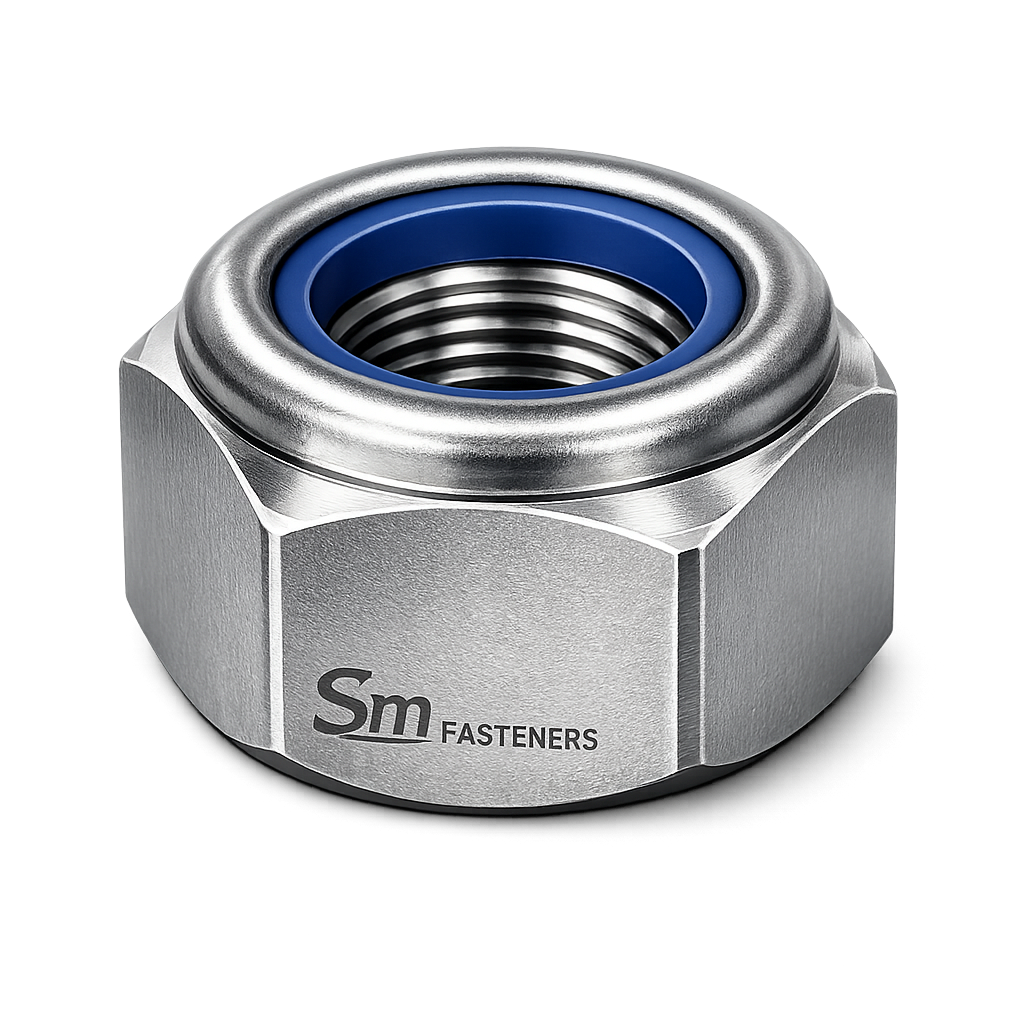
A Nylon Insert Lock Nut is defined as:
A hexagonal internally threaded fastener incorporating a polymer insert positioned at the top of the nut, producing prevailing torque through elastic deformation and thread interference.
2.1 Construction Elements
Primary Components
- Hex nut body (metallic)
- Internal thread
- Polymer locking insert (nylon collar)
The nylon insert is installed concentrically within a recessed section of the nut.
2.2 Prevailing Torque Locking Mechanism
When a bolt engages the insert:
- The bolt thread displaces the nylon material.
- The insert elastically deforms.
- Radial pressure develops against the bolt thread flanks.
- Continuous frictional resistance is generated.
This resistance exists before clamp load is achieved, which differentiates prevailing torque nuts from standard nuts.
2.3 Elastic Deformation Principle
The nylon insert functions as an elastic medium:
- Deforms during installation
- Stores elastic strain energy
- Maintains radial force against threads
- Recovers partially after removal
This creates resistance against rotational loosening caused by vibration.
2.4 Difference Between Free-Spinning Nut and Prevailing Torque Nut
| Characteristic | Standard Hex Nut | Nylon Insert Lock Nut |
|---|---|---|
| Initial rotation | Free spinning | Resistance present |
| Locking method | Clamp load only | Mechanical interference |
| Vibration resistance | Limited | High |
| Additional locking device | Often required | Typically unnecessary |
| Reusability | High | Limited |
2.5 Nylon Collar Function
The insert performs multiple roles:
- Generates prevailing torque
- Compensates for minor thread wear
- Dampens vibration transmission
- Reduces micro-movement between threads
The insert does not carry structural load; load transfer remains through metal threads.
2.6 Reusability Limitations
Repeated installations progressively reduce:
- Insert elasticity
- Prevailing torque values
ISO verification standards limit reuse based on minimum torque retention criteria.
Engineering practice within GCC projects commonly restricts reuse to:
- Inspection-based acceptance
- Non-critical service only
2.7 Temperature Limitations of Polymer Inserts
Standard nylon inserts operate effectively within:
- −40°C to +120°C (typical)
- Short-term exposure up to ~150°C
Above this range:
- Polymer softening occurs
- Locking capability decreases
- Creep deformation becomes possible
Therefore, nylon insert lock nuts are not selected for high-temperature pressure boundary applications.
2.8 Applicable International Standards
Nylon Insert Lock Nuts are governed by internationally recognized standards.
Dimensional Standards
- DIN 985 — Low type nylon insert lock nut
- DIN 982 — High type nylon insert lock nut
- ISO 7040 — Prevailing torque type hex nuts
Performance Standards
- ISO 2320 — Prevailing torque testing requirements
- ASME B18.16.6 — Nylon insert lock nut dimensions and performance
- IFI 100 / IFI 107 — Industrial Fastener Institute references
These standards define:
- Dimensions
- Mechanical properties
- Torque performance
- Inspection methods
3. Self-Locking Theory & Anti-Loosening Mechanics
3.1 The Junker Vibration Effect
Experimental studies demonstrate that transverse vibration causes progressive loss of preload in conventional threaded joints.
Mechanism:
- Lateral displacement occurs between clamped parts.
- Friction at thread interface decreases momentarily.
- Nut rotates incrementally.
- Clamp force drops rapidly.
This phenomenon is known as the Junker Effect.
Prevailing torque nuts resist this rotation by maintaining continuous friction independent of clamp load.
3.2 Transverse Load Loosening Mechanism
Key contributors:
- Cyclic shear loading
- Differential thermal expansion
- Dynamic equipment vibration
- Surface embedment relaxation
Once preload decreases below a critical threshold, loosening accelerates.
3.3 Clamp Load Retention Theory
The reliability of a bolted joint depends on maintaining preload greater than external separating forces.
Where:
 = Clamp force
 = External separating force
Prevailing torque adds rotational resistance even when preload fluctuates.
3.4 Bolt Preload Equation

Where:
 = Bolt preload
 = Applied torque
 = Nut factor (friction coefficient)
 = Nominal diameter
3.5 Torque–Tension Relationship
Approximately:
- 90% of applied torque overcomes friction
- 10% produces useful preload
Variations in friction conditions directly affect joint performance.
Nylon inserts stabilize torque behavior by providing controlled interference.
3.6 Friction Factor Influence
Factors affecting friction:
- Surface coating
- Lubrication
- Thread finish
- Environmental contamination
Prevailing torque introduces predictable friction independent of clamp interface conditions.
3.7 Elastic Recovery of Nylon Insert
After installation:
- Nylon attempts to return to original shape.
- Continuous radial pressure is maintained.
- Resistance to reverse rotation remains active.
This elastic recovery is central to anti-loosening capability.
3.8 GCC Bolted Joint Integrity Philosophy
Middle East operating companies emphasize:
- Passive safety systems
- Reduced reliance on operator intervention
- Predictable mechanical behavior
- Inspection traceability
Prevailing torque lock nuts align with these principles by providing mechanical locking without additional hardware.
4. Applicable Materials & Standards — GCC Engineering Mapping
Material selection for Nylon Insert Lock Nuts used in Middle East EPC projects is governed by mechanical strength requirements, corrosion exposure, operating temperature limits, and inspection authority acceptance.
Within GCC oil, gas, power, desalination, and infrastructure projects, fastener material selection is typically defined during:
- EPC design stage
- Material Requisition (MR) preparation
- Approved Vendor List (AVL) evaluation
- Mechanical integrity review
Nylon insert lock nuts are generally applied in secondary structural, rotating equipment auxiliary, and vibration-prone assemblies, rather than pressure-retaining flange joints.
4.1 Metallic Nut Body Materials
The metallic portion of the nut carries the entire structural load. The nylon insert provides locking only and does not contribute to load capacity.
ASTM A194 Grade 2H
Material Type: Alloy steel, quenched and tempered
Typical Characteristics
- High proof load capability
- Good resistance to relaxation under load
- Stable mechanical properties under cyclic loading
- Widely accepted in refinery and petrochemical construction
Typical GCC Applications
- Structural equipment supports
- Pump skid assemblies
- Pipe support frameworks
- Auxiliary rotating equipment fastening
Inspection Acceptance
Commonly recognized by Saudi Aramco, ADNOC, and QatarEnergy specifications when used outside pressure boundary service.
ASTM A563 Grade DH
Material Type: Carbon steel, heat-treated
Engineering Characteristics
- High strength structural nut
- Compatible with high-strength bolts
- Suitable for heavy mechanical assemblies
Typical Applications
- Steel structures
- Equipment mounting frames
- Offshore secondary structures
ASTM A563 Grade A
Material Type: Carbon steel
Characteristics
- Moderate strength classification
- Used where loading conditions are controlled
- Economical for large-volume structural installations
Typical Use
- Cable tray supports
- Electrical panel mounting
- HVAC structural components
Stainless Steel A2-70 (304)
Characteristics
- Good atmospheric corrosion resistance
- Suitable for coastal and humid regions
- Non-magnetic in annealed condition
Typical GCC Applications
- Desalination facilities
- Instrumentation mounting
- Food-grade utility plants
- External structural assemblies
Stainless Steel A4-80 (316)
Characteristics
- Enhanced resistance to chlorides
- Improved pitting corrosion resistance
- Preferred for marine exposure
Typical Applications
- Offshore platforms
- Seawater systems
- Coastal power plants
- Jetty structures
Duplex Stainless Steel
Characteristics
- High mechanical strength
- Superior resistance to stress corrosion cracking
- Suitable for aggressive offshore environments
Applications
- Offshore topsides
- Marine structural assemblies
- High-humidity chemical environments
4.2 Nylon Insert Materials
The polymer insert determines prevailing torque performance and temperature capability.
Nylon 6
Properties
- Good elasticity
- Stable friction characteristics
- Suitable for standard industrial service
Operating Temperature
Up to approximately 100–120°C continuous service.
Applications
General industrial fastening across GCC facilities.
Nylon 6/6
Improved Characteristics
- Higher melting temperature
- Better creep resistance
- Improved mechanical retention
Common Usage
Preferred insert material for EPC-grade nylon lock nuts.
High-Temperature Polymer Variants
Where elevated temperatures exist near equipment casings:
- Modified polyamide formulations
- Glass-filled nylon variants
- Engineering thermoplastics (project-specific)
Used when temperatures approach upper nylon limits.
4.3 Chemical Resistance Considerations
Nylon inserts demonstrate resistance to:
- Petroleum oils
- Hydraulic fluids
- Lubricants
- Mild hydrocarbons
Limitations exist with:
- Strong acids
- Phenolic solvents
- Continuous steam exposure
- High aromatic chemical environments
Material selection must align with project material compatibility matrices.
4.4 UV Stability in Desert Environments
GCC outdoor installations expose fasteners to:
- High solar radiation
- Surface temperature escalation
- Long-term ultraviolet exposure
Nylon formulations used for industrial lock nuts incorporate stabilizers to reduce degradation; however, prolonged exposure above temperature limits may reduce locking efficiency.
4.5 Temperature Capability Mapping
| Service Condition | Recommended Material |
|---|---|
| Indoor mechanical service | Carbon steel + Nylon 6/6 |
| Outdoor desert exposure | Zinc coated alloy steel |
| Coastal atmosphere | Stainless A4 |
| Offshore marine | Duplex stainless |
| Elevated temperature equipment | High-temp polymer variant |
4.6 Sour Service & Hydrocarbon Environment Considerations
Although nylon insert lock nuts are generally not used on pressure-retaining joints, GCC projects still assess compatibility with sour environments.
Engineering evaluation includes:
- Hydrogen sulfide exposure
- Stress corrosion susceptibility
- Coating integrity
- Polymer chemical resistance
When sour service compliance is required, metallic material selection must satisfy applicable NACE requirements.
5. Material Comparison Table (Mandatory)
| Material Grade | Proof Load Capability | Temperature Limit | Corrosion Resistance | Typical GCC Application |
|---|---|---|---|---|
| ASTM A563 Grade A | Moderate | 120°C | Moderate | Electrical & structural supports |
| ASTM A563 Grade DH | High | 120°C | Moderate | Structural assemblies |
| ASTM A194 Grade 2H | High | 120°C | Moderate | Equipment supports |
| Stainless Steel A2-70 | Moderate | 120°C | Good | Desalination & utilities |
| Stainless Steel A4-80 | High | 120°C | Excellent | Marine & coastal plants |
| Duplex Stainless Steel | Very High | 120°C | Superior | Offshore structures |
Temperature limit governed primarily by nylon insert capability.
6. Heat Treatment & Metallurgical Control
Mechanical reliability of lock nuts depends heavily on metallurgical consistency of the metal body prior to insert installation.
6.1 Quenching and Tempering (Alloy Steel Nuts)
Process sequence:
- Austenitizing at controlled temperature
- Rapid quenching
- Tempering cycle to achieve required strength
Engineering objectives:
- Achieve specified proof load
- Prevent brittle fracture
- Maintain ductility
6.2 Solution Annealing — Stainless Steel
Performed to:
- Restore corrosion resistance
- Remove cold work stresses
- Maintain austenitic structure
Improper annealing may lead to sensitization and reduced corrosion performance.
6.3 Stress Relieving
Applied when required to:
- Reduce residual forming stresses
- Improve dimensional stability
- Prevent distortion during service
6.4 Hardness Control
Typical hardness ranges:
| Material | Hardness Range |
|---|---|
| Carbon steel nuts | 24–36 HRC |
| Alloy steel nuts | Controlled per ASTM |
| Stainless steel | Lower hardness, higher ductility |
Hardness verification prevents:
- Thread stripping
- Galling
- Hydrogen embrittlement susceptibility
6.5 Hydrogen Embrittlement Prevention
Critical for plated high-strength fasteners.
Preventive measures include:
- Controlled electroplating processes
- Post-plating baking
- Hydrogen relief heat treatment
Inspection authorities frequently verify baking records during audits.
6.6 Surface Condition Prior to Insert Installation
Before nylon insertion:
- Threads must be free from oil contamination
- Burrs removed
- Coating thickness verified
- Dimensional tolerances confirmed
Insert installation after coating ensures locking performance remains consistent.
7. Manufacturing Process Flow — EPC Documentation Level
Manufacturing discipline is a major evaluation parameter during EPC vendor qualification.
7.1 Raw Material Traceability
Each production batch begins with:
- Mill certificates
- Heat number assignment
- Chemical composition verification
- Incoming inspection records
Traceability remains maintained throughout production.
7.2 Heat Number Control
Every lot is linked to:
- Raw material source
- Production batch
- Inspection documentation
- Final certification package
This enables full audit traceability required by GCC consultants.
7.3 Forging Operations
Cold Forging
Used for smaller sizes:
- Improved grain flow
- Higher fatigue resistance
- Dimensional consistency
Hot Forging
Applied for larger diameters:
- Reduced forming stress
- Improved mechanical uniformity
7.4 Thread Formation
Two primary methods:
Thread Rolling
- Superior fatigue performance
- Work-hardened surface
- Improved accuracy
Thread Machining
- Used for larger or special sizes
- Allows tighter tolerance control
Thread class verification performed using calibrated gauges.
7.5 Heat Treatment Stage
Conducted according to material specification:
- Furnace calibration
- Temperature recording
- Batch loading discipline
- Cooling rate control
Records retained for inspection review.
7.6 Surface Finishing
Common finishes:
- Zinc plating
- Mechanical galvanizing
- Hot dip galvanizing
- Passivation (stainless steel)
Coating selection influences torque characteristics and corrosion life.
7.7 Nylon Insert Press-Fit Installation
Critical manufacturing stage.
Process controls include:
- Insert dimensional verification
- Controlled press force
- Alignment monitoring
- Prevention of insert deformation
Improper installation directly affects prevailing torque performance.
7.8 Prevailing Torque Verification
Performed per ISO 2320:
- First installation torque measurement
- Removal torque testing
- Repeat cycle verification
- Statistical batch sampling
Only compliant batches proceed to shipment.
7.9 Batch Inspection & Quality Control
Inspection activities include:
- Dimensional checks
- Thread gauge verification
- Hardness testing
- Coating thickness testing
- Visual inspection
- Functional torque testing
Inspection frequency aligned with EPC and third-party expectations.
7.10 Product Marking & Traceability
Marking may include:
- Manufacturer identification
- Property class
- Heat code or batch number
Marking ensures field traceability during installation audits.
7.11 Dimensional Tolerance Control
Critical tolerances:
- Thread pitch diameter
- Across flats dimension
- Nut height
- Insert depth
Maintaining tolerance consistency ensures predictable torque–tension behavior during installation.
8. Dimensional Reference Tables
Dimensional conformity is essential for compatibility with internationally standardized bolts, studs, and threaded components used across EPC projects.
Nylon Insert Lock Nuts supplied for GCC industrial applications comply primarily with:
- DIN 985 (Low Type)
- DIN 982 (High Type)
- ISO 7040
- ASME B18.16.6
Dimensions influence:
- Load distribution
- Thread engagement length
- Prevailing torque performance
- Installation clearance
8.1 Metric Nylon Insert Lock Nut Dimensions (Reference)
| Thread Size | Pitch (mm) | Across Flats (mm) | Nut Height DIN 985 (mm) | Nut Height DIN 982 (mm) | Insert Position | Approx. Weight (kg/1000) |
|—|—|—|—|—|—|
| M4 | 0.7 | 7 | 5 | 8 | Top recessed | 0.35 |
| M5 | 0.8 | 8 | 5 | 8 | Top recessed | 0.55 |
| M6 | 1.0 | 10 | 6 | 9 | Top recessed | 0.95 |
| M8 | 1.25 | 13 | 8 | 12 | Top recessed | 2.0 |
| M10 | 1.5 | 17 | 10 | 14 | Top recessed | 4.0 |
| M12 | 1.75 | 19 | 12 | 18 | Top recessed | 6.5 |
| M16 | 2.0 | 24 | 16 | 24 | Top recessed | 15.0 |
| M20 | 2.5 | 30 | 18 | 30 | Top recessed | 32.0 |
| M24 | 3.0 | 36 | 22 | 36 | Top recessed | 60.0 |
| M30 | 3.5 | 46 | 26 | 45 | Top recessed | 120.0 |
8.2 Imperial Size Reference (ASME B18.16.6)
| Nominal Size | Thread Series | Across Flats (in) | Nut Height (in) | Insert Location | Approx Weight (lb/1000) |
|---|---|---|---|---|---|
| 1/4″ | UNC | 7/16 | 9/32 | Top | 8 |
| 5/16″ | UNC | 1/2 | 11/32 | Top | 12 |
| 3/8″ | UNC | 9/16 | 13/32 | Top | 18 |
| 1/2″ | UNC | 3/4 | 17/32 | Top | 40 |
| 5/8″ | UNC | 15/16 | 21/32 | Top | 75 |
| 3/4″ | UNC | 1-1/8 | 51/64 | Top | 125 |
| 7/8″ | UNC | 1-5/16 | 57/64 | Top | 190 |
| 1″ | UNC | 1-1/2 | 63/64 | Top | 270 |
8.3 Engineering Notes
- Minimum one full bolt thread should extend beyond insert after tightening.
- High-type nuts (DIN 982) provide greater thread engagement.
- Dimensional verification is mandatory for interchangeability within EPC installations.
9. Proof Load & Mechanical Strength Table
Correct bolt–nut pairing ensures the nut does not strip before the bolt reaches its design preload.
9.1 Property Class Compatibility
| Nut Property Class | Proof Load (MPa) | Minimum Tensile Strength Equivalent | Compatible Bolt Grade |
|---|---|---|---|
| Class 5 | 500 | Medium strength | Bolt Class 5.6 |
| Class 8 | 800 | High strength | Bolt Class 8.8 |
| Class 10 | 1000 | Very high strength | Bolt Class 10.9 |
| Class 12 | 1200 | Ultra-high strength | Bolt Class 12.9 |
9.2 Engineering Principle
Design requirement:
Nut proof load ≥ bolt proof load capacity.
If nut strength is lower:
- Thread stripping occurs
- Clamp force loss develops
- Joint reliability is compromised
GCC consultant reviews typically verify mechanical compatibility during Material Submittal approval.
10. Prevailing Torque Requirement Table (Mandatory)
Prevailing torque performance defines locking capability and is verified according to ISO 2320.
10.1 Typical Prevailing Torque Values (Metric Reference)
| Thread Size | Minimum Prevailing Torque (Nm) | Maximum Prevailing Torque (Nm) | First Installation Torque Range (Nm) | Recommended Reuse Limit |
|---|---|---|---|---|
| M6 | 0.5 | 3 | 8–10 | Limited |
| M8 | 1 | 5 | 20–25 | Inspection required |
| M10 | 1.5 | 7 | 40–50 | Reduced torque allowed |
| M12 | 2 | 10 | 70–85 | Controlled reuse |
| M16 | 5 | 20 | 170–210 | Application dependent |
| M20 | 8 | 30 | 330–400 | Limited reuse |
10.2 ISO 2320 Verification Logic
Testing sequence:
- Nut installed on calibrated bolt.
- Prevailing torque measured before seating.
- Nut tightened and removed.
- Torque rechecked after cycle.
Acceptance criteria:
- Torque must remain above minimum specified value.
- Insert must show no displacement or cracking.
10.3 Engineering Interpretation
Prevailing torque must be:
- High enough to prevent loosening
- Low enough to avoid thread damage
Excess torque indicates improper insert installation or dimensional deviation.
11. Torque–Tension Engineering Guide
Correct torque application directly determines clamp force reliability.
11.1 Torque Calculation Formula

Where:
- = Applied torque
- = Nut factor (friction coefficient)
- = Nominal bolt diameter
- = Desired preload
11.2 Sample Tightening Calculation
Example:
- Bolt Size: M16
- Desired preload: 90 kN
- Nut factor: 0.18
- Diameter: 16 mm

Actual torque must include prevailing torque contribution.
11.3 Lubricated vs Dry Installation
| Condition | Nut Factor (K) | Torque Requirement | Clamp Force Stability |
|---|---|---|---|
| Dry | 0.20–0.25 | Higher torque | Less predictable |
| Lubricated | 0.15–0.18 | Lower torque | More consistent |
| Coated fasteners | 0.12–0.16 | Controlled torque | Preferred for EPC |
Lubrication reduces friction variability, improving preload accuracy.
11.4 Influence of Coatings on Torque
Coatings modify friction behavior:
- Zinc plating lowers friction slightly
- Hot dip galvanizing increases friction
- PTFE or specialty coatings significantly reduce torque requirement
Torque tables must always correspond to coating condition.
11.5 Clamp Force Reliability
Reliable clamp force depends on:
- Consistent thread geometry
- Controlled surface finish
- Verified prevailing torque
- Proper tightening sequence
12. Mechanical Property Table
| Property | Carbon Steel | Alloy Steel | Stainless A2 | Stainless A4 | Duplex Stainless |
|---|---|---|---|---|---|
| Yield Strength (MPa) | 400–640 | 640–900 | ~450 | ~600 | 650–800 |
| Proof Load | High | Very High | Moderate | High | Very High |
| Hardness Range | Controlled | Controlled | Lower | Moderate | Moderate |
| Elongation | Moderate | Moderate | High | High | Moderate |
| Temperature Capability | Insert limited | Insert limited | Insert limited | Insert limited | Insert limited |
Mechanical limits primarily governed by polymer insert temperature capability.
13. Corrosion Resistance Comparison Table
Corrosion behavior is a major selection criterion in Middle East installations.
| Material | Marine Exposure | High Humidity | Desert Dust | Chemical Exposure | Offshore Atmosphere |
|---|---|---|---|---|---|
| Carbon Steel | Poor | Moderate | Good | Limited | Poor |
| Zinc Plated | Moderate | Moderate | Good | Limited | Moderate |
| Hot Dip Galvanized | Good | Good | Good | Moderate | Good |
| Stainless Steel A2 | Good | Good | Excellent | Moderate | Good |
| Stainless Steel A4 | Excellent | Excellent | Excellent | Good | Excellent |
| Duplex Stainless | Superior | Superior | Excellent | Excellent | Superior |
Engineering Selection Guidance
- Desert inland projects → Zinc plated or galvanized.
- Coastal desalination plants → A4 stainless preferred.
- Offshore installations → Duplex stainless recommended.
14. Inspection & Quality Assurance
Quality assurance expectations for GCC EPC projects extend beyond dimensional compliance.
Inspection discipline demonstrates manufacturing maturity and reliability.
14.1 Thread Gauge Inspection
Performed using:
- GO gauge
- NO-GO gauge
Ensures proper thread engagement without excessive clearance.
14.2 Prevailing Torque Testing
Mandatory functional verification:
- Conducted per batch
- Recorded and traceable
- Verified before shipment release
14.3 Hardness Testing
Methods:
- Rockwell hardness
- Vickers (where applicable)
Confirms mechanical property compliance after heat treatment.
14.4 Coating Thickness Testing
Common methods:
- Magnetic thickness measurement
- Micrometer verification
- Sampling inspection
Critical for corrosion protection and torque control.
14.5 Salt Spray Testing
Applied for coated products.
Typical evaluation:
- 72–720 hours depending on specification
Assesses coating durability under corrosive exposure.
14.6 Positive Material Identification (PMI)
Used when required for:
- Stainless steels
- Duplex materials
- Critical project verification
Confirms alloy composition matches certification.
14.7 Certification Documentation
Typical documentation supplied:
- EN 10204 3.1 Material Certificate
- Mechanical test reports
- Coating compliance records
- Prevailing torque test reports
- Dimensional inspection reports
3.2 certification may be issued when third-party witnessing is required.

14.8 Batch Traceability System
Traceability maintained through:
- Heat number tracking
- Production batch coding
- Inspection records
- Packing identification labels
Allows field verification during installation audits.
14.9 GCC Consultant Expectations
Third-party inspectors and consultants typically verify:
- Manufacturing control procedures
- Calibration records
- Test traceability
- Marking compliance
- Packaging integrity
Acceptance depends on documented evidence rather than product appearance.
15. Industries Served — Middle East Application Engineering Perspective
Nylon Insert Lock Nuts are deployed across GCC industrial projects where vibration resistance, installation efficiency, and maintenance reduction are primary engineering considerations.
Unlike pressure boundary bolting governed by specialized joint integrity procedures, prevailing torque lock nuts are typically selected for secondary but operationally critical assemblies where loosening could cause equipment malfunction, safety risk, or maintenance interruption.
15.1 Rotating Equipment Installations
Common equipment includes:
- Centrifugal pumps
- Process compressors
- Electric motors
- Fan assemblies
- Auxiliary drive systems
Engineering Challenge
Rotating equipment produces:
- Continuous vibration
- Transverse loading
- Micro-slip between components
Loss of clamp force leads to:
- Misalignment
- Increased bearing load
- Equipment shutdown risk
Role of Nylon Insert Lock Nuts
The prevailing torque mechanism provides resistance against rotational loosening independent of preload fluctuation, supporting joint stability between maintenance intervals.
Typical uses:
- Motor base frames
- Guard mounting systems
- Instrument brackets
- Auxiliary skid components
15.2 Compressors & Pump Skids
GCC oil and gas facilities operate large numbers of skid-mounted equipment assemblies transported as complete modules.
Operational factors include:
- Transportation vibration
- Installation handling stresses
- Continuous operational cycling
Lock nuts reduce dependency on secondary locking devices such as tab washers or chemical locking compounds.
15.3 Structural Steel Assemblies
Used in:
- Pipe racks
- Access platforms
- Equipment support frames
- Staircases and walkways
Structural vibration caused by:
- Wind loading
- Mechanical resonance
- Equipment startup/shutdown cycles
Prevailing torque nuts maintain fastener retention where periodic retightening is impractical.
15.4 Pipe Supports & Non-Pressure Hardware
Applications include:
- Spring supports
- Guide assemblies
- Instrument tubing brackets
- Expansion support structures
Thermal expansion movement produces cyclic loading. Nylon insert lock nuts maintain positioning stability while allowing controlled mechanical adjustment.
15.5 Instrumentation & Control Mounting
Instrumentation reliability depends heavily on mechanical stability.
Typical installations:
- Junction boxes
- Transmitter brackets
- Cable tray supports
- Analyzer panels
Small fasteners subjected to vibration are particularly susceptible to loosening. Prevailing torque locking minimizes signal interruption risks caused by mechanical movement.
15.6 Electrical Enclosures
Used in:
- MCC rooms
- Outdoor electrical cabinets
- Switchgear mounting
- Solar inverter structures
Operational conditions:
- Temperature fluctuation
- Thermal cycling
- Fan vibration
Lock nuts support long-term fastening stability without maintenance-intensive locking methods.
15.7 Offshore Structures
Marine conditions introduce combined challenges:
- Salt spray corrosion
- Continuous vibration
- Structural motion
Nylon insert lock nuts manufactured from stainless or duplex materials are commonly selected for:
- Cable supports
- Lighting structures
- Secondary steel connections
15.8 Renewable Energy Installations
GCC renewable projects increasingly include:
- Solar PV mounting structures
- Wind monitoring towers
- Energy storage installations
Vibration caused by wind loading makes prevailing torque locking advantageous for structural fasteners exposed to cyclic movement.
15.9 Water Treatment & Desalination Plants
Desalination facilities operate continuously under humid and saline environments.
Applications:
- Pump assemblies
- RO skid structures
- Chemical dosing systems
- Access platforms
Corrosion-resistant materials combined with prevailing torque locking support extended maintenance intervals.
16. Export & GCC Supply Capability
India Fasteners operates as a manufacturer supplying industrial fasteners for international EPC project environments where documentation, traceability, and logistics discipline are essential acceptance criteria.
16.1 Regional Export Supply Coverage
Supply capability supports projects across:
- Saudi Arabia
- United Arab Emirates
- Qatar
- Oman
- Kuwait
- Bahrain
Export documentation aligns with EPC procurement workflows and consultant review procedures.
16.2 Export Packaging Engineering
Packaging design protects both metallic components and polymer inserts during long-distance shipment and desert storage conditions.
Key requirements:
- Moisture barrier packaging
- Controlled humidity protection
- Segregated batch packing
- Mechanical protection preventing insert deformation
Packaging configurations include:
- Industrial cartons
- Wooden export crates
- Palletized shrink-wrapped units
- Containerized bulk packaging
16.3 Moisture Protection for Nylon Inserts
Polymer inserts must remain dimensionally stable prior to installation.
Controls include:
- Sealed packaging
- Desiccant inclusion where required
- Protection against prolonged UV exposure
- Avoidance of excessive stacking loads
These measures prevent degradation of prevailing torque performance before site installation.
16.4 Batch Identification System
Each shipment maintains traceability through:
- Batch number labeling
- Heat number reference
- Manufacturing date coding
- Inspection release identification
Traceability supports site verification during receipt inspection.
16.5 Documentation Supplied with Export Shipments
Typical project documentation package:
- Commercial invoice
- Packing list
- Certificate of conformity
- EN 10204 3.1 material certificate
- Mechanical property verification
- Prevailing torque test report
- Coating compliance documentation
- Inspection release note
Where required, third-party inspection release documentation accompanies shipment.
16.6 Inspection Release Discipline
Prior to shipment:
- Internal quality release performed
- Dimensional verification confirmed
- Functional torque testing validated
- Documentation cross-checked with purchase order
Third-party inspection agencies may witness inspection in accordance with project Inspection & Test Plans (ITP).
16.7 Container Loading Practices
Proper container loading prevents transport damage.
Practices include:
- Pallet stabilization
- Load distribution control
- Shock prevention measures
- Moisture isolation
- Container sealing documentation
17. Procurement & Installation Engineering View
From EPC procurement and construction perspectives, Nylon Insert Lock Nuts must demonstrate predictable installation behavior and controlled service limitations.
17.1 Installation Guidance
Recommended practices:
- Use calibrated torque tools.
- Ensure bolt threads are clean.
- Verify compatibility of nut property class with bolt grade.
- Confirm correct insert orientation toward bolt end.
Bolt should protrude through insert after tightening.
17.2 Lubrication Considerations
Lubrication affects both torque values and prevailing torque performance.
Engineering guidance:
- Follow project torque specification.
- Do not apply uncontrolled lubrication.
- Maintain consistent friction conditions across assemblies.
Prevailing torque must always be considered separately from tightening torque.
17.3 Torque Application Sequence
For multi-bolt assemblies:
- Snug tightening
- Sequential torque application
- Final verification pass
Uniform clamp load prevents localized overstressing.
17.4 Temperature Limitations During Installation
Nylon inserts must not be installed where component temperature exceeds allowable limits.
Typical restriction:
- Installation surface temperature ≤120°C
Installation on hot equipment may permanently reduce locking capability.
17.5 Reuse Limitations
Reuse policy depends on inspection acceptance.
Engineering considerations:
- Prevailing torque must remain above minimum specification.
- Insert damage or melting requires replacement.
- Critical equipment assemblies typically prohibit reuse.
Field verification using torque measurement is recommended where reuse is considered.
17.6 Inspection Checklist — Site Acceptance
Typical field inspection includes:
- Correct size verification
- Property class marking confirmation
- Insert integrity check
- Thread engagement confirmation
- Torque compliance verification
- Documentation traceability confirmation
17.7 Storage Conditions in Gulf Climate
Recommended storage conditions:
- Covered indoor storage
- Protection from direct sunlight
- Avoid temperatures exceeding polymer limits
- Maintain dry environment
Improper storage may reduce insert elasticity prior to installation.
17.8 Handling Practices
To prevent damage:
- Avoid dropping containers
- Prevent compression loading
- Do not expose inserts to chemicals before use
- Maintain packaging until installation stage
18. Custom Engineering Capability
Industrial projects frequently require deviations from standard catalog fasteners. Engineering customization enables compliance with project-specific requirements.
18.1 Special Thread Forms
Available configurations may include:
- Fine pitch threads
- UNF / UNEF threads
- Metric fine threads
- Left-hand threads
- Oversize tolerance classes
Used where vibration sensitivity or alignment precision is critical.
18.2 High-Temperature Locking Alternatives
Where nylon insert limitations exist, alternative prevailing torque designs may be engineered, including:
- All-metal prevailing torque nuts
- Deformed thread lock nuts
- High-temperature locking systems
Selection depends on operating temperature and joint classification.
18.3 Non-Standard Nut Heights
Project-specific requirements may include:
- Extended height nuts
- Reduced clearance designs
- Custom engagement lengths
Dimensional modifications maintain mechanical compatibility while addressing installation constraints.
18.4 Project-Specific Marking
Marking customization supports EPC traceability:
- Project identification codes
- Client-specific markings
- Heat number stamping
- Inspection authority identifiers
18.5 NACE-Compliant Supply
Where required, materials and processing routes may align with sour service material expectations, including controlled hardness limits and documented manufacturing controls.
18.6 Special Coatings for Offshore GCC Use
Engineering coating solutions may include:
- Hot dip galvanizing
- Mechanical galvanizing
- Zinc flake systems
- PTFE-based coatings
- Duplex coating systems
Coating selection balances corrosion resistance and torque performance.
18.7 EPC Project Kitting Capability
For construction efficiency, fasteners may be supplied as pre-engineered kits:
- Assembly-wise packaging
- Tagged installation sets
- Traceable component grouping
- Reduced site handling errors
Kitting supports large modular construction projects common across GCC developments.
Concluding Engineering Position
Nylon Insert Lock Nuts manufactured under controlled metallurgical processes, verified prevailing torque performance, and full inspection traceability provide a reliable solution for vibration-resistant fastening across GCC industrial environments.
When evaluated from a Saudi Aramco, ADNOC, or QatarEnergy contractor perspective, critical acceptance factors include:
- Compliance with international fastening standards
- Understanding of vibration-induced loosening mechanisms
- Control of material properties and heat treatment
- Verified prevailing torque performance
- Documentation traceability suitable for EPC audit review
- Export discipline aligned with Middle East project logistics
India Fasteners supplies Nylon Insert Lock Nuts within a manufacturing and documentation framework intended to meet consultant technical scrutiny, third-party inspection requirements, and international EPC procurement expectations.