
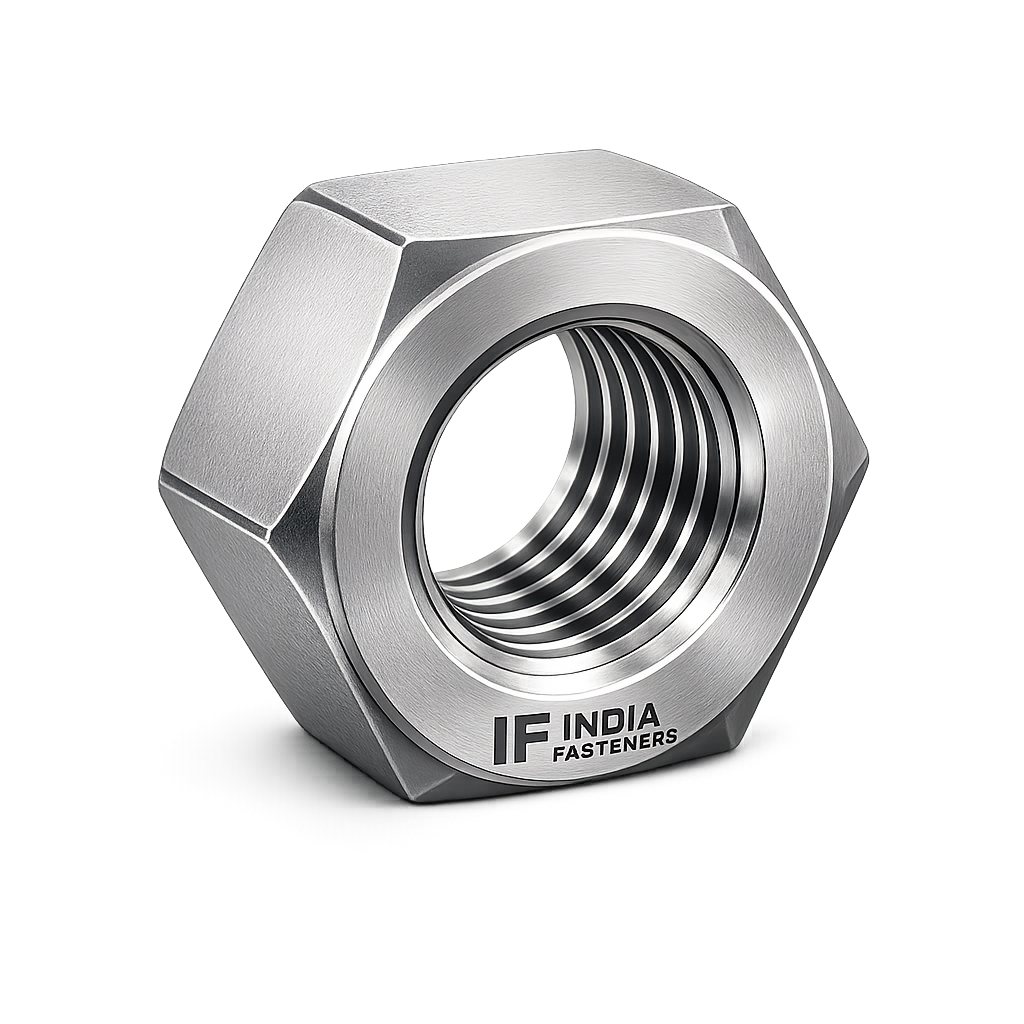
HEX NUT
1. Regional Industry Context — Middle East Mechanical Infrastructure
Across the Middle East industrial sector, mechanical reliability is predominantly achieved through engineered bolted joint systems rather than permanent welded connections. Hex nuts represent one of the most widely used load-retention components within these assemblies.
GCC facilities operate under demanding environmental, operational, and maintenance conditions requiring predictable mechanical performance, controlled preload generation, and maintainability during long operating lifecycles.
1.1 Oil & Gas Upstream Facilities
In upstream production environments, bolted joints are present in:
- Wellhead assemblies
- Christmas tree equipment
- Pressure control systems
- Flowline connections
- Valve bonnet assemblies
- Flanged piping networks
Hex nuts function as preload-retaining elements paired with stud bolts, allowing:
- Controlled disassembly during shutdowns
- Seal replacement without cutting or welding
- Integrity verification through torque or tension inspection
Continuous hydrocarbon exposure, cyclic pressure loading, and sand contamination demand fasteners with stable mechanical properties and reliable thread engagement.
1.2 Refineries and Gas Processing Plants
Refinery infrastructure across GCC regions operates at elevated temperatures and sustained mechanical stress.
Typical applications include:
- Heat exchanger channel covers
- Furnace assemblies
- Reactor vessels
- High-pressure piping flanges
- Catalyst handling equipment
Bolted joints allow periodic maintenance aligned with turnaround schedules. Hex nuts therefore become critical components governing:
- Gasket compression stability
- Flange leakage prevention
- Thermal expansion accommodation
Improper nut performance directly correlates with fugitive emission risks and unplanned shutdowns.
1.3 Petrochemical Complexes (Jubail / Ruwais Environments)
Petrochemical facilities operate under corrosive chemical exposure involving:
- Aromatics processing
- Polymer production units
- Acid and caustic services
- Hydrogen processing systems
Hex nuts used in these environments must withstand:
- Chemical corrosion
- Temperature cycling
- Sustained vibration from rotating machinery
Material selection, coating systems, and hardness control become governing factors.
1.4 LNG Terminals and Cryogenic Systems
Liquefied Natural Gas installations impose additional constraints:
- Cryogenic temperatures down to −196 °C
- Thermal contraction stresses
- Brittle fracture risks
Hex nuts paired with low-temperature stud bolts must maintain:
- Impact toughness
- Thread integrity
- Resistance to embrittlement
Charpy impact testing and controlled metallurgy are mandatory.
1.5 Power Generation Plants
Power generation assets across Saudi Arabia, UAE, and Qatar depend on bolted assemblies in:
- Steam turbine casings
- Boiler systems
- Flue gas equipment
- Structural supports
- Cooling water systems
Thermal expansion cycles continuously challenge preload retention.
Hex nuts must sustain clamp force despite:
- High operating temperatures
- Thermal relaxation
- Creep exposure
1.6 Desalination Facilities
Seawater desalination plants introduce combined challenges:
- Chloride-rich atmosphere
- High humidity
- Continuous saline exposure
Corrosion-resistant nut materials or coatings are required to prevent thread seizure and preload loss.
1.7 Offshore Platforms
Offshore environments present compounded loading conditions:
- Salt spray exposure
- Structural vibration
- Wind loading
- Wave-induced cyclic stresses
Hex nuts are used extensively in:
- Structural steel connections
- Pipe supports
- Equipment skids
- Deck modules
Material selection frequently shifts toward stainless steel or protected alloy grades.
1.8 Pipeline Flange Connections
Pipeline construction across desert and offshore environments relies heavily on stud bolt and hex nut assemblies.
Key performance requirements:
- Leak-tight flange compression
- Resistance to vibration loosening
- Field installation consistency
Bolting reliability directly influences environmental safety and operational continuity.
1.9 Structural Steel Installations
Heavy hex nuts and structural nuts are commonly used in:
- Pipe rack systems
- Steel frames
- Industrial platforms
- Equipment foundations
Structural bolting demands controlled proof load values and predictable bearing performance.
2. Importance of Bolted Joints vs Welding in Maintainable Systems
Welded joints provide permanent connections but limit inspection and replacement capability. GCC industrial philosophy favors bolting where periodic access is required.
Advantages of bolted joints:
- Non-destructive disassembly
- Controlled preload application
- Replaceable sealing elements
- Reduced shutdown duration
Hex nuts enable controlled mechanical clamping rather than metallurgical bonding.
3. Gulf Environmental Challenges Affecting Bolted Joints
3.1 Desert Temperature Fluctuation
Daily temperature swings may exceed 40 °C differences between day and night.
Effects include:
- Differential thermal expansion
- Bolt elongation variation
- Preload relaxation
Proper nut material hardness and thread accuracy are required to maintain clamp force stability.
3.2 Coastal Humidity and Saline Atmosphere
GCC coastal facilities experience accelerated corrosion due to airborne chlorides.
Risks:
- Thread galling
- Corrosion-induced preload loss
- Seizure during maintenance removal
Surface coating selection becomes essential.
3.3 Vibration and Fatigue Exposure
Rotating equipment introduces dynamic loading.
Failure mechanisms include:
- Self-loosening
- Micro-slip at bearing surfaces
- Thread wear
Correct torque application and friction control mitigate these risks.
4.Technical Definition of Hex Nut
A hex nut is an internally threaded mechanical fastener designed to engage with an externally threaded bolt or stud to generate clamp force through torque application.
Functional Definition
- Internally threaded load-retaining component
- Torque-to-tension conversion device
- Preload generating element in bolted joints
- Bearing surface load distributor
4.1 Nut–Bolt Interaction Mechanics
When torque is applied:
- Threads translate rotational motion into axial tension.
- Bolt elongates elastically.
- Joint members compress.
- Clamp force is generated.
The nut acts as the reaction element allowing tension development.
4.2 Thread Engagement Principles
Load transfer occurs through engaged threads.
Key considerations:
- Minimum engagement length
- Thread profile accuracy
- Pitch compatibility
- Material strength balance between bolt and nut
Typically, the first engaged threads carry the highest load concentration.
4.3 Load Transfer Through Bearing Surfaces
The nut bearing face distributes compressive load onto the joint surface.
Critical factors:
- Surface flatness
- Perpendicularity
- Hardness compatibility
Improper bearing geometry leads to uneven stress distribution.
4.4 Friction Influence on Clamp Force
Approximately:
- 50% torque lost to thread friction
- 40% lost to bearing friction
- 10% converted into useful bolt tension
Therefore, hex nut surface condition significantly influences joint performance.
5. Applicable International Standards
ASME B18.2.2
Defines dimensional requirements for hex nuts and heavy hex nuts in inch series.
ASTM A194
Covers carbon and alloy steel nuts for high-pressure or high-temperature service.
ASTM A563
Structural hex nuts for general structural bolting applications.
ISO 4032 / ISO 4033
Metric hex nut dimensional standards.
ASME PCC-1
Industry guideline governing bolted flange joint assembly practices.
6. Hex Nut Classification
Hex Nut vs Heavy Hex Nut
| Parameter | Hex Nut | Heavy Hex Nut |
|---|---|---|
| Width Across Flats | Standard | Larger |
| Load Distribution | Moderate | Improved |
| Common Use | General fastening | Pressure flanges & structural |
| GCC Usage | Equipment fastening | Oil & Gas flange joints |
Finished Nut vs Structural Nut
- Finished Nuts: Machine assemblies, equipment fabrication.
- Structural Nuts: High-strength bolting systems and steel structures.
Metric vs UNC / UNF Systems
- Metric Threads: ISO standard projects and European EPC influence.
- UNC: Coarse thread, preferred in field installations.
- UNF: Fine thread, higher tensile stress applications.
Standard Height vs High-Strength Configuration
Nut height affects:
- Thread engagement strength
- Proof load capability
- Resistance to stripping
Heavy hex nuts provide greater thread shear area.
Bolted Joint Engineering & Load Mechanics
6.1 Clamp Force Generation
Clamp force (Preload): F=TK×DF = \frac{T}{K \times D}F=K×DT
Where:
- F = preload force
- T = applied torque
- K = nut factor (friction coefficient)
- D = nominal bolt diameter
6.2 Torque–Tension Relationship
Torque does not directly equal tension due to friction variability.
Lubrication condition strongly affects achieved preload.
Elastic Interaction Between Bolt and Joint
A bolted joint behaves as a spring system:
- Bolt = tensile spring
- Joint = compressive spring
Joint stiffness ratio determines load distribution during service loading.
6.3 Preload Loss Mechanisms
Common causes:
- Embedment relaxation
- Thermal expansion mismatch
- Gasket creep
- Vibration loosening
- Corrosion product formation
Proof Load Concept
Proof load represents maximum safe preload without permanent deformation.
Proof stress: σp=FpAs\sigma_p = \frac{F_p}{A_s}σp=AsFp
Where:
- FpF_pFp = proof load
- AsA_sAs = stress area
6.4 Thread Shear Strength
Approximate thread shear capacity: Fs=π×dm×Le×τF_s = \pi \times d_m \times L_e \times \tauFs=π×dm×Le×τ
Where:
- dmd_mdm = mean thread diameter
- LeL_eLe = engagement length
- τ\tauτ = allowable shear stress
A. Stress Relaxation in High-Temperature Gulf Services
Elevated temperature exposure causes:
- Material creep
- Reduction in preload
- Joint leakage risk
Heat-treated alloy nuts are required for sustained performance.
B. Vibration Loosening Risks
Self-loosening occurs when transverse vibration exceeds friction resistance.
Mitigation methods:
- Controlled tightening
- Lubrication control
- Proper bearing surface condition
C. Controlled Tightening Importance
Field tightening must follow engineered procedures:
- Torque control
- Hydraulic tensioning
- Cross-pattern tightening sequence
Aligned with ASME PCC-1 philosophy.
6.5 Applicable Material Standards — GCC Service Mapping
Hex nuts used in Middle East EPC projects are selected primarily based on pressure class, temperature exposure, environmental corrosion risk, and mechanical preload requirement.
Material specification is not determined by strength alone. Compatibility with stud bolt material, joint design requirements, and international pressure equipment codes governs selection.
Industrial hex nuts manufactured by India Fasteners are produced in accordance with internationally recognized specifications used across GCC projects.
ASTM A194 — High Pressure & High Temperature Nut Standard
ASTM A194 applies to carbon, alloy, and stainless steel nuts intended for:
- Pressure vessels
- High-temperature flanges
- Refinery process equipment
- Steam and hydrogen services
This specification is widely referenced within:
- ASME B31.3 Process Piping
- ASME Section VIII Pressure Vessels
- Saudi Aramco mechanical standards
- ADNOC project specifications
ASTM A194 Grade 2H
Material Type: Quenched and tempered carbon steel
Typical Characteristics
- High proof strength
- Stable performance under elevated temperature
- Compatible with ASTM A193 B7 stud bolts
GCC Application Areas
- Refinery piping systems
- Hydrocarbon processing equipment
- Power plant steam systems
- High-pressure flange joints
Service Temperature Range
Approx. −29 °C to +425 °C
Engineering Considerations
- Controlled hardness prevents brittle fracture
- Frequently required for pressure-retaining bolted joints
- Mandatory traceability in EPC procurement
ASTM A194 Grade 7
Material Type: Alloy steel heat-treated nuts
Used where improved strength and temperature resistance are required beyond Grade 2H capability.
Applications
- High-pressure gas service
- Elevated temperature reactors
- Severe mechanical loading environments
6.6 ASTM A563 — Structural Hex Nut Standard
ASTM A563 covers carbon and alloy steel nuts used primarily in structural applications.
Common GCC grades include:
ASTM A563 Grade DH
Characteristics
- Heat-treated structural nut
- High strength structural bolting
- Compatible with ASTM A325 / A490 bolting systems
Applications
- Pipe racks
- Steel platforms
- Offshore structures
- Equipment supports
ASTM A563 Grade C
Characteristics
- Medium strength carbon steel
- General structural fastening
Applications
- Non-pressure steel assemblies
- Infrastructure supports
- Mechanical equipment frames
ASTM A182 Stainless Steel Nuts
Forged stainless steel materials used where corrosion resistance dominates material selection.
ASTM A182 F304
Properties
- Austenitic stainless steel
- Good corrosion resistance
- Suitable for chemical processing environments
Typical Use
- Desalination plants
- Water systems
- Petrochemical auxiliary equipment
ASTM A182 F316
Enhanced Feature
- Molybdenum addition improves chloride resistance
GCC Relevance
Highly suitable for:
- Offshore platforms
- Coastal refineries
- Marine-exposed facilities
6.7 Duplex Stainless Steel Nuts
Duplex grades provide combined benefits:
- High mechanical strength
- Superior resistance to chloride stress corrosion cracking
Applications include:
- Offshore oil platforms
- Seawater injection systems
- High salinity process environments
Alloy Steel Grades
Alloy steel nuts are selected for:
- High-temperature refinery service
- Hydrogen environments
- Pressure equipment operating beyond carbon steel limits
Material compatibility with alloy stud bolts remains mandatory.
6.8 Low-Temperature Service Grades (L7 Compatibility)
Cryogenic LNG facilities require materials capable of maintaining ductility at low temperatures.
Nut material selection must match:
- ASTM A320 L7 bolts
- Cryogenic piping systems
- LNG storage equipment
Requirements include:
- Controlled chemistry
- Impact testing verification
- Reduced transition temperature
Hydrogen sulfide environments introduce risk of:
- Sulfide stress cracking
- Hydrogen embrittlement
Typical controls include:
- Hardness limitation
- Controlled heat treatment
- Verified metallurgical structure
NACE MR0175 / ISO 15156 requirements are commonly referenced by GCC operators.
Standards Mapping to GCC Codes
| Standard | Engineering Relevance |
|---|---|
| ASME B18.2.2 | Dimensional compliance |
| ASTM F606 | Mechanical testing procedures |
| ISO Property Classes | Metric strength classification |
| ASME B31.3 | Process piping bolting requirements |
| ASME Section VIII | Pressure vessel bolting rules |
A. Material Comparison Table — GCC Engineering Reference
| Grade | Proof Load (MPa) | Yield Strength (MPa) | Temperature Limit | Corrosion Resistance | Typical GCC Application |
|---|---|---|---|---|---|
| ASTM A194 2H | ~850 | High | 425°C | Moderate | Refinery flanges |
| ASTM A194 7 | Higher | Very High | 500°C+ | Moderate | High-pressure gas |
| ASTM A563 DH | High | High | 300°C | Low | Structural steel |
| ASTM A563 C | Medium | Medium | 250°C | Low | General structures |
| A182 F304 | Moderate | Moderate | 870°C | Good | Chemical plants |
| A182 F316 | Moderate | Moderate | 870°C | Very Good | Offshore & marine |
| Duplex SS | High | High | 300°C | Excellent | Offshore seawater |
| L7 Compatible | High | High | −101°C | Moderate | LNG cryogenic service |
Values represent typical engineering ranges used for comparison purposes. Project specifications govern final selection.
B .Heat Treatment & Metallurgical Control
Mechanical performance of hex nuts depends significantly on metallurgical conditioning rather than chemical composition alone.
Quenching and Tempering
Benefits:
- Dimensional stability
- Improved fatigue resistance
- Reduced distortion during service
Used for austenitic stainless steel nuts.
Purpose:
- Restore corrosion resistance
- Dissolve carbide precipitation
- Improve ductility
Rapid quenching preserves corrosion-resistant structure.
Forging operations refine grain flow direction aligned with load paths.
Result:
- Improved mechanical strength
- Enhanced fatigue resistance
- Increased toughness under cyclic loading
Hardness must remain within specification limits.
Excess hardness risks:
- Hydrogen cracking
- Reduced ductility
Insufficient hardness risks:
- Thread deformation
- Preload loss
Hardness testing is conducted according to ASTM F606.
6.9 Hydrogen Embrittlement Prevention
Electroplated components may absorb hydrogen during processing.
Preventive controls include:
- Post-coating baking
- Controlled plating chemistry
- Hardness monitoring
Critical for high-strength alloy nuts.
A.NACE Hardness Limits
Sour service environments typically restrict hardness to prevent sulfide stress cracking.
Heat treatment cycles are controlled to maintain allowable hardness levels.
Charpy Impact Testing for LNG Service
Low-temperature service requires toughness verification.
Testing confirms:
- Energy absorption capacity
- Resistance to brittle fracture
- Safe performance in cryogenic exposure
Impact testing temperatures correspond to project specification requirements.
7. Manufacturing Process Flow — Documentation Level
Manufacturing discipline directly influences dimensional accuracy, mechanical performance, and traceability acceptance during EPC inspection.
7.1 Steel Sourcing & Traceability
Raw material procurement includes:
- Approved steel mills
- Heat number assignment
- Chemical composition verification
- Incoming material inspection
Each production batch remains traceable to mill origin.
7.2 Heat Number Verification
Material identity maintained through:
- Physical tagging
- Documentation linkage
- Production batch control
Traceability supports EN 10204 certification requirements.
7.3 Hot Forging / Cold Forming
Hot Forging
- Preferred for heavy hex nuts
- Produces favorable grain structure
- Improves mechanical integrity
Cold Forming
- Suitable for smaller sizes
- High dimensional repeatability
Process selection depends on nut size and material grade.
7.4 Blank Trimming
Forged blanks undergo trimming to remove flash and ensure dimensional conformity prior to threading.
7.5 Thread Tapping Process
Internal threading performed using precision taps.
Critical controls:
- Pitch accuracy
- Thread angle conformity
- Surface finish quality
Thread tolerances must meet ASME or ISO requirements.
7.6 Thread Gauge Verification
Inspection performed using:
- GO gauges
- NO-GO gauges
Ensures functional interchangeability with mating bolts.
7.7 Heat Treatment Cycle Control
Furnace operations include:
- Temperature monitoring
- Time recording
- Cooling rate control
Records maintained for inspection review.
7.8 Surface Finishing
Depending on service requirement:
- Black oxide finish
- Phosphate coating
- Zinc plating
- Hot-dip galvanizing
- Fluoropolymer coatings
Surface preparation affects friction coefficient and torque performance.
7.9 Coating Application
Coatings selected based on corrosion exposure and preload control requirements.
Uniform coating thickness prevents thread interference.
7.10 Marking & Stamping
Each hex nut may be marked with:
- Manufacturer identification
- Material grade
- Heat number or batch code
Marking ensures field traceability.
7.11 Final Inspection
Quality verification includes:
- Dimensional inspection
- Mechanical testing
- Hardness verification
- Visual inspection
- Coating thickness checks
Inspection results compiled into quality documentation packages.
7.12 Dimensional Tolerance Control
Key tolerances monitored:
- Across flats dimension
- Nut height
- Thread concentricity
- Bearing face perpendicularity
Tolerance compliance ensures proper preload generation and uniform load distribution.
7.13 Thread Accuracy
Thread class accuracy directly affects:
- Torque consistency
- Assembly efficiency
- Joint reliability
Inspection procedures align with EPC consultant expectations.
8. Dimensional Reference Tables — Hex Nuts
Dimensional control of hex nuts directly affects:
- Load distribution
- Tool engagement
- Thread engagement efficiency
- Assembly repeatability in field installation
All dimensions referenced below align with ASME B18.2.2 (inch series) and ISO 4032 / ISO 4033 (metric series).
Values shown represent common EPC project ranges. Project specifications govern final dimensional acceptance.
8.1 Imperial Series Hex Nut Dimensions (ASME B18.2.2)
| Nominal Bolt Size | Across Flats (mm) | Nut Height (mm) | Thread Pitch | Approx. Weight /100 pcs (kg) | Applicable Bolt Diameter |
|---|---|---|---|---|---|
| 1/2″ | 19 | 11 | UNC 13 | 1.2 | 12.7 mm |
| 5/8″ | 24 | 13 | UNC 11 | 2.0 | 15.9 mm |
| 3/4″ | 29 | 16 | UNC 10 | 3.3 | 19.0 mm |
| 7/8″ | 34 | 18 | UNC 9 | 4.8 | 22.2 mm |
| 1″ | 38 | 20 | UNC 8 | 6.5 | 25.4 mm |
| 1-1/8″ | 42 | 23 | UNC 7 | 8.5 | 28.6 mm |
| 1-1/4″ | 48 | 25 | UNC 7 | 11.0 | 31.8 mm |
| 1-1/2″ | 57 | 30 | UNC 6 | 18.0 | 38.1 mm |
| 2″ | 76 | 38 | UNC 4.5 | 38.0 | 50.8 mm |
8.2 Metric Series Hex Nut Dimensions (ISO 4032 / 4033)
| Bolt Size | Across Flats (mm) | Nut Height (mm) | Pitch (mm) | Weight /100 pcs (kg) | Typical GCC Use |
|---|---|---|---|---|---|
| M12 | 19 | 10 | 1.75 | 1.1 | Equipment fastening |
| M16 | 24 | 13 | 2.0 | 2.0 | Pipe supports |
| M20 | 30 | 16 | 2.5 | 3.5 | Structural steel |
| M24 | 36 | 19 | 3.0 | 5.5 | Flange assemblies |
| M30 | 46 | 24 | 3.5 | 10.5 | Heavy equipment |
| M36 | 55 | 29 | 4.0 | 17.0 | Structural joints |
| M42 | 65 | 34 | 4.5 | 27.0 | Offshore modules |
| M48 | 75 | 38 | 5.0 | 42.0 | Pressure vessels |
Engineering Note
Across-flats dimension consistency ensures:
- Proper wrench engagement
- Controlled torque application
- Reduced rounding during hydraulic or manual tightening
9. Mechanical Property Tables
Mechanical properties are verified according to ASTM F606 testing procedures.
9.1 Carbon & Alloy Steel Hex Nuts
| Grade | Proof Load (MPa) | Hardness (HBW/HRC) | Yield Strength (MPa) | Tensile Strength (MPa) | Elongation (%) |
|---|---|---|---|---|---|
| ASTM A194 2H | ≥850 | 24–35 HRC | High | ≥1000 | ≥12 |
| ASTM A194 7 | ≥950 | 26–38 HRC | Very High | ≥1100 | ≥12 |
| ASTM A563 DH | ≥830 | 248–352 HBW | High | ≥980 | ≥14 |
| ASTM A563 C | ≥600 | 187–302 HBW | Medium | ≥760 | ≥16 |
9.2 Stainless Steel Hex Nuts
| Grade | Proof Load (MPa) | Hardness | Yield Strength (MPa) | Tensile Strength (MPa) | Elongation |
|---|---|---|---|---|---|
| F304 | ≥450 | ≤223 HB | Moderate | ≥515 | High |
| F316 | ≥450 | ≤223 HB | Moderate | ≥515 | High |
| Duplex SS | ≥650 | Controlled | High | ≥800 | Moderate |
Engineering Interpretation
Proof load governs maximum tightening preload without permanent deformation.
Consultants typically verify:
- Proof load compatibility with stud bolt grade
- Hardness limits for sour service
- Mechanical test traceability
10. Torque vs Preload Chart (Mandatory Engineering Reference)
Torque values depend strongly on friction conditions.
Values below represent engineering reference data used during preliminary tightening planning.
10.1 Torque–Preload Relationship (Carbon Steel Stud + Hex Nut)
| Bolt Size | Dry Torque (Nm) | Lubricated Torque (Nm) | Expected Clamp Force (kN) |
|---|---|---|---|
| M12 | 95 | 70 | 45 |
| M16 | 230 | 170 | 80 |
| M20 | 450 | 330 | 125 |
| M24 | 780 | 570 | 180 |
| M30 | 1550 | 1150 | 300 |
| M36 | 2700 | 2000 | 420 |
| M42 | 4300 | 3200 | 600 |
| M48 | 6500 | 4800 | 820 |
10.2 Tightening Efficiency Considerations
Torque conversion efficiency varies due to:
- Surface finish
- Coating type
- Lubrication condition
- Thread quality
- Bearing face friction
Typical torque energy distribution:
- Thread friction: ~50%
- Bearing friction: ~40%
- Useful preload: ~10%
Therefore, identical torque values may produce different clamp loads.
10.3 GCC Installation Practice
Projects frequently apply:
- Controlled torque tightening
- Hydraulic tensioning for large diameters
- Multi-pass tightening sequences
Aligned with ASME PCC-1 bolting assembly guidance.
11. Thread Engagement & Strength Calculation Guide
Correct engagement length prevents thread stripping before bolt tensile failure.
11.1 Minimum Engagement Length
General engineering rule: Le≥1.0×DL_e \geq 1.0 \times DLe≥1.0×D
Where:
- LeL_eLe = engagement length
- DDD = bolt diameter
For stainless steel combinations, greater engagement may be required.
11.2 Thread Stripping Criterion
Thread failure occurs when shear strength of internal thread is exceeded.
Approximate relationship: Fstrip=π×dm×Le×τF_{strip} = \pi \times d_m \times L_e \times \tauFstrip=π×dm×Le×τ
Where:
- dmd_mdm = mean diameter
- LeL_eLe = engagement length
- τ\tauτ = allowable shear stress
11.3 Load Distribution Across Threads
Typical distribution:
- First thread carries highest load (~30%)
- Second thread ~20%
- Remaining threads share decreasing load
This explains importance of accurate thread geometry.
11.4 Sample Consultant Verification Example
Given
- Bolt size: M24
- Engagement length: 24 mm
- Allowable shear stress: 300 MPa
Consultant verifies stripping load exceeds bolt tensile capacity.
Result confirms nut strength adequate for joint integrity.
11.5 Consultant Evaluation Logic
Inspection engineers typically confirm:
- Nut grade ≥ bolt strength class
- Thread engagement adequate
- Hardness compatibility
- No galling risk
12. Surface Coating & Corrosion Protection Table
Surface finish influences both corrosion resistance and tightening friction.
| Coating Type | Corrosion Resistance | Friction Stability | Typical GCC Environment |
|---|---|---|---|
| Black Finish | Low | Stable | Indoor equipment |
| Phosphate | Moderate | Good lubrication retention | General industrial |
| Zinc Plating | Moderate | Variable | Dry desert climate |
| Hot-Dip Galvanized | High | Higher friction | Structural steel outdoors |
| PTFE Coating | High | Low friction | Chemical plants |
| Xylan Coating | Very High | Controlled friction | Offshore platforms |
Engineering Observations
- Galvanized coatings increase thread friction.
- Fluoropolymer coatings reduce torque requirement.
- Coating thickness must not interfere with thread tolerance.
GCC Environmental Mapping
Marine Exposure
→ Stainless steel or fluoropolymer coatings.
Desert Environment
→ Zinc or phosphate systems acceptable.
Petrochemical Plants
→ PTFE/Xylan preferred for chemical resistance.
Offshore Installations
→ Duplex stainless or advanced coating systems.
13. Inspection & Quality Assurance
GCC EPC projects place strong emphasis on documentation-backed verification rather than visual acceptance alone.
13.1 Dimensional Inspection
Verification includes:
- Across flats dimension
- Nut height
- Thread concentricity
- Bearing surface flatness
Measured using calibrated instruments.
13.2 Thread Gauge Inspection
Mandatory checks:
- GO gauge acceptance
- NO-GO rejection
13.3 Hardness Testing
Performed using:
- Rockwell testing
- Brinell testing
Confirms compliance with material specification and NACE limits.
13.4 Mechanical Testing
Conducted according to ASTM F606:
- Proof load testing
- Load verification
- Mechanical strength confirmation
13.5 Coating Thickness Verification
Measured using calibrated coating thickness gauges.
Ensures corrosion protection without thread interference.
13.6 Positive Material Identification (PMI)
Applied where required by EPC specifications.
Confirms alloy composition using spectrometric analysis.
Common for:
- Stainless steel
- Alloy steel
- Sour service materials
13.7 Batch Traceability
Each manufacturing batch maintains:
- Heat number linkage
- Production records
- Inspection history
- Certification references
Traceability remains available throughout product lifecycle.
13.8 Certification Documentation
Typical GCC documentation package includes:
- EN 10204 3.1 Mill Test Certificate
- Mechanical test reports
- Heat treatment records
- Coating inspection reports
- Dimensional inspection records
For critical applications, third-party witnessing may be required.
13.9 Third-Party Inspection Expectations
Independent inspection agencies typically verify:
- Material conformity
- Mechanical property compliance
- Marking traceability
- Documentation completeness
Inspection readiness significantly influences vendor approval status.
13.10 Quality Philosophy for EPC Acceptance
Hex nuts are evaluated not as individual components but as part of a complete bolted joint integrity system.
Consultant approval relies on:
- Dimensional consistency
- Mechanical reliability
- Traceability transparency
- Documentation clarity
14. Industries Served — Middle East Industrial Applications
Hex nuts function as critical load-retaining elements within bolted joint systems across GCC industrial infrastructure. Their performance directly influences pressure containment integrity, structural stability, and maintainability of mechanical installations.
In EPC environments, hex nuts are evaluated as engineered components rather than commodity fasteners.
14.1 Oil & Gas Processing Facilities
Upstream and midstream hydrocarbon facilities depend heavily on removable mechanical joints.
Typical installations include:
- Wellhead assemblies
- Separator vessels
- Flowlines and manifolds
- Gas compression units
- Produced water treatment systems
Hex nuts are used with stud bolts for:
- Flanged piping connections
- Valve assemblies
- Pressure boundary closures
Operational requirements:
- Resistance to vibration from rotating equipment
- Stable preload retention under temperature cycling
- Compatibility with high-pressure hydrocarbon service
Bolted joints allow controlled disassembly for inspection without thermal distortion associated with welding.
14.2 Refineries
Refinery environments introduce combined exposure to:
- Elevated temperature
- Hydrocarbon processing fluids
- Thermal expansion cycling
- Continuous vibration
Typical hex nut applications:
- Furnace systems
- Heat exchangers
- Reactor flanges
- Hydrogen service piping
- Catalyst handling equipment
Engineering focus includes:
- Controlled preload generation
- Resistance to stress relaxation
- Compatibility with alloy stud materials
14.3 Petrochemical Plants
Facilities operating in industrial zones such as Jubail and Ruwais require bolting capable of sustained chemical exposure.
Common assemblies:
- Polymer processing units
- Ethylene and propylene systems
- Storage tank accessories
- Process skids
Material selection prioritizes:
- Corrosion resistance
- Chemical compatibility
- Long inspection intervals
Hex nuts serve as reusable fastening elements supporting maintenance-driven plant operation philosophy.
14.4 LNG Installations & Cryogenic Systems
Liquefied natural gas infrastructure introduces unique mechanical challenges:
- Extremely low temperatures
- Thermal contraction effects
- Fracture toughness requirements
Hex nuts used in LNG service must maintain ductility and prevent brittle fracture.
Applications include:
- Cryogenic piping
- Storage tanks
- Loading arms
- Insulated valve systems
Material compatibility with low-temperature stud bolts is essential.
14.5 Power Generation Plants
Thermal and combined-cycle power plants employ extensive bolted connections.
Typical areas:
- Steam turbine casings
- Boiler systems
- Heat recovery steam generators
- Cooling water systems
Operational conditions involve:
- High temperature gradients
- Cyclic loading
- Scheduled maintenance shutdowns
Hex nuts enable repeatable tightening procedures aligned with maintenance programs.
14.6 Desalination Facilities
Seawater desalination plants present aggressive corrosion environments due to:
- Chloride-rich exposure
- High humidity
- Continuous moisture presence
Common applications:
- Pump assemblies
- Reverse osmosis skids
- Structural equipment supports
- Piping flanges
Material selection often favors stainless steel or coated carbon steel nuts.
14.7 Pipeline Construction
Pipeline systems across GCC regions rely on bolted joints for:
- Valve stations
- Pig launchers and receivers
- Compressor stations
- Metering installations
Requirements include:
- Rapid installation capability
- Field tightening reliability
- Long-term preload stability
Hex nuts allow controlled joint assembly during large-scale pipeline construction activities.
14.8 Structural Steel Infrastructure
Industrial steel structures depend on structural hex nuts for load transfer.
Applications include:
- Pipe racks
- Equipment platforms
- Cable tray supports
- Offshore module frames
Structural integrity relies on:
- Proper torque application
- Accurate dimensional tolerances
- Verified mechanical properties
14.9 Offshore Platforms
Offshore environments represent the most demanding GCC operating conditions.
Exposure factors:
- Salt spray
- Continuous vibration
- Humidity saturation
- Cyclic loading
Hex nuts are used throughout:
- Topside modules
- Deck equipment
- Process skids
- Safety systems
Material selection and coating performance are critical for long-term reliability.
15. Export & GCC Supply Capability
International EPC procurement requires manufacturing capability supported by structured export discipline.
India Fasteners supplies industrial hex nuts as engineered components supported by documentation and logistics control.
15.1 Regional Export Coverage
Supply capability supports projects across:
- Saudi Arabia
- United Arab Emirates (Dubai and Abu Dhabi)
- Qatar
- Oman
- Kuwait
- Bahrain
Export programs align with EPC contractor procurement procedures.
15.2 Export Packaging Methods
Packaging objectives:
- Prevent corrosion during transit
- Maintain traceability
- Preserve coating integrity
Typical methods include:
- Moisture-resistant packaging
- Sealed cartons or crates
- Palletized shipment
- Vapor corrosion inhibitor protection where required
Packaging selection considers:
- Transit duration
- Marine shipment exposure
- Storage conditions upon arrival
15.3 Corrosion Protection During Shipment
Preventive controls include:
- Protective oil application
- Desiccant inclusion
- Sealed packaging systems
- Controlled container loading
These measures reduce risk associated with extended sea freight to Gulf ports.
15.4 Documentation Supplied with Export Shipments
Typical project documentation package includes:
- Mill Test Reports
- Heat treatment records
- Mechanical testing reports
- Coating inspection results
- Dimensional inspection reports
- Packing lists
- Batch traceability documentation
Documentation structure supports consultant review and material approval workflows.
15.5 Inspection Release Notes
Prior to shipment, inspection status may include:
- Manufacturer inspection release
- Third-party inspection clearance
- Project-specific acceptance documentation
Inspection release confirmation allows material entry into EPC project supply chains.
15.6 Material Traceability Documentation
Traceability ensures each hex nut can be linked to:
- Raw material heat number
- Production batch
- Inspection records
- Certification documents
Traceability continuity remains critical during contractor audits.
15.7 Container Loading Discipline
Loading procedures consider:
- Weight distribution
- Packaging stability
- Damage prevention
- Identification labeling
Proper container management minimizes handling damage during international transport.
16. Procurement & Installation Engineering View
Hex nuts are evaluated by procurement engineers as part of complete bolted joint systems rather than standalone items.
16.1 Stud Bolt + Hex Nut Assemblies
Typical configuration:
- Stud bolt
- Two hex nuts
- Hardened washers (when specified)
Performance depends on compatibility between all components.
Material mismatch may result in:
- Thread galling
- Uneven load transfer
- Premature joint failure
16.2 Tightening Sequence Practices
Controlled tightening ensures uniform gasket compression.
Common methods:
- Hand snugging
- Star-pattern tightening
- Multi-pass torque application
- Final verification pass
Large flange joints require systematic preload distribution.
16.3 ASME PCC-1 Bolting Philosophy
Installation philosophy emphasizes:
- Controlled preload generation
- Qualified tightening procedures
- Trained bolting technicians
- Documented tightening records
The objective is predictable joint performance rather than maximum torque application.
16.4 Lubrication Requirements
Lubrication affects torque–tension conversion.
Functions include:
- Reduction of thread friction
- Prevention of galling
- Improved preload consistency
Lubricant selection must be compatible with service temperature and coating system.
16.5 Torque vs Tension Control
Torque tightening provides indirect preload control.
For critical services, EPC contractors may apply:
- Hydraulic tensioning
- Ultrasonic bolt measurement
- Load indicating systems
Hex nut dimensional accuracy supports these methods.
16.6 Gasket Seating Considerations
Correct preload generated by hex nuts ensures:
- Leak prevention
- Uniform gasket compression
- Pressure boundary integrity
Under-tightening causes leakage; over-tightening damages gasket structure.
16.7 Field Inspection Checklist
Typical installation verification includes:
- Material grade confirmation
- Coating condition inspection
- Thread cleanliness
- Lubrication verification
- Tightening record validation
- Marking visibility
Inspection procedures align with project quality plans.
16.8 Storage Practices for Gulf Climates
Improper storage can degrade bolting performance before installation.
Recommended practices:
- Covered storage areas
- Elevated pallets
- Protection from sand contamination
- Moisture control
- Separation by heat number
Storage discipline supports long-term traceability.
17. Custom Engineering Capabilities
Industrial projects frequently require deviations from standard catalog dimensions or materials.
India Fasteners supports engineered manufacturing solutions aligned with EPC project requirements.
17.1 Custom Thread Forms
Capability includes production of:
- UNC / UNF / Metric threads
- Fine pitch threads
- Special tolerance classes
- Project-specific thread requirements
Thread geometry verified using calibrated gauges.
17.2 Non-Standard Dimensions
Manufacturing flexibility allows:
- Special nut heights
- Modified across-flat dimensions
- Heavy section configurations
- Project drawing compliance
Used when dictated by engineering design constraints.
17.3 High-Temperature Service Nuts
Materials supplied for elevated temperature applications include:
- Alloy steel grades
- Heat-resistant materials
- Controlled hardness structures
Used in refinery and power plant equipment.
17.4 Cryogenic Service Hex Nuts
Low-temperature applications may require:
- Impact-tested materials
- Controlled metallurgical structure
- Matching compatibility with L7 bolting systems
Ensures ductile behavior under cryogenic exposure.
17.5 NACE-Compliant Supply
Where sour service exists, manufacturing controls include:
- Hardness limitation
- Heat treatment verification
- Metallurgical review
Supports hydrogen sulfide environments typical in GCC oil fields.
17.6 Heavy Hex Configurations
Heavy hex nuts provide:
- Increased bearing surface
- Improved load distribution
- Enhanced wrench engagement
Commonly specified for pressure equipment flanges.
17.7 Special Coatings for Offshore GCC Service
Available coating systems selected based on project requirement:
- Fluoropolymer coatings
- Marine-grade protection systems
- Controlled-friction coatings for torque accuracy
Coating selection balances corrosion resistance and tightening behavior.
17.8 Project-Specific Marking & Identification
Identification options include:
- Grade marking
- Manufacturer identification
- Heat number stamping
- Project-specific coding
Supports field verification and lifecycle traceability.
Engineering Conclusion
Hex nuts used within GCC industrial projects serve as engineered load-retention components essential to bolted joint integrity.
Performance acceptance depends on:
- Compliance with international dimensional standards
- Controlled material metallurgy
- Verified mechanical properties
- Accurate manufacturing processes
- Traceable inspection documentation
- Understanding of Gulf environmental operating conditions
When evaluated from an EPC consultant perspective, a manufacturer demonstrating structured control over material selection, manufacturing discipline, inspection readiness, and bolted joint engineering principles meets technical expectations for project qualification.