
PLOW BOLTS
1. Industry Context (Global + GCC Relevance)
1.1 Earthmoving Equipment Environment
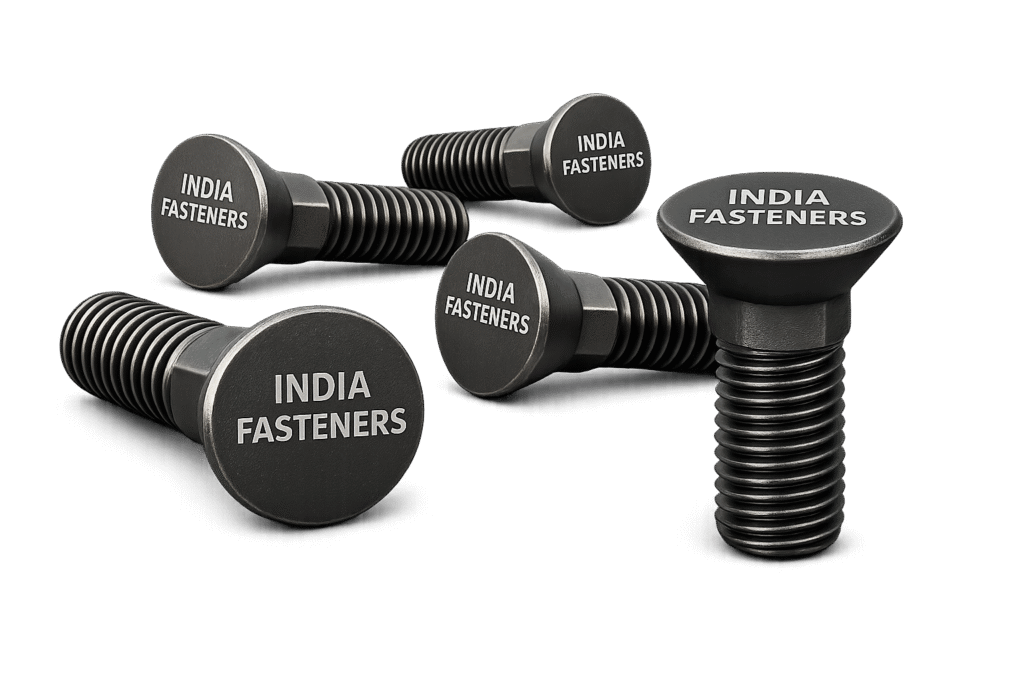
Plow bolts are critical fastening elements in ground engaging tool (GET) systems used across:
- Bulldozers (cutting edges, end bits)
- Motor graders (moldboard blades)
- Wheel loaders (bucket edges and liners)
- Excavators (wear plates and adapters)
These systems operate under continuous exposure to:
- High abrasion from soil, sand, and aggregates
- Impact loading from rocks and debris
- Cyclic stress from repeated ground engagement
In such environments, the fastening system is not secondary—it directly influences wear life, structural integrity, and operational safety.
1.2 Mining & Quarry Opera
https://indiafastners.com/industrial-rods-astm/tions
In mining environments:
- Surface mining equipment experiences extreme abrasion and impact
- Rock hardness varies from soft sedimentary to high-density igneous formations
- Equipment uptime directly affects production output
Plow bolts are used in:
- Bucket lips
- Wear liners
- Crusher feed components
- Dragline and shovel systems
Failure of a single fastener can result in:
- Loss of wear plate alignment
- Accelerated structural wear
- Equipment downtime
1.3 Road Construction & Infrastructure Projects
Motor graders and road planers rely on:
- Precision blade alignment
- Smooth surface contact with road material
Plow bolts ensure:
- Flush blade mounting
- Uniform grading without obstruction
- Consistent surface finishing
In GCC infrastructure projects:
- Long-duration operation in desert environments
- Continuous exposure to silica-rich sand
- High ambient temperatures affecting material properties
1.4 Agricultural Soil-Engaging Equipment
Agricultural plows, cultivators, and tillage tools require:
- Low-resistance soil penetration
- Minimal drag
- Replaceable wear components
Plow bolts are used to secure:
- Plowshares
- Shovels
- Harrow components
Flush mounting ensures:
- Reduced soil resistance
- Prevention of soil buildup
- Consistent operational depth
1.5 GCC Environmental Challenges
Equipment operating in GCC regions faces:
- Fine sand abrasion (high silica content)
- Elevated ambient temperatures (>50°C surface exposure)
- Thermal expansion and contraction cycles
- Corrosion potential in coastal environments
Implications for fastening systems:
2. Technical Definition of Plow Bolt
2.1 Core Definition
A plow bolt is:
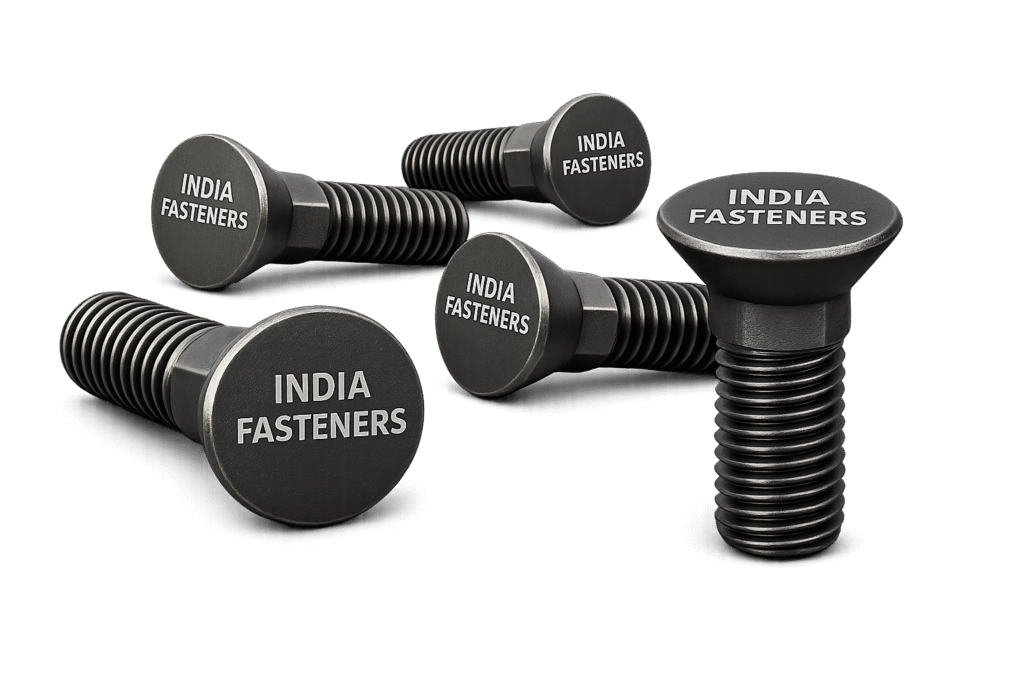
- A flat head (countersunk) bolt
- Featuring a square neck or ribbed neck
- Designed for flush installation in countersunk holes
- Used in wear plates, cutting edges, and ground engaging components
2.2 Key Design Features
Flat Countersunk Head
- Typically 80° or 90° head angle
- Ensures flush seating with mating surface
- Eliminates protrusion above wear surface
Square Neck / Ribbed Neck
- Located beneath the head
- Engages with square or specially shaped hole
- Prevents rotation during tightening
Threaded Shank
- Standard metric or UNC/UNF threads
- Designed for high clamping force
2.3 Functional Characteristics
- Flush mounting reduces abrasion exposure
- Square neck enables one-sided installation
- High clamping force maintains component integrity
- Suitable for high shear and tensile loads
2.4 Comparison: Plow Bolt vs Standard Hex Bolt
| Parameter | Plow Bolt | Hex Bolt |
|---|---|---|
| Head Type | Countersunk | Hexagonal |
| Surface Profile | Flush | Protruding |
| Wear Resistance | High (due to flush design) | Low in abrasive zones |
| Anti-Rotation | Square neck | Requires tool engagement |
| Application | Wear plates, blades | General fastening |
2.5 Standards Reference
Applicable standards include:
- ASTM A307 – Low carbon steel bolts
- ASTM A325 – Structural high-strength bolts
- ASTM A449 – Quenched and tempered bolts
- SAE J429 – Mechanical properties classification
- ISO 10642 – Countersunk head fasteners
Selection depends on:
- Load requirements
- Environmental exposure
- Equipment specification
3. Load Mechanics & Performance Requirements
3.1 Loading Conditions in GET Applications
Plow bolts operate under:
Shear Loading
- Occurs when cutting edge resists material movement
- Bolt resists lateral displacement forces
Tensile Loading
- Generated from clamping force
- Maintains tight contact between components
Impact Loading
- Sudden forces from rocks or debris
- Causes stress spikes
Combined Loading
- Simultaneous shear + tensile + impact
- Most critical operating condition
3.2 Shear Stress
Shear stress is defined as: 
Where:
 = shear stress
 = applied force
 = cross-sectional area
In plow bolts:
3.3 Tensile Stress

Where:
 = tensile stress
- = axial force
Tensile stress is induced during:
- Bolt tightening (preload)
- Dynamic loading cycles
3.4 Bearing Stress

Where:
 = projected bearing area
In plow bolts:
- Bearing stress occurs under the countersunk head
- Proper seating distributes load evenly
3.5 Clamping Force

Where:
 = applied torque
 = friction factor
 = nominal diameter
Clamping force is critical for:
- Preventing joint separation
- Maintaining alignment
- Reducing fatigue failure
3.6 Surface Pressure Distribution
Countersunk design ensures:
- Uniform pressure across seating surface
- Reduced localized stress concentrations
- Improved load transfer to base material
3.7 Fatigue Considerations
Plow bolts are subjected to:
- Repeated loading cycles
- Vibrations from equipment movement
Fatigue failure may occur due to:
- Insufficient preload
- Surface defects
- Material inconsistencies
3.8 Failure Modes
Head Shear
- Caused by excessive shear load
- Often linked to improper grade selection
Thread Stripping
- Due to over-tightening or weak nut material
Loosening
- Result of vibration and insufficient preload
Wear-Induced Failure
- Erosion of surrounding material
- Loss of seating integrity
3.9 Importance of Flush Seatin
Flush seating:
- Eliminates direct exposure to abrasive flow
- Prevents head erosion
- Maintains structural integrity over time
In abrasive environments such as GCC deserts:
Plow bolts extend service life significantly
Non-flush fasteners fail rapidly
4. Material Grades & Standards
Plow bolts used in ground engaging and wear applications require material selection based on:
- Load intensity (shear + tensile)
- Abrasive exposure level
- Impact severity
- Operating environment (temperature, corrosion)
Material selection is not uniform across applications. Mining equipment requires higher hardness and strength compared to agricultural equipment, where toughness and cost efficiency are prioritized.
4.1 Carbon Steel (Medium & High Carbon Grades)
Typical Grades
- ASTM A307 (low strength applications)
- Medium carbon steels (C35, C45 equivalent)
- High carbon steels (EN8, EN9 type)
Characteristics
- Moderate strength
- Good machinability
- Limited wear resistance without heat treatment
Applications
- Agricultural implements
- Light-duty earthmoving components
- Non-critical wear plates
Limitations
- Lower fatigue resistance
- Not suitable for high-impact mining environments
4.2 Alloy Steel (Quenched & Tempered)
Typical Standards
- ASTM A325
- ASTM A449
- SAE J429 Grade 5 / Grade 8
Characteristics
- High tensile and yield strength
- Improved fatigue resistance
- Good impact toughness when properly heat treated
Applications
- Bulldozer cutting edges
- Grader blades
- Loader bucket edges
- Structural wear components
Engineering Relevance
- Most widely used material category for plow bolts in heavy equipment
- Suitable for combined loading conditions
4.3 Boron Steel (Wear-Resistant Applications)
Characteristics
- Enhanced hardenability
- High surface hardness after heat treatment
- Improved wear resistance
Applications
- Mining equipment
- High-abrasion environments
- Quarry operations
Engineering Consideration
- Requires precise heat treatment control
- Excessive hardness can reduce toughness if not balanced
4.4 High-Strength Structural Grades
Typical Grades
- ASTM A490 equivalent
- SAE Grade 8 high-strength bolts
Characteristics
- Very high tensile strength
- Designed for structural integrity under heavy loads
- Lower ductility compared to medium-strength grades
Applications
- High-load GET systems
- Critical fastening zones in mining equipment
4.5 Material Selection Mapping
| Application Type | Recommended Material | Reason |
|---|---|---|
| Agricultural plows | Medium carbon steel | Cost-effective, sufficient strength |
| Road grading | Alloy steel (Grade 5) | Balanced strength and toughness |
| Earthmoving | Alloy steel (Grade 8) | High load capacity |
| Mining / quarry | Boron steel / A490 | Maximum wear resistance and strength |
5. Material Comparison Table (MANDATORY)
| Material Grade | Yield Strength (MPa) | Tensile Strength (MPa) | Hardness (HRC) | Wear Resistance | Typical Application |
|---|---|---|---|---|---|
| ASTM A307 | ~250 | ~400 | 15–20 | Low | Light-duty fastening |
| SAE Grade 5 | ~620 | ~830 | 25–34 | Moderate | Grader blades |
| SAE Grade 8 | ~940 | ~1040 | 33–39 | High | Heavy earthmoving |
| ASTM A449 | ~860 | ~1000 | 28–36 | High | Structural GET fastening |
| Boron Steel (heat-treated) | 900–1200 | 1100–1400 | 38–48 | Very High | Mining & quarry |
6. Heat Treatment & Metallurgical Control
Material performance is significantly influenced by heat treatment processes. Plow bolts used in wear environments require controlled hardness and toughness balance.
6.1 Quenching and Tempering
Process
- Heating steel above critical temperature
- Rapid cooling (quenching)
- Reheating to controlled temperature (tempering)
Purpose
- Increase strength and hardness
- Improve toughness
- Reduce brittleness
Application
- SAE Grade 5 and Grade 8 plow bolts
- Alloy steel bolts for heavy equipment
6.2 Through Hardening
- Uniform hardness throughout the cross-section
- Suitable for smaller diameter bolts
- Ensures consistent mechanical properties
6.3 Case Hardening (Selective Applications)
- Hard outer layer with tougher core
- Improves wear resistance on head surface
- Used in extreme abrasion zones
6.4 Grain Structure Control
- Fine grain structure improves:
- Fatigue resistance
- Impact strength
- Controlled through:
- Heat treatment cycles
- Material composition
6.5 Hardness Optimization
Excessive hardness:
- Increases brittleness
- Reduces impact resistance
Insufficient hardness:
- Leads to rapid wear
- Reduces service life
Engineering requirement:
- Balanced hardness for wear resistance + toughness
6.6 Hydrogen Embrittlement Prevention
High-strength bolts are susceptible to hydrogen embrittlement due to:
- Acid pickling
- Electroplating processes
Preventive measures:
- Controlled coating processes
- Post-coating baking
- Use of non-acidic cleaning methods
6.7 Surface Integrity
Critical for:
- Fatigue resistance
- Crack prevention
- Load distribution
Surface defects such as:
- Micro-cracks
- Decarburization
must be controlled during manufacturing.
7. Manufacturing Process Flow
Plow bolt manufacturing requires precision control at each stage to ensure compliance with OEM and industrial specifications.
7.1 Raw Material Inspection
- Chemical composition verification
- Mechanical property validation
- Surface defect inspection
Standards compliance required before processing.
7.2 Wire Rod / Bar Selection
- Selected based on:
- Required grade
- Diameter
- End-use application
Material traceability maintained from source.
7.3 Forging Process
Cold Forging
- Used for smaller diameters
- Produces high dimensional accuracy
- Improves material strength due to work hardening
Hot Forging
- Used for larger sizes
- Allows complex geometry formation
- Reduces internal stress
7.4 Head Forming (Countersunk Geometry)
- Precision die forming
- Head angle controlled (80° / 90°)
- Flat surface finish required for flush seating
Tolerance control is critical to ensure:
- Proper seating
- Load distribution
7.5 Square Neck Formation
- Formed during forging stage
- Ensures anti-rotation functionality
Dimensional accuracy is essential for:
- Proper fit in mating hole
- Prevention of slippage during tightening
7.6 Thread Rolling
- Threads formed by rolling, not cutting
- Benefits:
- Improved fatigue strength
- Better surface finish
- Grain flow continuity
Thread standards:
- Metric (ISO)
- UNC / UNF (ASME)
7.7 Heat Treatment
- Applied after forging and threading
- Controlled to achieve required:
- Strength
- Hardness
- Toughness
Batch-wise processing ensures consistency.
7.8 Surface Finishing
Depending on application:
- Black oxide (standard industrial use)
- Zinc plating (corrosion resistance)
- Hot-dip galvanizing (limited use due to tolerance constraints)
Selection depends on:
- Environmental exposure
- Fit requirements
7.9 Final Inspection
Includes:
- Dimensional verification
- Mechanical testing
- Surface inspection
Inspection ensures compliance with:
- ASTM / ISO / SAE standards
- OEM specifications
7.10 Marking & Traceability
- Batch identification marking
- Grade marking (where applicable)
- Heat number traceability
Required for:
7.11 Dimensional Tolerance Control
Critical parameters:
- Head angle accuracy
- Head diameter
- Neck dimensions
- Thread pitch and fit
Improper tolerances can result in:
- Poor seating
- Load imbalance
- Premature failure
7.12 Quality Consistency in Mass Production
Maintained through:
- Process control systems
- Statistical quality monitoring
- Batch-wise testing
8. Dimensional Tables (MANDATORY)
Plow bolt dimensions are governed by functional requirements of:
- Flush seating in countersunk holes
- Anti-rotation engagement via square neck
- Adequate thread engagement for clamping force
Dimensional control must align with OEM blade, bucket, and wear plate specifications.
8.1 Standard Plow Bolt Dimensions (Metric Series)
| Bolt Diameter (mm) | Length (mm) | Head Diameter (mm) | Head Angle (°) | Square Neck (mm) | Thread Length (mm) |
|---|---|---|---|---|---|
| M10 | 30–80 | 20–22 | 90° | 10 × 10 | 20–30 |
| M12 | 40–100 | 24–26 | 90° | 12 × 12 | 25–40 |
| M16 | 50–150 | 30–34 | 90° | 16 × 16 | 30–60 |
| M20 | 60–200 | 36–40 | 90° | 20 × 20 | 40–80 |
| M24 | 80–250 | 44–48 | 90° | 24 × 24 | 50–100 |
| M30 | 100–300 | 56–60 | 90° | 30 × 30 | 60–120 |
8.2 Standard Plow Bolt Dimensions (Imperial Series)
| Diameter (inch) | Length (inch) | Head Diameter (inch) | Head Angle (°) | Square Neck (inch) | Thread Length (inch) |
|---|---|---|---|---|---|
| 3/8″ | 1.5–3″ | 0.75–0.85 | 90° | 0.375 | 1–1.5 |
| 1/2″ | 2–4″ | 1.0–1.1 | 90° | 0.5 | 1.5–2 |
| 5/8″ | 2.5–5″ | 1.2–1.3 | 90° | 0.625 | 2–3 |
| 3/4″ | 3–6″ | 1.4–1.5 | 90° | 0.75 | 2.5–3.5 |
| 1″ | 4–8″ | 1.8–2.0 | 90° | 1.0 | 3–4 |
8.3 Engineering Considerations
- Head diameter must ensure full seating without overhang
- Square neck must fit tightly to prevent rotation
- Thread length must allow:
- Full nut engagement
- Adequate clamping force
Tolerance ranges are typically maintained within:
- ±0.2 mm (critical dimensions)
- ISO tolerance class for threads (6g / 6H)
9. Mechanical Property Table
Mechanical properties are defined based on material grade and heat treatment condition.
| Grade | Yield Strength (MPa) | Tensile Strength (MPa) | Hardness (HRC) | Elongation (%) |
|---|---|---|---|---|
| ASTM A307 | 250 | 400 | 15–20 | 20–25 |
| SAE Grade 5 | 620 | 830 | 25–34 | 12–16 |
| SAE Grade 8 | 940 | 1040 | 33–39 | 10–14 |
| ASTM A449 | 860 | 1000 | 28–36 | 12–15 |
| Boron Steel (HT) | 900–1200 | 1100–1400 | 38–48 | 8–12 |
10. Load Capacity Table
Load capacity is determined based on bolt diameter, material grade, and application conditions.
10.1 Typical Load Capacities (Metric Bolts)
| Bolt Size | Shear Capacity (kN) | Tensile Capacity (kN) | Recommended Torque (Nm) |
|---|---|---|---|
| M10 | 25–30 | 35–45 | 40–60 |
| M12 | 35–50 | 50–70 | 70–100 |
| M16 | 70–90 | 100–130 | 150–250 |
| M20 | 110–140 | 160–200 | 300–450 |
| M24 | 160–200 | 230–300 | 500–700 |
| M30 | 250–320 | 350–450 | 900–1200 |
10.2 Engineering Notes
- Shear capacity assumes single shear condition
- Tensile capacity depends on:
- Stress area of thread
- Material grade
Safety factors must be applied depending on:
- Equipment type
- Load variability
- Environmental conditions
11. Torque Chart (MANDATORY)
Torque values are critical for achieving correct preload and ensuring joint integrity.
11.1 Torque Values (Metric Series)
| Bolt Size | Grade | Dry Torque (Nm) | Lubricated Torque (Nm) |
|---|---|---|---|
| M10 | 8.8 | 49 | 36 |
| M12 | 8.8 | 85 | 65 |
| M16 | 8.8 | 210 | 160 |
| M20 | 8.8 | 410 | 320 |
| M24 | 10.9 | 710 | 550 |
| M30 | 10.9 | 1420 | 1100 |
11.2 Torque–Preload Relationship
Torque applied to a bolt generates preload based on:
- Thread friction
- Under-head friction
- Lubrication condition
Higher torque results in:
- Increased clamping force
- Improved joint stability
However:
- Excess torque → thread damage or bolt failure
- Insufficient torque → loosening under vibration
11.3 Importance in GET Applications
In heavy equipment:
- Continuous vibration and impact are present
- Proper preload prevents:
- Joint separation
- Bolt fatigue
- Wear plate movement
12. Wear Resistance & Performance Table
Comparison between plow bolts and conventional fastening systems in abrasive environments:
| Parameter | Plow Bolt | Standard Hex Bolt |
|---|---|---|
| Surface Exposure | Flush | Protruding |
| Abrasion Resistance | High | Low |
| Wear Rate | Low | High |
| Service Life | Extended | Reduced |
| Failure Rate | Lower | Higher |
| Maintenance Frequency | Reduced | Increased |
12.1 Engineering Interpretation
Plow bolts:
- Minimize direct contact with abrasive material
- Maintain structural integrity of wear components
Standard bolts:
- Act as wear points
- Fail prematurely in GET applications
13. Inspection & Quality Assurance
Quality assurance for plow bolts is essential for:
- OEM compliance
- Export acceptance
- Operational reliability
13.1 Dimensional Inspection
Measured parameters:
- Head diameter
- Head angle
- Square neck dimensions
- Thread pitch and length
Inspection tools:
- Vernier calipers
- Micrometers
- Profile gauges
13.2 Hardness Testing
Methods:
- Rockwell hardness test (HRC scale)
- Brinell hardness (for larger components)
Purpose:
- Verify heat treatment effectiveness
- Ensure compliance with specified grade
13.3 Tensile Testing
Conducted using:
- Universal Testing Machine (UTM)
Measured parameters:
- Yield strength
- Ultimate tensile strength
- Elongation
13.4 Thread Gauge Inspection
Tools:
- Go / No-Go gauges
Ensures:
- Thread fit accuracy
- Compliance with ISO / UNC standards
13.5 Surface Defect Inspection
Includes:
- Visual inspection
- Magnetic particle testing (for cracks)
Detects:
- Surface cracks
- Forging defects
- Heat treatment anomalies
13.6 Coating Thickness Testing
Applicable for:
- Zinc-coated bolts
- Protective surface treatments
Methods:
- Micron thickness measurement
- Adhesion testing
13.7 Batch Traceability
Each batch is tracked through:
- Heat number
- Production lot
- Inspection records
Enables:
- Full traceability from raw material to final product
- Compliance with EPC and project documentation requirements
13.8 Third-Party Inspection Readiness
Typical inspection agencies:
- SGS
- BV (Bureau Veritas)
- TUV
Inspection scope includes:
- Dimensional verification
- Mechanical testing
- Documentation review
13.9 Mill Test Certificates (MTC)
Documentation includes:
- Chemical composition
- Mechanical properties
- Heat treatment condition
Required for:
- Export shipments
- Project approvals
- EPC contractor validation
13.10 Quality Control Summary
Critical quality checkpoints:
- Raw material verification
- In-process dimensional control
- Heat treatment validation
- Final inspection and testing
- Documentation and traceability
Failure to maintain control at any stage can result in:
- Premature bolt failure
- Equipment downtime
- Safety risks
14. Industrial Applications
Plow bolts are used in high-wear, high-load interfaces where flush surface fastening is required to maintain equipment efficiency and structural integrity. Their application is directly linked to ground engagement, abrasion exposure, and impact loading.
14.1 Bulldozer Cutting Edges
Application Scope
- Main cutting edge sections
- End bits
- Replaceable wear segments
Engineering Requirement
- Continuous ground contact under high pressure
- Resistance to abrasive soil and rock interaction
Function of Plow Bolts
- Secure cutting edges without protrusion
- Maintain blade geometry under load
- Prevent bolt head wear due to direct ground contact
Failure Risk Without Proper Fastening
- Edge displacement
- Uneven cutting performance
- Accelerated wear of blade assembly
14.2 Motor Grader Blades
Application Scope
- Moldboard blade fastening
- Blade extensions
Operational Conditions
- High-speed grading
- Continuous contact with road material
- Requirement for smooth surface finish
Engineering Role
- Maintain flush blade surface
- Prevent scoring or irregularities in road finishing
- Ensure consistent grading depth
14.3 Loader Bucket Edges & Wear Plates
Application Scope
- Bucket lip edges
- Side cutters
- Internal wear liners
Loading Conditions
- Impact from rock and aggregates
- Abrasion from repeated loading cycles
Function
- Secure wear components firmly under dynamic loads
- Prevent liner movement
- Maintain structural continuity of bucket assembly
14.4 Excavation & Mining Equipment
Applications
- Excavator bucket wear plates
- Dragline buckets
- Shovel assemblies
Operating Environment
- High-impact loading
- Abrasive mineral contact
- Cyclic stress conditions
Engineering Requirement
- High-strength fastening with resistance to loosening
- Compatibility with high-hardness wear plates
14.5 Agricultural Plow Systems
Application Scope
- Plowshares
- Cultivator shovels
- Harrow discs (select configurations)
Operational Requirement
- Low resistance soil penetration
- Minimal soil adhesion
Role of Plow Bolts
- Maintain smooth soil flow
- Prevent clogging
- Enable quick replacement of worn parts
14.6 Snow Plow Assemblies
Application Scope
- Snow blades
- Wear shoes
- Replaceable cutting edges
Operating Conditions
- Low temperature environments
- Repeated contact with road surfaces
Engineering Consideration
- Maintain flush surface to avoid damage to pavement
- Ensure durability under cyclic loading
14.7 Wear Plate Systems
Plow bolts are used in:
- Chutes
- Hoppers
- Conveyor transfer points
Where abrasion is significant, flush mounting ensures:
- Reduced material buildup
- Extended wear plate life
- Improved material flow
15. GCC & Global Supply Capability
India Fasteners operates as a manufacturer and exporter aligned with industrial supply requirements for GCC and international markets.
15.1 Target Export Regions
- Saudi Arabia
- United Arab Emirates
- Qatar
- Oman
- Kuwait
- Africa (mining-intensive regions)
15.2 Supply Requirements in GCC Projects
Projects in these regions require:
- Compliance with international standards (ASTM / ISO / SAE)
- Documentation aligned with EPC contractor requirements
- Consistency across bulk supply
15.3 Environmental Considerations
Fasteners supplied to GCC must withstand:
- High ambient temperatures
- Sand abrasion
- Potential corrosion in coastal areas
Material and coating selection is based on:
- Project location
- Equipment exposure
- Maintenance cycles
15.4 Export Packaging
Typical packaging configurations:
- Bulk packed in wooden crates
- Palletized loads for container shipment
- Moisture-resistant packaging for marine transport
Packaging considerations:
- Prevention of mechanical damage
- Corrosion protection
- Ease of handling at site
15.5 Shipment Methods
- Full Container Load (FCL) for large volume orders
- Less than Container Load (LCL) for smaller shipments
Documentation includes:
- Packing list
- Commercial invoice
- Certificate of origin
- Mill test certificates
15.6 Traceability & Documentation
Each shipment includes:
- Batch identification
- Heat number traceability
- Inspection records
Required for:
- EPC contractor approval
- Third-party inspection validation
- Project compliance
16. Installation Engineering Guidelines
Correct installation of plow bolts directly affects performance, service life, and safety.
16.1 Hole Preparation
Countersinking Requirements
- Match head angle (typically 90°)
- Ensure smooth seating surface
Dimensional Accuracy
- Proper hole diameter for square neck engagement
- Avoid oversizing to prevent rotation
16.2 Bolt Seating
- Head must sit completely flush with surface
- No gap between head and mating surface
- Improper seating leads to:
- Uneven load distribution
- Increased wear
16.3 Anti-Rotation Engagement
- Square neck must fully engage with hole
- Prevents bolt rotation during tightening
If engagement is insufficient:
- Bolt spins during tightening
- Clamping force cannot be achieved
16.4 Nut Tightening Procedure
Steps:
- Insert bolt into prepared hole
- Ensure full seating of head
- Apply nut from opposite side
- Tighten using calibrated torque tool
16.5 Torque Application
- Apply torque as per specification (see Part 3)
- Use calibrated torque wrench
Important considerations:
- Lubricated vs dry condition
- Consistent torque across all bolts
16.6 Use of Locking Mechanisms
Depending on application:
- Lock nuts
- Prevailing torque nuts
- Thread locking compounds
Used in high vibration environments to:
- Prevent loosening
- Maintain preload
16.7 Replacement Intervals
Replacement depends on:
- Wear level of surrounding material
- Operating hours
- Load conditions
General practice:
- Replace bolts during wear plate replacement
- Inspect during routine maintenance
17. Failure Analysis & Maintenance
Understanding failure modes allows corrective actions and improved system reliability.
17.1 Common Failure Causes
Improper Tightening
- Under-tightening → loosening
- Over-tightening → thread damage or fracture
Overloading
- Exceeding design load capacity
- Leads to shear or tensile failure
Wear Exposure
- Improper seating exposes bolt head
- Causes erosion and weakening
Material Mismatch
- Incorrect grade selection
- Leads to premature failure
17.2 Failure Modes
- Head shear under impact
- Thread stripping
- Fatigue cracking
- Loosening due to vibration
17.3 Inspection Practices
Routine inspection should include:
- Visual inspection of bolt heads
- Check for loosening
- Assessment of wear plate condition
17.4 Replacement Criteria
Replace plow bolts when:
- Head is worn or deformed
- Threads are damaged
- Bolt shows signs of cracking
- Loss of preload is observed
17.5 Safety Considerations
Failure of fastening system can result in:
- Detachment of wear components
- Equipment damage
- Operator safety risk
Maintenance schedules must align with:
- Equipment manufacturer recommendations
- Site operating conditions
18. Custom Manufacturing Capabilities
India Fasteners provides manufacturing flexibility for OEM and project-specific requirements.
18.1 Non-Standard Sizes
- Custom diameters and lengths
- Application-specific head dimensions
- Modified square neck configurations
18.2 Special Material Grades
- High-strength alloy steel variants
- Boron steel for high wear applications
- Custom heat treatment specifications
18.3 Surface Coating Options
- Zinc coating for corrosion resistance
- Phosphate coating for improved lubrication
- Black oxide for standard industrial use
18.6 Bulk Production Capability
- Large volume manufacturing for project supply
- Batch consistency control
- Export-ready production planning
18.7 Engineering Support
Support includes:
- Material selection guidance
- Application-specific recommendations
- Load and performance considerations
Conclusion — Engineering Suitability
Plow bolts function as critical load-bearing and wear-compatible fastening components in ground engaging systems. Their performance depends on:
- Proper material selection
- Controlled manufacturing processes
- Accurate installation
- Regular inspection and maintenance
From an engineering and supply perspective, India Fasteners aligns with:
- Industrial fastening system requirements
- Heavy equipment application standards
- GCC and global export expectations
The combination of:
- Standard compliance
- Manufacturing control
- Application-specific design capability
positions the product for evaluation in:
- OEM supply chains
- EPC project procurement
- Mining and infrastructure operations