
Industrial Rods
Industrial Rods in GCC Load-Bearing & Pressure Infrastructure
1. Technical Definition of Industrial Rods
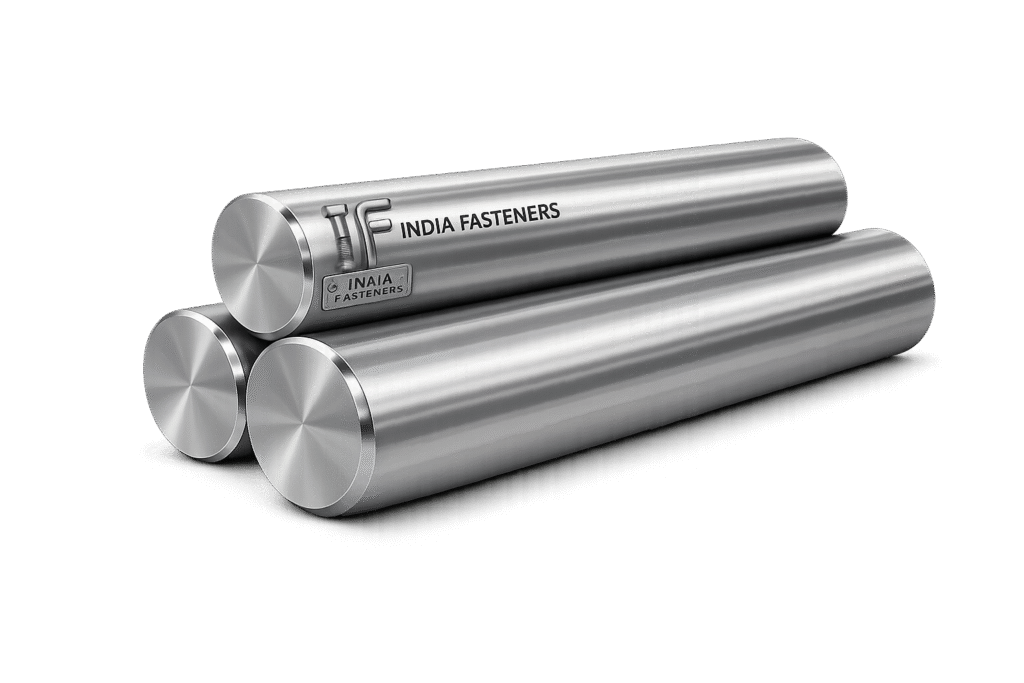
Industrial rods are cylindrical metallic components designed primarily to transmit axial tensile loads, though they may also resist shear and bending depending on installation configuration.
They are manufactured in carbon steel, alloy steel, or stainless steel, and supplied in threaded or plain configurations.
1.1 Categories
Fully Threaded Rods
Continuous thread profile across full length. Commonly used in:
- Pipe supports
- Structural bracing
- Adjustable assemblies
Stud Bolts
Double-end threaded rods with unthreaded center or fully threaded configuration. Used in:
- Flanged pressure joints
- Heat exchanger assemblies
- Valve connections
Tie Rods
Heavy-diameter rods for structural reinforcement in:
- Steel frameworks
- Bridge elements
- Braced systems
Anchor Roanchords
Designed for embedment in concrete. Supplied straight or with:
- L-bend
- J-bend
- Headed ends
Commonly manufactured to ASTM F1554.
Round Bars
Unthreaded cylindrical bars for machining or fabrication.
2. Regional Industry Context – Middle East Engineering Environment
Industrial rods form a primary axial load-transfer component across oil, gas, petrochemical, structural, and power infrastructure within the Gulf Cooperation Council (GCC) region. In Saudi Arabia, the United Arab Emirates, Qatar, Oman, Kuwait, and Bahrain, rod systems are integrated into both pressure-retaining and structural assemblies under severe environmental and operational conditions.
2.1 Oil & Gas Processing Facilities
In onshore fields of the Saudi Arabia and offshore platforms in the United Arab Emirates, industrial rods are typically used in:
- Flanged joint bolting (stud bolts)
- Structural pipe rack bracing
- Equipment foundation anchoring
- Skid frame tie systems
- Valve and actuator support assemblies
High ambient temperatures (often exceeding 50°C surface exposure), combined with thermal cycling due to process temperatures, create differential expansion stresses. Rod materials must maintain tensile capacity without excessive relaxation or creep under sustained loading.
2.2 Petrochemical Complexes
In industrial cities such as Jubail (KSA) and Ruwais (UAE), rods are integrated into:
- Reactor support structures
- Heat exchanger tie assemblies
- Structural steel bracing
- Storage tank anchoring systems
Hydrocarbon vapor presence and potential sour gas exposure (H₂S) require consideration of sulfide stress cracking resistance and hardness limitations per NACE guidelines.
2.3 LNG Terminals – Cryogenic Service
In LNG export infrastructure within the Qatar, low-temperature service introduces additional mechanical constraints:
- Cryogenic contraction
- Impact toughness requirements
- Charpy V-notch compliance
Grades such as ASTM A320 L7 are typically specified for sub-zero service environments to ensure ductility retention.
2.4 Structural Steel Frameworks
Industrial rods are used in:
- Cross bracing systems
- Portal frame tension members
- Lateral load tie assemblies
- Seismic reinforcement components
Although the GCC is not classified as a high seismic zone in most areas, wind loading in coastal regions creates sustained tensile loading conditions.
2.5 Desalination Plants
Desalination facilities across the Gulf coastline operate in high-chloride environments. Rods used in:
- Pump foundations
- Structural supports
- Brine discharge systems
must resist marine corrosion and pitting, especially where exposed to saline mist and humidity.
2.6 Power Generation Turbine Foundations
Steam and gas turbine bases rely on anchor rods for:
- Foundation embedment
- Equipment alignment retention
- Vibration load transfer
Dynamic loading requires attention to preload control, fatigue performance, and relaxation resistance.
2.7 Pipe Support Systems & Tank Farms
In refinery tank farms and long pipe rack corridors:
- Tie rods stabilize elevated pipe bridges
- Anchor rods secure steel columns
- Threaded rods provide adjustable support elements
Thermal expansion from process lines imposes cyclic tensile and compressive stresses, requiring evaluation of buckling risk for slender members.
3. Mechanical Load Behavior & Engineering Theory
3.1 Axial Tensile Stress
Axial stress: σ=PA\sigma = \frac{P}{A}σ=AP
Where:
σ = axial stress (MPa)
P = applied load (N)
A = tensile stress area (mm²)
The tensile stress area for threaded rods is less than the nominal cross-sectional area due to thread root reduction.
3.2 Shear Stress
τ=VA\tau = \frac{V}{A}τ=AV
Where:
τ = shear stress
V = applied shear force
Though rods are primarily tension members, anchor rods in shear walls may experience combined stress conditions.
3.3 Yield vs Ultimate Strength
- Yield strength (Fy): Stress at which permanent deformation begins
- Ultimate tensile strength (Fu): Maximum stress before fracture
Design safety factors in GCC EPC projects typically range from 1.5 to 3.0 depending on application classification (structural vs pressure boundary).
3.4 Modulus of Elasticity
Steel modulus:
E ≈ 200 GPa
Determines elastic elongation under load: δ=PLAE\delta = \frac{PL}{AE}δ=AEPL
Elastic elongation influences preload retention in bolted assemblies.
3.5 Buckling Consideration (Euler Formula)
For compression-prone rods: Pcr=π2EI(KL)2P_{cr} = \frac{\pi^2 E I}{(K L)^2}Pcr=(KL)2π2EI
Where:
Pcr = critical buckling load
E = modulus of elasticity
I = moment of inertia
K = effective length factor
L = unsupported length
Slenderness ratio: λ=KLr\lambda = \frac{KL}{r}λ=rKL
Rods used in long unsupported spans within pipe racks must be evaluated against buckling if compressive load is possible.
3.6 Thread Engagement & Stress Concentration
Threads introduce:
- Reduced core diameter
- Stress concentration at root radius
- Potential crack initiation points
Proper engagement length typically equals 1 to 1.5 times nominal diameter in steel-to-steel connections.
Thread stripping resistance depends on:
- Shear area of engaged threads
- Material hardness compatibility
4. Applicable International Standards
Industrial rods supplied for GCC projects typically comply with:
- ASTM A36 – Carbon steel structural bar
- ASTM A193 B7 – Alloy steel bolting for high temperature
- ASTM A193 B7M – Controlled hardness version
- ASTM A320 L7 – Low temperature bolting
- ASTM A307 – General purpose carbon steel bolts
- ASTM F1554 – Anchor rods
- ISO Metric Thread Standards (ISO 261 / ISO 965)
Material Engineering, Metallurgy & Manufacturing Discipline
4. Applicable Material Grades – Mapped to GCC Engineering Use
Material selection for industrial rods in GCC infrastructure is governed by:
- Operating temperature range
- Axial load demand
- Environmental corrosion exposure
- Sour service compatibility
- Structural vs pressure boundary classification
Below is a structured engineering mapping of applicable grades.
4.1 ASTM A36 – Carbon Steel Structural Bar
Material Type: Low carbon structural steel
Minimum Yield Strength: 250 MPa
Typical Tensile Strength: 400–550 MPa
Temperature Range: -20°C to +400°C (non-pressure structural use)
Heat Treatment: As-rolled or normalized
GCC Application Context:
- Structural tie rods in pipe racks
- Secondary steel frameworks
- Tank farm bracing systems
- Non-pressure anchor rods
Limitations:
- Not suitable for high-temperature bolted pressure joints
- Limited corrosion resistance without coating
- Not acceptable for sour gas service without qualification
Commonly specified for structural steel infrastructure in industrial cities of the Saudi Arabia and the United Arab Emirates.
4.2 ASTM A193 B7 – Alloy Steel High-Strength Rod
Material Type: Chromium-molybdenum alloy steel
Minimum Yield Strength: 720 MPa
Minimum Tensile Strength: 860 MPa
Hardness Range: 248–341 HB
Temperature Range: -29°C to +425°C
Primary Use:
- Stud bolts for flanged pressure joints
- High-strength threaded rods
- Equipment foundation anchor rods
GCC Application Context:
- Oil & gas processing units
- Refinery piping systems
- Heat exchanger assemblies
Commonly referenced under search phrase:
ASTM A193 B7 threaded rod supplier Saudi Arabia
Hardness control is critical for sour service exposure. Where H₂S is present, compliance with NACE MR0175 hardness limitations must be verified.
4.3 ASTM A193 B7M – Controlled Hardness Variant
Similar chemical composition to B7 but supplied at lower hardness:
- Max hardness typically 235 HB
- Improved sulfide stress cracking resistance
Used in:
- Sour gas environments
- Offshore hydrocarbon facilities
4.4 ASTM A320 L7 – Low Temperature Service
Material Type: Quenched and tempered alloy steel
Minimum Yield Strength: 720 MPa
Charpy V-Notch Testing: Mandatory
Temperature Range: Down to -101°C
Application in LNG infrastructure, particularly in facilities within the Qatar.
Charpy impact testing ensures adequate fracture toughness under cryogenic contraction conditions.
4.5 ASTM A307 – General Purpose Carbon Steel
Lower mechanical strength relative to A193 grades.
Used in:
- Light structural bracing
- Non-critical anchor systems
- Temporary installation assemblies
Not recommended for pressure-retaining flange joints.
4.6 ASTM F1554 – Anchor Rod Specification
Covers anchor rods in three grades:
- Grade 36
- Grade 55
- Grade 105
Used in:
- Concrete embedment systems
- Turbine foundation anchoring
- Structural column base plates
For heavy foundation anchoring in UAE infrastructure, high-strength anchor rods UAE are typically supplied under F1554 Grade 105.
4.7 Stainless Steel Rods – 304 & 316
SS304
- Yield Strength ≈ 215 MPa
- Moderate corrosion resistance
- Suitable for general industrial environments
SS316
- Improved pitting resistance
- Higher molybdenum content
- Suitable for marine exposure
Commonly specified under search phrase:
Stainless steel threaded rods Middle East
4.8 Duplex Stainless Steel
- Yield strength approximately 450–550 MPa
- Excellent chloride resistance
- Superior stress corrosion cracking resistance
Used in:
- Offshore platforms
- Desalination plants
- High-salinity coastal facilities
5. Material Comparison Table
| Grade | Yield Strength (MPa) | Tensile Strength (MPa) | Operating Temperature | Corrosion Resistance | Typical GCC Application |
|---|---|---|---|---|---|
| ASTM A36 | 250 | 400–550 | -20°C to 400°C | Low | Structural tie rods |
| ASTM A193 B7 | 720 | ≥860 | -29°C to 425°C | Moderate | Pressure joint stud bolts |
| ASTM A193 B7M | 720 | ≥860 | -29°C to 425°C | Improved for sour service | Offshore hydrocarbon |
| ASTM A320 L7 | 720 | ≥860 | Down to -101°C | Moderate | LNG facilities |
| ASTM F1554 Gr 36 | 250 | 400 | Ambient structural | Low | Anchor rods |
| ASTM F1554 Gr 105 | 724 | 862 | Structural/high load | Moderate | Turbine foundations |
| SS304 | 215 | 505 | -50°C to 870°C | Moderate | Industrial plant areas |
| SS316 | 205 | 515 | -50°C to 870°C | High | Marine coastal zones |
| Duplex SS | 450–550 | 620–800 | -50°C to 300°C | Very High | Desalination / offshore |
6. Heat Treatment & Metallurgical Control
Metallurgical stability directly influences rod performance under axial and cyclic loading.
6.1 Normalizing
Applied to carbon steel grades:
6.2 Quenching & Tempering
Applicable to A193 B7 and A320 L7.
Process steps:
- Austenitizing at controlled temperature
- Rapid quenching (oil or water medium)
- Tempering to achieve required hardness
Purpose:
- Achieve high yield strength
- Control brittleness
- Optimize impact toughness
6.3 Stress Relieving
Used for:
- Large-diameter rods
- Machined components
- Post-weld fabrication
Reduces residual stresses and distortion.
6.4 Solution Annealing (Stainless Grades)
Heat treatment followed by rapid cooling:
- Restores corrosion resistance
- Dissolves carbides
- Maintains ductility
6.5 Charpy V-Notch Testing
Required for:
- ASTM A320 L7
- LNG and cryogenic projects
Ensures minimum absorbed energy at specified low temperatures.
6.6 Hardness Control for Sour Service
NACE compliance typically limits hardness to:
- ≤ 22 HRC for carbon/alloy steels
Hardness testing performed after heat treatment to verify compliance.
6.7 Microstructure & Grain Refinement
Controlled heat cycles produce:
- Fine pearlitic structures in carbon steel
- Tempered martensite in alloy steel
- Balanced austenite-ferrite phases in duplex
Grain refinement improves:
- Yield strength
- Fatigue resistance
- Fracture toughness
7. Manufacturing Process Flow – Documentation Level
Manufacturing discipline is structured for traceability and EPC audit readiness.
7.1 Raw Material Procurement
- Mill-certified billets or bars
- Heat number traceability
- Chemical composition verification
7.2 Incoming Inspection
- Visual inspection
- Dimensional verification
- Ultrasonic testing (if required)
7.3 Positive Material Identification (PMI)
Performed using portable spectrometer:
- Confirms alloy composition
- Ensures correct grade allocation
7.4 Straightening Process
Cold or hot straightening applied to:
- Maintain linearity tolerance
- Reduce bow distortion
Straightness typically controlled within 1/1000 of length unless otherwise specified.
7.5 Thread Formation
Thread Rolling (Preferred)
- Cold forming process
- Improved grain flow continuity
- Higher fatigue resistance
- Work-hardened surface
Thread Cutting
- Applied where diameter constraints exist
- More flexible for custom pitch
Rolled threads are generally preferred for high-load GCC applications.
7.6 CNC Machining (Where Required)
- End chamfering
- Reduced shank sections
- Special geometry fabrication
7.7 Heat Treatment
Performed in calibrated furnaces:
- Temperature uniformity controlled
- Soak time monitored
- Batch traceability maintained
7.8 Surface Coating
Options include:
- Hot Dip Galvanizing (HDG)
- PTFE coating
- Xylan coating
- Black oxide finish
- Zinc electroplating
Coating thickness verified per applicable standards.
7.9 Final Inspection
- Dimensional check
- Thread gauge verification (Go/No-Go)
- Hardness testing
- Tensile sampling (where required)
7.10 Marking & Stamping
Marking includes:
- Grade identification
- Manufacturer identification
- Heat number (where specified)
Stamping depth controlled to prevent stress concentration.
7.11 Packaging Discipline
For GCC export:
- Rust preventive oil application
- VCI wrapping
- Wooden crate packing
- Moisture barrier protection
Suitable for marine shipment to ports in the Oman, Kuwait, and Bahrain.
8. Dimensional Reference Tables
Dimensional control of industrial rods is fundamental to preload accuracy, tensile performance, and compatibility with nuts and flanges used in GCC oil, gas, petrochemical, and structural applications.
Thread geometry directly influences:
- Tensile stress area
- Shear resistance
- Stripping strength
- Fatigue performance
Below are reference tables for commonly used UNC and Metric threaded industrial rods in GCC projects.
…
8.1 UNC Thread – Dimensional Reference
| Nominal Diameter (inch) | Threads per Inch (TPI) | Core Diameter (mm approx.) | Tensile Stress Area (mm²) | Standard Lengths (mm) | Weight (kg/m approx.) |
|---|---|---|---|---|---|
| 1/2″ | 13 | 10.8 | 84 | 1000–3000 | 1.58 |
| 5/8″ | 11 | 13.8 | 140 | 1000–3000 | 2.47 |
| 3/4″ | 10 | 16.0 | 216 | 1000–3000 | 3.55 |
| 7/8″ | 9 | 19.1 | 303 | 1000–3000 | 4.83 |
| 1″ | 8 | 21.9 | 380 | 1000–3000 | 6.17 |
| 1-1/4″ | 7 | 28.5 | 655 | 1000–3000 | 9.63 |
8.2 Metric Thread – Dimensional Reference
| Nominal Diameter (mm) | Pitch (mm) | Core Diameter (mm approx.) | Tensile Stress Area (mm²) | Standard Lengths (mm) | Weight (kg/m approx.) |
|---|---|---|---|---|---|
| M12 | 1.75 | 10.2 | 84 | 1000–3000 | 0.89 |
| M16 | 2.0 | 13.8 | 157 | 1000–3000 | 1.58 |
| M20 | 2.5 | 17.3 | 245 | 1000–3000 | 2.47 |
| M24 | 3.0 | 20.7 | 353 | 1000–3000 | 3.55 |
| M30 | 3.5 | 26.2 | 561 | 1000–3000 | 5.55 |
| M36 | 4.0 | 31.5 | 817 | 1000–3000 | 7.99 |
Dimensional tolerances are maintained in accordance with ISO metric threading standards or ASME B1.1 for UNC/UNF threads.
9. Tensile Capacity Table
The tensile capacity of industrial rods depends on tensile stress area and material grade.
Formula: Ultimate Capacity=As×FuUltimate\ Capacity = A_s \times F_uUltimate Capacity=As×Fu
Where:
As = Tensile stress area (mm²)
Fu = Ultimate tensile strength (MPa)
Below is a reference table for ASTM A193 B7 (Fu ≥ 860 MPa).
| Diameter | Tensile Stress Area (mm²) | Proof Load (kN approx.) | Ultimate Tensile Capacity (kN approx.) |
|---|---|---|---|
| 1/2″ | 84 | 45 | 72 |
| 5/8″ | 140 | 75 | 120 |
| 3/4″ | 216 | 115 | 186 |
| 7/8″ | 303 | 160 | 261 |
| 1″ | 380 | 205 | 327 |
| 1-1/4″ | 655 | 350 | 563 |
Proof load typically corresponds to approximately 75% of yield strength for preloaded bolted joints.
These values are commonly referenced in high-strength applications such as heavy-duty tie rods for Saudi Aramco projects.
10. Bolt Torque Chart (Mandatory Section)
Torque must achieve required preload without exceeding proof stress.
General torque-preload relationship: T=K×F×dT = K \times F \times dT=K×F×d
Where:
T = Torque (Nm)
K = Torque coefficient (friction factor)
F = Desired preload (N)
d = Nominal diameter (m)
Typical friction factor:
- Dry: 0.18–0.22
- Lubricated: 0.12–0.16
10.1 ASTM A193 B7 – Recommended Torque (Approximate)
| Diameter | Dry Torque (Nm) | Lubricated Torque (Nm) |
|---|---|---|
| 1/2″ | 90 | 70 |
| 5/8″ | 175 | 135 |
| 3/4″ | 300 | 230 |
| 7/8″ | 480 | 370 |
| 1″ | 720 | 550 |
| 1-1/4″ | 1450 | 1120 |
10.2 ASTM A320 L7 – Low Temperature Bolting
Torque values are generally similar to B7 but must consider:
- Reduced ductility at low temperature
- Lubrication requirement to ensure preload accuracy
Proper preload is typically 60–75% of yield strength depending on joint design classification.
Preload verification methods in EPC projects may include:
- Torque wrench calibration
- Hydraulic tensioning
- Ultrasonic bolt elongation measurement
11. Buckling & Structural Calculation Guide (Mandatory Section)
Industrial rods subjected to compressive forces require evaluation for buckling.
11.1 Critical Buckling Load
Pcr=π2EI(KL)2P_{cr} = \frac{\pi^2 E I}{(K L)^2}Pcr=(KL)2π2EI
Where:
E = 200 GPa
I = πd⁴ / 64
K = Effective length factor
L = Unsupported length
11.2 Effective Length Factor (K)
| End Condition | K Value |
|---|---|
| Pinned–Pinned | 1.0 |
| Fixed–Fixed | 0.5 |
| Fixed–Pinned | 0.7 |
| Cantilever | 2.0 |
11.3 Slenderness Ratio
λ=KLr\lambda = \frac{KL}{r}λ=rKL
Where:
r = √(I/A)
High slenderness ratios increase buckling susceptibility.
11.4 Sample Calculation – Pipe Rack Support Rod
Assume:
- Diameter = 24 mm
- Length = 2.5 m
- Pinned–Pinned (K = 1)
Moment of inertia: I=πd464I = \frac{\pi d^4}{64}I=64πd4
For d = 0.024 m:
I ≈ 1.63 × 10⁻⁸ m⁴ Pcr=π2(200×109)(1.63×10⁻⁸)(1×2.5)2P_{cr} = \frac{\pi^2 (200×10^9)(1.63×10^{-8})}{(1×2.5)^2}Pcr=(1×2.5)2π2(200×109)(1.63×10⁻⁸)
Pcr ≈ 515 kN (approximate)
Design load must remain below allowable compressive capacity using appropriate safety factor.
This calculation format aligns with documentation required during EPC structural review in major GCC projects within the Saudi Arabia and the United Arab Emirates.
12. Mechanical Property Table
| Grade | Yield Strength (MPa) | Tensile Strength (MPa) | Elongation (%) | Hardness | Impact Energy |
|---|---|---|---|---|---|
| ASTM A36 | 250 | 400–550 | 20 | ~120 HB | Not mandatory |
| ASTM A193 B7 | 720 | ≥860 | 16 | 248–341 HB | Not mandatory |
| ASTM A193 B7M | 720 | ≥860 | 18 | ≤235 HB | Not mandatory |
| ASTM A320 L7 | 720 | ≥860 | 18 | 197–235 HB | Charpy required |
| ASTM F1554 Gr 105 | 724 | ≥862 | 15 | Controlled | As specified |
| SS316 | 205 | 515 | 40 | ~95 HRB | Not typical |
13. Corrosion Resistance Comparison Table
| Material | Marine Exposure | High Humidity | Sour Gas | Hydrocarbon Service | Desert Temperature Cycling |
|---|---|---|---|---|---|
| Carbon Steel | Low | Low | Limited | Acceptable (coated) | Acceptable |
| SS304 | Moderate | Moderate | Limited | Good | Good |
| SS316 | High | High | Moderate | Excellent | Good |
| Duplex SS | Very High | Very High | High | Excellent | Good |
Desalination plants and offshore structures in the Bahrain and Oman typically require SS316 or Duplex grades for exposed service.
14. Inspection & Quality Assurance
Industrial rods for GCC EPC projects are supplied with structured quality control documentation.
14.1 Positive Material Identification (PMI)
- Confirms chemical composition
- Verifies alloy grade
- Required for critical pressure boundary bolts
14.2 Ultrasonic Testing (UT)
Applicable for:
- Large diameter rods
- Critical anchor rods
Detects internal discontinuities.
14.3 Magnetic Particle Inspection (MPI)
Used for:
- Surface crack detection
- Thread root examination
14.4 Dimensional Inspection
- Diameter tolerance verification
- Thread pitch measurement
- Straightness confirmation
14.5 Coating Thickness Verification
Measured using calibrated coating thickness gauges.
Required for:
- Hot dip galvanized rods
- PTFE/Xylan coated bolts
14.6 Hardness Testing
Rockwell or Brinell methods used to:
- Confirm heat treatment compliance
- Verify sour service suitability
14.7 Thread Gauge Verification
Go/No-Go gauges ensure compliance with:
- ASME B1.1
- ISO 965
14.8 Certification & Documentation
Typical project documentation package includes:
- EN 10204 3.1 or 3.2 certificate
- Mill test certificate
- Heat treatment chart
- Hardness report
- PMI report
- Inspection release note
Third-party inspection readiness supports review by independent inspection bodies commonly engaged across GCC infrastructure projects.
GCC Industry Application, Export Capability & Procurement Engineering View
15. Industries Served – Middle East Infrastructure Context
Industrial rods are used across multiple infrastructure sectors in the Gulf region where axial load transfer, structural stabilization, and equipment anchoring are required. Engineering design specifications within EPC projects across the GCC generally define rod materials, thread types, mechanical properties, and coating requirements in accordance with ASTM and ISO standards.
The following sections outline typical rod applications across key industrial sectors in the region.
15.1 Upstream Oil & Gas Production Facilities
Upstream hydrocarbon extraction facilities involve equipment operating under high pressure, high temperature, and cyclic mechanical loads. Industrial rods are incorporated into both pressure-retaining assemblies and structural support systems.
Typical rod applications include:
• Stud bolts for flanged piping connections
• Compressor and pump foundation anchor rods
• Pipe rack tension bracing
• Structural reinforcement rods in drilling support systems
Stud bolts manufactured in alloy steel grades such as ASTM A193 B7 are commonly used in bolted flange joints where preload retention is required for pressure containment.
In desert environments across the Saudi Arabia, rods used in outdoor facilities must withstand:
• High ambient temperature fluctuations
• Sand abrasion
• Dust infiltration affecting threaded connections
Surface coatings and corrosion protection systems are therefore specified based on environmental exposure classification.
15.2 Petroleum Refineries
Refinery complexes include extensive networks of process piping, heat exchangers, reactors, and distillation columns. Rod components perform both structural and mechanical fastening functions.
Applications include:
• Stud bolts for pressure vessel flanges
• Anchor rods for heavy equipment foundations
• Structural tie rods in pipe rack assemblies
• Reactor support rod systems
Refinery process areas may also contain hydrogen sulfide or other corrosive gases. Material hardness control and metallurgical integrity are therefore evaluated during procurement to prevent sulfide stress cracking.
Large refinery complexes in the United Arab Emirates frequently specify third-party inspection witness during final inspection stages.
15.3 Petrochemical Plants
Petrochemical processing units operate with high-temperature hydrocarbon streams and heavy rotating equipment. Structural stability and vibration resistance are critical for plant safety and operational reliability.
Industrial rods are used in:
• Structural bracing for pipe racks
• Tie rods for equipment skids
• Anchor rods for reactor foundations
• Structural reinforcement in elevated platforms
Petrochemical complexes located along coastal zones experience high humidity and chloride exposure. Stainless steel or coated alloy steel rods are often specified for exposed installations.
15.4 LNG Facilities
Liquefied Natural Gas terminals involve cryogenic process conditions where temperatures can drop below −160°C during process operations.
Rod systems in LNG facilities are commonly used for:
• Cryogenic piping supports
• Equipment foundation anchoring
• Structural reinforcement systems
Alloy steel rods manufactured to ASTM A320 L7 are commonly specified for low-temperature bolting applications because of their verified Charpy impact toughness.
LNG infrastructure development within the Qatar often includes strict material traceability requirements and low-temperature mechanical testing verification.
15.5 Desalination Plants
Seawater desalination plants form critical infrastructure across the Gulf region where freshwater production is essential.
Industrial rods are used in:
• Pump base anchoring
• Structural steel frames supporting filtration units
• Pipe rack tie assemblies
• Maintenance platform structures
Due to marine atmospheric conditions, corrosion protection is a major engineering consideration. Stainless steel 316 or duplex stainless steel rods are often specified for installations exposed to saline mist or brine discharge systems.
Coastal desalination facilities in the Oman and the Bahrain frequently specify corrosion-resistant alloys.
15.6 Power Generation Infrastructure
Gas turbine and steam turbine installations require high-strength anchoring systems to maintain equipment alignment and resist dynamic loads.
Rod applications include:
• Turbine base anchor rods
• Structural bracing rods for turbine halls
• Pipe support tension rods
• Cooling tower structural rods
Vibration generated by rotating machinery imposes cyclic stresses. Rod materials must therefore exhibit adequate fatigue resistance and maintain preload over long service periods.
Power generation infrastructure across the Kuwait uses high-strength anchor rods conforming to ASTM F1554 or equivalent specifications.
15.7 Structural Steel Infrastructure
Industrial rods also serve as structural members in large-scale steel frameworks used in refineries, ports, and industrial plants.
Common uses include:
• Cross-bracing tension members
• Portal frame tie rods
• Tank farm anchoring systems
• Elevated walkway support rods
Structural rods must maintain dimensional straightness and uniform thread geometry to ensure proper installation and load distribution.
16. Export & GCC Supply Capability
Manufacturers supplying rods to Middle East infrastructure projects must provide consistent product quality supported by complete documentation and traceability.
16.1 Export Regions
Industrial rods manufactured for international markets are commonly supplied to:
• Saudi Arabia
• United Arab Emirates (Dubai and Abu Dhabi)
• Qatar
• Oman
• Kuwait
• Bahrain
Export shipments typically move through major Gulf ports including industrial terminals serving petrochemical complexes and EPC construction sites.
16.2 Export Packaging Standards
Packaging for industrial rods must protect against corrosion during sea transport and storage in humid Gulf environments.
Typical packaging procedures include:
• Application of rust preventive oil
• VCI (Volatile Corrosion Inhibitor) wrapping
• Moisture-resistant barrier packaging
• Heavy-duty wooden crates
• Steel banded bundles for large rods
Long threaded rods are often packed in reinforced wooden cases to prevent bending during container transport.
16.3 Project Documentation Package
For EPC project deliveries, a complete documentation package is generally required.
Typical documentation includes:
• Mill Test Certificate (MTC)
• EN 10204 3.1 material certificate
• Heat treatment records
• Mechanical test reports
• Chemical composition report
• Coating thickness verification report
• Dimensional inspection report
• Thread gauge inspection record
• Packing list and identification markings
Where specified in project contracts, documentation may also include third-party inspection certification.
16.4 Material Traceability
Traceability ensures that each rod can be linked to its originating steel heat.
Traceability system typically includes:
• Heat number stamping
• Batch identification marking
• Inspection report referencing
• Documentation linked to production lot
Traceability is essential for acceptance within major EPC procurement systems.
16.5 Container Loading Discipline
Proper container loading prevents mechanical damage during international transport.
Standard practices include:
• Use of timber separators between bundles
• Securing rods with steel strapping
• Protection of threaded ends with caps
• Weight distribution across container floor
These procedures minimize distortion during shipment to construction sites across the GCC.
17. Procurement & Installation Engineering View
From a procurement and installation engineering perspective, industrial rods must be handled and installed in accordance with project specifications to maintain mechanical integrity.
17.1 Pre-Installation Inspection
Before installation, the following checks are typically performed:
• Verification of rod diameter and length
• Confirmation of material grade markings
• Inspection for thread damage
• Verification of coating condition
Any damaged threads must be repaired or replaced before installation.
17.2 Thread Lubrication
Lubrication reduces friction during tightening and improves preload accuracy.
Typical lubricants include:
• Graphite-based compounds
• Molybdenum disulfide lubricants
• Anti-seize compounds
Lubrication also reduces galling risk in stainless steel threaded rods.
17.3 Torque Tightening Sequence
For multi-bolt assemblies such as flanged joints, tightening is performed in a controlled pattern to distribute load evenly.
Standard procedure includes:
- Initial snug tightening
- Cross-pattern torque sequence
- Incremental torque increase
- Final torque verification
This method ensures uniform gasket compression and preload distribution.
17.4 Anchor Rod Embedment Verification
Anchor rods installed in concrete foundations must maintain proper embedment depth to develop required tensile resistance.
Key checks include:
• Embedment depth measurement
• Anchor rod vertical alignment
• Verification of base plate contact
Incorrect embedment can significantly reduce load capacity.
17.5 Alignment Control
Industrial rods used in structural bracing or equipment anchoring must maintain precise alignment to prevent uneven stress distribution.
Alignment is verified using:
• Laser alignment systems
• Mechanical gauges
• Survey measurements
17.6 Storage for Gulf Climate Conditions
Improper storage can lead to corrosion or thread contamination.
Recommended storage practices include:
• Covered storage areas
• Elevated pallets to avoid ground moisture
• Protective caps on threaded ends
• Periodic inspection for corrosion
These practices are particularly important for outdoor construction sites in desert environments.
17.7 Field Inspection Checklist
Typical field inspection activities include:
• Confirmation of torque values
• Verification of rod straightness
• Inspection of coating integrity
• Verification of marking identification
Inspection records are usually included in project quality documentation.
18. Custom Engineering Capabilities
Industrial rod manufacturing often involves customization to meet specific project requirements.
Typical customization capabilities include:
• Non-standard diameters
• Long-length threaded rods exceeding standard bar lengths
• Heavy structural tie rods for large frameworks
• Anchor rods with custom bends or heads
• Special thread pitches
18.1 Marine Environment Coatings
For offshore or coastal installations, rods may be supplied with specialized protective coatings including:
• PTFE coatings
• Xylan fluoropolymer coatings
• High-performance epoxy coatings
These coatings provide corrosion protection in high-salinity environments.
18.2 NACE-Compliant Supply
Where sour gas exposure is present, rods may be supplied with:
• Hardness-controlled heat treatment
• Material testing documentation
• NACE compliance verification
18.3 Project-Specific Identification Marking
For EPC projects, rods may require custom stamping including:
• Manufacturer identification
• Grade designation
• Heat number
• Project code
This marking supports traceability during installation and inspection.
18.4 High-Yield Structural Rod Production
Large infrastructure projects may require high-yield structural rods with:
• Enhanced tensile capacity
• Controlled dimensional tolerance
• Precise thread geometry
These rods are commonly used in structural steel bracing systems and equipment foundation anchoring.
Conclusion – Technical Positioning of Industrial Rod Manufacturing
Industrial rods used in GCC infrastructure must meet stringent engineering, metallurgical, and documentation requirements.
For oil and gas, petrochemical, LNG, power generation, and desalination facilities, rods function as critical axial load-transfer components. Their performance depends on accurate material selection, controlled heat treatment, dimensional precision, and proper installation procedures.
Manufacturers supplying these components must demonstrate:
• Understanding of axial load mechanics and buckling behavior
• Compliance with ASTM and ISO standards
• Metallurgical control through heat treatment and testing
• Dimensional accuracy and thread quality verification
• Full traceability and inspection documentation
• Export packaging suitable for Gulf climate conditions
When these requirements are met, industrial rods can be reliably integrated into major infrastructure projects across the Middle East.