
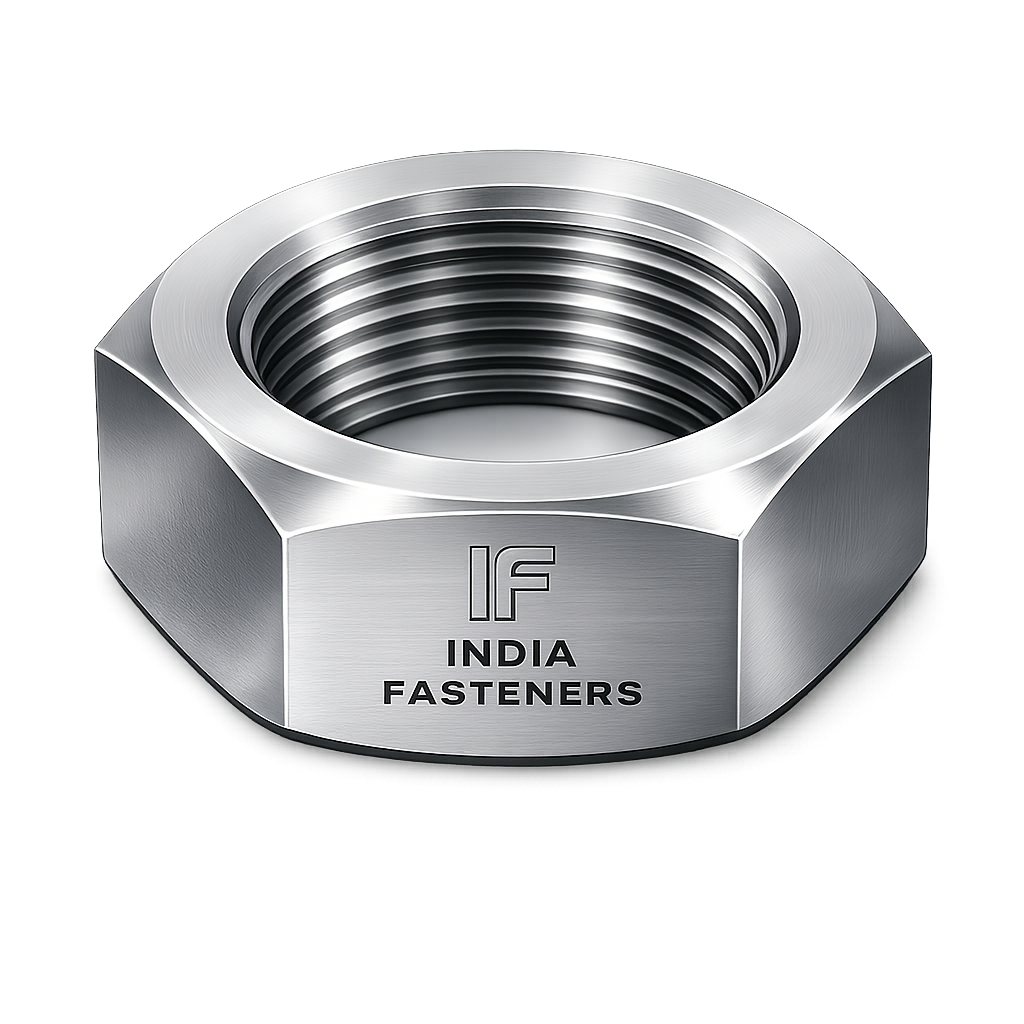
check nut
1. Regional Industry Context — Middle East Mechanical Operating Environment
Bolted joints used within GCC energy infrastructure operate under mechanical conditions significantly more severe than standard industrial environments. Facilities across Saudi Arabia, UAE, and Qatar are exposed to simultaneous thermal, vibrational, and corrosion mechanisms capable of degrading threaded joint preload.
Within EPC specifications issued for major Middle East projects, mechanical joint integrity is treated as a primary safety discipline, not merely a fastening requirement.
1.1 Oil & Gas Processing Facilities
Processing plants handling crude oil, gas compression, separation, and fractionation contain:
- High-pressure piping networks
- Vibrating compressors
- Reciprocating pumps
- Heat exchangers
- Structural pipe racks
Continuous vibration generated by rotating machinery induces cyclic shear forces into bolted joints. Even correctly torqued nuts experience progressive preload reduction when subjected to micro-slip between threads.
Loss of preload can result in:
- Flange leakage
- Equipment misalignment
- Fatigue cracking
- Joint separation under pressure
For this reason, EPC mechanical specifications frequently mandate secondary mechanical locking methods, including check nuts.
1.2 Offshore Platforms — UAE & Saudi Offshore Fields
Offshore installations introduce combined loading conditions:
- Wave-induced structural oscillation
- Wind loading
- Constant equipment vibration
- Chloride-rich marine atmosphere
Threaded assemblies are exposed to:
- Salt-induced corrosion
- Fretting wear
- Repeated load reversal
Marine corrosion reduces friction stability between mating threads. Reduced friction increases susceptibility to rotational loosening.
Double-nut locking systems using check nuts provide a non-degrading mechanical restraint independent of polymer inserts or coatings.
1.3 LNG Terminals — Qatar Operating Conditions
Liquefied Natural Gas installations introduce extreme temperature differentials:
- Cryogenic process zones
- Ambient desert heat exposure
- Rapid thermal cycling
Thermal expansion mismatch between bolts, nuts, and connected components causes preload variation.
When temperature fluctuates:
- Bolt elongation changes
- Thread friction reduces temporarily
- Rotation becomes possible
Check nuts stabilize preload by generating opposing thread forces, preventing rotational displacement during thermal cycling.
1.4 Refinery Rotating Equipment
Applications include:
- Turbine foundations
- Pump skids
- Motor baseplates
- Gearbox assemblies
Rotating equipment produces continuous harmonic vibration. Under these conditions, single-nut systems may loosen even when installed correctly.
GCC maintenance philosophies therefore implement:
- Double-nut systems
- Lock plates
- Safety wiring
- Positive retention hardware
Check nuts remain one of the most reliable passive locking systems because they contain no moving parts and no degradation mechanisms.
1.5 Power Generation Turbines & Boilers
Power plants across Saudi Arabia and UAE operate at:
- Elevated temperatures
- Cyclic startup and shutdown
- Continuous vibration transmission
Thermal relaxation leads to preload loss.
Secondary locking nuts prevent rotational back-off when thermal stress redistributes clamping force.
1.6 Desalination Pumping Systems
Desalination plants present unique mechanical exposure:
- High humidity
- Saline mist
- Pump vibration
- Long maintenance intervals
Check nuts provide long-term locking reliability without dependence on elastomer components vulnerable to heat and salt exposure.
1.7 Structural Steel Installations
Pipe racks, equipment supports, and elevated platforms experience:
- High desert wind loads
- Sand-induced vibration
- Thermal expansion of steel structures
Structural bolting frequently incorporates thin lock nuts to maintain joint compression over extended service periods.
Pipeline supports must remain stable despite:
- Flow-induced vibration
- Thermal expansion
- External environmental loading
Loss of nut preload may lead to pipe movement or support misalignment.
Check nuts serve as preload stabilizers within these assemblies.
1.9 Why Secondary Locking Systems Are Mandatory in GCC EPC Specifications
Major EPC contractors implement mechanical integrity philosophies aligned with international standards such as ASME PCC-1.
Key reasoning includes:
- Prevention of vibration-induced loosening
- Reduction of maintenance risk
- Improved operational safety margins
- Extended inspection intervals
- Compliance with third-party inspection expectations
Check nuts provide a predictable mechanical locking method acceptable to inspection agencies including TÜV, BV, and SGS when supplied with full material traceability.
2. Technical Definition of Check Nut
2.1 Engineering Definition
A Check Nut is a:
- Thin pattern hexagonal nut
- Installed as a secondary nut
- Used to mechanically lock a primary nut
- Friction-based anti-rotation device
It forms part of a double-nut locking system.
2.2 Functional Role
The check nut performs four engineering functions:
- Generates opposing axial forces within thread flanks
- Increases friction resistance to rotation
- Stabilizes bolt preload
- Prevents loosening caused by vibration
2.3 Terminology
Common engineering terminology includes:
2.4 Applicable Standards
Typical governing standards include:
- ISO 4035 — Hex Thin Nuts
- DIN 439 — Thin Hex Nuts
- ASTM A194 — Carbon and Alloy Steel Nuts
- ASME B18.2.2 — Inch Series Hex Nuts
- ISO Metric Thread Standards
These standards define:
- Geometry
- Thread tolerance
- Mechanical properties
- Material requirements
2.5 Difference Between Check Nut and Prevailing Torque Lock Nut
| Feature | Check Nut | Prevailing Torque Nut |
|---|---|---|
| Locking Method | Double-nut friction | Deformed thread or insert |
| Reusability | High | Limited |
| Temperature Resistance | High | Insert dependent |
| Chemical Compatibility | Excellent | Insert sensitive |
| EPC Preference | Common | Application specific |
Check nuts rely purely on mechanical interaction rather than plastic deformation.
2.6 Difference from Castle Nut
Castle nuts provide positive locking using cotter pins through drilled bolts.
Check nuts achieve locking without additional hardware.
2.7 Difference from Nylon Insert Lock Nut
Nylon insert nuts depend on polymer friction, which may degrade under:
- High temperature
- Hydrocarbon exposure
- Chemical environments
Check nuts remain fully metallic locking systems.
2.8 Locking Principle Using Opposing Torque
When tightened against a primary nut:
- Axial load distribution shifts
- Thread flanks experience opposing force directions
- Relative rotation becomes mechanically restricted
The resulting system resists vibration-induced loosening.
3. Mechanical Locking Theory & Thread Mechanics
3.1 Thread Friction Theory
A bolted joint maintains integrity through clamp load rather than tightening torque itself.
Torque applied during tightening converts into:
- Bolt elongation
- Clamp load generation
- Thread friction
- Bearing surface friction
Approximate torque relationship:
![\[T = K \times F \times d\]](https://indiafastners.com/wp-content/ql-cache/quicklatex.com-29706a356557e9febf0242bf5605b948_l3.png "Rendered by QuickLaTeX.com")
Where:
- T = Torque
- K = Nut factor (friction coefficient)
- F = Clamp load
- d = Nominal diameter
3.2 Clamp Load Stabilization
Clamp load must remain higher than separating forces acting on the joint.
Loss of preload results in micro-movement, accelerating loosening.
Check nuts maintain clamp stability by preventing relaxation-induced rotation.
3.3 Self-Loosening Mechanism (Junker Effect)
Experimental testing demonstrates that transverse vibration causes nuts to loosen even when initially torqued correctly.
Mechanism:
- Transverse displacement reduces friction momentarily
- Nut rotates incrementally
- Preload reduces progressively
- Joint failure occurs
The opposing torque generated by a check nut interrupts this mechanism.
3.4 Torque vs Preload Relationship
Only approximately 10–15% of applied torque produces useful clamp load.
Remaining torque is lost to friction.
Therefore, mechanical locking becomes essential when preload accuracy alone cannot guarantee joint security.
3.5 Friction Coefficient Impact
Variables affecting friction:
- Surface finish
- Lubrication
- Coating type
- Temperature
- Corrosion condition
Check nuts compensate for friction variability by creating an additional mechanical barrier to rotation.
3.6 Bolt Preload Calculation
Typical preload estimation:
![\[F = 0.75 \times A_s \times S_y\]](https://indiafastners.com/wp-content/ql-cache/quicklatex.com-88a5ad7664c8a85c14f46dab8934da67_l3.png "Rendered by QuickLaTeX.com")
Where:
 = Stress area
 = Yield strength
EPC specifications typically limit preload to 70–75% of yield strength to maintain safety margins.
3.7 EPC Safety Factor Philosophy
GCC projects adopt conservative design approaches:
- Redundant locking methods
- Verified installation procedures
- Traceable material supply
- Inspection verification
Check nuts support this philosophy by introducing secondary mechanical retention independent of installation variability.
4. Applicable Material Standards — Mapped to GCC Service Conditions
Material selection for check nuts is governed primarily by:
- Operating temperature
- Corrosion exposure
- Mechanical loading
- Pressure equipment classification
- Sour service requirements
In EPC environments, incorrect nut material selection represents a primary cause of bolted joint failure.
4.1 ASTM A194 Grade 2H — Carbon Steel (Quenched & Tempered)
Primary GCC Usage: Pressure-containing equipment bolting
Characteristics:
- Heat-treated carbon steel
- High proof load capacity
- Stable mechanical properties
- Compatible with high-strength bolting systems
Typical pairing:
- ASTM A193 B7 bolts
- High-pressure flange connections
- Valve assemblies
- Heat exchanger bolting
Operating suitability:
- Moderate temperature service
- Refinery piping
- Hydrocarbon processing equipment
Engineering Consideration:
Hardness control is essential to prevent hydrogen embrittlement risks.
4.2 ASTM A563 — Structural Carbon Steel Nuts
Application:
- Structural steel assemblies
- Equipment supports
- Pipe racks
- Non-pressure bolting
Advantages:
- Economical structural-grade solution
- Adequate proof load for static loading
- Compatible with structural bolt grades
Used where pressure-retaining certification is not required.
4.3 ASTM A105 Carbon Steel
Although primarily a forging material, A105 is utilized for forged nut manufacturing where higher toughness and uniform grain structure are required.
GCC Applications:
- Forged equipment connections
- High-load structural interfaces
- Heavy machinery anchoring
Provides improved mechanical homogeneity compared to bar-machined nuts.
4.4 Stainless Steel Grades — AISI 304 & AISI 316
Stainless steel check nuts are selected where corrosion resistance governs material choice.
AISI 304
Suitable for:
- Atmospheric exposure
- Utility piping
- Non-chloride environments
Limitations:
- Reduced resistance to chloride pitting
- Not ideal for marine offshore structures
AISI 316
Preferred for GCC coastal and offshore facilities.
Advantages:
- Molybdenum alloying improves pitting resistance
- Better chloride resistance
- Improved corrosion stability in humid environments
Typical uses:
- Offshore platforms
- Desalination plants
- Marine loading terminals
4.5 Duplex Stainless Steel
Increasingly specified in GCC projects due to combined strength and corrosion performance.
Properties:
- Higher yield strength than austenitic stainless steel
- Excellent resistance to stress corrosion cracking
- Reduced material thickness requirement
Applications:
- Sour gas environments
- Offshore process modules
- Aggressive chemical service
4.6 Alloy Steel Grades
Alloy steel check nuts are used where elevated temperature or creep resistance becomes critical.
Applications:
- Boilers
- Steam systems
- Turbine casings
- High-temperature piping
Material selection must align with bolt grade compatibility to prevent differential mechanical behavior.
4.7 ISO & International Mechanical Property Standards
Relevant standards governing nut mechanical performance include:
- ISO 898-2 — Mechanical properties of nuts
- ASTM F594 — Stainless steel nuts
- ASME PCC-1 — Bolted joint assembly guidance
These standards establish:
- Proof load capability
- Hardness limits
- Strength class compatibility
4.8 Sour Service & NACE Considerations
GCC oil and gas facilities frequently operate in hydrogen sulfide environments.
Material requirements must comply with NACE limitations:
- Controlled hardness levels
- Resistance to sulfide stress cracking
- Avoidance of excessive strength without toughness
Check nuts supplied for sour service must maintain hardness below specified thresholds to prevent cracking under hydrogen exposure.
5. Material Comparison Table (GCC Engineering Reference)
| Material Grade | Proof Load Capability | Yield Strength Level | Temperature Capability | Corrosion Resistance | Typical GCC Application |
|---|---|---|---|---|---|
| ASTM A194 Gr 2H | High | High | Up to ~450°C | Moderate | Pressure flanges, valves |
| ASTM A563 | Medium | Medium | Structural ambient | Moderate | Pipe racks, structures |
| ASTM A105 | High | High | Elevated service | Moderate | Forged equipment joints |
| SS 304 | Medium | Medium | ~425°C | Good | Utility systems |
| SS 316 | Medium | Medium | ~500°C | Excellent | Offshore & desalination |
| Duplex Stainless | High | High | ~300°C | Superior | Sour service & marine |
| Alloy Steel | Very High | High | >500°C | Service dependent | Boilers & turbines |
6. Heat Treatment & Metallurgical Control
Heat treatment establishes the mechanical integrity of check nuts used in EPC projects.
Improper heat treatment directly affects:
- Proof load capacity
- Fatigue resistance
- Thread durability
- Resistance to cracking
6.1 Quenching & Tempering (Carbon and Alloy Steel)
Process:
- Heating above transformation temperature
- Rapid quenching
- Controlled tempering
Purpose:
- Achieve required hardness range
- Improve toughness
- Stabilize grain structure
Critical Control Parameters:
- Cooling rate
- Tempering temperature
- Uniform furnace calibration
6.2 Stress Relieving
Residual stresses from forging or machining may initiate fatigue cracking.
Stress relieving:
- Reduces internal stress
- Improves dimensional stability
- Enhances long-term vibration resistance
Common requirement for heavy hex and large-diameter check nuts.
6.3 Solution Annealing — Stainless Steel Grades
Performed for stainless steel materials to:
- Restore corrosion resistance
- Dissolve carbide precipitation
- Prevent intergranular corrosion
Cooling rate after annealing is carefully controlled to preserve microstructure integrity.
6.4 Hydrogen Embrittlement Prevention
Hydrogen embrittlement risk exists when:
- High-strength materials
- Acid cleaning
- Electroplating processes
Mitigation measures include:
- Controlled pickling processes
- Post-coating baking
- Hardness limitation enforcement
Essential for GCC sour service approval.
6.5 Hardness Control & Verification
Hardness directly correlates with brittleness risk.
Typical EPC verification includes:
- Rockwell hardness testing
- Lot sampling inspection
- Compliance with ISO 898-2 limits
Over-hardened nuts may fracture under cyclic loading.
6.6 NACE Hardness Limits
For sour service:
- Hardness must remain within defined limits
- Excess hardness increases sulfide stress cracking risk
Material certification must clearly state measured hardness values.
6.7 Metallurgical Risks Addressed During Manufacturing
Galling
Occurs primarily in stainless steel assemblies.
Mitigation:
- Controlled surface finish
- Proper lubrication recommendations
- Material pairing guidance
Thread Deformation
Caused by:
- Improper forming pressure
- Poor heat treatment
- Incorrect machining parameters
Controlled through dimensional inspection.
Brittle Fracture Under Cyclic Loading
Prevented by:
- Correct tempering
- Proper alloy selection
- Verification of mechanical properties
7. Manufacturing Process Flow — EPC Documentation Level
Manufacturing of check nuts intended for GCC projects requires full process traceability.
7.1 Raw Material Procurement
Each batch originates from certified steel mills providing:
- Heat number identification
- Chemical composition report
- Mechanical property verification
Material traceability begins at this stage.
7.2 Heat Number Traceability
Every production lot maintains:
- Unique heat number
- Batch manufacturing record
- Traceable inspection documentation
Traceability enables project audit verification.
7.3 Forging or Cold Forming
Depending on size and grade:
Cold Forming
- Used for smaller sizes
- Improves grain flow
- Enhances fatigue strength
Hot Forging
- Applied to larger diameters
- Maintains structural integrity
- Prevents machining-induced weakness
7.4 Thread Manufacturing
Two methods applied:
Thread Rolling
- Superior surface finish
- Improved fatigue resistance
- Preferred for critical applications
Thread Tapping / Machining
- Used for large sizes or special threads
- Allows custom engineering configurations
Thread class produced according to ISO or ASME tolerance requirements.
7.5 CNC Finishing Operations
Operations include:
- Facing
- Chamfering
- Deburring
- Dimensional correction
Ensures uniform seating surfaces for accurate preload transfer.
7.6 Surface Finishing
Common finishes for GCC applications:
- Black oxide
- Phosphate coating
- Hot dip galvanizing
- Zinc nickel plating
- PTFE coating systems
Coating selection depends on corrosion exposure and EPC specification.
7.7 Heat Treatment Execution
Performed under calibrated furnace control:
- Temperature recording
- Batch identification
- Cooling control documentation
Heat treatment records remain part of final project dossier.
7.8 Thread Gauging & Tolerance Verification
Inspection methods include:
- GO gauge verification
- NO-GO gauge rejection control
- Pitch diameter inspection
- Thread angle confirmation
Ensures compatibility with mating bolts under international standards.
7.9 Final Inspection Protocol
Before dispatch:
- Dimensional inspection
- Visual examination
- Mechanical testing review
- Marking verification
- Surface condition confirmation
7.10 Marking & Identification
Typical marking includes:
- Manufacturer identification
- Grade designation
- Heat traceability reference
Marking enables inspection agencies to verify compliance during site installation.
7.11 Documentation Generated for EPC Supply
Manufacturing output supports:
- EN 10204 3.1 certification
- Heat treatment reports
- Mechanical property verification
- Inspection release notes
- Traceability registers
These documents form part of the project Material Data Record (MDR).
8. Dimensional Reference Tables — Check Nut Geometry
Check nuts follow thin pattern nut geometry, enabling installation as a secondary locking element without significantly increasing bolt projection length.
Dimensions comply primarily with:
- ISO 4035 (Metric)
- DIN 439
- ASME B18.2.2 (Inch Series)
8.1 Metric Check Nut Dimensions (ISO 4035 Reference)
| Thread Size | Pitch (mm) | Across Flats (mm) | Thickness (mm) | Approx. Weight (kg/1000) | Applicable Standard |
|---|---|---|---|---|---|
| M6 | 1.0 | 10 | 3.2 | 2.5 | ISO 4035 |
| M8 | 1.25 | 13 | 4.0 | 4.8 | ISO 4035 |
| M10 | 1.5 | 17 | 5.0 | 9.5 | ISO 4035 |
| M12 | 1.75 | 19 | 6.0 | 15 | ISO 4035 |
| M16 | 2.0 | 24 | 8.0 | 32 | ISO 4035 |
| M20 | 2.5 | 30 | 10 | 62 | ISO 4035 |
| M24 | 3.0 | 36 | 12 | 105 | ISO 4035 |
| M30 | 3.5 | 46 | 15 | 210 | ISO 4035 |
| M36 | 4.0 | 55 | 18 | 380 | ISO 4035 |
Engineering note:
Thin profile permits locking without altering structural geometry or interfering with equipment clearances.
8.2 Inch Series Check Nut Dimensions (ASME Reference)
| Nominal Size | Thread Type | Across Flats (in) | Thickness (in) | Standard |
|---|---|---|---|---|
| 1/4″ | UNC/UNF | 7/16 | 1/8 | ASME B18.2.2 |
| 3/8″ | UNC/UNF | 9/16 | 3/16 | ASME B18.2.2 |
| 1/2″ | UNC/UNF | 3/4 | 1/4 | ASME B18.2.2 |
| 5/8″ | UNC/UNF | 15/16 | 5/16 | ASME B18.2.2 |
| 3/4″ | UNC/UNF | 1-1/8 | 3/8 | ASME B18.2.2 |
| 1″ | UNC/UNF | 1-1/2 | 1/2 | ASME B18.2.2 |
| 1-1/4″ | UNC/UNF | 1-7/8 | 5/8 | ASME B18.2.2 |
8.3 Thread Class & Fit
Common tolerances:
- Metric: 6H internal thread
- Inch Series: Class 2B or 3B
Thread compatibility must match bolt tolerance class to prevent preload loss.
9. Mechanical Load & Proof Load Table
Check nuts must possess mechanical strength equal to or greater than mating bolt requirements.
Typical compatibility mapping:
| Bolt Size | Compatible Bolt Grade | Recommended Nut Grade | Proof Load (kN) | Maximum Tightening Stress |
|---|---|---|---|---|
| M10 | ASTM A193 B7 | A194 2H | 45 | 75% Yield |
| M12 | ASTM A193 B7 | A194 2H | 64 | 75% Yield |
| M16 | ASTM A193 B7 | A194 2H | 118 | 75% Yield |
| M20 | ASTM A193 B7 | A194 2H | 183 | 70% Yield |
| M24 | ASTM A193 B7 | A194 2H | 265 | 70% Yield |
| M30 | ASTM A193 B7 | A194 2H | 460 | 70% Yield |
9.1 Compatibility With Common GCC Bolting Systems
Typical EPC bolting combinations:
- ASTM A193 B7 + ASTM A194 2H
- ASTM A320 L7 + A194 7 nuts (low temperature)
- Stainless bolting systems (AISI 316)
- Duplex stainless assemblies
Engineering rule:
Nut proof strength must never be lower than bolt strength class.
10. Torque Recommendation Chart (MANDATORY)
Torque values vary depending on lubrication, coating, and friction coefficient.
Values below represent engineering reference ranges.
10.1 Metric Torque Reference
| Thread Size | Dry Torque (Nm) | Lubricated Torque (Nm) | Recommended Preload |
|---|---|---|---|
| M10 | 50 | 35 | 70–75% |
| M12 | 85 | 60 | 70–75% |
| M16 | 210 | 150 | 70% |
| M20 | 410 | 290 | 70% |
| M24 | 710 | 500 | 70% |
| M30 | 1420 | 1000 | 65–70% |
10.2 Torque Engineering Considerations
Torque scatter occurs due to:
- Lubrication condition
- Surface roughness
- Coating thickness
- Thread cleanliness
- Operator technique
Variation may exceed ±25%.
Therefore, mechanical locking via check nut installation remains essential.
10.3 Lubrication Impact
Lubrication reduces friction coefficient:
- Increases preload for same torque
- Reduces galling risk
- Improves installation repeatability
Typical EPC lubrication:
- Molybdenum disulfide compounds
- Nickel anti-seize
- Graphite-based lubricants
11. Double-Nut Locking Method Guide (MANDATORY)
Correct installation determines locking effectiveness.
11.1 Step 1 — Primary Nut Installation
- Install primary nut.
- Tighten to specified torque.
- Achieve required preload.
Primary nut carries structural load.
11.2 Step 2 — Check Nut Positioning
- Install thin check nut behind primary nut.
- Hand tighten until contact achieved.
11.3 Step 3 — Counter-Torque Application
Two wrench method:
- Hold primary nut stationary.
- Tighten check nut against primary nut.
- Apply moderate counter torque.
This creates opposing axial force.
11.4 Step 4 — Locking Mechanism Formation
Resulting effects:
- Thread flank compression reversal
- Increased frictional resistance
- Elimination of rotational clearance
The assembly behaves as a single locked system.
11.5 Step 5 — Inspection Verification
Inspector confirms:
- Both nuts fully seated
- No visible thread damage
- Required bolt protrusion present
- Witness marking applied
11.6 Mechanical Explanation of Locking Effectiveness
Opposing torque shifts load distribution:
- Primary nut loads lower thread flanks
- Check nut loads upper thread flanks
This opposing stress state prevents rotation under vibration.
12. Mechanical Property Table
Typical mechanical properties (reference values):
| Property | Carbon Steel 2H | SS304 | SS316 | Duplex SS |
|---|---|---|---|---|
| Proof Load | High | Medium | Medium | High |
| Hardness (HB) | 248–352 | 150–220 | 150–220 | 260–310 |
| Tensile Strength | High | Moderate | Moderate | High |
| Elongation | Moderate | High | High | Moderate |
| Impact Resistance | Good | Excellent | Excellent | Excellent |
Mechanical properties must be verified through certification.
13. Corrosion Resistance Comparison Table
| Material | Marine Exposure | High Humidity | Sour Gas | Desert Temperature |
|---|---|---|---|---|
| Carbon Steel | Low | Low | Limited | Excellent |
| Hot Dip Galvanized | Medium | Medium | Limited | Good |
| SS304 | Good | Good | Moderate | Good |
| SS316 | Excellent | Excellent | Good | Excellent |
| Duplex Stainless | Superior | Superior | Excellent | Excellent |
Material selection must consider full lifecycle corrosion exposure.
14. Inspection & Quality Assurance
GCC EPC procurement requires documented quality control.
14.1 Thread Gauge Inspection
Performed using calibrated gauges:
- GO gauge must pass
- NO-GO gauge must reject
Ensures dimensional compliance.
14.2 Dimensional Verification
Inspection confirms:
- Across flats dimension
- Nut thickness
- Thread pitch accuracy
- Surface condition
14.3 PMI Testing (Positive Material Identification)
Applied when:
- Alloy steels specified
- Stainless grades supplied
- Critical service involved
Confirms chemical composition.
14.4 Hardness Testing
Conducted to verify:
- Mechanical strength compliance
- NACE hardness limits
- Heat treatment effectiveness
14.5 Coating Thickness Measurement
Methods:
- Magnetic thickness gauges
- Micron verification
- Sampling per inspection plan
Important for corrosion performance.
14.6 Visual Inspection
Inspection checks:
- Surface defects
- Cracks
- Burrs
- Coating discontinuity
14.7 Documentation Package
Typical EPC submission includes:
- EN 10204 3.1 certification
- Chemical composition report
- Mechanical test report
- Heat treatment record
- Inspection release documentation
- Traceability log
Third-party inspection agencies may witness testing prior to shipment release.
14.8 Third-Party Inspection Readiness
Supply prepared for inspection bodies such as:
- TÜV
- Bureau Veritas
- SGS
Inspection scope may include:
- Material verification
- Dimensional sampling
- Witness testing
- Document audit
15. Industries Served — Middle East Mechanical Application Context
Check nuts are applied where long-term preload retention is required under vibration, thermal cycling, or limited maintenance accessibility.
15.1 Oil & Gas Processing Facilities
Typical applications include:
- Pump base frame bolting
- Compressor skid anchoring
- Valve actuator mounting
- Instrument support structures
- Pipe support assemblies
Mechanical Function:
Check nuts prevent gradual loosening caused by vibration transmitted through rotating equipment.
Operational Benefit:
Maintains alignment integrity between equipment and foundation structures, reducing fatigue stresses.
15.2 Refineries
Refineries contain continuous vibration sources:
- Cracking units
- Distillation towers
- Fired heaters
- Process piping systems
Threaded assemblies exposed to thermal expansion and shutdown cycles require secondary locking.
Check nuts stabilize preload during:
- Thermal contraction
- Startup expansion
- Pressure fluctuations
15.3 Petrochemical Plants
Petrochemical equipment frequently operates with:
- High cyclic loading
- Chemical exposure
- Elevated temperature zones
Check nuts are applied on:
- Structural steel frames
- Cable tray supports
- Equipment access platforms
- Mechanical enclosures
Their metallic locking mechanism avoids degradation associated with polymer locking devices.
15.4 LNG Terminals
LNG facilities combine cryogenic and ambient temperature environments.
Mechanical risks include:
- Differential contraction
- Bolt relaxation
- Reduced friction at low temperatures
Double-nut locking systems maintain assembly stability even when thermal movement occurs.
15.5 Power Generation Facilities
Applications include:
- Turbine auxiliary systems
- Boiler support structures
- Generator mounting frames
- Cooling water pump systems
Check nuts provide passive locking suitable for high-temperature environments where nylon inserts or adhesives are unsuitable.
15.6 Water Treatment & Desalination Plants
Desalination infrastructure across GCC coastal regions introduces:
- Chloride exposure
- Continuous pump vibration
- Long service intervals
Check nuts in stainless or duplex grades provide durable locking without maintenance-intensive retention devices.
15.7 Structural Steel & Infrastructure Projects
Used extensively in:
- Pipe racks
- Offshore modules
- Cable bridges
- Platform access structures
- Heavy equipment foundations
Wind-induced vibration common in open desert installations makes secondary locking necessary.
15.8 Pipeline Supports & Mechanical Restraints
Pipeline supports must allow thermal movement while maintaining restraint integrity.
Check nuts:
- Prevent backing-off of support bolts
- Maintain calibrated support positioning
- Reduce inspection adjustment frequency
15.9 Rotating Equipment Assemblies
Critical rotating equipment demands predictable fastener behavior.
Typical locations:
- Motor hold-down bolts
- Gearbox mounting
- Fan housings
- Pump alignment systems
Locking reliability directly influences equipment lifespan.
16. Export & GCC Supply Capability
Supply to Middle East EPC projects requires disciplined export execution beyond manufacturing capability.
16.1 Primary Export Regions
Supply structured for:
- Saudi Arabia
- United Arab Emirates (Dubai & Abu Dhabi)
- Qatar
- Oman
- Kuwait
- Bahrain
Documentation prepared to match regional project approval procedures.
16.2 Export Packaging Standards
Packaging objectives:
- Prevent corrosion during marine transport
- Maintain traceability
- Enable site identification
Typical methods:
- Moisture-resistant packing
- Vacuum sealing where required
- Heat-number segregation
- Palletized export cartons
- Container humidity control measures
Packaging follows project preservation requirements.
16.3 Project Documentation Packages
EPC supply typically includes:
- Material Test Certificates (EN 10204 3.1 / 3.2)
- Chemical composition reports
- Mechanical property verification
- Heat treatment documentation
- Dimensional inspection reports
- Coating certification
- Packing list traceability
Documentation compiled into Material Data Record (MDR).
16.4 Traceability Records
Traceability maintained from:
Steel mill → Manufacturing batch → Inspection → Shipment → Site delivery
Each shipment allows consultant verification during:
- Incoming material inspection
- Warehouse audit
- Installation review
16.5 Inspection Release Discipline
Before shipment:
- Internal quality release
- Third-party inspection witnessing (when required)
- Documentation validation
- Identification marking verification
Inspection Release Note (IRN) issued prior to dispatch.
16.6 Container Loading Discipline
Export logistics consider Gulf climate risks:
- High humidity exposure
- Temperature variation
- Long marine transit
Controls applied:
- Desiccant placement
- Load segregation
- Mechanical protection against deformation
- Proper stacking to avoid thread damage
17. Procurement & Installation Engineering View
This section reflects expectations typically applied by EPC mechanical and construction teams.
17.1 Correct Nut Pairing Practice
Engineering rule:
The check nut must never replace the primary load-bearing nut.
Recommended configuration:
- Full-height primary nut — carries clamp load
- Thin check nut — provides locking action
Material grade compatibility must match bolt strength classification.
17.2 Bolt Protrusion Requirements
Adequate thread engagement is mandatory.
Typical requirement:
- Minimum two full threads visible beyond check nut after installation.
Insufficient protrusion reduces locking effectiveness.
17.3 Torque Sequence
Recommended installation sequence:
- Tighten primary nut to specified torque.
- Apply lubrication as specified.
- Hold primary nut stationary.
- Tighten check nut using counter torque method.
- Apply witness mark.
Improper sequence reduces locking performance.
17.4 Lubrication Selection
Lubrication affects preload accuracy and galling resistance.
Common GCC practices:
- Nickel anti-seize for high temperature
- Molybdenum disulfide for pressure bolting
- Controlled lubrication factors defined in torque procedures
Lubricant must be compatible with coating system.
17.5 Anti-Seize Usage
Particularly important for:
- Stainless steel assemblies
- Offshore installations
- High-temperature equipment
Prevents thread seizure during future maintenance.
17.6 Field Inspection Checklist
Site inspectors typically verify:
- Correct nut orientation
- Proper torque application
- Double-nut locking completed
- No coating damage
- Required protruding threads present
- Witness marking applied
Inspection documentation becomes part of construction turnover records.
17.7 Storage Requirements — Gulf Climate Conditions
Improper storage frequently causes corrosion before installation.
Recommended practices:
- Indoor covered storage
- Elevated pallets
- Sealed packaging until use
- Protection from sand contamination
- Controlled humidity exposure
Storage discipline preserves coating performance and thread accuracy.
17.8 EPC Installation Expectations
EPC contractors expect supplied fasteners to integrate seamlessly into:
- Controlled bolting procedures
- Torque management systems
- Mechanical completion documentation
- Commissioning verification processes
Check nuts must support repeatable installation without specialized tooling.
18. Custom Engineering Capability
Large Middle East projects regularly require engineered variations beyond catalogue dimensions.
18.1 Special Thread Sizes
Capability includes:
- Non-standard metric pitches
- UNC / UNF variations
- Fine pitch locking assemblies
- Oversized structural diameters
Manufactured to project drawings or EPC specifications.
18.2 Heavy Hex Check Nuts
Used where:
- Higher bearing surface required
- Large preload values exist
- Structural load distribution must improve
Heavy hex geometry enhances load transfer stability.
18.3 High-Temperature Alloy Supply
Available for applications including:
- Steam turbines
- Boiler systems
- Process heaters
Material selection aligned with bolt metallurgy to avoid differential expansion.
18.4 NACE-Compliant Supply
For sour service projects:
- Controlled hardness
- Certified metallurgy
- Documented compliance limits
Prepared for hydrogen sulfide exposure environments.
18.5 Special Coating Systems
Common project requirements:
- PTFE coating
- Zinc Nickel plating
- Hot Dip Galvanizing
- Fluoropolymer systems
Coating selection determined by corrosion category and EPC specification.
18.6 Project Stamping & Identification
Where required:
- Project-specific marking
- Heat number traceability
- Grade identification stamping
Supports inspection verification during construction.
18.7 Custom Hardness Ranges
Certain applications demand controlled hardness windows to balance:
- Strength
- Toughness
- Crack resistance
Heat treatment adjusted accordingly with supporting certification.
EPC TECHNICAL CONCLUSION
Check nuts remain one of the most mechanically reliable secondary locking systems used within GCC industrial facilities.
When manufactured under controlled metallurgical processes, verified through inspection discipline, and installed using correct counter-torque procedures, the check nut provides:
- Stable clamp load retention
- Resistance to vibration loosening
- Suitability for high temperature service
- Compatibility with pressure equipment bolting
- Long-term mechanical reliability
From a consultant and procurement engineering standpoint, the documentation framework presented demonstrates alignment with:
- International fastening standards
- Mechanical joint integrity principles
- GCC environmental operating conditions
- EPC material approval expectations
The product and manufacturing discipline described support evaluation for inclusion within project-approved fastening systems used across Middle East energy and infrastructure developments.