
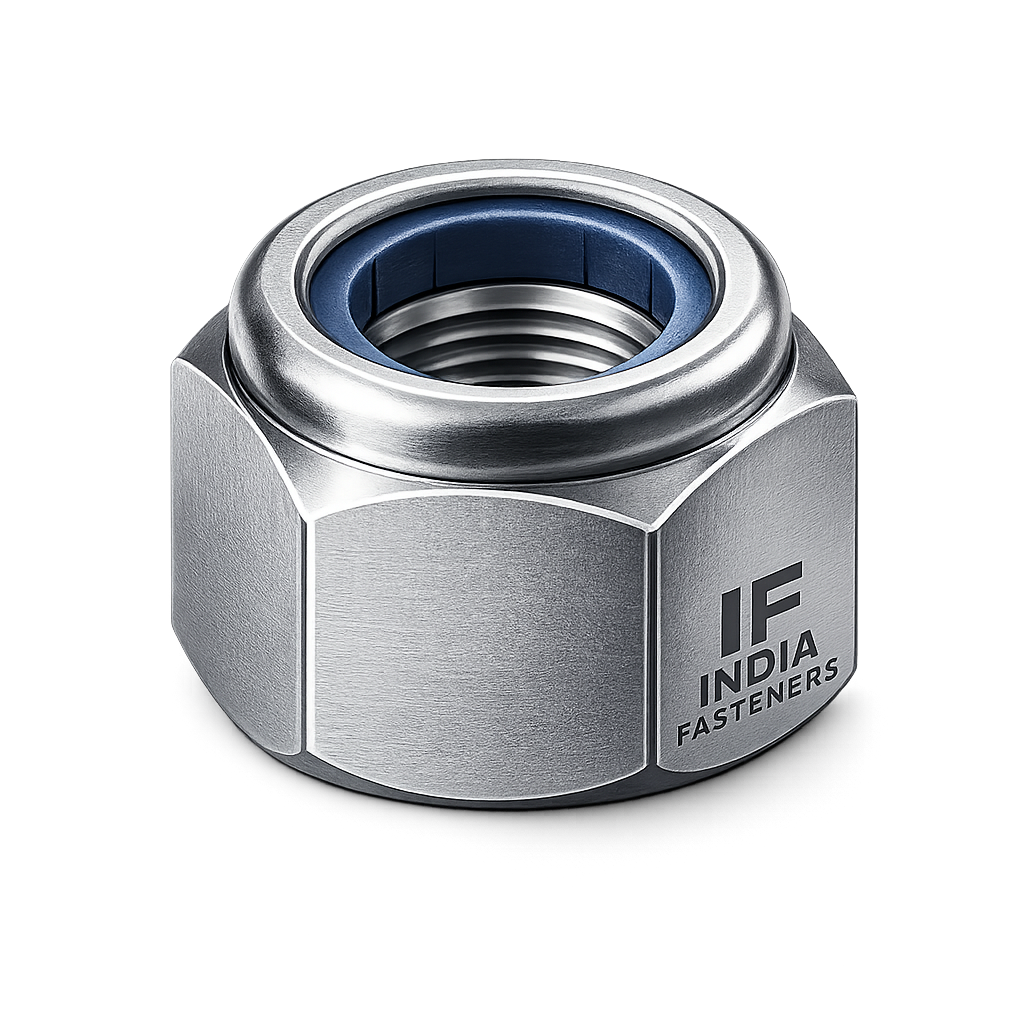
Prevailing torque nut
1. Regional Industry Context — Middle East Operations
Bolted joint reliability within Gulf Cooperation Council (GCC) industrial infrastructure operates under environmental and operational conditions significantly different from standard temperate installations. Mechanical fastening systems installed across Saudi Arabia, UAE, Qatar, Oman, Kuwait, and Bahrain must maintain structural integrity under combined exposure to vibration, thermal cycling, corrosive atmosphere, and long maintenance intervals.
Prevailing torque nuts are specified in critical applications where conventional nut systems demonstrate unacceptable loosening risk.
1.1 Operational Environments Requiring Anti-Vibration Fastening
Oil & Gas Upstream Facilities
Onshore desert production fields and offshore platforms operate under continuous vibration and fluctuating thermal loads.
Typical sources of loosening:
- Reciprocating compressor vibration
- Pump skid cyclic loading
- Pipeline pulsation
- Structural resonance
- Pressure transient events
Bolted joints experience transverse displacement rather than axial loading alone. Standard hex nuts relying purely on preload lose clamp force progressively when subjected to lateral movement.
Prevailing torque nuts introduce independent frictional resistance, preventing rotation even after partial preload relaxation.
Petrochemical Complexes — Jubail & Ruwais Type Installations
Petrochemical plants operate continuously with minimal shutdown windows.
Key fastening challenges:
- Elevated process temperatures
- Chemical exposure
- Thermal expansion mismatch between connected materials
- Long operational campaigns exceeding five years
Self-loosening in structural frames, pipe supports, and equipment mounting assemblies can introduce fatigue cracking or misalignment. Mechanical locking systems are therefore preferred over chemical thread locking agents that degrade under temperature or chemical exposure.
LNG Terminals & Cryogenic Installations
Cryogenic environments introduce additional mechanical considerations:
- Thermal contraction during cooldown
- Differential material shrinkage
- Loss of preload due to temperature gradients
Prevailing torque nuts maintain locking action independent of clamp force, preserving rotational resistance even when preload temporarily decreases during thermal transition.
Desalination Plants
Continuous exposure to saline atmosphere produces aggressive corrosion mechanisms:
- Chloride-induced corrosion
- High humidity cycles
- Salt deposition
Mechanical locking methods avoid polymer components that degrade in marine environments. All-metal prevailing torque nuts maintain functionality without reliance on non-metallic inserts.
Power Generation & Turbine Installations
Gas turbines, steam turbines, and auxiliary rotating equipment produce persistent vibration spectra.
Failure modes commonly observed:
- Progressive nut rotation
- Loss of bolt preload
- Equipment misalignment
- Bearing overload
Prevailing torque nuts are routinely selected for:
- Turbine casing attachments
- Generator frames
- Auxiliary skid assemblies
- Structural anchoring systems
District Cooling Networks
Large pump stations and cooling distribution systems operate under:
- Continuous hydraulic vibration
- Pressure pulsation
- Thermal cycling between seasonal loads
Mechanical locking fasteners reduce maintenance frequency while maintaining clamp stability.
Refineries & Gas Processing Units
Refinery structures combine:
- Elevated temperatures
- Sulfur compounds
- Hydrocarbon contamination
- Mechanical vibration
Fastener reliability directly affects process safety and shutdown risk.
1.2 Environmental Challenges Unique to GCC Regions
Thermal Expansion in Desert Climate
Day–night temperature differences exceeding 35°C create cyclic expansion and contraction.
Consequences:
- Preload relaxation
- Micro-movement at joint interface
- Progressive rotational loosening
Prevailing torque nuts compensate by generating locking torque independent of bolt tension.
Sand Ingress & Contamination
Airborne sand particles introduce abrasive effects into exposed threads.
Effects include:
- Reduction of friction predictability
- Thread wear
- Variable tightening torque
Controlled thread deformation used in prevailing torque nuts maintains locking resistance even under contaminated conditions.
Offshore Corrosion Exposure
Offshore structures encounter:
- Salt spray
- Galvanic interaction
- Continuous humidity
All-metal locking mechanisms remain functional after coating degradation, unlike polymer insert nuts.
High Cyclic Loading
Rotating equipment induces transverse motion described by vibration loosening theory.
Repeated cyclic shear forces reduce friction between mating threads, enabling self-loosening unless additional locking resistance exists.
Maintenance Reliability Expectations
GCC operators prioritize:
- Extended maintenance intervals
- Predictable inspection schedules
- Elimination of secondary locking devices
Prevailing torque nuts reduce dependency on:
- Spring Washers (Lock Washers)
- Chemical adhesives
- Double-nut assemblies
2. Technical Definition of Prevailing Torque Nut
A Prevailing Torque Nut is a self-locking threaded fastener designed to generate rotational resistance through controlled interference between mating threads, independent of clamping force.
Core Functional Definition
A prevailing torque nut:
- Produces frictional locking torque without reliance on preload
- Resists rotation under vibration
- Maintains locking after preload relaxation
- Functions as a reusable mechanical locking device
2.1 Mechanical Locking Principle
Locking is achieved through intentional elastic or plastic deformation of specific thread sections.
Common deformation methods include:
- Elliptical distortion
- Top thread compression
- Offset pitch geometry
- Flexural slotting
The bolt thread must elastically conform during installation, producing sustained friction.
2.2 Major Types of Prevailing Torque Nuts
All-Metal Prevailing Torque Nut
- No polymer insert
- Suitable for high temperature
- Offshore and refinery service compatible
Top-Lock Distorted Thread Nut
Deformation applied to top threads creating interference zone.
Used widely in structural and mechanical assemblies.
Elliptical Offset Nut
Nut body intentionally ovalized.
Provides uniform locking torque distribution.
Flex-Top Lock Nut
Slots create controlled elastic deformation.
Maintains reusable locking characteristics.
Stover Type Nut
Localized top deformation produces consistent prevailing torque.
Common in heavy mechanical equipment.
2.3 Governing Standards
Prevailing torque nuts are manufactured and verified according to internationally accepted fastening standards.
Primary standards include:
- ISO 7042 — All-metal prevailing torque type hexagon nuts
- DIN 980 — Prevailing torque nuts
- ASTM A563 — Carbon and alloy steel nuts
- ASME B18.16 — Locknut dimensional requirements
- ISO 2320 — Prevailing torque performance testing
These standards define:
- Dimensional tolerances
- Mechanical properties
- Torque verification requirements
- Reusability performance
2.4 Difference from Nylon Insert Lock Nuts
| Parameter | Prevailing Torque Nut | Nylon Insert Nut |
|---|---|---|
| Locking Mechanism | Metal deformation | Polymer friction |
| Temperature Limit | High temperature capable | Limited (~120°C) |
| Chemical Resistance | High | Limited |
| Offshore Suitability | Preferred | Restricted |
| Fire Safety | Metal safe | Polymer degradation risk |
2.5 Difference from Double Nut Locking
Double nut systems rely on:
- Opposing preload
- Installation skill
- Additional space
Prevailing torque nuts achieve locking within a single component, improving installation reliability.
2.6 Difference from Chemical Thread Lockers
Chemical lockers depend on adhesive curing.
Limitations:
- Temperature sensitivity
- Surface preparation requirements
- Difficult disassembly
- Shelf life control
Prevailing torque nuts provide immediate mechanical locking without curing.
2.7 Torque Retention Principles
Locking torque exists even when clamp force decreases.
This characteristic prevents rotational back-off caused by vibration.
3. Anti-Vibration Locking Theory
3.1 Self-Loosening Phenomenon
Self-loosening occurs primarily due to transverse joint movement, not axial load loss.
Even properly tightened bolts may loosen when subjected to lateral cyclic motion.
3.2 Junker Vibration Theory
The Junker test demonstrates that:
- Transverse displacement reduces friction between threads
- Clamp load decays rapidly
- Nut rotation begins once friction threshold is exceeded
Prevailing torque nuts increase rotational resistance beyond vibration-induced motion.
3.3 Clamp Load Loss Mechanisms
Clamp force decreases through:
- Embedment relaxation
- Thermal expansion mismatch
- Material creep
- Surface wear
- Vibration micro-movement
Prevailing torque compensates for these effects.
3.4 Bolt Preload Equation
![\[F = \frac{T}{K \times d}\]](https://indiafastners.com/wp-content/ql-cache/quicklatex.com-ee7cb6f9853c72044f067e268479e9af_l3.png "Rendered by QuickLaTeX.com")
Where:
 = Bolt preload force
 = Applied torque
 = Nut factor (friction coefficient)
 = Nominal diameter
3.5 Torque–Tension Relationship
Only a portion of tightening torque produces preload.
Typical distribution:
- 50% thread friction
- 40% bearing friction
- 10% preload generation
Variations in friction strongly influence achieved clamp load.
Prevailing torque introduces additional controlled friction independent of preload generation.
3.6 Friction Coefficient Influence
Variables affecting friction:
- Coating type
- Lubrication
- Surface finish
- Environmental contamination
Controlled deformation ensures predictable locking torque regardless of friction variability.
3.7 Prevailing Torque Measurement Concept
Prevailing torque is defined as:
Torque required to rotate the nut along the bolt without axial load applied.
Measured according to ISO 2320:
- Installation torque recorded
- Removal torque measured
- Locking performance validated after cycles
3.8 Preferred Applications in Rotating Equipment
Prevailing torque nuts are widely selected for:
- Pumps
- Compressors
- Fans
- Turbines
- Structural vibration zones
Because locking resistance remains even when preload fluctuates.
4. Applicable Material Standards — GCC Engineering Mapping
Material selection for prevailing torque nuts in Middle East EPC projects is not driven solely by strength requirements. Selection must simultaneously satisfy:
- Mechanical performance
- Temperature capability
- Corrosion resistance
- Sour service compatibility
- Inspection authority acceptance
- Long-term vibration resistance
GCC operators typically align bolting material selection with ASME pressure equipment codes, API practices, and internationally recognized metallurgy standards.
Prevailing torque nuts supplied for EPC projects must therefore demonstrate compatibility with pressure systems, structural assemblies, and rotating equipment environments.
4.1 Carbon Steel High-Strength Grades
ASTM A194 Grade 2H
Widely specified for pressure vessel and piping bolting.
Characteristics
- Quenched and tempered carbon steel
- High proof load capability
- Stable performance at elevated temperature
- Compatible with ASTM A193 B7 stud bolts
Typical GCC Applications
- Refinery piping systems
- Heat exchangers
- Pressure vessels
- Flanged joints
Engineering Considerations
ASTM A563 Grade DH
High-strength structural nut grade used in heavy mechanical and structural assemblies.
Characteristics
- Heat-treated alloy/carbon steel
- Higher mechanical strength than standard carbon nuts
- Good resistance to mechanical fatigue
Typical Applications
- Structural steel frames
- Pipe rack supports
- Equipment anchoring systems
- Offshore module structures
4.2 High Temperature Alloy Materials
ASTM A453 Grade 660 (Alloy A-286)
Selected for elevated temperature and creep-resistant applications.
Characteristics
- Precipitation-hardened alloy
- Excellent oxidation resistance
- Stable mechanical properties under thermal cycling
GCC Usage
- Gas turbine assemblies
- Exhaust systems
- High-temperature rotating equipment
- Power generation installations
Engineering Advantage
Prevailing torque performance remains stable where carbon steel nuts lose mechanical stability due to creep.
4.3 Stainless Steel Fastener Grades
Stainless steel prevailing torque nuts are frequently specified in desalination, offshore, and chemical processing environments.
A2-70 (Equivalent to 304 Stainless Steel)
Properties
- Good general corrosion resistance
- Suitable for atmospheric exposure
- Non-magnetic condition after forming
Applications
- District cooling installations
- HVAC structural assemblies
- General plant equipment
A4-80 (Equivalent to 316 Stainless Steel)
Enhanced Characteristics
- Superior chloride resistance
- Marine atmosphere compatibility
- Improved pitting resistance
Typical GCC Applications
- Offshore platforms
- Desalination plants
- Coastal petrochemical facilities
4.4 Duplex Stainless Steel
Used where combined strength and corrosion resistance are mandatory.
Features
- High yield strength
- Excellent resistance to stress corrosion cracking
- Superior chloride performance
Applications
- Offshore topsides
- Subsea equipment supports
- Marine structural assemblies
Duplex materials reduce required fastener size while maintaining load capacity.
4.5 Alloy Steel High-Temperature Grades
Alloy steels are applied where both mechanical load and temperature exposure exist simultaneously.
Typical services include:
- Steam systems
- Turbine casings
- Furnace structures
- Process heaters
Prevailing torque nuts manufactured from alloy steels maintain locking characteristics during thermal cycling.
4.6 Sour Service Considerations (NACE Alignment)
Hydrogen sulfide environments present risk of sulfide stress cracking.
Material controls include:
- Hardness limitation
- Controlled heat treatment
- Traceability verification
Prevailing torque nuts intended for sour environments must comply with hardness limits commonly applied under NACE requirements.
Typical limitation:
≤ 22 HRC for susceptible carbon steels.
4.7 Standard Alignment Relevant to GCC EPC Projects
Prevailing torque nuts supplied into Middle East projects must align with multiple overlapping standards.
Mechanical Property Standards
- ISO 898-2 — Mechanical properties of nuts
- ASTM F594 — Stainless steel nuts
Pressure System Requirements
- ASME B31.3 Process Piping
- ASME Section VIII pressure equipment expectations
Oil & Gas Expectations
- API bolting practices
- EPC project material specifications
Engineering acceptance depends on cross-compliance rather than a single governing specification.
5. Material Comparison Table (GCC Engineering Reference)
| Material Grade | Yield Strength (MPa) | Tensile Strength (MPa) | Max Service Temp | Corrosion Resistance | Typical GCC Application |
|---|---|---|---|---|---|
| ASTM A194 2H | ~660 | ~860 | 425°C | Moderate | Pressure vessel bolting |
| ASTM A563 DH | ~620 | ~830 | 400°C | Moderate | Structural steel |
| ASTM A453 Gr 660 | ~725 | ~1030 | 700°C | High | Turbines & power plants |
| A2-70 Stainless | ~450 | ~700 | 300°C | Good | Plant equipment |
| A4-80 Stainless | ~600 | ~800 | 400°C | Very High | Offshore & desalination |
| Duplex Stainless | ~550–750 | ~800–950 | 300°C | Excellent | Offshore structures |
| Alloy Steel HT Grades | 700+ | 900+ | 600°C | Moderate | High-temp process units |
6. Heat Treatment & Metallurgical Control
Mechanical locking reliability depends heavily on metallurgical stability.
Thread deformation zones must retain elastic behavior without cracking or excessive plastic collapse.
6.1 Quenching and Tempering
Applied to carbon and alloy steel grades.
Purpose
- Increase strength
- Improve toughness
- Control hardness
Improper tempering may lead to brittle deformation areas within locking threads.
6.2 Stress Relieving
Performed after forming operations.
Benefits:
- Reduces residual forming stress
- Improves fatigue resistance
- Prevents distortion during service
Critical for prevailing torque nuts due to localized deformation.
6.3 Solution Annealing — Stainless Grades
Stainless steel nuts undergo solution annealing to:
- Restore corrosion resistance
- Dissolve carbide precipitation
- Improve ductility
Ensures thread deformation does not introduce sensitization risk.
6.4 Hydrogen Embrittlement Prevention
High-strength fasteners exposed to electroplating processes require strict control.
Preventive actions:
- Controlled pickling
- Post-plating baking
- Coating process monitoring
Hydrogen embrittlement risk is especially relevant for hardness levels above 320 HV.
6.5 Hardness Control
Hardness must remain within specification limits to ensure:
- Adequate locking torque
- Avoidance of thread galling
- Resistance to cracking
Hardness verification forms part of lot inspection records.
6.6 Grain Flow Integrity After Forming
Forging processes align grain structure with load path.
Advantages include:
- Improved fatigue resistance
- Enhanced vibration durability
- Reduced crack initiation risk
Machined nuts without controlled grain flow may exhibit reduced service life.
6.7 NACE Hardness Limits
For sour service:
- Hardness restrictions prevent sulfide stress cracking
- Heat treatment records must demonstrate compliance
Documentation must be traceable to heat numbers.
6.8 Impact Testing Considerations
Low-temperature or cyclic loading installations may require impact toughness verification.
Typical evaluation:
- Charpy V-notch testing
- Material ductility confirmation
6.9 High Temperature Creep Resistance
At elevated temperature, sustained stress leads to creep deformation.
Alloy grades such as A453 Grade 660 are selected where long-term dimensional stability is required.
Prevailing torque deformation must remain stable throughout creep exposure.
7. Manufacturing Process Flow — EPC Documentation Level
Manufacturing discipline determines whether prevailing torque nuts perform consistently across project quantities.
GCC EPC contractors evaluate process control rather than individual product appearance.
7.1 Raw Material Traceability
Manufacturing begins with certified raw material.
Requirements include:
- Heat number identification
- Mill Test Certificate verification
- Chemical composition confirmation
- Incoming inspection documentation
Traceability must remain intact through final shipment.
7.2 Heat Number Verification
Each production batch is linked to:
- Steel mill origin
- Heat treatment record
- Mechanical test results
Traceability enables third-party audit acceptance.
7.3 Forging Process
Nuts may be produced using:
- Cold forging
- Warm forming
- Hot forging (large sizes)
Forging advantages:
- Continuous grain flow
- Improved fatigue strength
- Dimensional consistency
7.4 Precision Thread Rolling / Tapping
Threads produced under controlled tooling conditions.
Key controls:
- Pitch accuracy
- Surface finish
- Thread flank geometry
- Gauge conformity
Thread quality directly influences prevailing torque repeatability.
7.5 Controlled Thread Deformation (Locking Creation)
Critical manufacturing stage.
Process involves:
- Mechanical deformation of upper threads
- Controlled distortion tolerance
- Calibration against torque targets
Excess deformation causes installation difficulty; insufficient deformation reduces locking performance.
Process control is validated through torque testing.
7.6 Heat Treatment
Performed after forming to achieve required mechanical properties.
Controls include:
- Furnace calibration
- Temperature uniformity
- Cooling rate monitoring
- Batch documentation
7.7 Surface Finishing
Common finishes include:
- Black oxide
- Zinc plating
- Hot dip galvanizing
- Phosphate coating
- Zinc-nickel systems
Selection depends on project specification and environmental exposure.
7.8 Coating Application Discipline
Coatings must maintain:
- Thread fit tolerance
- Torque predictability
- Corrosion resistance
Coating thickness is verified during inspection.
7.9 Calibration of Locking Torque
Each production lot undergoes prevailing torque validation.
Measured parameters:
- First installation torque
- Prevailing torque without clamp load
- Removal torque
Testing follows ISO 2320 methodology.
7.10 Inspection Verification
Inspection stages include:
- Dimensional measurement
- Thread gauge verification
- Hardness testing
- Visual inspection
- Surface condition verification
Records become part of project documentation packages.
7.11 Stamping & Traceability Marking
Markings typically include:
- Manufacturer identification
- Property class
- Heat traceability
Marking must remain legible after coating and service exposure.
7.12 Thread Geometry Control
Critical dimensional aspects:
- Pitch diameter tolerance
- Lead accuracy
- Flank angle precision
Improper geometry produces inconsistent locking torque.
7.13 Consistency of Locking Performance
Statistical process control ensures uniform prevailing torque values across production batches.
Engineering objective:
Predictable installation behavior across thousands of assemblies.
7.14 Manufacturing Tolerances
Tolerance management addresses:
- Across flats dimension
- Nut height
- Thread class
- Deformation consistency
Compliance ensures interchangeability with standard bolts and studs.
8. Dimensional Reference Tables — Engineering Format
Prevailing torque nuts must comply simultaneously with dimensional standards and locking performance requirements. Dimensional conformity ensures compatibility with standardized stud bolts, structural bolts, and pressure equipment assemblies used across GCC EPC projects.
Dimensions are typically aligned with:
- ISO metric thread series
- ASME Unified thread series
- Heavy hex configurations where specified
The following tables represent standard engineering reference values commonly used for EPC procurement evaluation.
8.1 Metric Series — ISO Prevailing Torque Nuts
| Thread Size | Pitch (mm) | Nut Height (mm) | Across Flats (mm) | Typical Prevailing Torque Range (Nm) | Proof Load Capacity (kN) |
|---|---|---|---|---|---|
| M6 | 1.0 | 5 | 10 | 0.8 – 2.0 | 8 |
| M8 | 1.25 | 6.5 | 13 | 1.5 – 4.0 | 14 |
| M10 | 1.5 | 8 | 17 | 3 – 8 | 23 |
| M12 | 1.75 | 10 | 19 | 5 – 14 | 33 |
| M16 | 2.0 | 13 | 24 | 12 – 28 | 60 |
| M20 | 2.5 | 16 | 30 | 20 – 45 | 95 |
| M24 | 3.0 | 19 | 36 | 35 – 75 | 135 |
| M30 | 3.5 | 24 | 46 | 70 – 140 | 220 |
| M36 | 4.0 | 29 | 55 | 120 – 240 | 320 |
Values vary depending on coating condition, material grade, and locking deformation design.
8.2 Imperial Series — ASME Compatible Sizes
| Thread Size | TPI | Nut Height (in) | Across Flats (in) | Prevailing Torque (ft-lb) | Proof Load (kips) |
|---|---|---|---|---|---|
| 1/4″ | 20 | 0.22 | 7/16 | 0.5 – 1.5 | 3 |
| 3/8″ | 16 | 0.33 | 9/16 | 2 – 5 | 8 |
| 1/2″ | 13 | 0.44 | 3/4 | 5 – 12 | 12 |
| 5/8″ | 11 | 0.55 | 15/16 | 10 – 20 | 19 |
| 3/4″ | 10 | 0.66 | 1-1/8 | 18 – 40 | 28 |
| 1″ | 8 | 0.88 | 1-1/2 | 45 – 90 | 51 |
| 1-1/4″ | 7 | 1.09 | 1-7/8 | 80 – 160 | 82 |
Heavy hex dimensions may apply for structural or pressure bolting applications.
Engineering Observation
Prevailing torque increases proportionally with:
- Nominal diameter
- Thread engagement area
- Degree of thread deformation
However, locking torque must remain within standard limits to prevent installation damage.
9. Prevailing Torque Performance Table (ISO 2320 Basis)
ISO 2320 defines the verification procedure for locking nuts. Performance evaluation confirms that the nut maintains sufficient resistance during installation and reuse.
9.1 Prevailing Torque Performance — Typical Engineering Values
| Thread Size | Minimum Prevailing Torque (Nm) | Maximum Prevailing Torque (Nm) | Installation Torque Range (Nm) | Removal Torque After Test |
|---|---|---|---|---|
| M8 | 1.5 | 4 | 18 – 24 | ≥ 1.2 Nm |
| M10 | 3 | 8 | 35 – 50 | ≥ 2.5 Nm |
| M12 | 5 | 14 | 60 – 85 | ≥ 4 Nm |
| M16 | 12 | 28 | 140 – 200 | ≥ 9 Nm |
| M20 | 20 | 45 | 280 – 400 | ≥ 15 Nm |
| M24 | 35 | 75 | 480 – 680 | ≥ 25 Nm |
9.2 ISO 2320 Test Logic
Testing procedure includes:
- Nut installation onto calibrated bolt without clamping load
- Measurement of prevailing torque during rotation
- Full tightening to specified torque
- Removal torque measurement
- Repeated installation cycles
Acceptance criteria:
- Locking torque must remain above minimum limits
- No cracking or thread damage permitted
- Consistent torque behavior across samples
EPC inspectors evaluate both initial and post-cycle performance.
10. Torque–Tension Engineering Guide
Proper tightening of prevailing torque nuts requires understanding the interaction between applied torque and generated preload.
10.1 Torque Equation
![\[T = K \times F \times d\]](https://indiafastners.com/wp-content/ql-cache/quicklatex.com-29706a356557e9febf0242bf5605b948_l3.png "Rendered by QuickLaTeX.com")
Where:
- = tightening torque
- = nut factor (friction coefficient)
- = desired preload
- = nominal bolt diameter
Prevailing torque is added to tightening torque but does not contribute to preload.
10.2 Separation of Torque Components
Total applied torque consists of:
![\[T_{total} = T_{preload} + T_{prevailing}\]](https://indiafastners.com/wp-content/ql-cache/quicklatex.com-4ffd769b819d816c119251446580aecf_l3.png "Rendered by QuickLaTeX.com")
Installers must account for this distinction.
Failure to compensate may result in insufficient clamp load.
10.3 Friction Coefficient Influence
Typical nut factor values:
| Condition | Nut Factor (K) |
|---|---|
| Dry carbon steel | 0.20 |
| Lubricated | 0.15 |
| Zinc plated | 0.18 |
| PTFE coated | 0.10–0.12 |
Variation in friction can alter preload by ±30%.
Prevailing torque nuts reduce loosening risk but do not eliminate the need for correct tightening procedures.
10.4 Lubricated vs Dry Installation
Dry Installation
- Higher torque required
- Greater scatter in preload
- Increased galling risk (stainless steel)
Lubricated Installation
- Improved preload accuracy
- Reduced installation wear
- Preferred for critical bolting
Lubricant compatibility must align with project specifications.
10.5 Recommended Preload Percentage
Engineering practice typically targets:
- 70–75% of bolt proof load
Lower preload increases loosening risk even when locking nuts are used.
10.6 Tightening Accuracy Limits
Field tightening methods produce varying accuracy:
| Method | Typical Accuracy |
|---|---|
| Hand wrench | ±35% |
| Torque wrench | ±25% |
| Hydraulic torque tool | ±10% |
| Tensioning systems | ±5% |
GCC projects increasingly adopt hydraulic tightening for critical joints.
11. Reusability & Locking Efficiency Analysis
Prevailing torque nuts are reusable within defined engineering limits.
11.1 Torque Decay After Reuse
Repeated installation gradually reduces deformation-induced friction.
Typical trend:
- Cycle 1: 100% locking torque
- Cycle 3: ~80–90%
- Cycle 5: noticeable reduction depending on material
Inspection determines acceptability.
11.2 Engineering Inspection Criteria
A nut may be reused if:
- Prevailing torque remains above minimum specification
- Threads show no galling
- No cracking at deformation zone
- Coating remains functional
11.3 Maximum Reuse Recommendations
Common EPC practice:
- Critical joints: single-use or verified reuse
- Structural assemblies: limited reuse allowed after inspection
- Rotating equipment: conservative reuse policy
Final decision remains project specification dependent.
11.4 Failure Indicators
Reject nuts showing:
- Reduced locking torque
- Visible deformation collapse
- Thread stripping
- Corrosion penetration
- Loss of coating integrity
12. Mechanical Property Table
Mechanical properties must match mating bolt strength to prevent thread stripping or joint failure.
| Property | Carbon Steel Class 10 | Stainless A4-80 | Alloy A453 Gr 660 |
|---|---|---|---|
| Yield Strength (MPa) | ≥ 940 | ≥ 600 | ≥ 725 |
| Proof Load (MPa) | ≥ 830 | ≥ 580 | ≥ 690 |
| Hardness | 28–36 HRC | ≤ 320 HV | Controlled precipitation |
| Elongation | ≥ 12% | ≥ 15% | ≥ 15% |
| Max Service Temp | 425°C | 400°C | 700°C |
Matching nut strength to bolt grade prevents thread shear failure.
13. Corrosion Resistance Comparison Table
Environmental exposure strongly influences material selection in GCC projects.
| Material | Marine Exposure | Humidity | Sour Gas | High Temperature | Chemical Plants |
|---|---|---|---|---|---|
| Carbon Steel | Low | Moderate | Restricted | Good | Moderate |
| Hot Dip Galvanized | Moderate | Good | Limited | Restricted | Moderate |
| SS304 | Good | Good | Limited | Moderate | Good |
| SS316 | Very Good | Excellent | Good | Moderate | Excellent |
| Duplex Stainless | Excellent | Excellent | Excellent | Moderate | Excellent |
| Alloy Steel HT | Moderate | Moderate | Controlled | Excellent | Good |
Material selection must align with corrosion allowance philosophy of project design.
14. Inspection & Quality Assurance — GCC Acceptance Level
Prevailing torque nuts supplied to EPC projects undergo comprehensive quality verification.
14.1 Dimensional Inspection
Verification includes:
- Across flats measurement
- Nut height confirmation
- Thread pitch accuracy
- Chamfer geometry
Measured using calibrated instruments.
14.2 Thread Gauge Verification
Go/No-Go gauges confirm thread conformity.
Ensures compatibility with:
- ISO bolts
- ASTM stud bolts
- ASME pressure bolting
14.3 Prevailing Torque Testing
Mandatory verification step.
Testing confirms:
- Minimum locking torque
- Repeatability
- Functional deformation performance
14.4 Hardness Testing
Methods:
- Rockwell hardness
- Vickers testing for stainless grades
Ensures mechanical property compliance and sour service suitability.
14.5 Coating Thickness Inspection
Measured using magnetic or X-ray techniques.
Controls:
- Corrosion resistance
- Thread fit preservation
14.6 Positive Material Identification (PMI)
Required for alloy and stainless grades.
Verifies:
- Chemical composition
- Heat traceability
- Material substitution prevention
14.7 Lot Traceability System
Each shipment maintains linkage between:
- Raw material heat number
- Production batch
- Inspection reports
- Test certificates
Traceability is essential for refinery and offshore acceptance.
14.8 Third-Party Inspection Readiness
Typical independent verification agencies:
- TÜV-type inspectors
- Bureau Veritas-type inspectors
- SGS-type inspectors
Inspection scope commonly includes:
- Witness testing
- Document review
- Random sampling
- Marking verification
14.9 Certification Documentation
Standard deliverables include:
- EN 10204 Type 3.1 Material Certificate
- Optional 3.2 certification with third-party endorsement
- Mill Test Certificates
- Inspection Release Notes
- Compliance statements to applicable standards
Consultant approval depends primarily on documentation completeness and traceability continuity.
15. Industry Applications — Middle East Engineering Focus
Prevailing torque nuts are specified in GCC projects where vibration, thermal cycling, or operational safety requirements demand a mechanical anti-loosening solution independent of clamp load stability.
Engineering selection is typically driven by reliability analysis rather than cost optimization.
15.1 Rotating Equipment Assemblies
Rotating equipment represents the primary application domain for prevailing torque nuts within oil & gas and power infrastructure.
Typical equipment includes:
- Centrifugal pumps
- Reciprocating compressors
- Blowers and fans
- Gearboxes
- Turbine auxiliaries
Engineering Justification
Rotating machinery generates continuous transverse vibration.
Failure mechanism sequence:
- Micro-slip between clamped surfaces
- Reduction in frictional resistance
- Nut rotation under cyclic motion
- Progressive preload loss
Prevailing torque nuts introduce rotational resistance independent of clamp force, interrupting this failure sequence.
Common installation locations:
- Motor base plates
- Pump skid structures
- Coupling guards
- Bearing housings
- Auxiliary brackets
Mechanical locking eliminates dependence on lock washers, which are generally ineffective under transverse vibration conditions.
15.2 Pipeline Supports & Pipe Rack Structures
Pipeline systems across refineries and gas processing facilities experience dynamic loading due to:
- Flow-induced vibration
- Thermal expansion
- Pressure fluctuation
- Structural wind loading
Bolted joints within pipe supports must resist gradual loosening during expansion cycles.
Prevailing torque nuts maintain joint stability where:
- Sliding supports move cyclically
- Spring hangers introduce oscillation
- Structural steel undergoes thermal growth
Engineering benefit:
Reduced inspection frequency and minimized retightening during plant operation.
15.3 Structural Steel Assemblies
Large petrochemical structures and offshore modules rely on bolted structural connections exposed to vibration from adjacent equipment.
Applications include:
- Pipe racks
- Equipment platforms
- Access structures
- Cable tray supports
- Modular construction frames
Structural engineers often specify prevailing torque nuts where vibration transmission paths exist through steel frameworks.
Mechanical locking prevents long-term loosening caused by resonance amplification.
15.4 Valve Mounting Systems
Valve assemblies introduce localized vibration from:
- Flow turbulence
- Actuator operation
- Pressure cycling
Prevailing torque nuts are used on:
- Valve actuator brackets
- Gear operators
- Control valve structures
- Instrument mounting assemblies
Locking stability preserves actuator alignment and operational reliability.
15.5 Pump and Compressor Skids
Skid-mounted packages supplied to GCC facilities frequently operate continuously.
Typical conditions:
- High-frequency vibration
- Thermal variation
- Maintenance intervals exceeding 24 months
Prevailing torque nuts reduce maintenance intervention requirements by maintaining resistance against loosening even after preload relaxation.
15.6 Offshore Modules
Offshore installations introduce combined mechanical and environmental stress:
- Constant vibration
- Salt spray exposure
- Limited access for maintenance
All-metal prevailing torque nuts are preferred because polymer inserts may degrade under ultraviolet radiation and marine exposure.
Applications include:
- Module structural connections
- Deck equipment mounting
- Cable ladder systems
- Safety barrier assemblies
15.7 Wind- and Vibration-Prone Structures
Tall structures such as flare stacks, communication towers, and elevated pipe racks experience wind-induced oscillation.
Engineering concern:
Low-amplitude cyclic motion causes gradual rotation of conventional nuts.
Prevailing torque locking maintains rotational resistance during oscillatory loading.
15.8 Power Generation Equipment
Power generation facilities introduce severe vibration environments.
Typical equipment:
- Gas turbines
- Steam turbines
- Generator housings
- Cooling tower systems
Prevailing torque nuts provide mechanical security where:
- Shutdown consequences are significant
- Access for maintenance is limited
- Thermal expansion occurs repeatedly
16. Export & GCC Supply Capability
Export supply to Middle East EPC projects requires disciplined logistics and documentation control equal in importance to manufacturing quality.
India Fasteners operates as a manufacturer aligned with export-controlled industrial supply expectations.
16.1 Regional Supply Coverage
Supply capability extends across:
- Saudi Arabia
- United Arab Emirates (Dubai and Abu Dhabi industrial zones)
- Qatar industrial cities
- Oman energy infrastructure
- Kuwait refining sector
- Bahrain downstream processing facilities
Material specifications, inspection procedures, and packaging requirements are adapted according to individual EPC project standards.
16.2 Export Packaging Discipline
Packaging is designed to preserve fastener integrity during marine transportation and desert storage.
Typical packaging measures:
- Moisture-resistant sealed cartons
- VCI corrosion protection materials
- Heat-treated wooden pallets compliant with international shipping standards
- Segregation by heat number and batch
Packaging labeling includes:
- Size identification
- Material grade
- Heat number traceability
- Quantity verification
16.3 Corrosion Protection for Marine Shipment
Marine shipment introduces prolonged humidity exposure.
Protection methods include:
- Protective oil application
- Vacuum-sealed packaging where required
- Desiccant inclusion
- Coating preservation barriers
Objective:
Maintain installation-ready condition upon arrival at Gulf ports.
16.4 Project Documentation Packs
EPC contractors evaluate documentation before accepting shipment.
Typical documentation package includes:
- Material Test Certificates (EN 10204 3.1 / optional 3.2)
- Mechanical property verification
- Chemical composition reports
- Heat treatment records
- Prevailing torque test reports
- Dimensional inspection reports
- Coating certification
- Packing list traceability
Documentation organization follows EPC audit expectations.
16.5 Traceability Systems
Traceability extends from raw material to installation.
Each lot maintains linkage between:
- Steel heat number
- Production batch
- Inspection results
- Shipment identification
Traceability enables retrospective verification during plant audits or incident investigation.
16.6 Container Loading Practices
Loading practices minimize damage during transport.
Controls include:
- Pallet stabilization
- Moisture isolation
- Weight distribution control
- Container desiccant installation
Proper loading prevents coating abrasion and dimensional damage.
16.7 Inspection Release Workflow
Typical workflow:
- Manufacturing completion
- Internal inspection verification
- Third-party inspection witness (when specified)
- Documentation approval
- Inspection Release Note issuance
- Controlled shipment dispatch
This process aligns with GCC EPC procurement procedures.
17. Procurement & Installation Engineering View
From a procurement engineer’s perspective, prevailing torque nuts must integrate seamlessly into existing bolting practices without introducing installation ambiguity.
17.1 Bolt Lubrication Requirements
Lubrication affects both preload and locking behavior.
Engineering requirements:
- Use approved lubricants only
- Maintain consistent friction factor
- Avoid contamination of deformation zone
Lubricant selection must match project specification.
17.2 Torque Application Sequence
Correct tightening procedure:
- Thread inspection
- Lubrication application (if required)
- Hand run-down verification
- Torque tool engagement
- Incremental tightening sequence
- Final torque verification
Prevailing torque must be included when determining applied torque value.
17.3 Calibration of Torque Tools
GCC project specifications typically require:
- Torque wrench calibration certificates
- Periodic verification
- Traceable calibration standards
Improper tool calibration remains a leading cause of preload error.
17.4 Compatibility with Stud Bolts
Prevailing torque nuts are designed for compatibility with:
- ASTM A193 stud bolts
- ISO property class bolts
- Structural bolt assemblies
Thread class compatibility ensures uniform load distribution and prevents thread stripping.
17.5 Installation Inspection Checklist
Field inspectors typically verify:
- Correct nut grade
- Coating condition
- Thread engagement length
- Proper tightening method
- Torque record documentation
- Absence of thread damage
Inspection records may become part of plant commissioning documentation.
17.6 Field Verification Methods
Verification techniques include:
- Torque audit checks
- Visual inspection
- Marking confirmation
- Random removal torque validation
Mechanical locking simplifies inspection compared with chemical locking systems.
17.7 Storage in Gulf Climate Conditions
Improper storage can degrade coatings before installation.
Recommended practices:
- Covered storage areas
- Elevated pallet placement
- Protection from direct sunlight
- Controlled humidity exposure
Packaging should remain sealed until installation.
18. Custom Engineering Capability
EPC projects frequently require deviations from catalogue fastener configurations.
India Fasteners supports project-driven customization aligned with engineering documentation requirements.
18.1 Non-Standard Thread Sizes
Capability includes manufacturing of:
- Fine pitch threads
- Oversize diameters
- Special tolerance classes
- Metric–imperial hybrid requirements
Produced according to approved project drawings.
18.2 High-Temperature Lock Nuts
Applications exceeding standard temperature limits require:
- Alloy material selection
- Controlled heat treatment
- Creep-resistant deformation design
Used in turbine and furnace environments.
18.3 Specialized Coatings
Available coating systems include:
- PTFE-based coatings
- Zinc-Nickel corrosion protection
- Xylan fluoropolymer coatings
- Phosphate lubrication systems
Coating selection balances corrosion resistance with torque predictability.
18.4 NACE-Compliant Supply
Where sour service is specified:
- Hardness control implemented
- Material verification conducted
- Documentation aligned with NACE acceptance expectations
Supplied only when metallurgical compliance is verified.
18.5 Heavy Hex Configurations
Heavy hex prevailing torque nuts are supplied for:
- Structural bolting
- Pressure equipment
- High-load flange assemblies
Geometry increases load-bearing area and improves installation stability.
18.6 Project-Specific Marking
Marking may include:
- Client identification
- Project code
- Heat number traceability
- Property class designation
Marking method selected to maintain legibility after coating.
18.7 Custom Prevailing Torque Calibration
Locking torque may be adjusted based on application requirements.
Engineering variables include:
- Degree of thread deformation
- Material hardness
- Coating friction characteristics
- Reusability requirements
Calibration validation performed through torque testing prior to supply.