
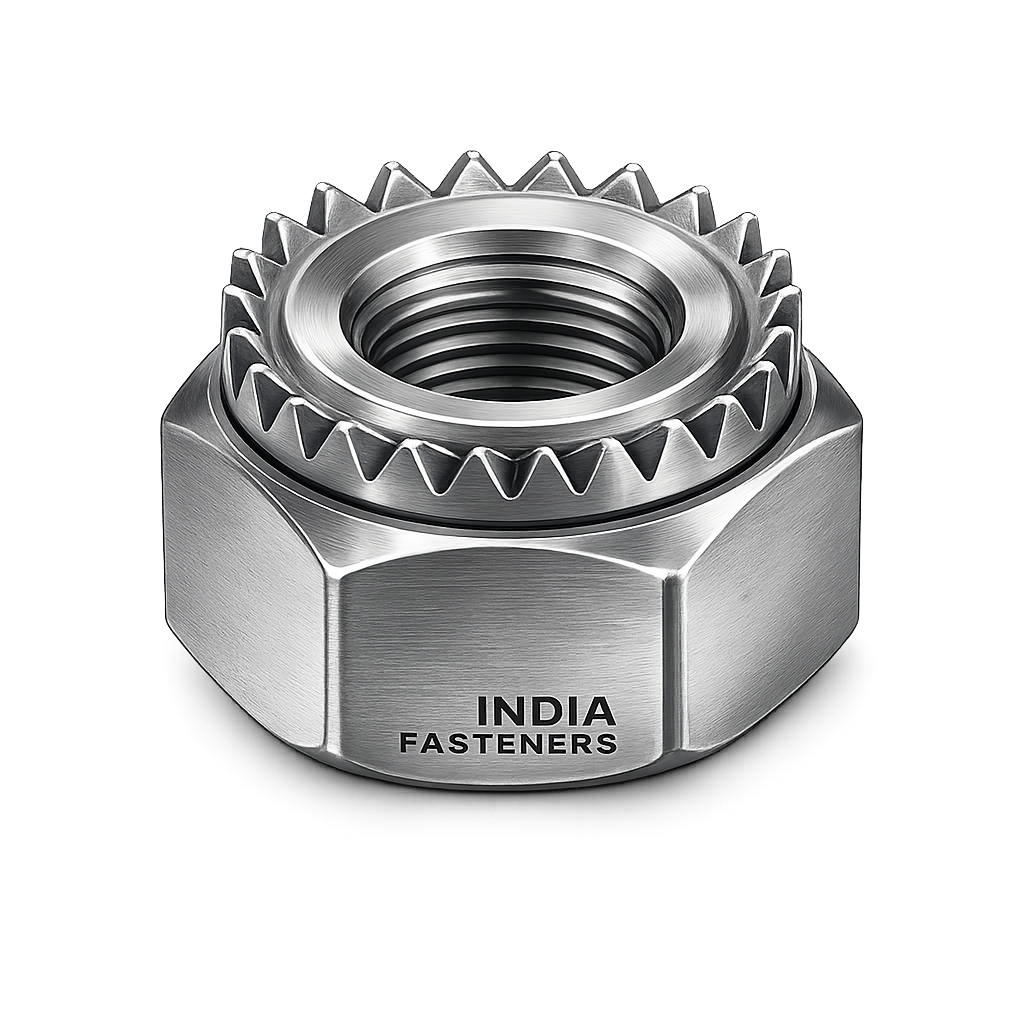
Kep Lock nut
1. Regional Industrial Context — Middle East Operating Environment
Industrial fastening selection within GCC projects is governed primarily by mechanical integrity, maintenance accessibility, and long-term preload retention under severe operating conditions. The Kep Nut — commonly identified as a lock washer nut with captive external tooth washer — addresses fastening reliability challenges frequently encountered across Middle East EPC installations.
1.1 GCC Industrial Infrastructure Characteristics
Major industrial assets across Saudi Arabia, UAE, Qatar, Oman, Kuwait, and Bahrain operate under combined environmental and operational stresses rarely observed simultaneously in temperate regions.
Typical facilities include:
- Oil & Gas processing plants
- Offshore production platforms
- LNG export terminals
- Petrochemical complexes
- Combined cycle power plants
- Desalination facilities
- District cooling systems
- Infrastructure megaprojects
- Industrial OEM equipment packages
Fastening systems in these installations must maintain preload integrity despite:
- Continuous vibration
- Thermal expansion cycles
- Corrosive marine atmospheres
- Sand contamination
- Restricted maintenance intervals
Kep nuts are widely applied where assembly efficiency and vibration resistance must coexist.
1.2 Oil & Gas Rotating Equipment Applications
Rotating equipment represents one of the primary drivers for anti-loosening fastener systems in GCC projects.
Typical equipment:
- Centrifugal pumps
- Compressors
- Gas turbines
- Blowers
- Cooling tower drives
- Fan assemblies
- Skid-mounted auxiliary systems
Operating characteristics include:
- Persistent vibration frequencies
- Start-stop operational cycles
- Shaft imbalance forces
- Resonance amplification through structural frames
Under such conditions, conventional nut and washer assemblies may experience:
- Loss of clamp load
- Micro-slip at joint interfaces
- Progressive loosening under cyclic shear
Kep nuts reduce assembly variability by integrating washer function directly into the nut design.
1.3 Compressor Skid Assemblies
GCC EPC projects increasingly utilize modular skid packages assembled internationally and installed onsite.
Typical fastening points:
- Instrument mounting brackets
- Control panel supports
- Cable trays
- Access platforms
- Guarding systems
- Secondary structural frames
Challenges include:
- Limited installation time during commissioning
- Multiple installation crews
- Reduced torque control consistency
A captive washer nut eliminates missing washer risks during rapid assembly operations.
1.4 Pump Packages & Mechanical Equipment Bases
Pump foundations and auxiliary equipment supports experience:
- Continuous micro-vibration
- Foundation settlement effects
- Thermal expansion differences between baseplate and structure
Kep nuts improve reliability where:
- Moderate locking performance is required
- Frequent inspection accessibility is limited
- Assembly speed affects commissioning schedules
1.5 Structural Steel Connections
Within GCC industrial plants, secondary steel structures frequently use mechanically locked fasteners for:
- Handrails
- Walkways
- Ladders
- Cable management systems
- Instrument racks
Environmental factors influencing joint stability:
- Desert wind-induced vibration
- Temperature cycling exceeding 45–55°C surface exposure
- Expansion and contraction cycles
Integrated serrated washers enhance resistance against rotational loosening without additional components.
1.6 Cable Tray & Instrumentation Support Systems
Instrumentation and electrical infrastructure represent high-volume fastening applications.
Typical requirements:
- High installation productivity
- Reduced part count
- Reliable retention under vibration from rotating machinery
- Consistent grounding contact where required
Kep nuts provide uniform washer contact pressure while simplifying inventory management for EPC contractors.
1.7 HVAC & District Cooling Installations
District cooling systems in GCC cities operate continuously at high loads.
Fastener exposure includes:
- Fan vibration
- Air handling unit oscillation
- Duct support resonance
- Chilled water pump vibration
Standard nuts may loosen due to cyclic vibration; captive washer nuts introduce friction locking through serrated engagement.
1.8 Switchgear Panels & Electrical Equipment
Electrical enclosures and switchgear assemblies require:
- Controlled tightening
- Reliable electrical bonding
- Resistance to vibration from transformers and generators
Kep nuts assist in maintaining electrical continuity where serrated washers penetrate coating layers to establish metal-to-metal contact.
1.9 Desalination Facilities
Desalination plants introduce additional stresses:
- High humidity
- Chloride-rich atmosphere
- Continuous equipment operation
Fasteners must resist both loosening and corrosion degradation.
Material selection becomes critical for Kep nut performance in these environments.
1.10 Offshore Platform Secondary Structures
Offshore environments combine:
- Salt spray exposure
- Wave-induced vibration
- Structural oscillation
- Maintenance accessibility limitations
Integrated washer locking reduces component loss risk during offshore installation activities.
2. Technical Definition of Kep Nut
A Kep Nut is defined as:
A hexagonal nut incorporating a permanently attached free-spinning external tooth lock washer designed to provide mechanical resistance against loosening while simplifying installation.
2.1 Construction Features
Primary elements:
- Hex nut body
- Captive external tooth washer
- Retention lip or crimping interface
- Free rotational washer interface
The washer remains permanently assembled yet rotates independently during installation.
2.2 Functional Characteristics
- Washer cannot separate from nut
- Washer distributes load during tightening
- Teeth create frictional resistance
- Single-component fastening solution
2.3 Difference from Standard Nut + Washer Assembly
| Feature | Standard Nut + Washer | Kep Nut |
|---|---|---|
| Components | Two separate items | Integrated unit |
| Assembly Risk | Washer omission possible | Eliminated |
| Installation Speed | Moderate | High |
| Inventory Complexity | Higher | Reduced |
| Washer Alignment | Manual | Automatic |
2.4 Load Distribution Mechanism
The captive washer performs multiple functions:
- Enlarges bearing surface
- Reduces localized stress
- Improves joint seating
- Enhances clamp load stability
2.5 Washer Retention Design
Retention methods include:
- Mechanical staking
- Formed collar capture
- Crimped interface
The washer rotates freely before tightening, preventing galling during thread engagement.
2.6 Anti-Rotation Behavior
External teeth engage mating surfaces through controlled penetration, increasing resistance to reverse rotation once preload is applied.
2.7 Installation Efficiency Advantages
EPC assembly environments benefit from:
- Reduced component handling
- Faster installation cycles
- Lower risk of assembly error
- Simplified kitting operations
2.8 Applicable Standards Reference
Kep nuts align functionally with requirements derived from:
- DIN 6923 (serrated flange nut comparison)
- ISO 4032 / ISO 4033 hex nut dimensional references
- ASME B18.2.2 dimensional practices
- IFI industrial fastener guidelines
3. Locking Mechanism Engineering & Load Behavior
3.1 Friction Locking Principle
Kep nuts rely primarily on friction-based locking rather than prevailing torque deformation.
Locking occurs through:
- Radial tooth engagement
- Increased friction coefficient
- Resistance to rotational back-off
3.2 Tooth Penetration Mechanics
During tightening:
- Washer seats against joint surface
- Serrations embed slightly into material surface
- Contact pressure increases frictional resistance
This creates mechanical resistance against loosening forces.
3.3 Prevailing Torque Behavior
Unlike nylon insert nuts, Kep nuts do not generate torque resistance before seating.
Prevailing torque develops only after:
- Full clamp load establishment
- Tooth engagement
- Surface compression
3.4 Resistance to Vibrational Loosening
Self-loosening occurs when transverse joint movement reduces frictional resistance.
The Kep nut counters this through:
- Increased interface friction
- Surface indentation
- Energy dissipation at tooth interface
3.5 Clamp Load Retention Theory
Bolt preload governs joint reliability.
Simplified preload equation:$$
F = \frac{T}{K \times D}
$$
Where:
- F = Clamp force
- T = Applied torque
- K = Nut factor (friction coefficient)
- D = Nominal diameter
Washer teeth increase effective friction coefficient, assisting clamp force retention.
3.6 Joint Relaxation Effects
After tightening, joints experience:
- Embedment relaxation
- Material settling
- Thermal expansion cycling
Kep nuts reduce loosening risk during early relaxation stages.
3.7 Influence of Friction Coefficient
Friction occurs at:
- Thread interface
- Bearing surface
- Washer teeth interface
Integrated washer design stabilizes bearing friction variability.
3.8 Junker Vibration Principle
The Junker test demonstrates that transverse vibration causes self-loosening even in properly torqued fasteners.
Kep nuts improve resistance by:
- Increasing slip resistance threshold
- Maintaining friction during cyclic motion
3.9 Preference in EPC Assembly Operations
Reasons EPC contractors select Kep nuts:
Consistent mechanical locking performance
Reduced installation components
Faster construction schedules
Lower assembly error probability
4. Applicable Materials for Kep Nuts — GCC Engineering Mapping
Material selection for Kep nuts used in Middle East EPC projects is determined by mechanical load requirement, environmental exposure, corrosion resistance, and project specification compliance rather than cost considerations.
GCC project consultants typically evaluate fasteners based on:
- Design life expectations (20–30+ years)
- Environmental classification
- Equipment criticality
- Inspection accessibility
- Maintenance philosophy
Kep nuts supplied for industrial applications must therefore be manufactured from controlled-grade materials supported by full traceability documentation.
4.1 Carbon Steel Kep Nuts
Carbon steel remains the most commonly specified material for general EPC mechanical assemblies.
Typical grades include:
- Equivalent to SAE Grade 5 / Grade 8
- ISO Property Class 8
- ISO Property Class 10
- ASTM A563 nut grades
Mechanical Characteristics
- High structural strength
- Stable preload capability
- Suitable for vibration-loaded assemblies
- Good machinability and forming response
GCC Application Suitability
Carbon steel Kep nuts are typically used in:
- Indoor mechanical installations
- Equipment skid assemblies
- Cable support systems
- HVAC structural connections
- Switchgear mounting structures
Limitations
Carbon steel requires protective coating when exposed to:
- Marine atmosphere
- Outdoor desert exposure
- Condensation-prone areas
4.2 ASTM A563 Grade Kep Nuts
ASTM A563 materials are commonly referenced in American-standard EPC specifications.
Applicable grades include:
- A563 Grade A
- A563 Grade DH (high strength applications)
Use Case Mapping
- Structural bolting compatibility
- High preload joints
- Equipment mounting systems
These grades allow compatibility with:
- ASTM A193 B7 bolts
- Structural anchor assemblies
- Machinery base installations
4.3 Stainless Steel Kep Nuts — AISI 304
Stainless Steel 304 Kep nuts provide corrosion resistance suitable for non-marine GCC environments.
Characteristics
- Excellent atmospheric corrosion resistance
- Good fabrication properties
- Non-magnetic condition after forming
- Stable performance across moderate temperature ranges
Typical Applications
- Electrical equipment
- Control panels
- Instrumentation supports
- HVAC assemblies
- Indoor desalination facilities
Environmental Limitation
Not recommended for direct chloride-rich coastal exposure without evaluation.
4.4 Stainless Steel Kep Nuts — AISI 316
AISI 316 stainless steel is widely specified for aggressive Gulf environments.
Added Alloying Elements
- Molybdenum content improves chloride resistance
- Enhanced pitting corrosion resistance
Typical GCC Applications
- Offshore platforms
- Desalination plants
- Coastal petrochemical installations
- Marine exposed structural components
Performance Benefits
- Reduced maintenance intervals
- Long-term corrosion resistance
- Suitable for humid and saline environments
4.5 Alloy Steel Kep Nuts
Alloy steel grades are applied where higher mechanical loads exist.
Typical applications include:
- High vibration rotating equipment
- Elevated temperature service
- Critical mechanical assemblies
Alloy steels undergo controlled heat treatment to achieve required hardness and strength.
4.6 Zinc-Plated Steel Kep Nuts
Zinc electroplating provides basic corrosion protection.
Engineering Purpose
- Prevent atmospheric oxidation
- Maintain thread integrity during storage
- Provide controlled friction characteristics
Common EPC Uses
- Indoor industrial installations
- Pre-assembled OEM equipment
- Electrical enclosure fastening
Limitations
Not recommended for outdoor coastal installations without supplementary coating systems.
4.7 Mechanical Galvanized Kep Nuts
Mechanical galvanizing deposits zinc through cold mechanical bonding.
Advantages include:
- Reduced hydrogen embrittlement risk
- Uniform coating thickness
- Improved performance over electroplating
Used where moderate outdoor exposure exists.
4.8 Hot-Dip Galvanized (HDG) Kep Nuts
Hot-dip galvanizing provides thick zinc coating for outdoor service.
Characteristics
- Heavy corrosion protection
- Extended outdoor life
- Suitable for desert and coastal climates
Typical GCC applications:
- Structural steel connections
- Cable tray systems
- Pipe rack supports
- Outdoor equipment platforms
HDG nuts require dimensional allowance for coating thickness.
4.9 Temperature Suitability Mapping
Material selection must align with service temperature ranges.
Typical GCC conditions:
- Ambient desert exposure: up to 60°C surface temperature
- Equipment service temperatures: elevated conditions depending on system
Stainless and alloy materials maintain mechanical integrity across wider temperature ranges compared to plated carbon steel.
5. Material Comparison Table (GCC Engineering Reference)
| Material Grade | Yield Strength | Tensile Strength | Hardness Range | Corrosion Resistance Level | Typical GCC Application |
|---|---|---|---|---|---|
| Carbon Steel Class 8 | Medium | Medium | 22–32 HRC | Low (coating required) | Indoor equipment, HVAC |
| Carbon Steel Class 10 | High | High | 28–36 HRC | Low | Rotating equipment |
| ASTM A563 Grade A | Medium | Medium | Controlled | Low | General structural use |
| ASTM A563 DH | High | High | Higher hardness | Low | Heavy equipment |
| Stainless Steel 304 | Medium | Medium | HRB range | Moderate | Electrical & indoor plants |
| Stainless Steel 316 | Medium | Medium | HRB range | High | Offshore & desalination |
| Alloy Steel | Very High | Very High | Heat treated | Depends on coating | High-load assemblies |
| Zinc-Plated Steel | Medium | Medium | Controlled | Moderate indoor | OEM equipment |
| Mechanical Galvanized | Medium | Medium | Controlled | Medium outdoor | Infrastructure supports |
| Hot-Dip Galvanized | Medium | Medium | Slightly reduced | High outdoor | Pipe racks, structures |
6. Heat Treatment & Metallurgical Control
Mechanical performance of Kep nuts depends heavily on metallurgical discipline.
GCC consultants routinely verify heat-treatment control during vendor qualification.
6.1 Cold Forming vs Hot Forging
Cold Forming
Most Kep nuts are produced by cold forming.
Advantages:
- Grain flow continuity
- Improved fatigue strength
- Dimensional accuracy
- High production consistency
Hot Forging
Used for larger sizes or high-strength alloy materials where forming loads exceed cold forming limits.
6.2 Thread Rolling Advantages
Threads may be produced through:
- Tapping
- Rolling
Thread rolling provides:
- Work-hardened surface
- Improved fatigue resistance
- Better thread finish
- Reduced crack initiation risk
6.3 Through Hardening
High-strength Kep nuts undergo controlled heating followed by quenching and tempering.
Purpose:
- Achieve required hardness
- Maintain toughness
- Prevent brittle fracture
6.4 Case Hardening (When Applied)
Certain washer designs may receive localized hardening to ensure:
- Tooth durability
- Consistent locking performance
- Wear resistance during repeated tightening
6.5 Tempering Control
Tempering stabilizes microstructure after hardening.
Improper tempering may lead to:
- Reduced strength
- Stress cracking
- Premature failure
Temperature monitoring and batch validation are therefore required.
6.6 Hydrogen Embrittlement Prevention
Electroplating processes introduce hydrogen into steel surfaces.
Mitigation includes:
- Controlled plating chemistry
- Immediate post-plating baking
- Time-controlled de-embrittlement cycles
Critical for high-strength fasteners supplied to EPC projects.
6.7 Post-Plating Baking Requirements
Typical baking practices:
- 190–230°C baking temperature
- Defined holding duration
- Traceable batch records
Required especially for property class 10 or higher materials.
6.8 Metallurgical Reliability Expectations in EPC Procurement
Third-party inspectors typically evaluate:
- Heat treatment records
- Hardness verification data
- Material heat traceability
- Process calibration documentation
Failure to demonstrate metallurgical control frequently results in vendor rejection during prequalification.
7. Manufacturing Process Flow — EPC Documentation Level
Industrial Kep nut manufacturing must follow controlled and traceable production stages aligned with international fastener manufacturing practice.
7.1 Raw Material Traceability
Incoming material includes:
- Steel wire rod or bar stock
- Stainless steel coils
- Alloy steel billets
Verification activities:
- Mill test certificate review
- Chemical composition confirmation
- Heat number allocation
- Incoming inspection recording
7.2 Material Certification Verification
Before production release:
- Mechanical properties validated
- Grade compliance confirmed
- Material stored under segregated identification
Traceability is maintained throughout production.
7.3 Cold Forging of Nut Body
Multi-station cold headers produce:
- Hex geometry
- Bearing surface
- Washer retention feature
Controlled forming pressure ensures dimensional accuracy.
7.4 Captive Washer Manufacturing
Washer production includes:
- Stamping operations
- External tooth formation
- Thickness control
- Flatness inspection
Tooth geometry directly influences locking performance.
7.5 Washer Assembly Integration
Washer is assembled onto nut prior to threading or after forming depending on design.
Requirements:
- Permanent retention
- Free rotation capability
- No separation under handling
Rotation torque must remain within controlled limits.
7.6 Thread Tapping / Thread Rolling
Threads manufactured according to:
- ISO metric
- UNC
- UNF
Inspection tools include:
- GO / NO-GO gauges
- Thread profile verification
- Pitch diameter control
7.7 Heat Treatment
Applicable batches undergo:
- Controlled furnace heating
- Quenching
- Tempering
Furnace calibration records form part of inspection documentation.
7.8 Surface Coating Application
Possible coatings:
- Zinc electroplating
- Mechanical galvanizing
- Hot-dip galvanizing
- Passivation (stainless steel)
Coating thickness monitored using calibrated instruments.
7.9 Torque Testing
Representative samples are tested for:
- Tightening torque consistency
- Washer engagement performance
- Bearing surface stability
7.10 Final Inspection
Inspection stages include:
- Dimensional verification
- Hardness testing
- Visual inspection
- Coating examination
Non-conforming parts are segregated.
7.11 Batch Traceability Marking
Each production lot maintains:
- Heat number reference
- Production batch ID
- Inspection record linkage
Traceability supports EN 10204 certification requirements.
7.12 Dimensional Tolerance & Washer Rotation Control
Critical acceptance criteria:
- Washer must rotate freely prior to tightening
- Washer must not detach during handling
- Bearing surface perpendicularity maintained
- Thread alignment verified
These controls ensure consistent installation behavior across EPC field assemblies.
8. Dimensional Reference Tables — Kep Nut Engineering Data
Dimensional conformity is a primary requirement during EPC technical evaluation. Kep nuts must comply with internationally accepted dimensional standards to ensure interchangeability with specified bolts and threaded assemblies.
Dimensions are typically aligned with:
- ISO metric thread standards
- ASME Unified thread systems (UNC / UNF)
- Functional comparison to DIN 6923 flange geometry where applicable
The following tables provide engineering reference dimensions used during design, procurement, and inspection activities.
8.1 Metric Kep Nut Dimensional Reference
| Thread Size | Across Flats (mm) | Nut Height (mm) | Washer OD (mm) | Washer Thickness (mm) | Thread Pitch (mm) | Approx. Weight (kg/1000 pcs) |
|—|—|—|—|—|—|
| M4 | 7 | 4.0 | 9 | 0.6 | 0.7 | 0.40 |
| M5 | 8 | 5.0 | 10 | 0.8 | 0.8 | 0.70 |
| M6 | 10 | 5.2 | 12 | 0.9 | 1.0 | 1.30 |
| M8 | 13 | 6.5 | 16 | 1.0 | 1.25 | 2.90 |
| M10 | 17 | 8.0 | 20 | 1.2 | 1.5 | 6.10 |
| M12 | 19 | 10.0 | 24 | 1.4 | 1.75 | 10.80 |
| M16 | 24 | 13.0 | 30 | 1.6 | 2.0 | 23.50 |
| M20 | 30 | 16.0 | 36 | 2.0 | 2.5 | 45.00 |
8.2 UNC Kep Nut Dimensional Reference
| Thread Size | Across Flats (inch) | Nut Height (inch) | Washer OD (inch) | Washer Thickness (inch) | Thread Pitch | Weight (lb/1000 pcs) |
|---|---|---|---|---|---|---|
| 1/4″-20 | 7/16 | 0.22 | 0.48 | 0.030 | 20 TPI | 1.2 |
| 5/16″-18 | 1/2 | 0.27 | 0.58 | 0.035 | 18 TPI | 2.0 |
| 3/8″-16 | 9/16 | 0.33 | 0.70 | 0.040 | 16 TPI | 3.6 |
| 1/2″-13 | 3/4 | 0.44 | 0.90 | 0.050 | 13 TPI | 7.8 |
| 5/8″-11 | 15/16 | 0.55 | 1.05 | 0.060 | 11 TPI | 14.5 |
Dimensional Engineering Notes
- Washer outer diameter determines bearing pressure distribution.
- Nut height governs thread engagement strength.
- Thread pitch compatibility must match bolt specification exactly.
- Washer thickness influences tooth penetration performance.
Dimensional verification forms part of incoming inspection during EPC construction.
9. Mechanical Performance Table
Mechanical performance data allows consultants and mechanical engineers to verify fastening suitability for operational loads.
| Thread Size | Proof Load (kN) | Clamp Load Range (kN) | Recommended Tightening Torque (Nm) | Hardness Range | Prevailing Torque Behavior |
|---|---|---|---|---|---|
| M6 | 8.0 | 5–7 | 9–11 | 22–30 HRC | Developed after seating |
| M8 | 14.5 | 9–12 | 22–28 | 22–32 HRC | Serration engagement |
| M10 | 23 | 14–18 | 45–55 | 24–34 HRC | Stable friction locking |
| M12 | 33 | 20–27 | 75–95 | 24–34 HRC | Anti-rotation resistance |
| M16 | 60 | 35–45 | 180–220 | 26–36 HRC | High vibration stability |
| M20 | 95 | 55–70 | 350–420 | 26–36 HRC | Maintains clamp load |
Engineering Interpretation
- Proof load defines maximum allowable service loading.
- Clamp load must remain below proof load to prevent permanent deformation.
- Kep nuts maintain preload primarily through frictional resistance rather than thread deformation.
10. Torque Tightening Chart — EPC Installation Reference
Correct torque application is essential to achieve designed preload.
Torque values vary depending on lubrication condition.
Property Class 8.8 Compatibility
| Bolt Size | Dry Torque (Nm) | Lubricated Torque (Nm) |
|---|---|---|
| M6 | 11 | 8 |
| M8 | 27 | 20 |
| M10 | 54 | 40 |
| M12 | 95 | 70 |
| M16 | 230 | 170 |
| M20 | 460 | 340 |
Property Class 10.9 Compatibility
| Bolt Size | Dry Torque (Nm) | Lubricated Torque (Nm) |
|---|---|---|
| M6 | 15 | 11 |
| M8 | 40 | 30 |
| M10 | 80 | 60 |
| M12 | 135 | 100 |
| M16 | 320 | 240 |
| M20 | 640 | 480 |
ASTM A193 B7 Bolt Compatibility
Typical refinery and petrochemical equipment assemblies utilize B7 bolting.
| Bolt Size | Dry Torque (Nm) | Lubricated Torque (Nm) |
|---|---|---|
| 1/2″ | 110 | 82 |
| 5/8″ | 220 | 165 |
| 3/4″ | 380 | 285 |
| 1″ | 750 | 560 |
Preload Percentage Logic
Industrial fastening practice targets:
- 70–75% of bolt proof load
Reasons:
- Prevent yielding
- Maintain elastic behavior
- Ensure vibration resistance
- Avoid thread stripping
Lubrication reduces friction coefficient, therefore torque must be reduced accordingly.
11. Anti-Vibration Performance Analysis
Vibration-induced loosening remains a major mechanical failure mechanism in industrial facilities.
11.1 Dynamic Loading Conditions
Fasteners experience:
- Transverse shear displacement
- Cyclic tensile loading
- Rotational excitation
- Equipment resonance amplification
These forces reduce friction at thread interfaces.
11.2 Vibration Frequency Impact
Higher vibration frequencies accelerate:
- Micro-slip formation
- Clamp load reduction
- Nut back-off rotation
Integrated tooth washers increase resistance to initial slip.
11.3 Friction Locking Reliability
Kep nuts resist loosening through:
- Increased bearing surface friction
- Radial tooth penetration
- Energy dissipation at interface contact points
Performance is particularly effective for:
- Light-to-medium vibration
- Secondary structural assemblies
- Equipment accessories
11.4 Engineering Comparison with Alternative Solutions
| Fastener Type | Locking Method | Vibration Resistance | Reusability |
|---|---|---|---|
| Plain Nut | Friction only | Low | High |
| Double Nut Method | Jam locking | Moderate | Moderate |
| Nylon Insert Lock nut | Polymer prevailing torque | Good | Limited temperature |
| Serrated Flange Nut | Serration friction | Good | Moderate |
| Kep Nut | Captive tooth washer | Good | Reusable (inspection dependent) |
Engineering Observation
Kep nuts provide reliable performance where:
- Assembly speed matters
- Moderate vibration exists
- Reusability is required
- Polymer locking elements are unsuitable due to temperature limits
12. Mechanical Property Table
Representative mechanical property ranges for industrial Kep nuts:
| Property | Carbon Steel Class 8 | Carbon Steel Class 10 | Stainless Steel 304 | Stainless Steel 316 |
|---|---|---|---|---|
| Yield Strength (MPa) | ≥ 640 | ≥ 940 | ≥ 205 | ≥ 205 |
| Ultimate Tensile Strength (MPa) | ≥ 800 | ≥ 1040 | ≥ 515 | ≥ 515 |
| Elongation (%) | 12 | 9 | 40 | 40 |
| Hardness | 22–32 HRC | 28–36 HRC | HRB | HRB |
| Proof Load | Standard | High | Moderate | Moderate |
Mechanical Integrity Considerations
Consultants evaluate compatibility between:
- Nut strength
- Bolt grade
- Joint material hardness
Mismatch may lead to:
- Thread stripping
- Washer tooth over-penetration
- Loss of preload
Corrosion behavior strongly influences fastener lifecycle in GCC environments.
13. Corrosion Resistance Comparison Table
| Finish | Coastal Exposure | Indoor Plant | Chemical Plant | Desalination Atmosphere | High Humidity Zones |
|---|---|---|---|---|---|
| Zinc Plated | Low | Good | Moderate | Low | Moderate |
| Hot-Dip Galvanized | High | Good | Good | Moderate | High |
| Stainless Steel 304 | Moderate | Excellent | Good | Moderate | Good |
| Stainless Steel 316 | Excellent | Excellent | Excellent | Excellent | Excellent |
Engineering Selection Guidance
- Offshore and desalination facilities typically specify SS316.
- Structural outdoor installations favor HDG.
- Indoor electrical systems commonly use zinc-plated or SS304 variants.
14. Inspection & Quality Assurance — EPC Expectations
Quality assurance for Kep nuts must support third-party inspection acceptance and consultant verification procedures.
14.1 Incoming Material Inspection
Verification includes:
- Heat number confirmation
- Chemical composition validation
- Mill certificate review
- Visual material condition inspection
14.2 Thread Gauge Verification
Inspection tools:
- GO gauge
- NO-GO gauge
- Pitch verification gauges
Ensures compatibility with specified bolt standards.
14.3 Hardness Testing
Performed using:
- Rockwell hardness testing
- Controlled sampling frequency
Confirms successful heat treatment.
14.4 Coating Thickness Testing
Methods include:
- Magnetic thickness measurement
- Micrometer verification
- Batch sampling
Critical for corrosion protection assurance.
14.5 Salt Spray Testing
Where specified, coatings undergo:
- Neutral salt spray testing
- Exposure duration verification
- Corrosion resistance validation
Supports coating performance qualification.
14.6 Torque Verification Testing
Random sample testing confirms:
- Washer seating performance
- Thread engagement behavior
- Consistent tightening torque response
14.7 Lot Traceability Control
Each production batch maintains:
- Manufacturing date reference
- Heat number traceability
- Inspection record linkage
Traceability remains mandatory for EPC documentation packages.
14.8 EN 10204 Certification Requirements
Typical documentation supplied:
- EN 10204 Type 3.1 inspection certificate
- Mechanical property confirmation
- Chemical composition report
- Heat treatment records
- Coating verification data
14.9 GCC Consultant Documentation Expectations
Inspection agencies typically review:
- Dimensional inspection reports
- Calibration certificates
- Process control records
- Non-conformance management procedures
- Packing traceability documentation
Acceptance depends on demonstrated process control rather than product appearance.
15. Industries Served — Middle East EPC Application Engineering
Kep nuts are deployed across multiple industrial sectors within GCC projects where fast installation, controlled preload, and vibration resistance are required without introducing complex locking systems.
Engineering selection is typically performed during:
- Mechanical design phase
- EPC material approval stage
- Vendor data sheet evaluation
- Construction methodology planning
The following sections describe application logic rather than product promotion.
15.1 Oil & Gas Facilities
Oil & gas installations across the Middle East operate continuously under dynamic mechanical loading conditions.
Typical Kep nut applications include:
- Instrument mounting assemblies
- Control valve accessories
- Pump auxiliary equipment
- Pipe support secondary connections
- Analyzer shelters
- Cable tray mounting structures
- Access platforms and safety systems
Engineering considerations:
- Moderate vibration environments
- Frequent inspection avoidance requirements
- Reduced loose component risk during installation
- Compatibility with carbon steel or stainless steel bolting
Kep nuts are generally not selected for primary pressure-retaining joints but are widely accepted for secondary mechanical assemblies.
15.2 Petrochemical Plants
Petrochemical facilities contain dense equipment layouts with extensive auxiliary systems requiring reliable fastening.
Common usage areas:
- Electrical support structures
- HVAC systems
- Fire and gas detection mounting
- Structural handrails
- Equipment guarding systems
- Maintenance access platforms
Operational challenges:
- Continuous thermal cycling
- Equipment-induced vibration
- Chemical atmosphere exposure
Material selection often shifts toward stainless steel or coated carbon steel variants depending on exposure classification.
15.3 Power Generation Facilities
Combined cycle and conventional power plants impose cyclic loading on structural and mechanical assemblies.
Applications include:
- Turbine enclosure panels
- Generator accessory mounting
- Cable ladder systems
- Cooling tower assemblies
- Auxiliary pump structures
- Vibration-isolated support frames
Engineering benefit:
Integrated washer nuts reduce assembly time during large-scale construction phases while maintaining required clamp stability.
15.4 Water Treatment & Desalination Plants
Desalination facilities represent one of the most aggressive corrosion environments in the GCC.
Fastening requirements include:
- High humidity resistance
- Chloride exposure tolerance
- Long maintenance intervals
Kep nuts manufactured from SS316 or suitable corrosion-resistant coatings are typically specified for:
- Instrument supports
- Electrical cabinets
- Walkways and gratings
- Maintenance structures
15.5 HVAC & District Cooling Infrastructure
District cooling networks operate continuously and experience mechanical vibration from fans, pumps, and compressors.
Kep nuts are applied in:
- Air handling unit assemblies
- Fan housings
- Duct support systems
- Vibration isolation structures
- Chiller plant auxiliary equipment
Engineering preference arises from simplified installation procedures across repetitive assemblies.
15.6 Electrical Infrastructure & Switchgear Systems
Electrical contractors frequently specify captive washer nuts to ensure installation consistency.
Typical locations:
- Switchgear mounting
- Transformer auxiliary equipment
- Earthing systems
- Control panels
- Cable tray support structures
External tooth washers assist in establishing metal contact where coatings exist on mating surfaces.
15.7 OEM Skid Manufacturers
OEM equipment packages supplied to GCC projects require:
- Factory pre-assembly
- Transportation resistance
- Reduced loose hardware risk
Kep nuts support:
- Pre-installed assemblies
- Shipping vibration resistance
- Simplified field erection
15.8 Infrastructure Megaprojects
Large infrastructure developments utilize high volumes of mechanical fasteners.
Applications include:
- Metro rail infrastructure
- Airport mechanical systems
- Industrial utilities
- Renewable energy installations
- Process plant expansions
The integrated washer concept assists contractors managing large material inventories across distributed construction zones.
16. Export & GCC Supply Capability
Export supply for EPC projects requires alignment with documentation, packaging, and inspection expectations rather than simple shipment capability.
India Fasteners operates as a manufacturer supplying engineered fastening systems for international project execution.
16.1 Regional Supply Coverage
Export deliveries commonly support projects in:
- Saudi Arabia
- United Arab Emirates (Dubai / Abu Dhabi)
- Qatar
- Oman
- Kuwait
- Bahrain
Each region may impose specific project documentation requirements aligned with contractor or end-user standards.
16.2 Export Packaging Standards
Industrial fasteners require controlled packaging to maintain traceability and corrosion protection during marine transport.
Typical packaging practices include:
- Batch-segregated cartons
- Moisture-resistant packaging
- Protective inner liners
- Weight-controlled boxes for manual handling
- Palletized export units
- Containerized loading plans
Packaging labeling includes:
- Size identification
- Material grade
- Heat number
- Quantity
- Purchase order reference
16.3 Batch Segregation Practices
GCC project supply requires strict batch integrity.
Procedures include:
- Lot separation during packing
- Independent labeling
- Traceability preservation from manufacturing to delivery
Mixed batches are typically rejected during third-party inspection.
16.4 Project Documentation Dossiers
Export shipments commonly include technical documentation packages containing:
- Mill test certificates
- EN 10204 3.1 inspection certificates
- Mechanical property reports
- Heat treatment records
- Coating inspection reports
- Dimensional verification reports
- Packing lists and traceability records
Documentation supports EPC material approval workflows.
16.5 Third-Party Inspection Release
Prior to shipment, projects may require inspection witness or review by independent agencies.
Inspection scope may include:
- Visual inspection
- Random dimensional verification
- Hardness testing validation
- Certification review
- Packing verification
Inspection release notes form part of shipment approval documentation.
16.6 Container Loading Practices for Fasteners
Marine transportation introduces risks such as condensation and cargo movement.
Engineering-controlled loading includes:
- Pallet stabilization
- Container moisture control
- Weight distribution planning
- Mechanical damage prevention
Proper loading prevents coating damage and maintains traceability upon arrival.
17. Procurement & Installation Engineering View
From a procurement and construction perspective, Kep nut performance depends heavily on correct installation practice.
17.1 Surface Preparation
Prior to assembly:
- Remove oil, scale, or debris
- Verify flat seating surface
- Ensure mating surface hardness compatibility
Excessive surface coatings may reduce washer tooth engagement effectiveness.
17.2 Torque Application Sequence
Recommended practice:
- Hand thread engagement
- Progressive tightening
- Final torque application using calibrated tools
- Verification inspection
Impact tools may be used where permitted but require torque confirmation.
17.3 Washer Seating Requirements
Proper function requires:
- Full washer contact
- No angular misalignment
- Adequate bearing surface area
Partial seating reduces locking performance.
17.4 Reuse Limitations
Reuse depends on inspection results.
Kep nuts may be reused when:
- Threads remain undamaged
- Washer teeth are intact
- No corrosion degradation exists
- Torque performance remains consistent
Replacement is recommended if tooth wear is visible.
17.5 Joint Inspection Procedures
Field inspection may include:
- Visual confirmation of seating
- Torque verification checks
- Evidence of loosening or rotation
- Corrosion assessment
Inspection frequency depends on equipment criticality.
17.6 Field Maintenance Considerations
Maintenance teams benefit from captive washer nuts because:
- Washer loss during disassembly is prevented
- Reassembly time is reduced
- Inventory simplification occurs
This is particularly relevant in offshore and remote desert installations.
17.7 Storage in Gulf Climate Conditions
Improper storage remains a common source of fastener degradation.
Recommended practices:
- Indoor covered storage
- Elevated pallets above ground
- Moisture protection
- Separation of stainless and carbon steel materials
- Controlled inventory rotation
High humidity and temperature variation inside containers can accelerate corrosion if not managed.
18. Custom Engineering Capability
Industrial projects frequently require deviations from standard fastener configurations.
India Fasteners supports project-specific engineering requirements aligned with EPC specifications.
18.1 Special Coating Systems
Available coating adaptations may include:
- Enhanced zinc systems
- Duplex coatings
- Marine-grade protection systems
- Project-specified corrosion resistance finishes
Coating selection depends on environmental classification.
18.2 Non-Standard Washer Configurations
Engineering customization may include:
- Modified washer diameter
- Alternative tooth geometry
- Increased washer thickness
- Surface compatibility optimization
Such modifications address unique joint design requirements.
18.3 High-Strength Variants
Where required, Kep nuts may be supplied in:
- Higher property classes
- Alloy steel materials
- Elevated preload applications
Mechanical compatibility with specified bolts remains mandatory.
18.4 Metric & Imperial Supply
GCC projects frequently combine standards.
Supply capability includes:
- ISO metric threads
- UNC threads
- UNF threads
Ensures compatibility with global equipment manufacturers.
18.5 Project-Specific Marking
Identification options may include:
- Manufacturer identification
- Material grade marking
- Heat number coding
- Project-specific traceability marking
Marking supports inspection and lifecycle tracking.
18.6 NACE-Related Applications
Where sour service or corrosion-sensitive environments exist, material selection and coating processes may be aligned with project corrosion control philosophies.
Engineering review determines suitability rather than generalized application.
Engineering Conclusion — EPC Technical Evaluation Perspective
A Kep nut functions as an integrated fastening solution combining:
- Load distribution capability
- Mechanical friction locking
- Installation efficiency
- Controlled vibration resistance
Within GCC industrial environments, fastening systems must address:
- Thermal cycling
- Sand-induced vibration
- Corrosive marine exposure
- Restricted maintenance access
- Long-term mechanical preload retention
Manufacturing discipline, metallurgical control, inspection traceability, and export documentation readiness collectively determine supplier suitability for EPC project evaluation.
When assessed from a consultant mechanical integrity viewpoint, a manufacturer demonstrating:
- Standards-compliant production
- Traceable material control
- Verified mechanical performance
- GCC environmental understanding
- EPC documentation capability
meets the technical expectations typically applied during Middle East project vendor qualification.