
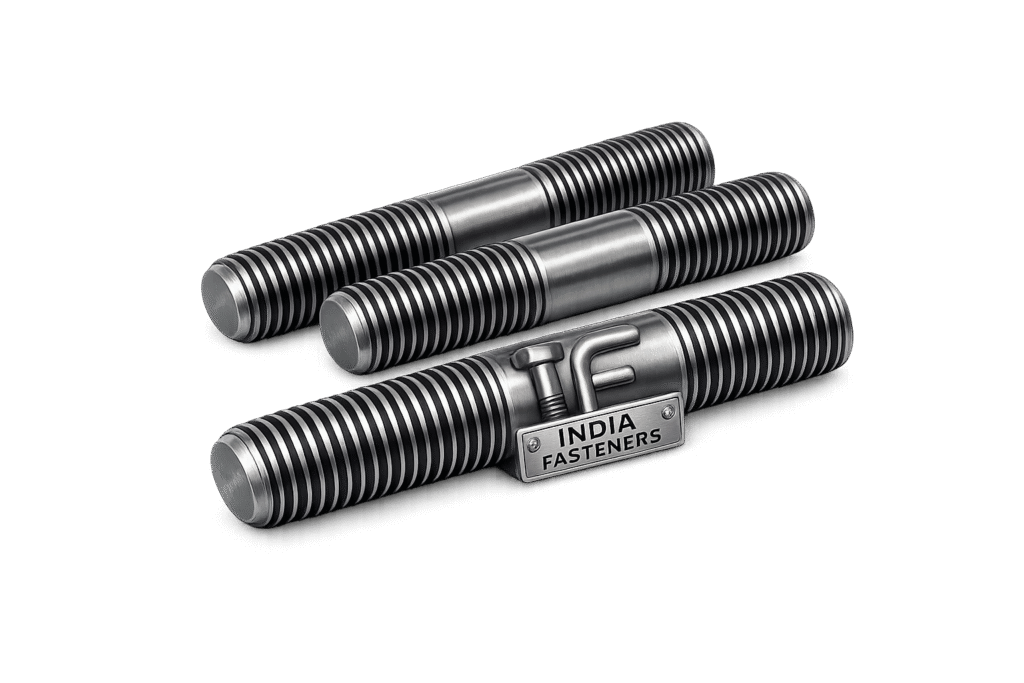
Fully Threaded Stud
1. Regional Industry Context – Middle East High-Pressure Bolted Joint Infrastructure
Industrial flange bolting is a critical mechanical element within hydrocarbon containment systems operating across the Gulf Cooperation Council (GCC) region. Process plants, pipelines, refineries, and power facilities depend on mechanically assembled flanged joints to maintain pressure integrity under severe operating conditions.
Across Saudi Arabia, the United Arab Emirates, Qatar, Oman, Kuwait, and Bahrain, pressure systems operate under combinations of:
- High internal pressures
- Elevated process temperatures
- Corrosive process fluids
- Marine atmospheric exposure
- Thermal cycling
- Cyclic mechanical loading
Fully threaded stud bolts form the primary load-bearing fastening system within these pressure-retaining assemblies.
The reliability of flange joints in these environments depends on controlled bolt preload, appropriate material selection, dimensional accuracy, and strict compliance with internationally recognized standards including ASME and ASTM.
Fully threaded stud bolts are commonly specified for pressure equipment used in:
- Oil and gas transmission pipelines
- Petrochemical complexes
- LNG processing terminals
- Thermal and combined cycle power plants
- Desalination facilities
- Offshore platforms
- Refinery processing units
- Gas compression stations
In these facilities, bolted flange joints enable controlled assembly and maintenance access to pressure equipment while maintaining containment of hazardous hydrocarbons.
Oil & Gas Pipeline Infrastructure
Pipeline infrastructure across the GCC region transports crude oil, refined products, natural gas, and condensate across long distances between production fields, processing plants, export terminals, and distribution networks.
Flanged joints are installed at key locations such as:
- Pumping stations
- Compressor stations
- Isolation valve assemblies
- Metering stations
- Pig launchers and receivers
Fully threaded stud bolts secure the flanged connections between piping components while maintaining gasket compression required to prevent leakage under internal pressure.
Pipeline pressure ratings frequently correspond to ASME B16.5 flange classes including:
- Class 150
- Class 300
- Class 600
- Class 900
- Class 1500
- Class 2500
As pressure class increases, flange bolt load requirements increase significantly. Stud bolt material strength and thread integrity therefore become critical engineering parameters.
Petrochemical Complexes
Large petrochemical production zones such as Jubail Industrial City in Saudi Arabia and Ruwais Industrial Complex in the United Arab Emirates contain extensive networks of process piping and pressure vessels.
These facilities process hydrocarbon feedstocks under conditions including:
- High operating temperatures
- Hydrogen-rich atmospheres
- Corrosive chemical environments
- Continuous plant operation cycles
Flanged joints are widely used in petrochemical plants to connect:
- Heat exchangers
- Reactor vessels
- Distillation columns
- Pump assemblies
- Process piping systems
Fully threaded stud bolts are used to generate the clamping force required to compress metallic or composite gaskets installed between mating flange faces.
Failure of a flange bolting system in such facilities can lead to:
- Hydrocarbon leakage
- Plant shutdown
- Fire or explosion hazards
- Environmental release
For this reason, EPC contractors and operating companies enforce strict bolting specifications during equipment procurement.
LNG Processing and Export Terminals
Liquefied natural gas (LNG) facilities located in Qatar and other GCC coastal areas operate under extremely low temperature conditions during gas liquefaction processes.
Flanged joints within LNG plants must maintain structural integrity under cryogenic temperatures that may reach approximately:
- −162°C (−260°F)
Standard carbon steel fasteners may lose toughness under these conditions. As a result, stud bolts manufactured from low-temperature alloy steels such as ASTM A320 L7 are frequently specified.
Fully threaded stud bolts used in LNG service must demonstrate:
- Adequate impact toughness
- Verified heat treatment
- Charpy impact test compliance
- Dimensional accuracy under cryogenic contraction
These mechanical requirements are validated through material testing and certification prior to installation.
Desalination Plants and Water Infrastructure
The Middle East operates some of the largest desalination plants in the world, supplying potable water through seawater desalination processes.
These plants contain:
- High-pressure pump systems
- Reverse osmosis units
- High-salinity pipelines
- Stainless steel process equipment
Bolted flange joints used in desalination plants must withstand:
- Chloride-rich marine environments
- High humidity
- Continuous water exposure
Fully threaded studs manufactured from corrosion-resistant materials such as stainless steel or alloy steels with protective coatings are frequently used in these applications.
Thermal and Combined Cycle Power Plants
Power generation facilities across the GCC region operate steam turbines, boilers, heat recovery steam generators, and high-pressure piping systems.
Bolted flange joints are used to connect:
- Steam lines
- Turbine casings
- Heat exchangers
- Boiler feedwater systems
These components operate at temperatures that may exceed:
- 500°C in certain high-temperature steam applications
Fully threaded stud bolts manufactured from high-temperature alloy steels such as ASTM A193 B16 are commonly specified for such conditions.
Maintaining proper bolt preload is critical to prevent leakage in high-temperature steam systems.
Offshore Platforms and Marine Installations
Offshore oil production platforms operate in highly corrosive marine environments characterized by:
- Salt spray exposure
- High humidity
- Wind-driven seawater
- Cyclic structural loading
Flanged joints used in offshore processing modules and subsea equipment rely on stud bolts capable of maintaining preload under continuous vibration and environmental corrosion.
Surface protection methods including:
- Hot-dip galvanizing
- PTFE coating
- Corrosion-resistant alloy materials
may be applied depending on project specifications.
Refineries and Gas Processing Facilities
Oil refineries process crude oil through complex chemical conversion units including:
- Hydrocrackers
- Catalytic reformers
- Distillation columns
- Hydrotreating reactors
These units operate under high pressures and temperatures.
Fully threaded stud bolts installed in refinery flanges must maintain joint integrity during:
- Thermal expansion cycles
- Process pressure fluctuations
- Maintenance shutdowns and restarts
Joint reliability depends on maintaining consistent bolt preload across all studs within the flange assembly.
Environmental Challenges in GCC Operating Conditions
Industrial fasteners used in the Middle East must withstand environmental conditions that are significantly more severe than those encountered in many other regions.
Key environmental factors include:
High Ambient Temperatures
Desert environments can produce ambient temperatures exceeding:
- 50°C during summer months
Thermal expansion and contraction cycles influence bolted joint performance over time.
Marine Corrosion Exposure
Facilities located near coastal regions are exposed to:
- Chloride-rich air
- Salt deposition
- Continuous humidity
Corrosion-resistant materials or coatings are often specified for flange bolting in these environments.
Sand and Dust Contamination
Wind-driven sand particles may accumulate on exposed fasteners and threads, potentially influencing torque control during assembly.
Proper thread cleaning and lubrication procedures are therefore recommended during installation.
Pressure Cycling in Process Systems
Process plants frequently experience pressure fluctuations due to:
- Flow rate changes
- Pump operations
- Process start-up and shutdown
These cyclic loads influence bolt stress and long-term joint performance.
2. Technical Definition of Fully Threaded Stud Bolts
A fully threaded stud bolt is a double-ended fastener featuring continuous threading along its entire length. Unlike partially threaded studs, there is no unthreaded shank section between the threaded ends.
The fastener is designed to be installed with two heavy hex nuts positioned on either side of a bolted flange joint.
The stud bolt functions as the primary tensile load-carrying component in a pressure-retaining flange assembly.
During installation, the nuts are tightened against the flange faces, generating tensile stress within the stud and compressive force across the gasket located between the flange surfaces.
This compressive force maintains sealing integrity under internal process pressure.
Structural Characteristics of Fully Threaded Stud Bolts
Key physical characteristics include:
- Continuous external thread along the entire stud length
- Chamfered ends for ease of nut engagement
- Uniform thread pitch conforming to standard thread profiles
- Material grade identification marking
- Heat number traceability where required
Fully threaded studs are typically used together with heavy hex nuts that comply with standards such as ASTM A194.
The combination of stud bolt and nut forms the complete bolting assembly used in flange connections.
Functional Role in Bolted Flange Assemblies
In a bolted flange joint, the stud bolt performs the following engineering functions:
- Provides tensile clamping force across the flange faces
- Maintains gasket compression required to prevent leakage
- Allows controlled preload application through torque tightening
- Accommodates elastic elongation during tightening
- Maintains joint integrity under pressure and temperature variations
Uniform preload distribution across all studs within the flange is essential to prevent flange distortion and gasket leakage.
Distinction Between Different Stud Bolt Types
Several stud bolt configurations exist within industrial bolting systems. Understanding their differences is important for correct engineering selection.
Fully Threaded Stud Bolts
- Continuous threading along full length
- Nuts can be positioned anywhere along stud
- Common in flange bolting assemblies
- Provides maximum adjustment flexibility
Tap End Stud Bolts
Tap end studs feature two different thread lengths:
- One end designed to screw directly into a tapped hole
- Opposite end designed to receive a nut
These studs are used when one side of the connection contains threaded equipment.
Double-End Stud Bolts
Double-end studs contain:
- Threaded sections at both ends
- Unthreaded shank in the center
These studs are commonly used in equipment where thread engagement length must be controlled precisely.
Continuous Threaded Rods
Threaded rods resemble fully threaded studs but are typically supplied in long bars rather than cut-to-length studs.
Threaded rods are often used in structural or support applications rather than pressure-retaining flange joints.
Advantages of Fully Threaded Stud Bolts in Pressure Equipment
Fully threaded studs provide several engineering advantages in high-pressure flange assemblies.
Uniform Load Distribution
Continuous threads allow nuts to engage along any point of the stud length, enabling balanced load distribution during assembly.
Assembly Flexibility
Installation technicians can adjust nut positions to accommodate minor variations in flange thickness or gasket compression.
Simplified Inventory Control
Because the entire stud length is threaded, the same stud design may be used across multiple flange configurations by varying nut placement.
Improved Maintenance Access
During plant maintenance shutdowns, fully threaded studs can be removed and replaced without special installation procedures.
Applicable Engineering Standards
Fully threaded stud bolts used in pressure equipment are manufactured according to internationally recognized standards that define material composition, mechanical properties, dimensional tolerances, and testing requirements.
Commonly referenced standards include:
ASTM A193
ASTM A193 covers alloy steel and stainless steel bolting materials intended for high-temperature and high-pressure service.
Common grades include:
- B7
- B7M
- B16
- B8
- B8M
These materials are widely used in refinery and petrochemical bolting systems.
ASTM A320
ASTM A320 specifies bolting materials suitable for low-temperature service.
Common grades include:
- L7
- L7M
These grades are frequently used in LNG facilities and cryogenic process equipment.
ASTM A307
ASTM A307 covers carbon steel bolts and studs used in general-purpose applications where high strength is not required.
This standard is typically applied in structural bolting rather than high-pressure flange joints.
ASME B16.5
ASME B16.5 defines flange dimensions, pressure ratings, bolt hole patterns, and bolting requirements for pipe flanges and flanged fittings.
Stud bolt dimensions and bolt circle arrangements in flange assemblies must comply with this standard.
ASME PCC-1
ASME PCC-1 provides guidelines for the assembly of pressure boundary bolted flange joints.
This document addresses:
- Bolt tightening procedures
- Torque sequences
- Lubrication practices
- Gasket seating stress requirements
The standard is widely used by refinery maintenance teams during plant turnaround activities.
3. Bolted Joint Engineering Theory
Understanding the mechanics of bolted flange joints is essential for ensuring long-term sealing integrity in pressure equipment.
Fully threaded stud bolts function within a mechanical system composed of:
- Two flanges
- A gasket
- Stud bolts
- Nuts
The performance of the joint depends on controlled interaction between these components.
Bolt Preload
Bolt preload refers to the tensile force intentionally applied to a bolt during tightening.
This preload creates compressive force across the gasket positioned between flange faces.
Proper preload must exceed the separating forces generated by internal process pressure.
If preload is insufficient, the gasket may lose compression, leading to leakage.
Gasket Compression
Gaskets require a minimum seating stress to form an effective seal.
During bolt tightening, stud bolts elongate slightly under tension, compressing the gasket between flange faces.
The amount of gasket compression must remain within acceptable limits.
Excessive compression may damage the gasket material, while insufficient compression may allow leakage.
Flange Rotation Control
When bolts are tightened, flanges may experience slight rotational movement.
Uneven bolt tightening can cause flange distortion, resulting in uneven gasket compression.
To prevent this condition, flange bolts must be tightened using controlled cross-pattern sequences.
This procedure distributes load evenly across all studs.
Joint Tightness Integrity
The tightness of a bolted flange joint depends on maintaining sufficient bolt preload throughout the operating life of the joint.
Loss of preload may occur due to:
- Thermal expansion
- Gasket creep
- Bolt relaxation
- Vibration
Engineering design must therefore consider these effects when selecting stud bolt materials and tightening procedures.
Bolt Tension vs Torque Relationship
Bolt tightening torque is used to generate tensile preload in the stud bolt.
However, torque applied to the nut does not directly translate into bolt tension because friction influences the torque-tension relationship.
Friction occurs in two primary locations:
- Between nut threads and stud threads
- Between the nut face and flange surface
Because friction varies depending on lubrication and surface condition, torque values must be adjusted accordingly.
Elastic Bolt Elongation
When torque is applied to the nut, the stud bolt elongates elastically.
This elongation creates tensile stress within the bolt material.
Elastic elongation is essential because it allows the bolt to act like a spring, maintaining clamping force even when the joint experiences small movements.
If the bolt is too rigid or insufficiently elastic, preload loss may occur more easily.
Gasket Seating Stress
Each gasket material requires a specific seating stress to form a leak-tight seal.
Typical gasket types include:
- Spiral wound gaskets
- Ring type joint (RTJ) gaskets
- Graphite gaskets
- PTFE gaskets
Fully threaded studs must generate sufficient clamping force to achieve the required seating stress without exceeding allowable flange stress limits.
Joint Relaxation Due to Temperature
Thermal expansion differences between bolts, flanges, and gaskets may cause bolt preload to decrease during operation.
In high-temperature refinery services, this effect is known as joint relaxation.
Material selection and initial preload values must account for these thermal effects.
High-temperature alloy studs such as ASTM A193 B16 are often used in such conditions.
Material Engineering, Standards & Manufacturing Discipline for Fully Threaded Stud Bolts
Fully threaded stud bolts used in refinery, petrochemical, LNG, and power generation flange assemblies must meet strict metallurgical and mechanical property requirements. These fasteners operate in pressure-retaining joints where failure can compromise hydrocarbon containment, equipment reliability, and plant safety.
Material selection for stud bolts used in GCC oil and gas facilities is governed primarily by ASTM bolting material standards. These standards define:
- Chemical composition
- Mechanical strength properties
- Heat treatment requirements
- Hardness limits
- Impact toughness criteria where applicable
- Traceability documentation
In pressure equipment applications, stud bolt materials are selected according to process temperature, corrosion exposure, and mechanical load requirements.
The most widely specified material grades for fully threaded studs in Middle East oil and gas facilities include:
- ASTM A193 B7
- ASTM A193 B7M
- ASTM A193 B16
- ASTM A320 L7
- ASTM A320 L7M
- ASTM A193 B8
- ASTM A193 B8M
These materials cover a broad range of service conditions including high-temperature refinery units, cryogenic LNG equipment, and corrosive offshore environments.
4. Applicable Stud Bolt Materials
ASTM A193 Grade B7
ASTM A193 Grade B7 is one of the most commonly specified stud bolt materials used in refinery and petrochemical flange assemblies.
This material is manufactured from chromium-molybdenum alloy steel that undergoes quenching and tempering heat treatment to achieve the required mechanical strength.
Mechanical Characteristics
- High tensile strength
- Good resistance to mechanical fatigue
- Stable performance at moderately elevated temperatures
Typical Operating Temperature Range
- Ambient temperature up to approximately 425°C
Common GCC Applications
ASTM A193 B7 fully threaded studs are commonly installed in:
- refinery process piping
- petrochemical plant flange assemblies
- hydrocarbon transmission pipelines
- heat exchanger flanges
- pump and valve installations
Because of its strength and reliability, ASTM A193 B7 is frequently used in ASME B16.5 flange classes from Class 150 through Class 2500.
ASTM A193 Grade B7M
ASTM A193 B7M is a modified version of the B7 alloy steel grade designed to provide lower hardness and improved resistance to stress corrosion cracking.
The chemical composition is similar to B7, but mechanical properties are controlled to maintain reduced hardness levels.
Mechanical Characteristics
- Reduced hardness compared with B7
- Improved resistance to sulfide stress cracking
- Suitable for sour gas service environments
Typical Applications
B7M stud bolts are frequently specified in:
- sour gas processing plants
- hydrogen sulfide service environments
- refinery hydrotreating units
Projects operating under NACE MR0175 requirements may specify B7M to reduce susceptibility to sulfide stress cracking.
ASTM A193 Grade B16
ASTM A193 B16 is a chromium-molybdenum-vanadium alloy steel designed for high-temperature service conditions.
This grade is used in applications where standard B7 studs may not provide sufficient strength retention at elevated temperatures.
Mechanical Characteristics
- Higher temperature strength retention
- Improved creep resistance
- Good structural stability under prolonged high-temperature exposure
Typical Operating Temperature Range
ASTM A193 B16 studs may be used in applications approaching:
- 540°C
Typical GCC Applications
B16 stud bolts are used in:
- high-temperature refinery reactors
- thermal power plant steam systems
- catalytic cracking units
- heat exchanger assemblies operating under elevated temperature conditions
ASTM A320 Grade L7
ASTM A320 Grade L7 is a low-temperature alloy steel designed specifically for cryogenic service conditions.
This material undergoes specialized heat treatment and impact testing to ensure adequate toughness at low temperatures.
Mechanical Characteristics
- High tensile strength
- Excellent low-temperature toughness
- Resistance to brittle fracture under cryogenic conditions
Impact Testing
Charpy impact testing is typically required for L7 materials to verify toughness at specified low temperatures.
Typical Applications
L7 fully threaded studs are widely used in:
- LNG processing facilities
- cryogenic storage tanks
- liquefied gas pipelines
- cold process equipment
These environments demand reliable fastener performance under extreme temperature conditions.
ASTM A320 Grade L7M
ASTM A320 L7M is a modified form of L7 designed for sour gas environments combined with low-temperature conditions.
Mechanical Characteristics
- Lower hardness limits compared with L7
- Improved resistance to sulfide stress cracking
- Maintained impact toughness for cryogenic service
Typical Applications
L7M studs are specified in:
- LNG plants processing sour natural gas
- cryogenic process units handling hydrogen sulfide
- offshore gas processing equipment
ASTM A193 B8 Stainless Steel Studs
ASTM A193 B8 is an austenitic stainless steel grade equivalent to Type 304 stainless steel.
Mechanical Characteristics
- Good corrosion resistance
- Non-magnetic structure
- Moderate strength compared with alloy steel grades
Typical Applications
B8 studs are used in:
- chemical processing plants
- desalination equipment
- water treatment systems
Because of their corrosion resistance, stainless steel studs may be used where chloride exposure or chemical attack is present.
ASTM A193 B8M Stainless Steel Studs
ASTM A193 B8M corresponds to Type 316 stainless steel, containing molybdenum for improved corrosion resistance.
Mechanical Characteristics
- Higher resistance to chloride-induced corrosion
- Improved performance in marine environments
- Resistance to pitting corrosion
Typical Applications
B8M studs are frequently installed in:
- desalination plants
- offshore platforms
- seawater handling systems
- chemical processing equipment
Sour Gas Service Considerations
Hydrogen sulfide present in sour gas environments can cause sulfide stress cracking in high-strength steel fasteners.
To reduce this risk, materials used in sour service must comply with requirements outlined in NACE MR0175 / ISO 15156.
These requirements may include:
- Hardness limitations
- Material chemistry restrictions
- Heat treatment controls
Grades such as B7M or L7M are commonly used where sour gas conditions exist.
5. Material Comparison Table (Engineering Reference)
| Grade | Yield Strength (MPa) | Tensile Strength (MPa) | Maximum Service Temperature | Corrosion Resistance Level | Typical GCC Application |
|---|---|---|---|---|---|
| ASTM A193 B7 | ~720 MPa | ~860 MPa | ~425°C | Moderate | Refinery piping, petrochemical flanges |
| ASTM A193 B7M | ~517 MPa | ~724 MPa | ~425°C | Improved sour service resistance | Sour gas processing units |
| ASTM A193 B16 | ~860 MPa | ~965 MPa | ~540°C | Moderate | High-temperature refinery equipment |
| ASTM A320 L7 | ~720 MPa | ~860 MPa | Low temperature service | Moderate | LNG plants, cryogenic piping |
| ASTM A320 L7M | ~517 MPa | ~724 MPa | Low temperature sour service | Improved sour resistance | LNG sour gas equipment |
| ASTM A193 B8 | ~205 MPa | ~515 MPa | ~425°C | High corrosion resistance | Chemical plants |
| ASTM A193 B8M | ~205 MPa | ~515 MPa | ~425°C | High marine corrosion resistance | Desalination plants |
Mechanical properties shown represent typical values specified within ASTM standards and may vary depending on manufacturing conditions.
6. Heat Treatment & Metallurgical Control
Heat treatment plays a critical role in achieving the mechanical strength and toughness required for stud bolts used in pressure equipment.
The heat treatment process modifies the internal microstructure of the steel, influencing:
- strength
- hardness
- ductility
- resistance to cracking
Manufacturers producing fully threaded studs for GCC EPC projects must implement controlled heat treatment procedures that comply with ASTM material standards.
Quenching and Tempering
Most alloy steel stud bolts, including ASTM A193 B7 and ASTM A320 L7, are produced using a quench and temper heat treatment process.
Quenching
During quenching, the steel is heated to an austenitizing temperature and then rapidly cooled using oil or water.
This rapid cooling transforms the steel microstructure into martensite, a hard but brittle phase.
Tempering
Following quenching, the material undergoes tempering at a controlled temperature.
Tempering reduces brittleness while maintaining high strength.
The final mechanical properties of the stud bolt depend on the selected tempering temperature.
Stress Relieving
Certain stud bolt grades may require stress relieving after machining or thread rolling operations.
Stress relieving reduces residual stresses that could otherwise lead to distortion or cracking.
This process typically involves heating the material to a temperature below the critical transformation temperature and holding it for a controlled time period.
Solution Annealing for Stainless Steel Studs
Stainless steel grades such as ASTM A193 B8 and B8M require solution annealing.
This heat treatment process involves:
- Heating the stainless steel to high temperature
- Dissolving carbide precipitates within the metal structure
- Rapid cooling to retain corrosion resistance
Solution annealing restores the corrosion-resistant properties of stainless steels after forming operations.
Hardness Control Limits
ASTM standards specify maximum hardness limits for certain stud bolt grades.
Hardness control is important because excessively hard steel may become susceptible to brittle fracture or stress corrosion cracking.
For example:
- ASTM A193 B7M requires reduced hardness compared with standard B7.
- ASTM A320 L7M must comply with controlled hardness values for sour service environments.
Hardness verification is performed using standardized testing methods such as Rockwell hardness testing.
Hydrogen Embrittlement Risks
High-strength alloy steel fasteners may be susceptible to hydrogen embrittlement.
Hydrogen atoms may enter the steel during:
- electroplating operations
- acid pickling
- exposure to hydrogen-containing environments
Hydrogen embrittlement can cause delayed cracking under tensile stress.
To minimize this risk:
- plating processes must be carefully controlled
- post-plating baking treatments may be applied
- hardness levels must remain within specified limits
Charpy Impact Testing for LNG Service
Low-temperature bolting materials such as ASTM A320 L7 must demonstrate adequate impact toughness.
Charpy impact testing measures the amount of energy absorbed by the material when subjected to sudden impact at low temperature.
Testing verifies that the material will resist brittle fracture when exposed to cryogenic operating conditions.
Impact testing is typically conducted at temperatures specified in project specifications or ASTM standards.
7. Manufacturing Process Flow for Fully Threaded Stud Bolts
The manufacturing of fully threaded stud bolts intended for pressure equipment applications must follow controlled production procedures to ensure dimensional accuracy and mechanical reliability.
A typical manufacturing process includes the following stages.
Raw Material Procurement and Traceability
Production begins with procurement of alloy steel bars from approved steel mills.
Each steel batch is assigned a unique heat number, which provides traceability to the original melting process.
Mill test certificates document the chemical composition and mechanical properties of the material.
Maintaining heat number traceability is required for EPC project documentation.
Incoming Material Inspection
Upon receipt of raw material bars, manufacturers perform verification procedures including:
- dimensional inspection
- surface defect examination
- verification of mill test certificates
This step confirms that the material complies with the specified ASTM grade requirements.
Steel Bar Cutting and Length Preparation
Steel bars are cut to predetermined lengths based on the required stud bolt size.
Cutting operations may use:
- band saw machines
- automated cutting systems
The cut pieces form the raw blanks used for stud bolt manufacturing.
Thread Rolling or Thread Cutting
Threads are produced using one of two primary methods:
Thread Rolling
Thread rolling is a cold forming process where hardened dies deform the surface of the steel to create threads.
Advantages include:
- improved thread strength
- smoother surface finish
- enhanced fatigue resistance
Thread Cutting
Thread cutting uses machining tools to remove material and form threads.
This process may be used for larger diameter studs or specialized thread forms.
Thread tolerances must comply with standard thread specifications such as UNC or UNF.
Chamfering
The ends of the stud bolt are chamfered to facilitate nut engagement during installation.
Chamfering prevents thread damage when nuts are initially threaded onto the stud.
Heat Treatment
After thread formation, alloy steel studs undergo heat treatment according to the specified ASTM material grade.
Heat treatment processes must be monitored using controlled furnace systems with recorded temperature cycles.
Proper heat treatment ensures the required combination of strength and toughness.
Surface Finishing
Surface finishing operations may include:
- shot blasting
- oil coating
- protective coating application
Surface finishing protects the stud bolts from corrosion during storage and transportation.
Marking and Identification
Each stud bolt may be marked with:
- manufacturer identification
- material grade
- heat number (where required)
Final Inspection
Completed stud bolts undergo final inspection procedures including:
- dimensional verification
- thread gauge inspection
- hardness testing
- visual surface inspection
Inspection ensures that each stud meets the specified dimensional and mechanical requirements.
Dimensional Accuracy and Thread Tolerance Control
Thread quality and dimensional accuracy directly influence the performance of the bolted joint.
Manufacturers must control:
- thread pitch accuracy
- major and minor diameters
- straightness of the stud
- thread engagement length
Thread gauges such as GO and NO-GO gauges are used to verify compliance with thread standards.
Maintaining strict dimensional tolerances ensures that nuts can be installed smoothly while maintaining the required mechanical engagement.
Technical Data Tables, Engineering Calculations & Quality Control for Fully Threaded Stud Bolts
Fully threaded stud bolts used in pressure-retaining flange assemblies must comply with dimensional, mechanical, and inspection requirements defined by international engineering standards. EPC contractors and operating companies in the GCC region evaluate stud bolt suppliers based on the accuracy of technical data, calculation methodology, and documented quality control systems.
This section provides engineering reference information used during:
- flange joint design
- bolting material selection
- installation planning
- inspection verification
- EPC procurement evaluation
The information presented reflects commonly referenced engineering practices used in refinery, petrochemical, LNG, and power generation facilities.
8. Stud Bolt Dimensional Reference Tables
Stud bolt dimensions used in flange assemblies must correspond to thread standards and flange bolt hole configurations defined in ASME piping specifications.
Fully threaded studs are typically produced using Unified Thread Series standards, including:
- UNC (Unified National Coarse)
- UNF (Unified National Fine)
Most ASME B16.5 flange bolting uses UNC thread profiles because coarse threads provide improved resistance to thread galling and easier field assembly.
The following dimensional reference table outlines typical stud bolt parameters used in industrial flange connections.
Typical Stud Bolt Dimensional Reference
| Nominal Stud Diameter | Thread Type | Thread Pitch (TPI) | Standard Nut Type | Typical Stud Length Range |
|---|---|---|---|---|
| 1/2 in | UNC | 13 | Heavy Hex Nut | 40 – 150 mm |
| 5/8 in | UNC | 11 | Heavy Hex Nut | 50 – 180 mm |
| 3/4 in | UNC | 10 | Heavy Hex Nut | 60 – 220 mm |
| 7/8 in | UNC | 9 | Heavy Hex Nut | 70 – 260 mm |
| 1 in | UNC | 8 | Heavy Hex Nut | 80 – 300 mm |
| 1 1/8 in | UNC | 7 | Heavy Hex Nut | 90 – 350 mm |
| 1 1/4 in | UNC | 7 | Heavy Hex Nut | 100 – 400 mm |
| 1 3/8 in | UNC | 6 | Heavy Hex Nut | 120 – 450 mm |
| 1 1/2 in | UNC | 6 | Heavy Hex Nut | 140 – 500 mm |
| 1 5/8 in | UNC | 5 | Heavy Hex Nut | 160 – 550 mm |
| 1 3/4 in | UNC | 5 | Heavy Hex Nut | 180 – 600 mm |
| 2 in | UNC | 4.5 | Heavy Hex Nut | 200 – 700 mm |
Actual stud length depends on the following parameters:
- flange thickness
- gasket thickness
- nut height
- required thread engagement
Engineering drawings or flange bolt charts are normally referenced to determine exact stud length requirements.
Thread Engagement Considerations
Correct thread engagement between stud bolts and nuts is essential for load transfer.
Typical engagement recommendations include:
- Minimum one full nut height engagement
- Additional exposed threads beyond the nut face for inspection
Excessively short thread engagement may reduce load capacity, while excessive exposed thread length may complicate installation in confined spaces.
9. Bolt Stress & Preload Calculations
Flange joint design requires calculation of bolt stress and preload force necessary to maintain gasket compression under internal pressure conditions.
The stud bolt acts as an elastic tension member within the joint. When tightened, it stretches slightly, generating clamping force between flange faces.
Engineering calculations used in flange design consider the relationship between bolt stress, preload force, and gasket compression.
Bolt Stress Equation
The basic relationship between tensile force and stress within a bolt is defined by the following equation.
![\[\sigma = \frac{F}{A}\]](https://indiafastners.com/wp-content/ql-cache/quicklatex.com-8e2fb3c58cad31d5780d496f647d2e51_l3.png "Rendered by QuickLaTeX.com")
Where:
- σ = Bolt stress
- F = Tensile preload force
- A = Effective tensile stress area of the threaded section
The tensile stress area is determined by the thread geometry and diameter of the stud bolt.
Bolt stress must remain below the allowable stress limits defined for the specific material grade.
Bolt Preload Force
Preload force is the tensile force intentionally applied to the stud bolt during tightening.
This preload must exceed the separating forces produced by internal process pressure acting on the flange.
If preload is insufficient, the flange faces may separate slightly, reducing gasket compression and allowing leakage.
In engineering design, preload values are selected to achieve:
- adequate gasket seating stress
- sufficient margin against joint separation
- safe bolt stress levels
Relationship Between Torque and Bolt Preload
Torque applied during tightening generates tensile force in the stud bolt through frictional interaction between threads and nut bearing surfaces.
The commonly used torque-tension relationship is expressed by:
![\[T = K \times F \times D\]](https://indiafastners.com/wp-content/ql-cache/quicklatex.com-ce1763d0c365717f9544d872e010b394_l3.png "Rendered by QuickLaTeX.com")
Where:
- T = Applied torque
- K = Torque coefficient (friction factor)
- F = Desired bolt preload
- D = Nominal bolt diameter
The torque coefficient varies depending on:
- thread lubrication
- surface condition
- plating or coating
Typical torque coefficient values range between 0.15 and 0.20 for lubricated threads.
Elastic Bolt Elongation
Stud bolts behave as elastic springs during tightening.
As torque is applied, the bolt elongates slightly, storing elastic strain energy.
This elastic behavior helps maintain clamping force even when minor joint movement occurs due to:
- thermal expansion
- gasket creep
- vibration
Elastic elongation is a critical property that allows the bolted joint to maintain sealing integrity during operation.
10. Bolt Torque Chart (Engineering Reference)
Torque charts are commonly used by installation technicians to apply appropriate tightening loads during flange assembly.
Torque values depend on several factors including:
- bolt diameter
- material strength
- lubrication condition
- desired preload level
The following table provides typical torque values used for common alloy steel stud bolts.
Typical Torque Values for Alloy Steel Stud Bolts
(Lubricated threads, approximate engineering reference values)
| Bolt Diameter | ASTM A193 B7 Torque (Nm) | ASTM A320 L7 Torque (Nm) |
|---|---|---|
| 1/2 in | 75 Nm | 70 Nm |
| 5/8 in | 150 Nm | 140 Nm |
| 3/4 in | 260 Nm | 250 Nm |
| 7/8 in | 420 Nm | 400 Nm |
| 1 in | 630 Nm | 600 Nm |
| 1 1/8 in | 880 Nm | 850 Nm |
| 1 1/4 in | 1220 Nm | 1180 Nm |
| 1 3/8 in | 1600 Nm | 1550 Nm |
| 1 1/2 in | 2100 Nm | 2000 Nm |
| 1 5/8 in | 2700 Nm | 2600 Nm |
| 1 3/4 in | 3400 Nm | 3250 Nm |
| 2 in | 4200 Nm | 4000 Nm |
Actual torque values used in plant installation may vary depending on:
- gasket type
- flange pressure class
- lubrication type
- project-specific bolting procedures
Many facilities follow tightening procedures defined in ASME PCC-1 or company maintenance manuals.
Torque Adjustment for Lubricated Threads
Thread lubrication significantly influences torque-tension relationships.
Lubricants commonly used during flange assembly include:
- molybdenum disulfide paste
- graphite-based compounds
- anti-seize lubricants
Lubrication reduces friction between threads and nut surfaces, allowing more consistent preload generation.
If torque charts developed for dry threads are applied to lubricated bolts without adjustment, excessive preload may result.
For this reason, torque procedures must specify whether lubrication is assumed.
11. Mechanical Property Table
Mechanical properties of stud bolts determine their ability to sustain tensile load without failure.
These properties are defined within ASTM material specifications and verified through mechanical testing.
Typical Mechanical Properties of Common Stud Bolt Grades
| Material Grade | Yield Strength | Tensile Strength | Hardness Range | Elongation | Impact Toughness |
|---|---|---|---|---|---|
| ASTM A193 B7 | ~720 MPa | ~860 MPa | 24–35 HRC | ~16% | Not normally required |
| ASTM A193 B7M | ~517 MPa | ~724 MPa | ≤235 HB | ~20% | Not normally required |
| ASTM A193 B16 | ~860 MPa | ~965 MPa | 30–36 HRC | ~15% | Not normally required |
| ASTM A320 L7 | ~720 MPa | ~860 MPa | ≤35 HRC | ~16% | Required for cryogenic service |
| ASTM A320 L7M | ~517 MPa | ~724 MPa | ≤235 HB | ~20% | Required |
| ASTM A193 B8 | ~205 MPa | ~515 MPa | ≤223 HB | ~30% | Not normally required |
| ASTM A193 B8M | ~205 MPa | ~515 MPa | ≤223 HB | ~30% | Not normally required |
These values represent standard specification limits. Actual mechanical properties must be verified through testing and documented in material certificates.
12. Corrosion Resistance Comparison
Stud bolt materials used in GCC industrial facilities must withstand varying levels of environmental corrosion exposure.
Corrosion resistance depends primarily on the material composition and surface protection methods.
Carbon Steel Stud Bolts
Carbon steel stud bolts are typically used in less aggressive environments.
However, without protective coatings they may be susceptible to corrosion when exposed to moisture or marine environments.
Typical applications include:
- indoor plant equipment
- structural bolting
- non-corrosive service environments
Protective coatings such as galvanizing or PTFE coatings may improve corrosion resistance.
Alloy Steel Stud Bolts
Alloy steel grades such as ASTM A193 B7 and B16 offer high mechanical strength but only moderate corrosion resistance.
These materials are widely used in refinery and petrochemical plants where:
- high temperature service is present
- mechanical strength is critical
Protective coatings or regular inspection programs may be implemented to mitigate corrosion risks.
Stainless Steel Stud Bolts
Stainless steel stud bolts such as ASTM A193 B8 and B8M provide significantly higher corrosion resistance.
These materials resist corrosion through the formation of a protective chromium oxide surface film.
Stainless steels are commonly used in:
- desalination plants
- chemical processing units
- marine environments
However, stainless steel fasteners generally exhibit lower tensile strength compared with alloy steel grades.
Environmental Exposure Comparison
| Environment | Carbon Steel | Alloy Steel | Stainless Steel |
|---|---|---|---|
| Dry industrial environment | Acceptable | Acceptable | Acceptable |
| High humidity | Moderate corrosion risk | Moderate corrosion risk | Good resistance |
| Marine atmosphere | High corrosion risk | Moderate corrosion risk | Good resistance |
| Sour gas environment | Restricted | Controlled materials required | Good resistance |
| High-temperature refinery service | Limited | Suitable | Limited strength |
Material selection must consider both mechanical load requirements and environmental exposure conditions.
13. Inspection & Quality Assurance
Stud bolts supplied to EPC contractors and pressure equipment fabricators must undergo documented inspection procedures to verify compliance with project specifications.
Quality assurance programs implemented by manufacturers typically include multiple inspection stages during production.
Positive Material Identification (PMI)
PMI testing verifies the chemical composition of alloy steel and stainless steel materials.
Portable spectrometers or X-ray fluorescence instruments may be used to confirm that the material corresponds to the specified grade.
PMI is frequently required for critical refinery and petrochemical projects.
Thread Gauge Inspection
Thread accuracy is verified using GO and NO-GO gauges.
This inspection ensures that thread dimensions comply with standard tolerances.
Improper thread dimensions may result in:
- nut binding
- incomplete engagement
- reduced load capacity
Maintaining accurate thread geometry is essential for proper joint assembly.
Magnetic Particle Testing
Magnetic particle testing may be used to detect surface cracks or discontinuities in alloy steel stud bolts.
The method involves magnetizing the component and applying magnetic particles that accumulate at defect locations.
This inspection method is particularly useful for detecting surface defects created during heat treatment or machining.
Ultrasonic Testing
For larger diameter studs or critical service applications, ultrasonic testing may be used to detect internal defects.
Ultrasonic waves are transmitted through the material, and reflected signals indicate internal discontinuities.
This method is typically used when project specifications require volumetric inspection.
Hardness Testing
Hardness testing verifies that the heat treatment process produced the correct mechanical properties.
Rockwell hardness testing is commonly used for alloy steel stud bolts.
Hardness values must fall within the limits defined by the relevant ASTM specification.
Dimensional Inspection
Dimensional verification confirms compliance with specified:
- stud length
- thread length
- diameter tolerance
- straightness
Precision measurement tools are used to ensure that the finished studs meet dimensional requirements.
Certification Requirements
Bolting materials supplied to GCC EPC projects are typically accompanied by documented certification.
The most commonly required documentation format is defined by EN 10204.
EN 10204 3.1 Certification
EN 10204 Type 3.1 certification provides:
- mill test results
- mechanical property verification
- chemical composition analysis
The certificate is issued by the manufacturer and confirms compliance with the material specification.
EN 10204 3.2 Certification
For critical pressure equipment applications, additional third-party verification may be required.
EN 10204 Type 3.2 certification includes:
- independent inspection verification
- witness testing by third-party inspection agencies
- confirmation of material properties
Third-party inspection organizations may witness manufacturing and testing procedures prior to shipment.
GCC EPC Documentation Expectations
EPC contractors and operating companies typically require comprehensive documentation for bolting materials used in pressure equipment.
Documentation packages may include:
- mill test certificates
- heat number traceability records
- heat treatment charts
- inspection reports
- dimensional inspection records
- third-party inspection release notes
Maintaining accurate documentation ensures traceability throughout the equipment lifecycle.
GCC Industry Application, Export Capability & Procurement Engineering Perspective for Fully Threaded Stud Bolts
Fully threaded stud bolts used in pressure equipment are supplied to multiple industrial sectors operating across the Gulf Cooperation Council (GCC) region. These sectors rely on reliable flange bolting systems to maintain containment of process fluids, structural integrity of pressure equipment, and long-term operational safety.
EPC contractors, plant operators, and pressure equipment fabricators typically procure stud bolts as part of piping packages, pressure vessel assemblies, heat exchanger installations, and rotating equipment connections.
In these applications, stud bolts are evaluated not only on mechanical strength but also on manufacturing discipline, traceability documentation, inspection readiness, and supply chain reliability.
14. Industries Served
Fully threaded stud bolts are widely used across industrial sectors where pressure-retaining flange connections are present. In GCC industrial infrastructure, the following sectors represent the primary areas of application.
Upstream Oil & Gas Production
Upstream oil and gas production facilities include wellhead platforms, gathering stations, separation units, and gas processing equipment.
Flanged connections are installed throughout these systems to connect:
- wellhead flowlines
- choke manifolds
- pressure separators
- gas dehydration units
- compressor piping
Stud bolts installed in upstream facilities must withstand:
- high pressure hydrocarbons
- vibration from rotating equipment
- cyclic pressure loading
Material grades such as ASTM A193 B7 and ASTM A320 L7 are commonly specified depending on operating temperature conditions.
Offshore installations may also require corrosion-resistant coatings or stainless steel bolting due to marine atmospheric exposure.
Petrochemical Processing Plants
Petrochemical plants process hydrocarbon feedstocks into chemical products including polymers, solvents, and intermediate chemical compounds.
These facilities operate complex piping networks that connect reactors, distillation columns, heat exchangers, and storage systems.
Flanged joints used in petrochemical processing equipment must maintain sealing integrity under conditions including:
- high operating temperatures
- chemical exposure
- thermal expansion cycles
Fully threaded stud bolts are used in flange connections installed in:
- process reactors
- heat exchanger assemblies
- catalyst regeneration systems
- pressure vessel nozzles
Material grades are selected according to operating conditions and corrosion exposure.
Oil Refineries
Oil refineries represent one of the largest industrial users of high-strength stud bolts.
Refinery process units contain extensive piping systems designed according to ASME pressure piping standards.
Fully threaded stud bolts are used in flange joints connecting:
- distillation towers
- hydrocracking units
- catalytic reforming reactors
- hydrogen processing equipment
- heat exchangers
- high-pressure pumps
Refinery bolting materials must withstand:
- elevated temperatures
- hydrogen-rich atmospheres
- hydrocarbon exposure
Common stud bolt grades used in refinery applications include:
- ASTM A193 B7
- ASTM A193 B16
- ASTM A193 B7M for sour service
Refinery maintenance shutdowns often involve large-scale flange joint disassembly and reassembly, requiring stud bolts capable of repeated installation cycles.
LNG Production and Cryogenic Processing
Liquefied natural gas facilities operate at extremely low temperatures during gas liquefaction and storage operations.
Fully threaded stud bolts installed in LNG facilities are used in:
- cryogenic pipeline systems
- LNG storage tanks
- liquefaction plant heat exchangers
- loading terminals
Low-temperature service requires stud bolts manufactured from materials capable of maintaining toughness under cryogenic conditions.
Typical materials include:
- ASTM A320 L7
- ASTM A320 L7M for sour service
These materials undergo impact testing to verify resistance to brittle fracture at low temperatures.
Power Generation Facilities
Power generation plants use high-pressure steam systems to drive turbines and produce electrical power.
Flanged connections within these plants are installed in:
- boiler piping systems
- steam turbine casings
- heat recovery steam generators
- condenser assemblies
Stud bolts used in power generation equipment must maintain preload under high-temperature operating conditions.
Alloy steel grades such as ASTM A193 B16 are frequently used in high-temperature steam applications.
Desalination Facilities
Desalination plants operate high-pressure pumps and seawater handling systems used in water treatment processes.
Flanged connections are used to assemble:
- reverse osmosis systems
- high-pressure pump assemblies
- seawater intake pipelines
- brine discharge systems
Fully threaded studs installed in these facilities must resist corrosion from seawater exposure.
Stainless steel grades such as ASTM A193 B8M are commonly used in these environments.
Pipeline Infrastructure
Pipeline networks transporting crude oil, refined petroleum products, and natural gas require reliable flange bolting systems at key pipeline locations.
Fully threaded studs are installed in flange connections located at:
- pump stations
- compressor stations
- metering stations
- isolation valve assemblies
Pipeline flange joints must withstand pressure fluctuations caused by variations in flow rate and operating pressure.
Stud bolt materials are selected to match pipeline operating temperature and pressure requirements.
Typical Equipment Applications for Fully Threaded Stud Bolts
Within the industries described above, fully threaded stud bolts are typically used in the following pressure equipment components.
Flanged Pipeline Connections
Flanged pipeline joints allow sections of piping to be connected and disconnected during installation or maintenance.
Stud bolts secure the flange faces together while compressing the gasket that seals the joint.
Pressure Vessel Covers
Pressure vessels often include removable covers or access ports connected using bolted flange assemblies.
Stud bolts maintain sealing integrity between the vessel shell and cover flange.
Heat Exchanger Flanges
Heat exchangers frequently contain bolted channel covers that allow internal tube bundle access.
Fully threaded studs provide the clamping force required to maintain gasket compression around the exchanger channel.
Valve Installations
Large industrial valves used in pipeline systems are installed between flanged piping connections.
Stud bolts connect valve flanges to the adjacent pipeline flanges, ensuring pressure containment across the joint.
15. Export Supply Capability
Manufacturers supplying fully threaded stud bolts to international industrial projects must maintain supply chain systems capable of supporting export logistics and documentation requirements.
For suppliers serving GCC industrial markets, export capability includes compliance with shipping, inspection, and documentation requirements commonly specified by EPC contractors.
Export Destinations in the GCC Region
Industrial fasteners are regularly supplied to major industrial zones in:
- Saudi Arabia
- United Arab Emirates (Dubai and Abu Dhabi)
- Qatar
- Oman
- Kuwait
- Bahrain
These regions contain large concentrations of oil and gas processing facilities, petrochemical complexes, power plants, and desalination plants.
Export Packaging Requirements
Stud bolts intended for international shipment must be packaged to prevent corrosion and mechanical damage during transportation.
Typical export packaging procedures include:
- rust preventive oil coating
- protective wrapping or bagging
- wooden crate packaging
- palletized shipment units
Proper packaging prevents thread damage and corrosion during long-distance marine transport.
Material Traceability Documentation
Export shipments of industrial fasteners used in pressure equipment typically include documentation packages that verify material properties and manufacturing traceability.
Documentation may include:
- mill test certificates
- heat number traceability records
- heat treatment verification records
- dimensional inspection reports
Maintaining traceability documentation allows EPC contractors to confirm compliance with project specifications.
Mill Test Reports
Mill test reports document:
- chemical composition of the steel
- mechanical property test results
- heat treatment condition
These reports are typically issued by the steel mill and referenced in manufacturer certification packages.
Inspection Release Documentation
Before shipment, many EPC contractors require inspection release approval from authorized inspectors.
Inspection release documentation may confirm that:
- material certification has been verified
- dimensional inspection has been completed
- required testing has been performed
Only after inspection release approval is granted may the shipment proceed for export.
Container Loading Procedures
Stud bolts packaged for export are typically loaded into shipping containers.
Container loading procedures must ensure:
- secure pallet placement
- moisture protection
- load stability during transport
Proper container loading prevents product damage and maintains traceability documentation integrity.
16. Installation Engineering Guidance
Correct installation procedures are essential for achieving the intended performance of fully threaded stud bolts in flange assemblies.
Installation technicians must follow established engineering procedures to ensure uniform preload distribution across the bolted joint.
Flange Alignment Verification
Before stud installation, flange faces must be inspected to confirm proper alignment.
Misaligned flanges may create uneven bolt loading, leading to gasket leakage.
Alignment checks should verify:
- parallel flange faces
- correct bolt hole alignment
- absence of debris between flange surfaces
Stud Installation Procedure
Stud bolts are inserted through the aligned bolt holes of the mating flanges.
Heavy hex nuts are installed on both ends of the stud.
Installation procedures typically recommend that:
- threads are cleaned before installation
- nuts rotate freely along the stud threads
- lubricant is applied to threads if specified by the bolting procedure
Cross-Pattern Tightening Sequence
To ensure even load distribution across the flange joint, bolts are tightened in a cross-pattern sequence.
This sequence alternates tightening across opposite sides of the flange rather than progressing sequentially around the bolt circle.
Cross-pattern tightening prevents localized flange distortion and promotes uniform gasket compression.
Incremental Torque Application
Torque is usually applied in multiple stages rather than in a single step.
Typical tightening procedures may include:
- Initial snug tightening
- Intermediate torque stage
- Final torque application
Gradual torque application allows gasket compression to stabilize before final preload is achieved.
Torque Wrench Usage
Torque wrenches used during stud bolt installation must be properly calibrated.
Calibration ensures that the torque values applied during installation correspond to the intended bolt preload.
Periodic calibration is required to maintain measurement accuracy.
Thread Lubrication
Thread lubrication may be specified in bolting procedures to reduce friction during tightening.
Lubrication improves torque accuracy and reduces thread galling.
Common lubricants include:
- molybdenum disulfide compounds
- graphite-based lubricants
- anti-seize pastes
Lubricant type must be compatible with process conditions and project specifications.
Gasket Compression Control
Correct gasket compression is essential for maintaining a leak-tight flange joint.
Over-tightening may crush or damage the gasket, while under-tightening may allow leakage.
Installation procedures must therefore ensure that bolt preload corresponds to the gasket seating stress recommended by the gasket manufacturer.
17. Procurement Engineering Perspective
EPC procurement teams responsible for sourcing stud bolts evaluate suppliers based on technical capability, manufacturing discipline, and documentation quality.
Procurement evaluation typically involves both technical review and supplier qualification processes.
Material Certification Verification
Procurement engineers review material certificates to confirm that stud bolts meet specified ASTM material grades.
Certificates must include:
- chemical composition analysis
- mechanical property test results
- heat number identification
This information verifies that the material used in production complies with project requirements.
Heat Traceability
Traceability systems allow each stud bolt batch to be linked to its original steel heat number.
Heat traceability ensures that any quality issue discovered during inspection can be traced back to the original steel batch.
Maintaining traceability is an essential requirement for pressure equipment components.
Manufacturing Process Compliance
Suppliers must demonstrate that their manufacturing processes comply with the applicable ASTM standards.
This includes verification of:
- thread manufacturing methods
- heat treatment procedures
- hardness control
EPC contractors may request manufacturing process documentation during supplier qualification.
Inspection Readiness
Manufacturers supplying stud bolts to industrial projects must maintain inspection readiness for both internal quality control and external verification.
Inspection readiness includes:
- availability of inspection reports
- traceability records
- testing documentation
Third-party inspectors may review these records prior to shipment approval.
Supplier Documentation Capability
Beyond product manufacturing, suppliers must maintain documentation systems capable of supporting project requirements.
Typical documentation packages requested by EPC contractors may include:
- manufacturing records
- inspection reports
- heat treatment charts
- material certificates
- packing lists
Suppliers capable of producing structured documentation are more likely to meet procurement requirements for major industrial projects.
18. Custom Manufacturing Capability
Industrial projects frequently require stud bolts with dimensions or material characteristics outside standard stock ranges.
Manufacturers supplying EPC projects must therefore maintain the capability to produce custom stud bolt configurations.
Non-Standard Stud Lengths
Flange assemblies may require stud bolts of specific lengths based on flange thickness and gasket type.
Manufacturers must be capable of producing studs according to project drawings or custom specifications.
Special Thread Configurations
Certain equipment designs may specify thread forms other than standard UNC threads.
Manufacturers must be able to produce thread profiles according to project requirements.
High-Temperature Alloy Grades
Certain refinery units operate at temperatures requiring high-performance alloy steels.
Manufacturers may supply stud bolts produced from materials designed for elevated temperature service.
Cryogenic Service Stud Bolts
LNG facilities require stud bolts capable of maintaining toughness under cryogenic temperatures.
Production of these fasteners requires controlled heat treatment and impact testing verification.
NACE-Compliant Stud Bolts
Projects involving sour gas service may require stud bolts that comply with NACE MR0175 material requirements.
Manufacturers must verify that material hardness and chemistry meet these requirements.
Project-Specific Marking
Industrial projects often require identification markings on stud bolts indicating:
- material grade
- manufacturer identification
- heat number traceability
These markings allow inspectors to verify that installed fasteners correspond to approved material documentation.
Conclusion
Fully threaded stud bolts serve as the primary tensile load-bearing component within bolted flange joints used in pressure equipment across the oil and gas, petrochemical, LNG, power generation, and desalination industries.
Their performance depends on multiple engineering factors including:
- material strength and metallurgy
- dimensional accuracy
- controlled manufacturing processes
- appropriate heat treatment
- correct installation procedures
- documented inspection and certification
For suppliers serving industrial projects in the Middle East, compliance with internationally recognized standards such as ASTM material specifications and ASME flange assembly guidelines is essential.